RSS

Category Archives: Poetry

Six Away from the Dead

Six away from the Dead

They were common as mud
And joined it,
Stories raining from the sky.
Feeding the Earth
Returned to air
Souls to rise
To drift as wraiths
Through dreams and lives
Omnipresent in a way
Only the dead can sustain.

One day we did not know them.
They were not our loved ones,
They were not our friends
But now
They are the colors of sunset,
Soot on a windowpane,
Ash mud on a lugged boot,
A cough in our lungs,
Threads of their flesh
Woven tightly into our
Communal inheritance,
The myths of a young country,
Repeated, repeated, repeated.

And we mourn them,
Not despite their commonness
But because of it.
Because it was New York,
It could have been Charlotte, Chicago, Philly.
Because it was D.C.,
It could have been Boston, Miami, L.A.
Because it was Shanksville,
It could have been Durham, Melbourne, Santa Fe.
Because it was them,
It could have been us
And we are made of the common,
We Americans,
And not one of us
More than six away
From the dead of that day.

 
3 Comments

Posted by on September 11, 2007 in Culture, History, Poetry


Tags: , , , , , , , , , ,

A New Set of Malas

I miss my bones.

As a sign of impermanence, of the temporary nature of life, few objects are better, more universally recognized, more viscerally understood than bones. As a sign we all come to an end, bones do it every time. The rich, important, beautiful. Loved and valued, we all end up bones. Bone.

Perhaps there might be some things, now that I take the time to consider it, to better represent the transitory nature of life than bone, but anything else I can think of, and I have never been short on imagination, would not be quite as understated as bone. Bone drives the point but can still appear clean and acceptable. Bone is body but not blood, flesh but not fleshy. It states itself plainly and clearly without comment. Understated. A bracelet of intestines would be noticed in the company of even the most impolite. People will talk. Wear one to your local grocery store or temple and you would see my point.

Bone.

Of course, there was the fellow I knew who made a necklace of his kidney stones. It seems like so much trouble to go through and the total cost rather exorbitant. It took him four bouts before he had enough material. Still, as far as custom made jewelry, how many people can claim to have created their’s from scratch? How’s that for being material.

But beads of bone. Unobtrusive. Understated. Inoffensive. Much less expensive than lithotropy.

And so, missing my bones and not wanting to use any of my own, homegrown material, I set out to shop for malas.

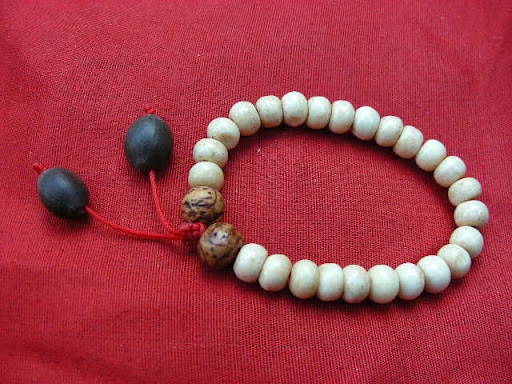
I had a set I had recently given up. They were a gift to me by monks from the Drepung Loseling monastery. Deprung Loseling has been around since the 1300’s. In the 1950’s the Chinese government destroyed nearly all the monasteries in Tibet including, Deprung Loseling, and left alive only two hundred and fifty of its nearly three thousand monks. This who survived escaped, walked though the Himalayan Winter to India, were welcomed and settled in the south of that country where they rebuilt from nothing.

For several years running, while I lived in Fort Lauderdale, the monks would fly in from India to come to town to create sand mandalas. Not just Ft. Lauderdale, of course. We were but one location in a tour of several months – a welcomed stop each fall. Each November the monks came to Piper High.

I was teaching English at Piper when the email call went out. They would be there, in our auditoriuam, nine Tibetan monks, and we needed to find them places to stay. We lived, myself, my wife, Lee, my daughter of eighteen and son of thirteen in a small trailer. I asked my wife is she would mind.

Lee was in medical school then and in class or clinic each day and spent her nights in study. On the couch, sci-I on tv, she was inside an oversized text of some four inches thickness each side when splayed open on her lap. I could see her body but her mind – her mind was in the book.

“Do you mind if we have some monks stay here? They will be at Piper and we are farming them out and…”

“Do you know how some authors write like they are talking to you? How they are easily understood because they speak to you as though it were a conversation? How even the most difficult subjects, like this, for instance, the physiology of disease, can be simple when written like that?”

“Yes”

“Well, this isn’t one of those authors. If you need to do something for school, do it. And would you get me some apple juice please?”

Excellent.

I agreed to house three or four of them. In two weeks they would arrive.

The day came. This person petered out, that person became unavailable, rides dried up. I arrived home followed by a van with nine monks from Tibet and one translator of questionable ability.

This was when I discovered what I had chosen to be unaware of. My wife had not listened to word I had said. It was, obviously, the lack of apple juice.

She made that very clear. After the shock.

They would be with us five days. It was Chanukah. That came to forty-five presents.

It is dinner
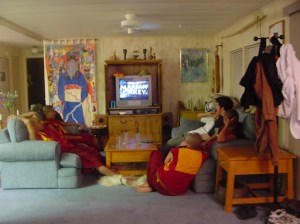
and Nine Monks from Tibet
are sitting down to lentil soup, bread,
halva, fresh cranberry tarts
and a steak.

One has just tricked another guest
into eating a fire pepper,
one has told an extremely unkind joke about the Chinese
(who can blame him?),
Lopsang is playing with my Wheelo®
(manufactured in China by twelve-year-olds),
Soman is tapping his forehead with a spoon
for nearly five minutes now
and Dharma is standing silently behind my son
ready to pull his ear,
again.

In saffron and cinnamon puddles
they pour onto the couch,
absorb into the cushions and
turn on the TV
wondering if the obvious
grand gestures and laugh track
mean the program
about two gay guys and a straight girl
is a comedy and
two are checking their email.

As the week ended, the last night came and the Rinpoche had learned the prayers, in Hebrew. for the lighting of the candles and would do it with us. It took ten seconds but the gesture, the effort was an honour for our household.


Barukh ata Adonai Eloheinu melekh ha‑olam, asher kid’shanu b’mitzvotav vetzivanu l’hadlik ner (shel) hanuka.
“Blessed are You, Lord, our God, Sovereign of the universe, who has sanctified us with Your commandments and commanded us to light the Hanukkah candle[s].”

Barukh ata Adonai Eloheinu melekh ha‑olam, she‑asa nisim la‑avoteinu ba‑yamim ha‑heim ba‑z’man ha‑ze.
“Blessed are you, Lord, our God, Sovereign of the universe, who performed miracles for our ancestors in those days at this time.”
He then led three monks in a prayer for us. That took five minutes. And the presents. Dreidles and chocolate gelt, whistles and small toys.

My daughter was offered to come to India and paint tankas. They had been amazed at the collage tanka she created of magazines, shower curtains, old shirts and beads. They gave her an invitation and a Khata – a white silk scarf of welcoming, goodwill and compassion.

To my son they gave a khata as well. My wife, a khata and prayer flags and a picture of our monks at their monastery. OUR monks, I say, as the Rinpoche told us, from now on, they would be our monks. To me they gave a khata and wrist malas of yak bone.

Rarely did it come off. I used it to breath. To meditate. To count beads on when what I thought what I really wanted to do was throttle someone. When a student or administrator was, in the depths of my mind, being separated neck from torso, I would be smiling, in seeming equanimity, counting beads. After a few bones had slipped between my fingers I knew I really didn’t want to throttle anyone. Everyone thought I was so happy.

It would come off when I was mowing the lawn, digging the garden, washing dishes. When I felt it might get caught on something.

After a while it started to slip off on its own. But so had my watch. So had, for that matter, my pants. I had lost a good bit of weight and the malas needed to be smaller if I was going to keep them in use.

I tied a knot in the cord. It didn’t hold long. I tried to restring them but that didn’t work: the cord would not hold, the knot loosen, the malas slip off. I brought them to bead shops and they seemed not to know what to do with them either. I even showed them pictures but each shop I left, baggy bones clanking around my wrist.

Then Carol visited. She brought with her a necklace for me, beads, done beautifully. Her new hobby. I showed her my malas, let them fall over my hand and into her lap. She thought she could fix them. No problem.

Carol lives in Boynton Beach. That is in Palm Beach County, Florida. I am a little under two hours north of her. My malas went on a trip to South Florida.

I thought it fitting. They are, after all, a sign of impermanence. Nothing lasts. But Carol is my oldest friend. Nothing lasts, ‘tis true. But friendship, in the span of a lifetime, is as close to permanence as one can get. A strong, close, real friendship. The malas of impermanence fixed by one of the most permanent things of which I know. A friend. I let them go.

That was about a year ago.

I miss my bones.

Time to go shopping.

While in Asheville, I looked. While at Pagan gatherings, I looked. In Austin, I looked. At gem and mineral shows I looked. In New Age shops I looked and was frequently lambasted for wanting bone by shopkeeps playing holier-than-though with Tibetan monks. I found nothing.

On eBay I found plenty but nothing that struck me, nothing that spoke to me, called me.. It would need to be something I found in person. After all, the last set was a gift. It was the universe telling me a truth.

I was thinking to myself. Ruminating. Circular. Maybe I just need to be patient. Maybe a set will come to me. Maybe I don’t need them anymore. Maybe I am playing monkey in the middle with my mind; what is being tossed and doing the tossing the same thing. Maybe… What is that? It’s them. There they are.

I had looked up bone malas on the Internet. I am not sure why I did this after having decided to forget about them. Perhaps it was a discussion that morning with the Abbot of the local Thai Temple, Wat Punyawanaram.

I was there for the festivities commemorating the opening of the new monastery, for the blessing of he grounds by the community and the blessing of the community by the monks, for the long period when monks do not leave the temple and the laity gathers to bring them the materials they will need for the coming year.

I was there with several people from our local Unitarian Universalist Church. We had raised enough funds to supply the monks ten sets of robes and it was my honour to present several of them during the ceremony. I sat with the abbot in a large sanctuary, peopled to capacity, feeling very comfortable – uncommon for me. But I walk into a Buddhist temple and I feel immediately calm, at peace and at home. He asked how my meditation was going. I imagine that is what he said. He speaks only slightly more English than I do Thai. I speak no Thai.

He had helped me quite a bit in the last year as I worked teaching, feeling as though I was forcing students to do that which they did not wish, feeling as though I was doing harm, at odds with my vows. I understood him. Common spoken language or none, it did not matter.

And, suddenly, I missed my malas.

Open Google. Malas bone wrist. I found several pages that felt unsatisfactory. I expected nothing. Then one struck me. What I noticed first was the different materials, seeds and beads and stones and bones of which malas may be made, were explained. Here was a person who understood why I wanted what I did. Secondly, it was set up on a blog. A catablog! Ingenious. He even included a video of what malas were for and how to use them. This deserved a further look.
I found what I was looking for, almost. I found a price I could well afford and it was so terribly close to my birthday I didn’t experience my normal need to resist my own wants and trivialize my own desires. Oh, who am I kidding? Of course I did. But the perfection, price and proximity of my natal day won and nearly sealed the deal.

What did I do? I hesitated. I wrote him from a link on the catalogue. If this was anything like most email communication, and I was sure it would be, I would log yet another birthday past this present one before I seeing an answer. But here was a man making malas. Making them as they were ordered. For specific people. Not beads sitting in a case. I had to try.

It was 4:22 on a Sunday evening. Here is what I wrote:

Hi,

I was looking at your page and was wondering if I had missed, or if you could make, a bone wrist mala?

I am looking for yakbone with the pulltie as opposed to elastic (which keep breaking). I guess they would be 27 or 18 beads. I’m note sure of a lotus seed or bodhi seed could be incorporated.

Thanks,

Adam

The answer, by email standards, was nearly immediate. It came in the early evening and included links and suggestions as well as an offer to answer any question I might have. So, at that invitation, I replied and questions I had. Can this be used, can that be used, will the bone change colour as I wear it (I hope so), can I change the string colour? I wrote, further:

I do wish there were a way to work the bodhi seeds in as well as the Lotus seeds onto the ends/tassels. Perhaps the last two beads before the slipknot bodhi seeds and the tassel-ends lotus. If not, I would prefer lotus.

I want the bone for impermanence. I want the bodhi seed to remind me to sit, to remind me there is nothing to be done about that impermenance. I want the lotus seed so I can remind myself I need not be mired in this, that beauty comes from the mud. I want. Maybe it is because I am an American., but I am suddenly presented with a choice and I choose not to choose.

His reply:


Sure. That sounds like a plan. Bodhi will be the last two at the slip knot and the tassel beads will be lotus. On thick red string. Perfect! The bodhi may be of a different size but not TOO different.

The bone does not get darker as time goes on…the oils from your skin will give the bead a translucent quality to the beads over time Great. Would you like a pic of the wrist mala to be sure you are happy with the design before it gets shipped tomorrow?

Thank you.

A picture? A picture? Was he serious? And not ten minutes later that is what I got.

And then we were positively chatty:

The mala looks incredible. I can’t imagine not being happy with them.

I spent the day at a Thai Temple. The only game in town, as it were, and where all the Buddhists tend to go regardless of being Thai, Tibetan, Cambodian, Chinese or from wherever. In my talk with the abbot I was reminded how much I missed having my malas.

So thanks so very much.

Adam


From: Destination OM – Custom Malas [mailto:destinationom@yahoo.ca]
Sent: Sunday, July 29, 2007 11:34 PM
To: Adam
Subject: RE: Bone Wrist Malas?

I learned my craft in Bodhgaya and make malas for many traditions. It is a blessing to serve practitioners and in turn help support friends throughout Asia. I collect supplies by traveling to Asia and hire friends to purchase supplies for me later. I make all malas here on Saltspring but will be returning to Asia for one year in November and will be making malas in Bodhgaya in April next year for six months alongside my teacher to learn more about the craft.

Actually today is the most auspicious day of the calendar year to purchase a mala as it is GURU PURNIMA (The full moon of the guru) and on this day we spend the day reflecting on the guru and connecting ourselves to the infinite wisdom. I spent the day with a Rinpoche who blessed the malas and wrist malas so you are triply blessed today 🙂

Thank you for the payment. This will go out tomorrow.

And it did. And it arrived today, seven days later.

It is in a yellow package. Eight by five inches. It is oriented vertically and labeled “Small Packet Petit Paquet” The entire package is labled in English and French. The return address tells me it came from Saltspring Island, BC in Canada. My address is below it, highlighted in yellow.

Immediately below my address is a space for the listing of contents. It says “Buddhist/Hindu Rosary. On the next line there is a star and the words “Made in Canada.” Below that, a star and the words “For religious purposes.” Everything is in capital letters. It arrived at about four this afternoon.

I didn’t open it. I opened the package from Bookmooch. I opened the DVD from SWIM. All this with the sealed package beside me.

I read the article in Poets and Writers titled “Will Write for Free: Why Is Asking to Get Paid So Difficult?” by Steve Almond with the still-sealed envelope inside the folded magazine.

I had tried to open it. I began, gingerly, to pull back the adhesived fold. It started to give with little pressure and I stopped. I simply could not. Not until I… Not until what? Not until I wrote about it. And now I have. Seven hours or so later, I am here, at the end of this essay. This envelope and me. And now I will open it.

I reach my hand in. They feel cool. I pull them out slowly. They are gorgeous. I can’t wait to sit, to count, to breath.

All there is to do now is to say “Thank you.”

Thank you.

 
5 Comments

Posted by on August 16, 2007 in Culture, Poetry, Religion


Tags: , , , , , , ,

House of Books

I had the illusion I was brought up a in house of books. I had that illusion in the same way I had the illusion my mother went to Harvard. In reality, she went to Harvard in the same way she knew the Kennedys. I discovered in my early twenties my mother had attended Harvard Secretarial School, rather near the University of that name but not quite that university, and she lived some blocks from the Kennedys; neighbourhoods in Boston can change rather abruptly.

My father had attended college as well. He would tell us stories of his five-year quest for his associate degree at Sam Houston Institute of Technology, later to have changed its name to Sam Houston State Teacher’s College. We disbelieved the tales of bull riding and jerking cars into reverse at eighty miles per hour to drop the transmissions. How believable are such tales told by a man who was a teen on a farm in upstate New York who was a boy born on the streets of Brooklyn?

Some time in my late teens we traveled to Texas for an Amway convention. We stopped in Hunstville, Texas to visit the folk he lived with while in college. They lived in a small home off a main street in the small town near the prison. It was a home numbers with a half numeral, full of knick-knacks and smelling of old-stuffing in the chairs and that nothing could be moved except to be dusted and put right back again, same place, measured and maintained.

While there, I was told tales of bull riding and jerking cars into reverse at eighty miles per hour to drop the transmissions. I was told how, after four years he was told by his parents he had one year to complete his two year degree. A year later he was called to come home and back to New York he went, his back having be rodeo-broken twice, the college bank having been closed by the parents. And back up to the big old stone house he went, no degree.

Such people do not normally fill a house with books.

I had the illusion I was brought up in a house of books. It’s just most people had fewer books than we did and that was a bit of a shame because we didn’t have that many. We had a few books of poetry, rather old each. A book of children’s verse contained my favorite poem, “The Duel (The Gingham Dog and the Calico Cat)” by Eugene Field. An old copy, quilt covered, of Tales of the Wayside Inn, a huge red book of games, and a few more books of varied sorts. My grandmother, living with us from my earliest memory, had some books but I was not to look at them. One was Valley of the Dolls.

I remember my father attempting to throw out the history books en masse exclaiming they were old, the information had changed and they were of no use. He failed until the year after I moved. Then, out they went.

It appears, the books in the house grew out of my desire to read, not anything genetic. I learned to read at the age of four; not exactly the age of prodigy. It hurt. My first book was Duck on Truck. I later read Curious George and various Dr. Seuss. My mother taught me to read. According to the docs I was supposed to go blind. I had just learned to walk a year earlier. Now I was reading and crying about it but, cry as I did, I read and read more. I read no matter how much it strained or how my head ached. Little has changed.

Reading seems to be the thing to do. I had little eyesight for sports and less desire for it than sight. The TV was on constantly, tuned to Hee Haw or the Dukes of Hazard or The Jeffersons. Music was on when the TV was not and we listened to 30’s and 40’s pop, big band, classical or country. I had nearly no experience with Rock and Roll until high school. “My Sharona” was hardly a song to draw me into a life of loud music and the common corporate pop-culture.

And so, against this I pushed with my books. I am a solid proponent of Drive Theory.

Later on, The Eagles and Pink Floyd would grab me, The Kinks would shake me but never hard enough to dislodge John Denver. The first 45 I bought was The Archies singing “Sugar Sugar.” The first 33 was an EP of “Raindrops Keep Falling on my Head” by B.J. Thomas. My first album was by Helen Ready. My second? Read on.

I collected “Big Little Books” and poetry books. Soon I had books in my room on the night table and the floor and on the dresser. This is about the age of seven, or so I am told and, thus, my recollection of living in a house of books.

It seems we sometimes had more books than food. I have verified this as a fact wanting to make sure my memory has not played tricks on me. I would ask for a book and, if it meant not having a particular food item, we ended up with the book. Why not? I still grew older and overweight. I carried this tradition on when, in my early twenties and a struggling young married fellow, I picked up a leather-bound copy of Zen and the Art of Motorcycle Maintenance when we had no money set aside for milk and bread. I discover, later, we were allergic to both milk and bread so, in the long run, we were better off. Besides, twenty years hence, still we are here, still is the book as well and where would the bread be?

Before I was ten I had a collection of folktales and myths. I had devoured all the poetry I could find and had a collection of Campbell, Jung, Erikson and, strange for my age, Richard Bach. My second album was Richard Harris reading Jonathan Livingston Seagull.

At some time in my late single-digits I happened into a golden-age science fiction novel. I was a goner. It was probably Asimov. It might have been Clark or an early Heinlein but, for the sake of the argument I am having with myself over this, it was Asimov. I have three shelves of Asimov, one shelf of Clark, one of Bradbury, and on it goes. As I said, I was a goner.

I remember putting in an order for a copy of Foundation’s Edge weeks before it was due to come out. I thought that would be the only way to get one. The year was 1982. I was nearly the only person in B.Dalton Booksellers in the now defunct Skylake Mall. There was no line. Just me, at seventeen, putting in my bit of cash and my mother putting in the rest. School ended the illusion other kids read. Pre-ordering Foundations Edge ended the illusion adults read.

I remember the moment I decided I was going to write. I recognize it as a single instance which, while reading, I realized I wanted nothing more than to write and, at the same time, knew I did not. I was reading “There Will Come Soft Rains” by Bradbury from The Martian Chronicles and thinking I could never, no one could ever, write better than that. I had thought so of Poe. I still know this to be true, but here was Bradbury, a live human, writing better than I could hope to, writing beautifully, in words with melody and meaning and sound and sight and I could never write as well as he. Poe was dead one hundred and forty years but Bradbury, he was a live person. Why try?

And I read Teasdale, Levertov, Benet, Snyder, Frost, why try? Cummings (I never know what to do with the initial letter in his name) stopped me cold. I could never write as well, never write as well as they. And I was correct. I knew that. I still do. I can never write like they did. But, I also realized, I didn’t like everything, each and every bit, they wrote. Some things I did like better than others. There. There was my opening. Skill or no skill, some things I liked better than others. Some poems, some stories struck, resonated, made sense to me where others fell, thudded and laid still no matter the skill employed.

I can never write like they can, but I can write like I do. And some of my work will fall, thud, lay still on the soil, decay. But some, some may resonate, strike, make sense, germinate, grow in someone’s soul. Some will live for the reader. It might not be the writing I think it should be. Who am I to judge an unfinished work since, without the reader, what work is complete? If some of my work sings with melody and meaning, sound and sight, just some, then I have done something. I have done what Bradbury did. One day someone may listen to my work and think never, never could they write that well.

Once more I had that experience. Once more I knew I could never write that well. While riding one late-past-midnight, headed home from a full-moon revelry, my wife and I down a twenty-mile road from Jonesville to Gainesville in Florida, we turned on a non-existent, according to the FCC, radio station playing from Gainesville. Music, commentary and, right now, poetry. I listened to the poem being read and found myself at full attention. The sound and the rhythm, music and meaning. I thought, what is that? Who wrote that? My wife must have seen my face. She nudged me. “Don’t you recognize that?” I didn’t.

“That’s yours. You don’t recognize your own poetry?”

And it was. It was mine and I recognized it then as my own. It was “Recognizing Kali in a Young Girl,” I was the writer and I was the reader or, in this case, the listener. I completed my own circle. Had done so unknowingly. One day someone listened to my work and thought never, never could they write that well. One day, it was me.

I can’t write as well as some but I can write as well as me. If I work hard, practice, listen, learn, read and write, some day, they will be the same.

 
2 Comments

Posted by on June 11, 2007 in Books, Education, Family, Poetry, Writing


Tags: , , , , , , , , , , , , ,

Jesus Christ went to Prison Today

Jesus Christ went to prison today.
He was resurrected outside Washington DC
And immediately attended an antiwar rally.

Jesus finally appeared and
When they took him away,
Fox News didn’t know what to do.

Here was Jesus, resurrected
And he turns out to be a liberal
So they pulled the story

And ran one instead
About a celebrity who forgot
To put her pants on.

 
2 Comments

Posted by on May 25, 2007 in Culture, Poetry, Religion, Social


The Diffusion of Memory

I am trying to remember my daughter. At the age of five. Then eight. Ten. I cannot. Not fully. I have memories of events, trips, ways of being and things we did. I have memories of how I felt, diffuse and drawn. But to none of these are attached any visions. I remember taking pictures but not the pictures themselves save the presence of those on our walls.

I try to remember my son. Again, I recall pictures but none of these exist in my head, only in albums and frames. I know how I feel, how I felt, how we were. But our time together is a recording with audio only. It is not like an audio tape though, which, as it is, stand full and complete. It is a video-tape running blank and black and I listen, wondering where the picture has gone.

Should I feel badly? I don’t know, but I do – as though I have lost something precious. I don’t want them to know I can hear them through the ages but cannot tell anyone what they looked like in middle school, playing in the band, at aikido, twirling in a swing, watching the water drop from a height. And a sadness settles in on me of a distinct kind. It is a sadness of loss continuing.

It is a sadness that all I have is now. I have read this. I know this. I know all I have is the clarity of this very moment and then it is gone. Even a memory is experienced ‘now.’ My children at ten are gone. My daughter dancing is gone. My son lying on the grass is gone. All that is continuous is my perception of myself and the sadness. And, someday, I know, the sadness will be all that is left.

It is my lunchtime. I take a walk. Out behind the school and there is no break in the chain-link for me to get to the field. There is a track and I do not enter as the area is full of students. I do not wish to walk with them. I do not wish to walk with anyone but my children at ten, at twelve. But they are sixteen and twenty-one and that cannot be.

I walk further on and find an oak. If I were more use to experiencing now in clarity, perhaps this would not bother me so. I have not meditated in weeks. Life. Life. And what has it gotten me? This sadness born of realization. It is a realization brought on by meditation and only meditation will render it clear, transparent; ok. The only way out is in. I remove some dried grass and sit.

My eyes close for a moment and I hear voices – Mr. Tritt, Mr. Tritt. What are you doing? Are you meditating? Do you like sitting under trees? – It continues without cease. There are five students. Then ten. Others arrive I do not know and tell me they are annoying and will be annoying me next year. They will not be. I will not even remember them. Only how it felt.

They talk, ask questions, play at the fence as some leave and are replaced by others as they yell, “Look it’s Mr. Tritt.” Then they are called from the fence by the coach, the bells rings and again, all is quiet. I could have left when they had first discovered me. But why hurt feelings? I have but a few moments of solitude remaining as I sit and all becomes still.

Another bell rings, I rise, knowing at this point in my life I am ruled by bells. As I walk back to my class, I think of my wife. Can I remember her? Video with the picture gone. A TV with only sound. But her, I will be seeing tonight, part of my present, my now. And I should take more care with that. It is all I have.

 
2 Comments

Posted by on May 7, 2007 in Education, Family, philosophy, Poetry, psychology, Social


The Phoenix and the Dragon is about to hit the Shelves

Yes, this is a shameless plug!

My second book, The Phoenix and the Dragon: Poems of the Alchemical Transformation, is about to hit the shelves. It follows my first book, Tellstones, and several anthologies and is my first collection through Smithcraft Press, a localy owned publisher.

Included in this volume are pieces for which I was awarded the 2006 EPPIE Prize for poetry in an anthology.

It includes rather stunning graphics by local artist, Evanne Floyd.

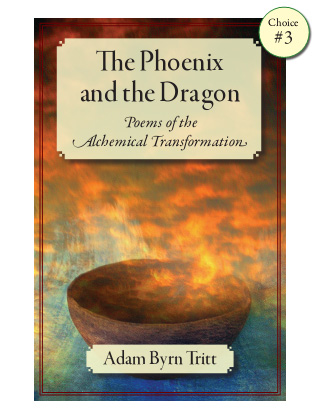
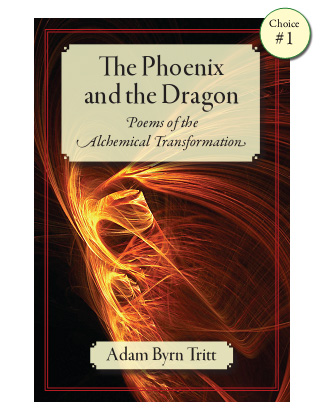
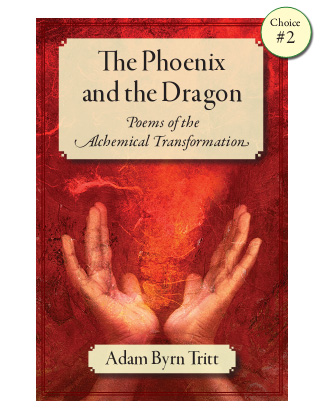
There is only one problem: We don’t quite have a cover yet. We have three. An embarassment of riches.

Below, you’ll see the three covers. Please, please, PLEASE, look to see which one you like best. If you saw all three on a bookshelf, which one would you pick up? Then, leave a comment or send an email with your choice.

This is, I think, the FIRST time a book cover has ever been chosen by blog! Come on: be a part of history. Choose a cover!

THEN… support the arts, writing and, most importantly, ME, by looking below and ordering your advance copy.

Here is are some reviews:

Adam Byrn Tritt puts me on the horns of that dilemma between Apollo or Pan. So what makes his poetry good, then? As a poet he consulted not so much with his mortal texts, but with his heart, personal muses, and the Gods.
Raymond T. Anderson, Editor, Oestara Publishing

[Tritt is] unique, brilliant, wicked-ass funny, and a mensch….
Valerie Turner, Editor

You can reserve your advance copy at the Pre-release Price.

The easiet way to order is to simply click on the book cover on the left of the page. Or you can send me your email address.

Thank you, and PLEASE, FORWARD THIS WHERE EVER YOU CAN. Let us lift and support each other.

Adam


The Phoenix and The Dragon is about to hit the shelves!

When The Phoenix and the Dragon is released in May, it will sell for
$14.95 in bookstores. If you reserve your advance copy, we’ll knock 18% off
the list price— and we’ll even pay for the shipping and handling!

ONLY—$12.26!

(Fine Print)
($14.95 less 18% discount = $12.26. Florida residents please add 74¢ Florida sales tax.)
Cash, check, PayPal, and credit cards accepted.

Vote. Reserve. We’ll both be happier.

 
4 Comments

Posted by on April 20, 2007 in Books, Poetry, Writing


Passover and the Industrial Revolution

From my collection, Yom Kippur as Manifest in an Approaching Dorsal Fin.

Every Passover I bake matzah.
I wait until there is
Nothing left to do,
I wait for the lull
In the torrent of business and busyness
And preparation for the unexpected guest,
The soup is bubbling slowly
Covered, tsimis done,
Chorosth setting
And Passover plate
Covered, in the fridge
Next to the gefilte fish.

When there is nothing left to do
And everything is finished
I bake
I work as quickly as I can
Rushing, like of old
When there was everything to do
And nothing to be done but hurry.

I work to make bread
Matzah shemurah,
‘Watched matzah’
As of old,
Before the machines were invented,
Before 1838 and the rollers,
Before 1857 and the mixers and kneaders,
Perforators, machines of the
Industrial revolution.
In fewer than eighteen minutes
From flour to done,
Nothing can rise
But the realization of the mitzvah,
Purpose for preparation,
Intention
And prayers.

At a temperature I can comfortably reach my hand into
They bake.
Quickly
Like bare feet on desert sand.

When they are done
They have opened in the
Center, crisp and brown,
Heavy and thick,
Empty. Receptive…

This is not like the matzah
From a box.
My matzah is not a gigantic saltine
Stacked like x-ray plates
Or cards
Or slates.
Although…

When I was seven
I went on a field trip
Through the Jersey Countryside
To the clogged vessels of
Dense New York streets,
Sitting in the Yeshiva bus,
Staring down
At the faces in the unmoving cars
We slid, heated, halting,
Metal to metal cells, fuming forward.
Finally, stilled, we gratefully
Disembarked, stood and walked along

Delancey Street
The lower east side
Of Manhattan,
With my school class,
We visited a temple during minion
Sat separated
Girls from boys
On an austere balcony of
Dark woods and dark ages
Staring above the vaulted steps
At the dais of black-coated men
Listening to the song to their beloved
Carried with the audible overtone of the holy
And an undertone of confidence
The song was surely heard.

We were there for days or minutes
And fidgeted, fussed, squirmed
In the presence of the Universal King.
After, released of our confinement
Reconfined to sturdy lines to walk
On to the great mystery of the
Matzah factory.

Past the pickle barrels
On the sidewalks
Where for ten cents
We all got to dip our hands
And pull a half-sour
From the briny cask,
Close by,
And brick-built
Red and high-windowed
Was the matzah factory.

We entered though the loading dock
And never wondered if there was
A door, an office, a warehouse but
There were ovens
Vast and hot.

We stood on a balcony
Over the open factory floor,
Vats and vaults
Mixers and all over the smell of flour.
Rolling from the vat,
Poured onto a sheet, rolled into the ovens
Pressed by combs
For perforation
For ease of use

For profit
For Horowitz-Margareten,
Streit’s, Manischewitz
The Matzah Monopoly
For tables during Passover
For people to gingerly, slowly shop for
In Pathmark, Shop-Rite, Foodtown
Kids in cart, mamma picking her box
Of matzah, plums, salami
And, if she was in a hurry
It had nothing to do with
Evacuation, or the Pharaoh
Or Moses except that
We’d read it in the Haggadah
And break the matzah,
Ask the questions, dip the
Parsley, spread the horseradish
And bite.

The factory was hot with baking
And we left, sweating, drenched
Flour-powdered without and
Within, samples of matzah,
In a single-file exodus from the ovens.
Which, every Passover
I recreate in my kitchen.

The bread of affliction
Is my joy, my revolt,
My exodus and cry unto the wilderness
To my own kind –
“Let my people go.”

 
6 Comments

Posted by on April 1, 2007 in Culture, Family, Food, Poetry, Religion, Social


Powwow Suite

Those constant readers of my work will notice a theme running through much of my poetry: degradation or loss of cultural identity.

In 2005 I attended the Intertribal Powwow in Melbourne, Florida. I went at the request of my parents who are fans of such things.

What I found was how much was not there. People will tell me one finds what one already sees. In part, true. But if I find loss in the cultural heritage of native peoples, I am neither alone nor the first. Indigenous peoples all over the US are starting to question sending their children to state-run schools, have begun to teach their native languages, held on the tongues of only the eldest members of the tribe and often in danger of being lost, have started re-co-opting celebrations brought to them by the missionaries with their own, replacing the new myths with their old. Everything old is new again.

Some have handled this by bridging the worlds Native and Christian. They see syncretism and commonality in worship, celebration. They hold on to their heritage but practice, in many ways, an amalgamation. They flow back and forth and fit in.

And some hold on to their chains.

This is true of Native American groups.

This is true of African groups.

This is true of European groups.

It is true of me.

*****

In his essay, “Jesus Is Lord on The Crow Reservation,” (Notes from the Dreamtime) Craig R. Smith discusses his own suprise as an outsider experiencing this degradation during his travels across the West.

So, here is an essay wrapped in a poem. Or a poem in essayic clothing. Either way, it’s a shame.

*****

Powwow Suite

Enter

An Intertribal Unity Powwow
Is being held at the field at
The local community college.

Come early and stay late
We are told
Bring a chair and enjoy the festivities.

It advertises $10,000 in prizes for dancers
Education in tribal heritage
And a spectacular Grand Entrance.

We pay $5.00 each to get in
At a booth run by
The Boy Scouts of America.

We enter along into the Indian World
Row of vendors, frybread, hides, giant belt buckles
Plastic spears, buy and sell jewelry and kiddie bow and arrow kits.

And everywhere there are pictures of Jesus as an Indian.

I

Only 1% of Native Americans are recorded as following an aboriginal spiritual path.

Jesus Leads The Grand Entrance

It is Grand Entrance
And the participants enter
In silver and feathers.

Headdresses and hides flow
Over iridescent polyester dresses
And buckskin pants and flashing flag buckles.

Traditions succumb to Wal-Mart
As the sequined parade
Shines its way to the arena.

A snake through the fairgrounds
Dancers follow in a line
Behind the headman and headwoman.

In beaded regalia they lead
The troops of nostalgia
And Indian style.

Women march with children
All dressed in blue print covered
With small white crosses.

And I can’t tell
If they are offering themselves up
Or laying themselves low.

I cannot tell
If it is a symbol of sacrifice
Or ownership and surrender.

But I wonder
Who has nailed you to these
And sells you to the willing crucifixion?

In old Hollywood westerns the cavalry
Would come over hill
Just in time to save the Christians.

By killing the Indians
And leaving the skulls to bleach,
Each a small Golgotha.

Now, without bidding
You march your nations
To Calvary.

And you bring your own nails.

II

Identification with the aggressor is a well-documented defense mechanism.

Opening the Powwow

In the arena
The microphone passes to the MC
And he begins the Veterans’ Dance.

Joined by Vets from the crowd
In a circle they move, stomp, walk
Following the Flag of the United States.

Next to me stands a man
Wearing a T-shirt showing
Four Comanche warriors.

The picture is pulled crisp by fat
As he stands to attention
I read the caption.

Homeland Security
Fighting terrorism
Since 1492.

As the dance closes the MC
Leads the prayer
To open the Powwow.

The Veterans are blessed,
The dancers are blessed and
The venders are blessed.

But the grounds are never blessed
And the sky is never addressed
But they are thankful in the name of Jesus.

Or they are walking proof
Of the Stockholm Syndrome
And where is the great father now?

And what has Jesus done with your buffalo?

III

By 1885, the government estimated only 200 buffalo were alive in the wild.

Sawhorse Buffalo Guards Coyote

Spotted Pony Traders has a sawhorse out front
Higher than your head
Longer than your father’s body.

It takes the place of the bone and integrity
Of a buffalo whose skin
Rides the horse.

Draped down the sides
Massive and empty
Smooth and soft and I swear.

I pretend I can feel some
Remnant of the life that was once
So much a part of the beast.

Hanging lifeless
One could hardly picture it
Herding across the plains.

As creature of beating heart and pounding hoof
One could scarcely imagine it
A sawhorse hide.

Inside the booth, faces
Fox faces, Raccoon faces
Coyote faces.

Five dollars each and two for eight.
I never pick one up
But lay my eyes, my hand on the table.

Atop the tipping piles of faces,
Feel the fox nose,
Another kind of skin.

Feeling the ears and finding an opening
My finger slips inside
I realize.

This is where the brain was,
The seat of the living,
Once breathing fox.

I never touch the coyote.

IV

Native Americans are 2.8 times more likely to have diabetes than whites.

Fast food Native American Style

I don’t know if the old Sioux
Knew he was stuck,
Blind, he was in his wheelchair.

Pushed by his old wife and his daughter
He ended three inches deep in the mud.
The women linger over him.

He cannot get out of his chair,
Stares ahead from his seat.
But he doesn’t see anything.

The old woman pulls at the handles.
These are part of the old man now
And she cannot move him.

Her daughter pushes it this way and that
Wiggles the chair but the only thing that shakes
Are the old handles.

She slips in the mud.
Her moccasins are covered with mud
Her mother’s moccasins are covered with mud.

I’m wearing crapstompers and dungarees
And don’t care about mud
As I wade in.

I pull hard at the wheelchair
To free the old Sioux
Of the mud.

It is nothing to do.
He is old and pale,
Wan, disappearing.

He is ancient, waifish,
Head to toe in buckskin,
Clothed in heritage.

The old lady thanks me
And I tell her it’s nothing,
It was nothing to do.

And it is a blessing
To be of use and
I’m happy.

She tells me how hard it is
To take care of him, blind,
Lame, and diabetic, as is she.

And so many of her relatives
Her tribe, Other tribes.
Her daughter.

It’s a long line for frybread and lemonade,
Elephant ears and curly fires and coke
At the booth marked Indian Food.

Frybread is the symbol for Intertribal Unity.

Exit

We are admonished to come early
For the Grand Entrance
And stay ‘till dark for the exit.

For all the great dancing between,
The vendors and
Fun to be had.

Stay for the Closing Dance
We were told.
A one of a kind event.

And the closing ceremony
Prayers and the
Magnificent Grand Exit.

At the Melbourne Native American Indian Intertribal Unity Powwow
We spent a little under three hours
And $44.28 including admission.

That is my willing sacrifice.

 
Leave a comment

Posted by on March 17, 2007 in Culture, Poetry, psychology, Religion, Social


Panty Raid

Not every poem is a gem. The problem is each eye sees a poem differently and to some eyes the poem is a jewel of clarity and translucence without flaw and to another, little is seen but stone, dull and rough all around.

Published, non-published, well-known and not, opinions vary and there is, alas, no set of rules and measures, clear and objective by which to judge.

Those least favorite of my own writing are those which win awards and those I consider gems often sit quietly, lingered over by only a few who see them as I, while those lesser children of my creativity are fawned upon by masses.

It was years before I would read publicly. I saw people clapping for everything and anything and the applause seemed all the same. I thought, why bother if there is no discrimination between trash and treasure, gravel and gold. If rant and screed, angst-fests and treasure-chests were all received with the same enthusiasm, why read at all? There would be no way to say if my poetry was good or bad.

Yet, finally, I was pulled up to stage to read. Of course, as you know, gentle reader, my first time taking part in a public performance was a clothing optional poetry reading with over two hundred people in attendance pressed into a standing room only venue. There was little clothing in sight and all I had for cover was poetry. Eight and half by eleven doesn’t cover much.

I have had reviews. Most of them good, I am delighted to say. Many are superlative. I have taken to not believing any of them. If I believe the good ones, soon, I would think them real. Then, if I get a bad one, when I get a bad one, I might believe that as well.

There is definitely bad poetry. I know it when I read it. Poetry that, by comparison, makes Vogon verse seem pleasant and melodic. Yet, for the most part, I see good and bad poetry depends on trends, fashions, what is in vogue with those in the know and currently taught in the towers and bowers of academia.

I have, as late, received an abysmal review. My first. It’s from Bryan Roth. Mr. Roth says he represents the Colorado Poets Association.

“The only thing worse than a really bad poet, is a really bad poet who promotes himself shamelessly. You should get some shame. There’s already enough bad poetry in the world.”

His website is a free Geocities page at www.geocities.com/bryan_roth/index.html. It has been under construction for some long time now and is not quite up to date. I won’t review his work. He must be good because, otherwise, he could scarcely critique others with such depth and skill. His schedule says he gives a reading a month and they take place in Colorado. Few of the readings give any more specific a location than the entirety of that state. He must require a great deal of space.

His bio says he is the founder and executive director of the Colorado Poets Association and I wonder how many members it has. He also points out all the important people he studied with and I have heard of a few. He has no degree listed, specifically points out he hasn’t an MFA. He has no books in print.

By the way, the Colorado Poets Association website is under construction. If you like, you can reach Mr. Roth at coloradopoets@yahoo.com in case you should wish to join.

Have I written bad poetry? Of course I have. Horrendous poetry, in my own humble opinion. Sometimes for fun, sometimes because not every idea works well even after countless revision and such poetry I scrap except, sometime, someone sees it before hand and, horror of horrors, likes it. Likes it!

And I get asked to read it. In public. Often.

This happens each Yuletide when I know I’ll be asked to read ”M&Ms”, a poem about my daughter growing delicious melt in your mouth, not in your hand, candy-coated miniature holiday-hued chocolates. This is a terrible poem I have actually deleted several times but my wife has radar for it, has dug it out of e-oblivion and sent it around via the persistent insidiousness of the Internet. I revise, rewrite, revamp it each year starting in November and, by December, it is still horrible. And I am asked to read it again and again and again.

My first award was for my least favorite poem, “But the Son of Man, or Respite.” It won the South Florida Book Club Award. This means Dave Barry liked my work. I’m still not sure how I feel about that. It does, however, prove he got over that elbow in the ribs I gave him when we were the last two in line for the one remaining copy of Hitchhiker’s Guide to the Galaxy at a Douglas Adams book signing. I hope he healed quickly.

At the reception, I was asked to read some of my favorites. I did. The Broward County Main Library auditorium was full of confused faces bending forward, tilting sideways. After the second poem, the coordinator leaned over and asked me, shielding the microphone, if they were mine. I said, mic unshielded, no, she had asked me to read my favorites. That’s what I was doing. She then asked me to read the poem for which I won the award. Why, I asked. I thought you wanted me to read something good?

Over the space of December 26th through January 1st, I attend a sort of Winter Camp in South Florida. It’s geek-central and full of artists and the like. Among the creative types are singers, guitarists, fiddlers, flautists, painters, sculptors, but no writers, or so it always appears, save myself. And so, I end up being poet-in-residence.

This year was no exception and I took the role gladly, even managing to set up a reading in Wellington while I was away, deep in the Everglades of the western-most reaches of Palm Beach County beyond where roads become failed sand paths and fade to suggestion in the bush. If you have never taken a swamp-buggy to a performance, I recommend giving it a try. One arrives in true high style and with barely a mark.

At a small outdoors venue I performed poetry designed to fit the themes set for the event: spirit and ecology. Under a pavilion, behind a mic I read poem, after poem, sometimes taking requests and sometimes, though I dislike doing so, letting some requests go when they would toss us too far off the theme. But, as the poetry turned more humorous – as there is much humor in spirituality and ecology and, if one looks not even deeply, much more needed – I gave in to a request repeated, repeated, repeated.

“Read the Panty Poem.”

As that is not what the poem is called, I, at first, ignored it. Then, “Read the Underwear Poem.” Drats. It’s harder to ignore it when they know the title, but I managed.

“We want to hear The Underwear Poem. Unless you have your own swampbuggy, we suggest you read it.”

Here in the Glades, literature met deliverance and poetry met survival. Since that survival was mine, I quickly changed my mind. And why not? I was there for them, not me. They wanted to hear it. Why not?

Why not is because it is terrible. It is horrible beyond my own ability to describe. Written as a joke, I first read it as a joke. Known for taking poetic challenges, having just finished an epistle to John Gotti in the style of Alexander Pope, on a dare, I thought I would poke a bit of fun at a new challenge I had received at a Barnes and Noble Writer’s forum after a hamper-full of panty poems by several female participants. Cute, short and, to a poem, devastatingly horrendous. I had none, of course but was told there was no reason not to have one of my own next time and I set out to show the ladies exactly why I should not; the manifold reasons I shouldn’t write about undies. And I copied their style as best I could from my one evening’s listen.

I read it at the next meeting to, aghast as I was, applause. But it was bad. Apparently it was so bad as to be funnier than I had anticipated. It was, after all, bad on purpose. Had I done such a good job at making it so bad it was actually good? If I made it worse yet, would it be better still? I set out to revise it and make it worse, hitting as many sour notes and worn contrivances as I could. I sent it to a friend. Brilliantly awful.

And so, once in a while it was requested. Then a bit more often and then, nearly each event, it is asked for and, if they ask by name, who am I to tell them no? If not reading it means I am to find myself stranded in a field surrounded by wiregrass and alligators, refusing seems a singularly bad idea.

So read it I did. And this much I read:

I have some acquaintances
Who, at a poetry reading
Each read cute, short
Pieces about their underwear.
Panty poems. I had none
But was told that next time
There was no reason I should
Not have one of my own.

True enough. But try as I
Might, nothing. I just don’t
Pay attention to my underwear.
I’m a guy and I just don’t care.
So I ask you
Give me yours.

Then, suddenly, I heard a rustling and noticed color in the air, fluttering objects heading toward me, audience arms raised and swung. The space before me was full of small bits of cloth and I jolted back a step, but a moment later, the ground around me, my shoulder, my right arm, all were decorated with panties. I was being showered with underwear.

I am not new to this. I have weathered theatric adversity before and wish I could say I was fully nonplussed and continued being the consummate professional I dream I am but not this time. I’m told I had a smile on my face and cannot imagine I did not. I’m told I paused and cannot imagine I did not. I know these things because I asked, not because I remember and, I should add, I’m told I had a bit of a look of shock on my face and, in truth, I cannot imagine I did not.

In a moment, which seemed to me much, much more, I continued:

Large, small, granny or mini
Full or thong,
Hand it over.

Someone quickly spanned the ten feet between the audience and myself and put a pair of grannies on my head and I immediately realized some of these were not coming to me directly from the drawer.

I have had readings where women sat directly at my feet, knees at my toes, set after set, listening, staring up, requesting, between poems, I wear shorts next performance and showing up at each and every reading to check whether I had, sitting again at my feet. Performance after performance.

I have had readings where youngling students of mine showed up and I have had to redesign a set and self-censor on the fly. I have had school board members and those above me in the district food-chain attend my performances having previously reminded me I am not to be an ‘embarrassment’ to the board or my school lest I face dismissal. All this, I take in stride.

But, this time, I ceased. Momentarily, but cease I did. I know it showed on my face. I left the pair of granny panties on my head, picked the pair off my right arm with my left hand and put them in my pocket. Bending at the knees, I scooped up a pair beside my left foot and held them in my hand. I read on and as I read this:

You’ll be more comfy and I,
I’ll have underwear to write about.

I’ll describe how they’re stretched here around the leg
And the elastic is bare of cloth at the waist,
How one is discolored so some of the small roses
Seem an odd hue
Like a new hybrid
And I can name them, these new roses,
After you,
After your panties.
I can name the flowers after
Your underwear
And I’ll line all the panties up in a row
And all the sizes and shapes and colors
Will remind me of all of you gals
And your poetry.

I expect this will be the end of their poetry suggestions.

A young lady from the audience, swayed up with a thong, holding it out-spread for me to see even as I read. A black pair with a well-placed pentacle and, around it, the words “Worship here.” And I did not stop my reading. Oh, no, not this time. I finished as she tucked it, fully half of it, slowly, into the front waist of my dungarees.

If you do not have groupies, you need them. Trust me. You do. Groupies could make nearly anybody smile. Even, perhaps, Mr. Roth.

 
5 Comments

Posted by on January 12, 2007 in Poetry, Social, Writing