RSS

Six Away from the Dead

Six away from the Dead

They were common as mud
And joined it,
Stories raining from the sky.
Feeding the Earth
Returned to air
Souls to rise
To drift as wraiths
Through dreams and lives
Omnipresent in a way
Only the dead can sustain.

One day we did not know them.
They were not our loved ones,
They were not our friends
But now
They are the colors of sunset,
Soot on a windowpane,
Ash mud on a lugged boot,
A cough in our lungs,
Threads of their flesh
Woven tightly into our
Communal inheritance,
The myths of a young country,
Repeated, repeated, repeated.

And we mourn them,
Not despite their commonness
But because of it.
Because it was New York,
It could have been Charlotte, Chicago, Philly.
Because it was D.C.,
It could have been Boston, Miami, L.A.
Because it was Shanksville,
It could have been Durham, Melbourne, Santa Fe.
Because it was them,
It could have been us
And we are made of the common,
We Americans,
And not one of us
More than six away
From the dead of that day.

 
3 Comments

Posted by on September 11, 2007 in Culture, History, Poetry


Tags: , , , , , , , , , ,

Progeria: An Exercise

Progeria: An Exercise.

I had thought I had written about a singular experience. It certainly was for me.

I sent this essay to a friend, Craig Smith, to look at. A fan (I am delighted to say) and a trusted editor and critic, I wanted him to take a look. I expected advice, suggestions, some way to fix a grammatic gaff. I must have expected, or suspected, something or I would not have sent it.


It’s good. I think the revelation of the progeria was a little overdramatic; so many people have seen kids with progeria on talk shows (Maury Povich had one on nearly every week, it seemed) that your shock–or your character’s?–while understandable, doesn’t need quite the big build-up.

What? On TV? So popular culture and the media has desensitized America to what, in my life, was an experience that sat upon my memory in a way unlike nearly any other.

What did I reply?

Hmm… Interesting as I have never seen a child such as this since. This is the only one. So it feels real to me but will not translate into the culture because of talk shows have widened the exposure of most people to things that I have little exposure to.

In other words, what I find a novel and shocking, many people have become inured to. So what seems overdramatic, to me, is actually my process of realization. But it is not reading that way to those who have more experience than I.

What else has pop culture ruined? Now wonder we no longer shudder at gross injustices and horrific torture. No wonder we have so few heartstrings left to pull.

But, still, I felt I could pull the essay off. I’d like for you to be the judge.

Please read. There’s a quiz at the end.

*****

I don’t remember what year it was. The mid nineties, perhaps. I was working as a skip tracer, finding people who had run out on sizable debts, dropped financial responsibilities, were hiding mobile homes, trailers, boats and whatnot-of-size from repossession. I found them, someone else hauled ‘em, arrested ‘em, collected ‘em.

It was a great job. Lots of day trips, I nearly never got a Doberman set on me or a shotgun pointed at me. Rarely was I shot at.

I was chasing a trailer. I think it was in Florahome, or nearby, where we would go to pick blueberries and scuppernogs. Where the sandpears grew. East-central north Florida. I was on the hunt. I scammed the records, recorded the address, and found the narrow washboard road in a short space between the live oaks.

It was a long slow drive. I stopped from time to time to let the newly-hatched wild turkeys follow their mothers across the road. Slowed to watch the dear in the thick. At length, in the distance, I saw the trailer. Continuing slowly, I pulled into the small space in front and checked the description. It fit. I got out, went to the door and knocked.

It was a single-wide and shorter than the norm so, after the initial knock, it took no more than a few moments for me to notice the creak of approaching footsteps. The door opened and I was greeted by the smallest old lady I had ever met, saying hello, puffing though stringy white hair and wrinkled mouth, in the voice of a young girl. Resting on the knob, an ancient hand.

I asked to whom the home belonged and she answered in words a child would use. From behind her, a young woman approached and, as she neared, spoke to the elder as though she were not aged, not senior, but barely of experience. As though she were her child.

And the old lady answered as if she were, indeed, a child. Her child. Then, I knew, this was not right. So far from what I could have possible expected, I did not grasp the facts through the seemingly paradoxic cues. Something was wrong in an order of magnitude I could not comprehend in the scant time I had. But my body reacted even as my mind slowed and halted. Perhaps I could not keep my face. I remember my stomach tightening, my diaphragm rising toward my chest. My body knew.

The taller woman was her mother. The first person to the door was her child. This was an old child. She looked ninety. She sounded ninety. Her words and behaviour were nine.

Her mother asked her to go back inside while she remained to talk with me. I could require no explanation but needed one. What I had just seen did not fit. It was something I could have thought would come from a horror movie, from a science fiction film. Here it was. I could not ask but needed to know. She could see that.

She was nine. She told me this. She started aging at two. She would die of old age by eleven. It was called progeria. They moved out of town because they could not stand the idea she would spend her short life growing old to the cruelty of children, the whispers of adults and the stares of all eyes.

And so here they were – out in the country, one fewer job, a family, a ninety year old child.

I could not say don’t worry. I could not say everything would be ok. There was little I could say but good bye.

I know she expected, in the next day or so, to lose her home in the forest and the anonymity of the woods. But, that I know of, that never happened. The records were lost. Markers disappeared. Officially, I never found the house.

I was reminded of this today. I cannot say quite what the connection was but it came to me of a rush, strong and vibrant. I, of limited visual memory, have the meeting of that child as one of the few clear visions I retain. I feel it as though it were fresh, new, shocking. It remains one of the staggering moments of my life. It was important in a way I cannot still fully appreciate. It lasts.

It came to me last week. When my mother was telling me she might have herself trepanned and electrified to fight her Parkinson’s. That she might have breast cancer.

And it came to me again today. I held a rabbit in my hands. In the overbearing heat, in my yard, a rabbit, running, running, then not, small tongue, darting in and out and then still. Then stiff. In my arms, how much it seemed sleeping.

Good night little girl.

*****.

So here are the questions:

Do you think pop culture has made experiential essays, such as this, less effective?

Does your knowledge of the disease lessen the effect?

What worked and what did not?

Is there anything you would change?

Comment please.

 
4 Comments

Posted by on September 3, 2007 in Culture, psychology, Social, Writing


Tags: , , ,

On My Walk this Morning, about Forty Minutes

First half of my walk, away from my home.

“I haven’t seen him in days. I just hear the dogs.”

“We need a unit on Bianca.”

“Danny, it was great.”

“It was just like the bar. Miss that place. Most of them are dead now. Nut’in but friendly faces.”

“You ain’t said you loved me. You ain’t never said you loved me.”

“A child of god. I am a man, what else am I supposed to do? We have the owner of Suntrust kneeling every Sunday in front of that altar.”

Back home again.

Wind.

 
Leave a comment

Posted by on August 24, 2007 in Culture, Nature, philosophy


Tags: , , , ,

A New Set of Malas

I miss my bones.

As a sign of impermanence, of the temporary nature of life, few objects are better, more universally recognized, more viscerally understood than bones. As a sign we all come to an end, bones do it every time. The rich, important, beautiful. Loved and valued, we all end up bones. Bone.

Perhaps there might be some things, now that I take the time to consider it, to better represent the transitory nature of life than bone, but anything else I can think of, and I have never been short on imagination, would not be quite as understated as bone. Bone drives the point but can still appear clean and acceptable. Bone is body but not blood, flesh but not fleshy. It states itself plainly and clearly without comment. Understated. A bracelet of intestines would be noticed in the company of even the most impolite. People will talk. Wear one to your local grocery store or temple and you would see my point.

Bone.

Of course, there was the fellow I knew who made a necklace of his kidney stones. It seems like so much trouble to go through and the total cost rather exorbitant. It took him four bouts before he had enough material. Still, as far as custom made jewelry, how many people can claim to have created their’s from scratch? How’s that for being material.

But beads of bone. Unobtrusive. Understated. Inoffensive. Much less expensive than lithotropy.

And so, missing my bones and not wanting to use any of my own, homegrown material, I set out to shop for malas.

I had a set I had recently given up. They were a gift to me by monks from the Drepung Loseling monastery. Deprung Loseling has been around since the 1300’s. In the 1950’s the Chinese government destroyed nearly all the monasteries in Tibet including, Deprung Loseling, and left alive only two hundred and fifty of its nearly three thousand monks. This who survived escaped, walked though the Himalayan Winter to India, were welcomed and settled in the south of that country where they rebuilt from nothing.

For several years running, while I lived in Fort Lauderdale, the monks would fly in from India to come to town to create sand mandalas. Not just Ft. Lauderdale, of course. We were but one location in a tour of several months – a welcomed stop each fall. Each November the monks came to Piper High.

I was teaching English at Piper when the email call went out. They would be there, in our auditoriuam, nine Tibetan monks, and we needed to find them places to stay. We lived, myself, my wife, Lee, my daughter of eighteen and son of thirteen in a small trailer. I asked my wife is she would mind.

Lee was in medical school then and in class or clinic each day and spent her nights in study. On the couch, sci-I on tv, she was inside an oversized text of some four inches thickness each side when splayed open on her lap. I could see her body but her mind – her mind was in the book.

“Do you mind if we have some monks stay here? They will be at Piper and we are farming them out and…”

“Do you know how some authors write like they are talking to you? How they are easily understood because they speak to you as though it were a conversation? How even the most difficult subjects, like this, for instance, the physiology of disease, can be simple when written like that?”

“Yes”

“Well, this isn’t one of those authors. If you need to do something for school, do it. And would you get me some apple juice please?”

Excellent.

I agreed to house three or four of them. In two weeks they would arrive.

The day came. This person petered out, that person became unavailable, rides dried up. I arrived home followed by a van with nine monks from Tibet and one translator of questionable ability.

This was when I discovered what I had chosen to be unaware of. My wife had not listened to word I had said. It was, obviously, the lack of apple juice.

She made that very clear. After the shock.

They would be with us five days. It was Chanukah. That came to forty-five presents.

It is dinner
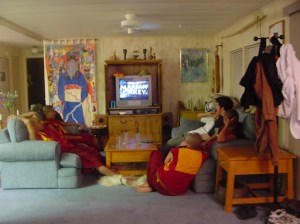
and Nine Monks from Tibet
are sitting down to lentil soup, bread,
halva, fresh cranberry tarts
and a steak.

One has just tricked another guest
into eating a fire pepper,
one has told an extremely unkind joke about the Chinese
(who can blame him?),
Lopsang is playing with my Wheelo®
(manufactured in China by twelve-year-olds),
Soman is tapping his forehead with a spoon
for nearly five minutes now
and Dharma is standing silently behind my son
ready to pull his ear,
again.

In saffron and cinnamon puddles
they pour onto the couch,
absorb into the cushions and
turn on the TV
wondering if the obvious
grand gestures and laugh track
mean the program
about two gay guys and a straight girl
is a comedy and
two are checking their email.

As the week ended, the last night came and the Rinpoche had learned the prayers, in Hebrew. for the lighting of the candles and would do it with us. It took ten seconds but the gesture, the effort was an honour for our household.


Barukh ata Adonai Eloheinu melekh ha‑olam, asher kid’shanu b’mitzvotav vetzivanu l’hadlik ner (shel) hanuka.
“Blessed are You, Lord, our God, Sovereign of the universe, who has sanctified us with Your commandments and commanded us to light the Hanukkah candle[s].”

Barukh ata Adonai Eloheinu melekh ha‑olam, she‑asa nisim la‑avoteinu ba‑yamim ha‑heim ba‑z’man ha‑ze.
“Blessed are you, Lord, our God, Sovereign of the universe, who performed miracles for our ancestors in those days at this time.”
He then led three monks in a prayer for us. That took five minutes. And the presents. Dreidles and chocolate gelt, whistles and small toys.

My daughter was offered to come to India and paint tankas. They had been amazed at the collage tanka she created of magazines, shower curtains, old shirts and beads. They gave her an invitation and a Khata – a white silk scarf of welcoming, goodwill and compassion.

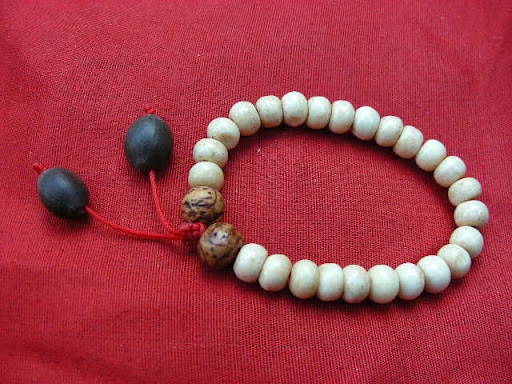
To my son they gave a khata as well. My wife, a khata and prayer flags and a picture of our monks at their monastery. OUR monks, I say, as the Rinpoche told us, from now on, they would be our monks. To me they gave a khata and wrist malas of yak bone.

Rarely did it come off. I used it to breath. To meditate. To count beads on when what I thought what I really wanted to do was throttle someone. When a student or administrator was, in the depths of my mind, being separated neck from torso, I would be smiling, in seeming equanimity, counting beads. After a few bones had slipped between my fingers I knew I really didn’t want to throttle anyone. Everyone thought I was so happy.

It would come off when I was mowing the lawn, digging the garden, washing dishes. When I felt it might get caught on something.

After a while it started to slip off on its own. But so had my watch. So had, for that matter, my pants. I had lost a good bit of weight and the malas needed to be smaller if I was going to keep them in use.

I tied a knot in the cord. It didn’t hold long. I tried to restring them but that didn’t work: the cord would not hold, the knot loosen, the malas slip off. I brought them to bead shops and they seemed not to know what to do with them either. I even showed them pictures but each shop I left, baggy bones clanking around my wrist.

Then Carol visited. She brought with her a necklace for me, beads, done beautifully. Her new hobby. I showed her my malas, let them fall over my hand and into her lap. She thought she could fix them. No problem.

Carol lives in Boynton Beach. That is in Palm Beach County, Florida. I am a little under two hours north of her. My malas went on a trip to South Florida.

I thought it fitting. They are, after all, a sign of impermanence. Nothing lasts. But Carol is my oldest friend. Nothing lasts, ‘tis true. But friendship, in the span of a lifetime, is as close to permanence as one can get. A strong, close, real friendship. The malas of impermanence fixed by one of the most permanent things of which I know. A friend. I let them go.

That was about a year ago.

I miss my bones.

Time to go shopping.

While in Asheville, I looked. While at Pagan gatherings, I looked. In Austin, I looked. At gem and mineral shows I looked. In New Age shops I looked and was frequently lambasted for wanting bone by shopkeeps playing holier-than-though with Tibetan monks. I found nothing.

On eBay I found plenty but nothing that struck me, nothing that spoke to me, called me.. It would need to be something I found in person. After all, the last set was a gift. It was the universe telling me a truth.

I was thinking to myself. Ruminating. Circular. Maybe I just need to be patient. Maybe a set will come to me. Maybe I don’t need them anymore. Maybe I am playing monkey in the middle with my mind; what is being tossed and doing the tossing the same thing. Maybe… What is that? It’s them. There they are.

I had looked up bone malas on the Internet. I am not sure why I did this after having decided to forget about them. Perhaps it was a discussion that morning with the Abbot of the local Thai Temple, Wat Punyawanaram.

I was there for the festivities commemorating the opening of the new monastery, for the blessing of he grounds by the community and the blessing of the community by the monks, for the long period when monks do not leave the temple and the laity gathers to bring them the materials they will need for the coming year.

I was there with several people from our local Unitarian Universalist Church. We had raised enough funds to supply the monks ten sets of robes and it was my honour to present several of them during the ceremony. I sat with the abbot in a large sanctuary, peopled to capacity, feeling very comfortable – uncommon for me. But I walk into a Buddhist temple and I feel immediately calm, at peace and at home. He asked how my meditation was going. I imagine that is what he said. He speaks only slightly more English than I do Thai. I speak no Thai.

He had helped me quite a bit in the last year as I worked teaching, feeling as though I was forcing students to do that which they did not wish, feeling as though I was doing harm, at odds with my vows. I understood him. Common spoken language or none, it did not matter.

And, suddenly, I missed my malas.

Open Google. Malas bone wrist. I found several pages that felt unsatisfactory. I expected nothing. Then one struck me. What I noticed first was the different materials, seeds and beads and stones and bones of which malas may be made, were explained. Here was a person who understood why I wanted what I did. Secondly, it was set up on a blog. A catablog! Ingenious. He even included a video of what malas were for and how to use them. This deserved a further look.
I found what I was looking for, almost. I found a price I could well afford and it was so terribly close to my birthday I didn’t experience my normal need to resist my own wants and trivialize my own desires. Oh, who am I kidding? Of course I did. But the perfection, price and proximity of my natal day won and nearly sealed the deal.

What did I do? I hesitated. I wrote him from a link on the catalogue. If this was anything like most email communication, and I was sure it would be, I would log yet another birthday past this present one before I seeing an answer. But here was a man making malas. Making them as they were ordered. For specific people. Not beads sitting in a case. I had to try.

It was 4:22 on a Sunday evening. Here is what I wrote:

Hi,

I was looking at your page and was wondering if I had missed, or if you could make, a bone wrist mala?

I am looking for yakbone with the pulltie as opposed to elastic (which keep breaking). I guess they would be 27 or 18 beads. I’m note sure of a lotus seed or bodhi seed could be incorporated.

Thanks,

Adam

The answer, by email standards, was nearly immediate. It came in the early evening and included links and suggestions as well as an offer to answer any question I might have. So, at that invitation, I replied and questions I had. Can this be used, can that be used, will the bone change colour as I wear it (I hope so), can I change the string colour? I wrote, further:

I do wish there were a way to work the bodhi seeds in as well as the Lotus seeds onto the ends/tassels. Perhaps the last two beads before the slipknot bodhi seeds and the tassel-ends lotus. If not, I would prefer lotus.

I want the bone for impermanence. I want the bodhi seed to remind me to sit, to remind me there is nothing to be done about that impermenance. I want the lotus seed so I can remind myself I need not be mired in this, that beauty comes from the mud. I want. Maybe it is because I am an American., but I am suddenly presented with a choice and I choose not to choose.

His reply:


Sure. That sounds like a plan. Bodhi will be the last two at the slip knot and the tassel beads will be lotus. On thick red string. Perfect! The bodhi may be of a different size but not TOO different.

The bone does not get darker as time goes on…the oils from your skin will give the bead a translucent quality to the beads over time Great. Would you like a pic of the wrist mala to be sure you are happy with the design before it gets shipped tomorrow?

Thank you.

A picture? A picture? Was he serious? And not ten minutes later that is what I got.

And then we were positively chatty:

The mala looks incredible. I can’t imagine not being happy with them.

I spent the day at a Thai Temple. The only game in town, as it were, and where all the Buddhists tend to go regardless of being Thai, Tibetan, Cambodian, Chinese or from wherever. In my talk with the abbot I was reminded how much I missed having my malas.

So thanks so very much.

Adam


From: Destination OM – Custom Malas [mailto:destinationom@yahoo.ca]
Sent: Sunday, July 29, 2007 11:34 PM
To: Adam
Subject: RE: Bone Wrist Malas?

I learned my craft in Bodhgaya and make malas for many traditions. It is a blessing to serve practitioners and in turn help support friends throughout Asia. I collect supplies by traveling to Asia and hire friends to purchase supplies for me later. I make all malas here on Saltspring but will be returning to Asia for one year in November and will be making malas in Bodhgaya in April next year for six months alongside my teacher to learn more about the craft.

Actually today is the most auspicious day of the calendar year to purchase a mala as it is GURU PURNIMA (The full moon of the guru) and on this day we spend the day reflecting on the guru and connecting ourselves to the infinite wisdom. I spent the day with a Rinpoche who blessed the malas and wrist malas so you are triply blessed today 🙂

Thank you for the payment. This will go out tomorrow.

And it did. And it arrived today, seven days later.

It is in a yellow package. Eight by five inches. It is oriented vertically and labeled “Small Packet Petit Paquet” The entire package is labled in English and French. The return address tells me it came from Saltspring Island, BC in Canada. My address is below it, highlighted in yellow.

Immediately below my address is a space for the listing of contents. It says “Buddhist/Hindu Rosary. On the next line there is a star and the words “Made in Canada.” Below that, a star and the words “For religious purposes.” Everything is in capital letters. It arrived at about four this afternoon.

I didn’t open it. I opened the package from Bookmooch. I opened the DVD from SWIM. All this with the sealed package beside me.

I read the article in Poets and Writers titled “Will Write for Free: Why Is Asking to Get Paid So Difficult?” by Steve Almond with the still-sealed envelope inside the folded magazine.

I had tried to open it. I began, gingerly, to pull back the adhesived fold. It started to give with little pressure and I stopped. I simply could not. Not until I… Not until what? Not until I wrote about it. And now I have. Seven hours or so later, I am here, at the end of this essay. This envelope and me. And now I will open it.

I reach my hand in. They feel cool. I pull them out slowly. They are gorgeous. I can’t wait to sit, to count, to breath.

All there is to do now is to say “Thank you.”

Thank you.

 
5 Comments

Posted by on August 16, 2007 in Culture, Poetry, Religion


Tags: , , , , , , ,

A Blatant, Unabashed Attempt to Convince Cool People to Move to Palm Bay, Florida

I recently spent a few days in Asheville, North Carolina. I had a chance to stay there on my way up from Florida to Ohio, stopping here and there to do an open mic, a booksigning or wax poetic to the gathered masses. I had the luxury of staying with friends who could show me all the better sights of a city I had been through many times but had never had a chance to explore. I was anxious, excited and nearly salivating over my good fortune and impending visit.

Each time through Asheville, we thought of moving. Every single time. Once, after a summer visit when the temperature never ventured above eighty degrees, after my wife remarked how downtown was like a small Philadelphia, I started looking for a teaching assignment there. I was told, over and over, the only way to get one was to know someone on the inside and then wait for a teacher to retire or, more likely considering how little teachers get paid in North Carolina, die. If I didn’t want to wait for a teacher to die on his own, I could actively create the vacancy. That has actually happened there. Either way, it didn’t seem a good career move.

Ashville is an oasis of liberal thought and action in a sea of social conservatism. Billy Graham was close by. Frequently one would find Falwell too. (Where he is now is a matter of debate.) One would also find the Earthhaven Ecovillage. Amid the many communes one cannot help but notice the many survivalist, neo-nationalist and right-wing religious orthodoxist groups. A friendly mix.

This time, there was something different. Coming into town from the south, about four in the afternoon, we sat on Interstate 26 nearly an hour to move fewer than ten miles. In Asheville? In Asheville.

Apparently I would have greater time to enjoy the pleasantly curving, gently sloping, tree-shaded streets as I would be spending quite a bit of time on them sitting still.

On a Friday evening, at the circular park central to downtown, across, on one side, from Malaprops, one of the most lauded independent booksellers in the US, and, on the other, a store devoted to Tibetan and Buddhist art and artifacts, I had the opportunity to attend a drum circle.

I had attended these in many towns but none were like this. At Fort Lauderdale’s South Beach one would find a dozen drummers, half a dozen belly dancers and, perhaps, nearly one hundred people. Not bad for a county population of 1.5 million. In Gainesville, Florida, college town and home to U of F, the community plaza might have two dozen drummers, a few dozen dancers and two hundred or so attendees. Not bad for a county population of 240 thousand. Of course, during the summer, you can hear a pin drop. I actually did this. Stood in the Gainesville Downtown Plaza and dropped a pin. Clank.

But Asheville is another story. The population of the county is slightly over 222 thousand. The downtown common, concave, deep, ringed by combination steps and seats, wide and inviting and green at the center, was full. Fitting another person in would have taken a pry bar or tackle and hoist.

I stopped counting the drummers at fifty. Dancers I stopped counting at one hundred. This did not begin to account for the number of people there sitting, talking, moving, swaying, singing and enjoying themselves in the summer night while, elsewhere downtown, a stage was set with constant live music while residents shopped at stalls along the plaza. People milled on the streets, at outdoor cafes, on benches. No part of downtown was not full of life.

Palm Bay, on the other hand. Palm Bay. We’ll discuss Palm Bay later.

Back to Asheville. Amid the hippies and hipsters one passes downtown, one must also deal with one of the largest per capita homeless populations in the United States. While I watched the drummers, while I walked downtown, I was accosted, and I use that word in its literal sense, multiple times by people cursing me because I did not give them money. Street musicians in New York and Philly and New Orleans play and if you toss them coins, well and good. In Asheville, if you don’t toss them a coin, expect the music to stop and the epithets to begin. That is the best you can hope for. You might find yourself with a new companion whom you have to pay to repel.

At charity events I often talk or read poetry to patrons until they pay me, pay the charity, to have me leave them alone. It works beautifully. But patrons expect to have their pockets lightened at charity events and I bath. This is very different than what I encountered in Asheville.

I asked about it. My Asheville friends told me one of the state institutions was nearby. When being mentally ill was, shall we say ‘decriminalised,’ the patrons of that state’s institutions were let out with no place to go. Asheville was where many ended up. Many. It seemed like all of them. With a mild climate and the blessing of proximity as well as tourism, Asheville seemed a natural choice even for those non compos mentis.

Perhaps this is not the cause of the relatively high crime in Asheville, but it can’t have helped. Asheville’s rate for violent and non-violent crime is quite a bit above the national average. And, still people move there in increasingly alarming numbers.

The Asheville Citizen-Times ran an editorial cartoon that depicted a company specializing in tours of Asheville dedicated to showing tourists all the places tourists ought not see if one hopes for repeat business and word-of-mouth advertising. It starts off on Merriman Street. I have walked alone in Liberty City, I’ve worked in Overtown and lived in the inner city of Detroit but I won’t walk alone on Merriman. I’m nuts but not quite that nuts.

The message is plain: The tour is to convince us Asheville is terrible. Horrible. Contemptible at nearly every level. “You don’t want to move here. Move someplace else. Someplace nice. Really. We truly care about you and your happiness so move to Florida instead.”

So, if you were planning a move to Asheville, if you were in contemplation of a relocation, here is an idea: move to Palm Bay instead.

Don’t think South Florida. The population here is remarkably different, diverse, from all around the world, but English speaking, able and willing to work together to make new projects happen, happen now, happen smoothly and still preserve the natural glory that is the place we live. The environment for creativity is accepting and open.

The environment as a whole is much different than South Florida as well. Not like any other part of Florida, the temperature never gets too high as the ocean air travels over the Indian River and brings a constant pleasant breeze. Nearly never into the forties in the winter nights, barely out of the eighties in the height of summer days and always cooling at with the evening, you will find the desire to sit outside watching the manatees and dolphins a real distraction. But you can handle it, right?

Of course there is one other distraction that is an accepted part of life here. Once every other month or so, nearly the entire population gathers outside, sometimes during the day, sometimes at night, to watch the bright exclamation point of fire leap into the sky as NASA launches a shuttle or satellite. Everybody looks up and the whole world seems to pause for a while. Work stops and everyone understands.

What else do you get? Homes. Your pick, as a matter of fact. So many are standing empty, built just before and during the spike in purchases and high real estate prices that you can have your pick and nearly name your price. A new one? No problem. Land? Sure. Condo? You got it. By the ocean? Absolutely. On the river? Of course. Commune? We have ’em. Want to start a new one? Go for it.

Looking to start a farm? You have people ready and willing to buy the produce of your labour. Make it organic and you’ll never have to sit behind a desk again unless that’s where you are comfy counting cash.

You see, we need cool people. We have drummers, dancers, artists and writers but we need more. We need that growth in the arts and creative elements of the population that will make creativity and a colorful life not only acceptable but an expected, welcomed part of the everyday here in Brevard County. And You can help make that happen.

Sure, we have drumming. We even meet downtown to drum and dance but the park is small, semi-circular at the point of a flatiron where two streets converge to form a ‘Y’ but there is little room. The drummers and dancers spill onto the street. Of course, this is in downtown Melbourne, just on the outside fringe of Palm Bay.

With more people like you, more people who would have moved to Asheville before discovering the horrible truth of it, we could move the drumming slightly south, to Palm Bay, to the beach, to one of the many river parks, to where drumming would not mean pausing to dodge a Dodge.

We have a downtown area. Of course, it used to have more buildings in it before four hurricanes in one year took many of them to Mexico. Now, the rents are low and the city is not only asking for people to bring in creative business, it is go so far as helping foot the bill with loans, incubator projects, assistance with equipment, business plans and advertising. The City of Palm Bay wants you and is willing to lend you the cash to set up shop.

Music is everywhere here. Jazz, Bluegrass and Rock fill the parks on weekends with bands and jams hosted by clubs, colleges and the city of Palm Bay. Renaissance and medieval music ensembles, theatre guilds (even the world-renown F.I.T., an engineering school, has a theatre guild) and writers’ clubs mix and match for a vibrant community of word and sound. We might be the only people to have that. Where else can you go to a coffeehouse and find the first violinist for the local symphony and the president of the ACLU in one New-world Beat Tribal-Fusion band? World’s fastest banjoist? Yes sir. How about Punk Eco-Ska? We got that, too. Here. Palm Bay.

And as for communities of faith, those are many and varied as well. Sure, there are churches of differing types and sizes from Apostolic to Zion, but there is also Unity, United and Universal. Temples? Orthodox, Conservative and Reform, sumptuous synagogues to homey chabads. We have mosques and ashrams. UU? You bet. (And the Unitarian Universalist Minister Ann Fuller kicks ass!)

Buddhism? Looking for Zen, Shin, Forth Wave, Engaged? Sure. We have a Thai temple and monastery open full time to the community complete with classes, meditation hall and monthly festivals. Asatru and Alexandrian? It’s here. Looking for Bacchus in Brevard? He’s here too. Wicca? We got it. North European, East Asian, West African and South American. You’ll find it in Palm Bay. If it exists, it is here. If it doesn’t exist, it might be here anyway.

Recreation? If you are into Kayaking, boating, cycling or walking, you have it day or night, year in and year out. You can’t drive down any of the main streets on any morning or afternoon without seeing volleyball, soccer or kickball. Into watching but not getting your hands dirty? We have soccer and baseball teams. Spend an evening watching the roller derby as the derby girls of the Harbor City Nautigals beat the crap out of the Bellevue Betties or the Space Coast Slashers.

If you are into classes, the community centers have them in spades ranging from acrobatics to Zumba. Martial arts are all over and include tai chi, chi kung, kung fu, Japanese sword, archery and Brazilian Capoaeira. We have kick boxing and Jiu Jitsu. I have not seen Krav Maga and Hisardut, but, really, it’s only a matter of time.

If you are into skateboarding, you found a great place. With plenty of outdoor skateparks and new indoor parks as well, skating is big and, if you are into streetsurfing, you’ll find the best in equipment and shops available all around.

Into the salty sea? If you are into the ocean in any way – surfing, skimming or wakeboarding – you haven’t just found a great place, you found THE place. The area Between Cocoa Beach and Sabeastian Inlet, of which Palm Bay is smack in the center, is year-round Surf-Heaven. There is a reason Ron Jons is in Cocoa Beach, after all, and Sebastian Inlet is home to several national surfing events every year and is well known to have the best surfing on the east coast.

Walk the beach any early morning and see people surf-fishing or running. Walk it in the evening in the summer and you may spot sea turtles coming up to nest or heading back out to the sea in the predawn.

Enjoy being a political thorn in the establishment’s side? There is an active growing progressive movement all though our county. One can be a part of the Space Coast Progressive Alliance, Patriots for Peace, Vets for Peace or any of the many groups which, amazingly, actually work in concert toward well-defined goals. When is the last time you saw that?

What don’t we have? A bus tour to take you to the slums. We have a slum. It’s nicer than most of the places I have lived, but, by comparison, it is a slum. I drive through it in two minutes. I walk through it in ten.

Why no bus tour? Who needs it? Asheville does. Horrible place. Terrible. Don’t go there.

Come here. If you are a lefty, liberal, centrist and/or an eco-nut. If you are a tree-hugging dirt-worshiper. If you would rather drum than eat, garden than shop, walk than drive, dance than fight, sing than shout, we want you. If you’d rather wear tie dye than a silk tie, we want you. If you’d rather eat tabouli than a Big Mac and have acupuncture than surgery, massage than drugs, we want you. The City of Palm Bay wants you. The City of Palm Bay needs you. I know I do.

 
3 Comments

Posted by on August 2, 2007 in Culture, Nature, Social, Travel


Tags: , , , , , , , , , , , , , , , , ,

House of Books

I had the illusion I was brought up a in house of books. I had that illusion in the same way I had the illusion my mother went to Harvard. In reality, she went to Harvard in the same way she knew the Kennedys. I discovered in my early twenties my mother had attended Harvard Secretarial School, rather near the University of that name but not quite that university, and she lived some blocks from the Kennedys; neighbourhoods in Boston can change rather abruptly.

My father had attended college as well. He would tell us stories of his five-year quest for his associate degree at Sam Houston Institute of Technology, later to have changed its name to Sam Houston State Teacher’s College. We disbelieved the tales of bull riding and jerking cars into reverse at eighty miles per hour to drop the transmissions. How believable are such tales told by a man who was a teen on a farm in upstate New York who was a boy born on the streets of Brooklyn?

Some time in my late teens we traveled to Texas for an Amway convention. We stopped in Hunstville, Texas to visit the folk he lived with while in college. They lived in a small home off a main street in the small town near the prison. It was a home numbers with a half numeral, full of knick-knacks and smelling of old-stuffing in the chairs and that nothing could be moved except to be dusted and put right back again, same place, measured and maintained.

While there, I was told tales of bull riding and jerking cars into reverse at eighty miles per hour to drop the transmissions. I was told how, after four years he was told by his parents he had one year to complete his two year degree. A year later he was called to come home and back to New York he went, his back having be rodeo-broken twice, the college bank having been closed by the parents. And back up to the big old stone house he went, no degree.

Such people do not normally fill a house with books.

I had the illusion I was brought up in a house of books. It’s just most people had fewer books than we did and that was a bit of a shame because we didn’t have that many. We had a few books of poetry, rather old each. A book of children’s verse contained my favorite poem, “The Duel (The Gingham Dog and the Calico Cat)” by Eugene Field. An old copy, quilt covered, of Tales of the Wayside Inn, a huge red book of games, and a few more books of varied sorts. My grandmother, living with us from my earliest memory, had some books but I was not to look at them. One was Valley of the Dolls.

I remember my father attempting to throw out the history books en masse exclaiming they were old, the information had changed and they were of no use. He failed until the year after I moved. Then, out they went.

It appears, the books in the house grew out of my desire to read, not anything genetic. I learned to read at the age of four; not exactly the age of prodigy. It hurt. My first book was Duck on Truck. I later read Curious George and various Dr. Seuss. My mother taught me to read. According to the docs I was supposed to go blind. I had just learned to walk a year earlier. Now I was reading and crying about it but, cry as I did, I read and read more. I read no matter how much it strained or how my head ached. Little has changed.

Reading seems to be the thing to do. I had little eyesight for sports and less desire for it than sight. The TV was on constantly, tuned to Hee Haw or the Dukes of Hazard or The Jeffersons. Music was on when the TV was not and we listened to 30’s and 40’s pop, big band, classical or country. I had nearly no experience with Rock and Roll until high school. “My Sharona” was hardly a song to draw me into a life of loud music and the common corporate pop-culture.

And so, against this I pushed with my books. I am a solid proponent of Drive Theory.

Later on, The Eagles and Pink Floyd would grab me, The Kinks would shake me but never hard enough to dislodge John Denver. The first 45 I bought was The Archies singing “Sugar Sugar.” The first 33 was an EP of “Raindrops Keep Falling on my Head” by B.J. Thomas. My first album was by Helen Ready. My second? Read on.

I collected “Big Little Books” and poetry books. Soon I had books in my room on the night table and the floor and on the dresser. This is about the age of seven, or so I am told and, thus, my recollection of living in a house of books.

It seems we sometimes had more books than food. I have verified this as a fact wanting to make sure my memory has not played tricks on me. I would ask for a book and, if it meant not having a particular food item, we ended up with the book. Why not? I still grew older and overweight. I carried this tradition on when, in my early twenties and a struggling young married fellow, I picked up a leather-bound copy of Zen and the Art of Motorcycle Maintenance when we had no money set aside for milk and bread. I discover, later, we were allergic to both milk and bread so, in the long run, we were better off. Besides, twenty years hence, still we are here, still is the book as well and where would the bread be?

Before I was ten I had a collection of folktales and myths. I had devoured all the poetry I could find and had a collection of Campbell, Jung, Erikson and, strange for my age, Richard Bach. My second album was Richard Harris reading Jonathan Livingston Seagull.

At some time in my late single-digits I happened into a golden-age science fiction novel. I was a goner. It was probably Asimov. It might have been Clark or an early Heinlein but, for the sake of the argument I am having with myself over this, it was Asimov. I have three shelves of Asimov, one shelf of Clark, one of Bradbury, and on it goes. As I said, I was a goner.

I remember putting in an order for a copy of Foundation’s Edge weeks before it was due to come out. I thought that would be the only way to get one. The year was 1982. I was nearly the only person in B.Dalton Booksellers in the now defunct Skylake Mall. There was no line. Just me, at seventeen, putting in my bit of cash and my mother putting in the rest. School ended the illusion other kids read. Pre-ordering Foundations Edge ended the illusion adults read.

I remember the moment I decided I was going to write. I recognize it as a single instance which, while reading, I realized I wanted nothing more than to write and, at the same time, knew I did not. I was reading “There Will Come Soft Rains” by Bradbury from The Martian Chronicles and thinking I could never, no one could ever, write better than that. I had thought so of Poe. I still know this to be true, but here was Bradbury, a live human, writing better than I could hope to, writing beautifully, in words with melody and meaning and sound and sight and I could never write as well as he. Poe was dead one hundred and forty years but Bradbury, he was a live person. Why try?

And I read Teasdale, Levertov, Benet, Snyder, Frost, why try? Cummings (I never know what to do with the initial letter in his name) stopped me cold. I could never write as well, never write as well as they. And I was correct. I knew that. I still do. I can never write like they did. But, I also realized, I didn’t like everything, each and every bit, they wrote. Some things I did like better than others. There. There was my opening. Skill or no skill, some things I liked better than others. Some poems, some stories struck, resonated, made sense to me where others fell, thudded and laid still no matter the skill employed.

I can never write like they can, but I can write like I do. And some of my work will fall, thud, lay still on the soil, decay. But some, some may resonate, strike, make sense, germinate, grow in someone’s soul. Some will live for the reader. It might not be the writing I think it should be. Who am I to judge an unfinished work since, without the reader, what work is complete? If some of my work sings with melody and meaning, sound and sight, just some, then I have done something. I have done what Bradbury did. One day someone may listen to my work and think never, never could they write that well.

Once more I had that experience. Once more I knew I could never write that well. While riding one late-past-midnight, headed home from a full-moon revelry, my wife and I down a twenty-mile road from Jonesville to Gainesville in Florida, we turned on a non-existent, according to the FCC, radio station playing from Gainesville. Music, commentary and, right now, poetry. I listened to the poem being read and found myself at full attention. The sound and the rhythm, music and meaning. I thought, what is that? Who wrote that? My wife must have seen my face. She nudged me. “Don’t you recognize that?” I didn’t.

“That’s yours. You don’t recognize your own poetry?”

And it was. It was mine and I recognized it then as my own. It was “Recognizing Kali in a Young Girl,” I was the writer and I was the reader or, in this case, the listener. I completed my own circle. Had done so unknowingly. One day someone listened to my work and thought never, never could they write that well. One day, it was me.

I can’t write as well as some but I can write as well as me. If I work hard, practice, listen, learn, read and write, some day, they will be the same.

 
2 Comments

Posted by on June 11, 2007 in Books, Education, Family, Poetry, Writing


Tags: , , , , , , , , , , , , ,

Jesus Christ went to Prison Today

Jesus Christ went to prison today.
He was resurrected outside Washington DC
And immediately attended an antiwar rally.

Jesus finally appeared and
When they took him away,
Fox News didn’t know what to do.

Here was Jesus, resurrected
And he turns out to be a liberal
So they pulled the story

And ran one instead
About a celebrity who forgot
To put her pants on.

 
2 Comments

Posted by on May 25, 2007 in Culture, Poetry, Religion, Social


Condom Commando Slays School Board. As seen on YouTube

Condom Man Slays the Brevard County (Florida) School Board on Sex Ed Policy. Proud Papa. I guess we raised him right.

Check him out at Brave New Films, the people who brought you “Wal-Mart: The High Cost of Low Price,” “Outfoxed” and “Iraq for Sale: The War Profiteers.”

Alek is speaking about sex ed in our county – abstinence-based, not allowed to mention condoms except for their failure rate and the booklet used which is happily provided by a faith-based organisation that has no problem pushing a pro-church, anti-choice, homophobic agenda.

 
2 Comments

Posted by on May 23, 2007 in Culture, Education, Family


Wishbones

There are two wishbones on my kitchen sink, drying, crusty. I pick them up.

After three days or so, they are ready; crisp and lucky. These have been here since Passover. Thirteen days. A strange superstition to wait that amount of days, perhaps, but how strange, really, when applied to the act of placing a wish on a competition to see who gets the larger piece of a twisted chicken bone?

I brush them off. Small bits of meat fall as particulate into the sink. In a moment they are ready – ready to snap under shear. Ready to bring us luck, offer the fortune released from within with the snap. From within? From where? It matters not. I know it works and it is ready to grant my wish.

The wishbones on the kitchen sink are waiting

Cleaned, delivered

They are twice sacrificed

Brought from the holy feast

Where we were by them nourished

Now brought to the hands of my holy one

Where we will again be by them blessed.

If memory serves – and it matters not if it does; if it is fiction or fact, since, as a memory, it is as real as anything can remain – we broke a wishbone our first week together. Our first week.

For years we broke wishbones and our lives got better and better, more full, more joyous in each other’s company. With each wishbone came newness and surety our dreams would take hold, bear fruit, ripen, become sweet.

We never asked each other what our wishes were. Never. For years those wishes went silent and bright and we knew, no matter whose pull broke the bone, the wish was certain to come true.

Then one day she asked. What was my wish? How could I not say? My wish was for your wish to be granted. Whatever it was, that your wishes become real. That way, no matter who got the larger half, it was your wish that would come to be.

I saw a smile. And just slightly, I thought I saw a tear. “Please don’t do that,” she asked. I deserve dreams of my own, she told me. And, from that time on, we each made our own wishes but, in those, the other was never forgotten. We continued on as before, bone after bone. Wish after wish.

I have them in my hand, walk over to the couch where she is laying and sit at the edge near her knees, place one on the coffee table, hold up a wishbone by a single end, the thin one, hold it low.

She smiles and sits up, takes the other. A moment lapses and we pull. Pull. It snaps and for the first time I have ever seen such a thing it has broken cleanly, evenly, straight up the middle and we each are left with a full half, an equal half. We stare at them.

No wish granted? Both wishes granted? I ask her what she wished for. It must be safe; extraordinary questions are born of extraordinary events.

That your wish come true. My wish was that hers would be granted. After the many years, it seemed the night for that wish again. Equal wishes, equal halves.

No matter, I say. I have one more. There is always one more.

 
2 Comments

Posted by on May 18, 2007 in Family


Tags: , , , , , , , ,

The Diffusion of Memory

I am trying to remember my daughter. At the age of five. Then eight. Ten. I cannot. Not fully. I have memories of events, trips, ways of being and things we did. I have memories of how I felt, diffuse and drawn. But to none of these are attached any visions. I remember taking pictures but not the pictures themselves save the presence of those on our walls.

I try to remember my son. Again, I recall pictures but none of these exist in my head, only in albums and frames. I know how I feel, how I felt, how we were. But our time together is a recording with audio only. It is not like an audio tape though, which, as it is, stand full and complete. It is a video-tape running blank and black and I listen, wondering where the picture has gone.

Should I feel badly? I don’t know, but I do – as though I have lost something precious. I don’t want them to know I can hear them through the ages but cannot tell anyone what they looked like in middle school, playing in the band, at aikido, twirling in a swing, watching the water drop from a height. And a sadness settles in on me of a distinct kind. It is a sadness of loss continuing.

It is a sadness that all I have is now. I have read this. I know this. I know all I have is the clarity of this very moment and then it is gone. Even a memory is experienced ‘now.’ My children at ten are gone. My daughter dancing is gone. My son lying on the grass is gone. All that is continuous is my perception of myself and the sadness. And, someday, I know, the sadness will be all that is left.

It is my lunchtime. I take a walk. Out behind the school and there is no break in the chain-link for me to get to the field. There is a track and I do not enter as the area is full of students. I do not wish to walk with them. I do not wish to walk with anyone but my children at ten, at twelve. But they are sixteen and twenty-one and that cannot be.

I walk further on and find an oak. If I were more use to experiencing now in clarity, perhaps this would not bother me so. I have not meditated in weeks. Life. Life. And what has it gotten me? This sadness born of realization. It is a realization brought on by meditation and only meditation will render it clear, transparent; ok. The only way out is in. I remove some dried grass and sit.

My eyes close for a moment and I hear voices – Mr. Tritt, Mr. Tritt. What are you doing? Are you meditating? Do you like sitting under trees? – It continues without cease. There are five students. Then ten. Others arrive I do not know and tell me they are annoying and will be annoying me next year. They will not be. I will not even remember them. Only how it felt.

They talk, ask questions, play at the fence as some leave and are replaced by others as they yell, “Look it’s Mr. Tritt.” Then they are called from the fence by the coach, the bells rings and again, all is quiet. I could have left when they had first discovered me. But why hurt feelings? I have but a few moments of solitude remaining as I sit and all becomes still.

Another bell rings, I rise, knowing at this point in my life I am ruled by bells. As I walk back to my class, I think of my wife. Can I remember her? Video with the picture gone. A TV with only sound. But her, I will be seeing tonight, part of my present, my now. And I should take more care with that. It is all I have.

 
2 Comments

Posted by on May 7, 2007 in Education, Family, philosophy, Poetry, psychology, Social