RSS

Category Archives: Writing

Progeria: An Exercise

Progeria: An Exercise.

I had thought I had written about a singular experience. It certainly was for me.

I sent this essay to a friend, Craig Smith, to look at. A fan (I am delighted to say) and a trusted editor and critic, I wanted him to take a look. I expected advice, suggestions, some way to fix a grammatic gaff. I must have expected, or suspected, something or I would not have sent it.


It’s good. I think the revelation of the progeria was a little overdramatic; so many people have seen kids with progeria on talk shows (Maury Povich had one on nearly every week, it seemed) that your shock–or your character’s?–while understandable, doesn’t need quite the big build-up.

What? On TV? So popular culture and the media has desensitized America to what, in my life, was an experience that sat upon my memory in a way unlike nearly any other.

What did I reply?

Hmm… Interesting as I have never seen a child such as this since. This is the only one. So it feels real to me but will not translate into the culture because of talk shows have widened the exposure of most people to things that I have little exposure to.

In other words, what I find a novel and shocking, many people have become inured to. So what seems overdramatic, to me, is actually my process of realization. But it is not reading that way to those who have more experience than I.

What else has pop culture ruined? Now wonder we no longer shudder at gross injustices and horrific torture. No wonder we have so few heartstrings left to pull.

But, still, I felt I could pull the essay off. I’d like for you to be the judge.

Please read. There’s a quiz at the end.

*****

I don’t remember what year it was. The mid nineties, perhaps. I was working as a skip tracer, finding people who had run out on sizable debts, dropped financial responsibilities, were hiding mobile homes, trailers, boats and whatnot-of-size from repossession. I found them, someone else hauled ‘em, arrested ‘em, collected ‘em.

It was a great job. Lots of day trips, I nearly never got a Doberman set on me or a shotgun pointed at me. Rarely was I shot at.

I was chasing a trailer. I think it was in Florahome, or nearby, where we would go to pick blueberries and scuppernogs. Where the sandpears grew. East-central north Florida. I was on the hunt. I scammed the records, recorded the address, and found the narrow washboard road in a short space between the live oaks.

It was a long slow drive. I stopped from time to time to let the newly-hatched wild turkeys follow their mothers across the road. Slowed to watch the dear in the thick. At length, in the distance, I saw the trailer. Continuing slowly, I pulled into the small space in front and checked the description. It fit. I got out, went to the door and knocked.

It was a single-wide and shorter than the norm so, after the initial knock, it took no more than a few moments for me to notice the creak of approaching footsteps. The door opened and I was greeted by the smallest old lady I had ever met, saying hello, puffing though stringy white hair and wrinkled mouth, in the voice of a young girl. Resting on the knob, an ancient hand.

I asked to whom the home belonged and she answered in words a child would use. From behind her, a young woman approached and, as she neared, spoke to the elder as though she were not aged, not senior, but barely of experience. As though she were her child.

And the old lady answered as if she were, indeed, a child. Her child. Then, I knew, this was not right. So far from what I could have possible expected, I did not grasp the facts through the seemingly paradoxic cues. Something was wrong in an order of magnitude I could not comprehend in the scant time I had. But my body reacted even as my mind slowed and halted. Perhaps I could not keep my face. I remember my stomach tightening, my diaphragm rising toward my chest. My body knew.

The taller woman was her mother. The first person to the door was her child. This was an old child. She looked ninety. She sounded ninety. Her words and behaviour were nine.

Her mother asked her to go back inside while she remained to talk with me. I could require no explanation but needed one. What I had just seen did not fit. It was something I could have thought would come from a horror movie, from a science fiction film. Here it was. I could not ask but needed to know. She could see that.

She was nine. She told me this. She started aging at two. She would die of old age by eleven. It was called progeria. They moved out of town because they could not stand the idea she would spend her short life growing old to the cruelty of children, the whispers of adults and the stares of all eyes.

And so here they were – out in the country, one fewer job, a family, a ninety year old child.

I could not say don’t worry. I could not say everything would be ok. There was little I could say but good bye.

I know she expected, in the next day or so, to lose her home in the forest and the anonymity of the woods. But, that I know of, that never happened. The records were lost. Markers disappeared. Officially, I never found the house.

I was reminded of this today. I cannot say quite what the connection was but it came to me of a rush, strong and vibrant. I, of limited visual memory, have the meeting of that child as one of the few clear visions I retain. I feel it as though it were fresh, new, shocking. It remains one of the staggering moments of my life. It was important in a way I cannot still fully appreciate. It lasts.

It came to me last week. When my mother was telling me she might have herself trepanned and electrified to fight her Parkinson’s. That she might have breast cancer.

And it came to me again today. I held a rabbit in my hands. In the overbearing heat, in my yard, a rabbit, running, running, then not, small tongue, darting in and out and then still. Then stiff. In my arms, how much it seemed sleeping.

Good night little girl.

*****.

So here are the questions:

Do you think pop culture has made experiential essays, such as this, less effective?

Does your knowledge of the disease lessen the effect?

What worked and what did not?

Is there anything you would change?

Comment please.

 
4 Comments

Posted by on September 3, 2007 in Culture, psychology, Social, Writing


Tags: , , ,

House of Books

I had the illusion I was brought up a in house of books. I had that illusion in the same way I had the illusion my mother went to Harvard. In reality, she went to Harvard in the same way she knew the Kennedys. I discovered in my early twenties my mother had attended Harvard Secretarial School, rather near the University of that name but not quite that university, and she lived some blocks from the Kennedys; neighbourhoods in Boston can change rather abruptly.

My father had attended college as well. He would tell us stories of his five-year quest for his associate degree at Sam Houston Institute of Technology, later to have changed its name to Sam Houston State Teacher’s College. We disbelieved the tales of bull riding and jerking cars into reverse at eighty miles per hour to drop the transmissions. How believable are such tales told by a man who was a teen on a farm in upstate New York who was a boy born on the streets of Brooklyn?

Some time in my late teens we traveled to Texas for an Amway convention. We stopped in Hunstville, Texas to visit the folk he lived with while in college. They lived in a small home off a main street in the small town near the prison. It was a home numbers with a half numeral, full of knick-knacks and smelling of old-stuffing in the chairs and that nothing could be moved except to be dusted and put right back again, same place, measured and maintained.

While there, I was told tales of bull riding and jerking cars into reverse at eighty miles per hour to drop the transmissions. I was told how, after four years he was told by his parents he had one year to complete his two year degree. A year later he was called to come home and back to New York he went, his back having be rodeo-broken twice, the college bank having been closed by the parents. And back up to the big old stone house he went, no degree.

Such people do not normally fill a house with books.

I had the illusion I was brought up in a house of books. It’s just most people had fewer books than we did and that was a bit of a shame because we didn’t have that many. We had a few books of poetry, rather old each. A book of children’s verse contained my favorite poem, “The Duel (The Gingham Dog and the Calico Cat)” by Eugene Field. An old copy, quilt covered, of Tales of the Wayside Inn, a huge red book of games, and a few more books of varied sorts. My grandmother, living with us from my earliest memory, had some books but I was not to look at them. One was Valley of the Dolls.

I remember my father attempting to throw out the history books en masse exclaiming they were old, the information had changed and they were of no use. He failed until the year after I moved. Then, out they went.

It appears, the books in the house grew out of my desire to read, not anything genetic. I learned to read at the age of four; not exactly the age of prodigy. It hurt. My first book was Duck on Truck. I later read Curious George and various Dr. Seuss. My mother taught me to read. According to the docs I was supposed to go blind. I had just learned to walk a year earlier. Now I was reading and crying about it but, cry as I did, I read and read more. I read no matter how much it strained or how my head ached. Little has changed.

Reading seems to be the thing to do. I had little eyesight for sports and less desire for it than sight. The TV was on constantly, tuned to Hee Haw or the Dukes of Hazard or The Jeffersons. Music was on when the TV was not and we listened to 30’s and 40’s pop, big band, classical or country. I had nearly no experience with Rock and Roll until high school. “My Sharona” was hardly a song to draw me into a life of loud music and the common corporate pop-culture.

And so, against this I pushed with my books. I am a solid proponent of Drive Theory.

Later on, The Eagles and Pink Floyd would grab me, The Kinks would shake me but never hard enough to dislodge John Denver. The first 45 I bought was The Archies singing “Sugar Sugar.” The first 33 was an EP of “Raindrops Keep Falling on my Head” by B.J. Thomas. My first album was by Helen Ready. My second? Read on.

I collected “Big Little Books” and poetry books. Soon I had books in my room on the night table and the floor and on the dresser. This is about the age of seven, or so I am told and, thus, my recollection of living in a house of books.

It seems we sometimes had more books than food. I have verified this as a fact wanting to make sure my memory has not played tricks on me. I would ask for a book and, if it meant not having a particular food item, we ended up with the book. Why not? I still grew older and overweight. I carried this tradition on when, in my early twenties and a struggling young married fellow, I picked up a leather-bound copy of Zen and the Art of Motorcycle Maintenance when we had no money set aside for milk and bread. I discover, later, we were allergic to both milk and bread so, in the long run, we were better off. Besides, twenty years hence, still we are here, still is the book as well and where would the bread be?

Before I was ten I had a collection of folktales and myths. I had devoured all the poetry I could find and had a collection of Campbell, Jung, Erikson and, strange for my age, Richard Bach. My second album was Richard Harris reading Jonathan Livingston Seagull.

At some time in my late single-digits I happened into a golden-age science fiction novel. I was a goner. It was probably Asimov. It might have been Clark or an early Heinlein but, for the sake of the argument I am having with myself over this, it was Asimov. I have three shelves of Asimov, one shelf of Clark, one of Bradbury, and on it goes. As I said, I was a goner.

I remember putting in an order for a copy of Foundation’s Edge weeks before it was due to come out. I thought that would be the only way to get one. The year was 1982. I was nearly the only person in B.Dalton Booksellers in the now defunct Skylake Mall. There was no line. Just me, at seventeen, putting in my bit of cash and my mother putting in the rest. School ended the illusion other kids read. Pre-ordering Foundations Edge ended the illusion adults read.

I remember the moment I decided I was going to write. I recognize it as a single instance which, while reading, I realized I wanted nothing more than to write and, at the same time, knew I did not. I was reading “There Will Come Soft Rains” by Bradbury from The Martian Chronicles and thinking I could never, no one could ever, write better than that. I had thought so of Poe. I still know this to be true, but here was Bradbury, a live human, writing better than I could hope to, writing beautifully, in words with melody and meaning and sound and sight and I could never write as well as he. Poe was dead one hundred and forty years but Bradbury, he was a live person. Why try?

And I read Teasdale, Levertov, Benet, Snyder, Frost, why try? Cummings (I never know what to do with the initial letter in his name) stopped me cold. I could never write as well, never write as well as they. And I was correct. I knew that. I still do. I can never write like they did. But, I also realized, I didn’t like everything, each and every bit, they wrote. Some things I did like better than others. There. There was my opening. Skill or no skill, some things I liked better than others. Some poems, some stories struck, resonated, made sense to me where others fell, thudded and laid still no matter the skill employed.

I can never write like they can, but I can write like I do. And some of my work will fall, thud, lay still on the soil, decay. But some, some may resonate, strike, make sense, germinate, grow in someone’s soul. Some will live for the reader. It might not be the writing I think it should be. Who am I to judge an unfinished work since, without the reader, what work is complete? If some of my work sings with melody and meaning, sound and sight, just some, then I have done something. I have done what Bradbury did. One day someone may listen to my work and think never, never could they write that well.

Once more I had that experience. Once more I knew I could never write that well. While riding one late-past-midnight, headed home from a full-moon revelry, my wife and I down a twenty-mile road from Jonesville to Gainesville in Florida, we turned on a non-existent, according to the FCC, radio station playing from Gainesville. Music, commentary and, right now, poetry. I listened to the poem being read and found myself at full attention. The sound and the rhythm, music and meaning. I thought, what is that? Who wrote that? My wife must have seen my face. She nudged me. “Don’t you recognize that?” I didn’t.

“That’s yours. You don’t recognize your own poetry?”

And it was. It was mine and I recognized it then as my own. It was “Recognizing Kali in a Young Girl,” I was the writer and I was the reader or, in this case, the listener. I completed my own circle. Had done so unknowingly. One day someone listened to my work and thought never, never could they write that well. One day, it was me.

I can’t write as well as some but I can write as well as me. If I work hard, practice, listen, learn, read and write, some day, they will be the same.

 
2 Comments

Posted by on June 11, 2007 in Books, Education, Family, Poetry, Writing


Tags: , , , , , , , , , , , , ,

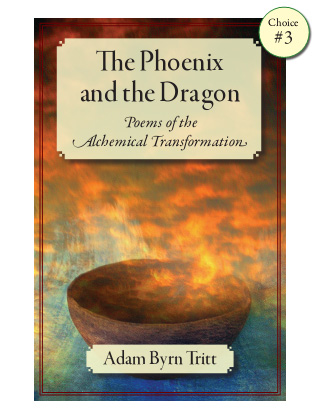
We have a winner: The Phoenix and the Dragon has a face

On-line and at our local Earth Day celebration, over 100 people voted and nearly half chose our cover number three. Next came cover two and the fewest cover one.

All this voting going on as I played auctioneer, helping raise over one thousand dollars for sea turtle preservation. They were so happy with the money raised they said I could choose any two turtles I liked and they’d make soup of them for me.

So let us look at the cover, unfettered by a bold number on the upper right corner, proud and ready to adorn the shelves of America and all those smaller places on the map that are so far away.

And let’s show the big conglomo-publishers a thing or two by making it the most purchased book in America. Take your time. We have a few weeks.

(Click on the front cover to get your copy. Spread the word.)


1 Comment

Posted by on April 23, 2007 in Books, Writing


The Phoenix and the Dragon is about to hit the Shelves

Yes, this is a shameless plug!

My second book, The Phoenix and the Dragon: Poems of the Alchemical Transformation, is about to hit the shelves. It follows my first book, Tellstones, and several anthologies and is my first collection through Smithcraft Press, a localy owned publisher.

Included in this volume are pieces for which I was awarded the 2006 EPPIE Prize for poetry in an anthology.

It includes rather stunning graphics by local artist, Evanne Floyd.

There is only one problem: We don’t quite have a cover yet. We have three. An embarassment of riches.

Below, you’ll see the three covers. Please, please, PLEASE, look to see which one you like best. If you saw all three on a bookshelf, which one would you pick up? Then, leave a comment or send an email with your choice.

This is, I think, the FIRST time a book cover has ever been chosen by blog! Come on: be a part of history. Choose a cover!

THEN… support the arts, writing and, most importantly, ME, by looking below and ordering your advance copy.

Here is are some reviews:

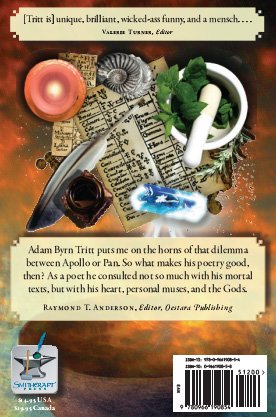
Adam Byrn Tritt puts me on the horns of that dilemma between Apollo or Pan. So what makes his poetry good, then? As a poet he consulted not so much with his mortal texts, but with his heart, personal muses, and the Gods.
Raymond T. Anderson, Editor, Oestara Publishing

[Tritt is] unique, brilliant, wicked-ass funny, and a mensch….
Valerie Turner, Editor

You can reserve your advance copy at the Pre-release Price.

The easiet way to order is to simply click on the book cover on the left of the page. Or you can send me your email address.

Thank you, and PLEASE, FORWARD THIS WHERE EVER YOU CAN. Let us lift and support each other.

Adam


The Phoenix and The Dragon is about to hit the shelves!

When The Phoenix and the Dragon is released in May, it will sell for
$14.95 in bookstores. If you reserve your advance copy, we’ll knock 18% off
the list price— and we’ll even pay for the shipping and handling!

ONLY—$12.26!

(Fine Print)
($14.95 less 18% discount = $12.26. Florida residents please add 74¢ Florida sales tax.)
Cash, check, PayPal, and credit cards accepted.

Vote. Reserve. We’ll both be happier.

 
4 Comments

Posted by on April 20, 2007 in Books, Poetry, Writing


Rejection Slips

Some rejection letters are treasures, some are trash. I just got a treasure in the mail.

Someone once challenged me to get to one hundred rejection slips and they’d buy me coffee. I’m notoriously frugal so I immediately set out to spend a ridiculous amount on stamps and envelopes so I could get a free cappuccino. I never got to one hundred. I never got to twenty. All I got was published. She bought me my coffee anyway.

I’m easy to trick like that.

I teach my students to send in their work. Anywhere and everywhere. What’s the worst that could happen? Rejection. The odds are against them but what is the cost for failure? Not even stamps, in some cases. The most it can cost is some time well-spent learning to revise and reformat.

And if a piece is accepted? Time to look at what the editor has said about your work. What did they suggest? What do they want? Changes. And with any of their suggestions you can do one of four things:

One: Just make the change. Sometimes the editor is right and when you see the comment you slap yourself in the head a la the V8 commercial and wonder how you missed such a bonehead, obvious error.

Two: Make the change. This is not a repeat. You think you are correct but you make the change anyway. Why? Is your writing making you money or bringing you fame sitting in your computer? Probably not. Is the edit one that changes the meaning of your work? Does it damage or degrade it? No? Then why not change it to the likes of the magazine and get it out into the public?

Three: Don’t change it – fix it. Explain why you are correct and the editor is not but that it is your fault. It happens. The editor suggests a change, perhaps one of word choice or punctuation and you believe it affects the meaning, feel or sound of the piece. Explain why it needs to be the way it is and take the blame for the editor’s confusion. Take the blame? Yes. Explain that if you were clear in your meaning it would have been clearly communicated, clear to the editor and clear to the reader so, if the editor did not get it, it must be your fault.

Why? The editor is your gateway to being published, for one. Don’t yell at your editor. Be kind. Also, it probably is your fault. If it read in a way that a word seemed wrong or another word seemed better, you are probably not getting your meaning across. Isn’t that what you want? To be read and understood? So, explain why the word or phrase needs to be there and then tell your editor you re-worked the section so the purpose and meaning were clear. Take the blame and make the fix but not the change.

Four: Tell her to take a hike. I don’t suggest this one. Your editor is the gateway reader. They stand in for the general reader of the magazine and, if they are any good, they read it the way their readership would. If they think a change should be made it is most often for a good reason. Think about it seriously.

Have your own copy of the work. In that, make editorial changes you agreed with and, otherwise, leave it alone. That way you have a solid, improved copy just the way you want it for publication later.

And the rejection letters? Print them out. Post them on the wall. They are your proof you are active. Richard Bach got rejected and so did e e cummings. Hemingway and Orwell. You too can be rejected. It means you are submitting. You are active. Celebrate every rejection slip.

I celebrated this one:

March 3, 2007

Dear Adam,

Thank you for your submission, “A Day at the Beach,” to Literary Liftoff. Unfortunately, however, its subject matter and its style are not suitable for our magazine. Because we are oriented toward a general audience, we are looking for stories and essays that are more conventionally structured and more suitable for family reading.

Because of its unconventional, free association style, I think you might be more successful in pursuing literary markets that are looking for more experimental work.

Thanks again for your submission, and I wish you luck in placing your manuscript elsewhere in a more suitable publication.

Revisions editor, Literary Liftoff

I love it. I sent this reply:

Hi,

I LOVE that rejection letter. I sent it to six people and they immediately wanted to read the essay. If it doesn’t fit, I don’t mind a bit. I fully understand. In the meantime, it’s great advertising.

Thank you,

Adam

And, if you go here, you can read it too.

 
2 Comments

Posted by on March 27, 2007 in Books, Education, Writing


Panty Raid

Not every poem is a gem. The problem is each eye sees a poem differently and to some eyes the poem is a jewel of clarity and translucence without flaw and to another, little is seen but stone, dull and rough all around.

Published, non-published, well-known and not, opinions vary and there is, alas, no set of rules and measures, clear and objective by which to judge.

Those least favorite of my own writing are those which win awards and those I consider gems often sit quietly, lingered over by only a few who see them as I, while those lesser children of my creativity are fawned upon by masses.

It was years before I would read publicly. I saw people clapping for everything and anything and the applause seemed all the same. I thought, why bother if there is no discrimination between trash and treasure, gravel and gold. If rant and screed, angst-fests and treasure-chests were all received with the same enthusiasm, why read at all? There would be no way to say if my poetry was good or bad.

Yet, finally, I was pulled up to stage to read. Of course, as you know, gentle reader, my first time taking part in a public performance was a clothing optional poetry reading with over two hundred people in attendance pressed into a standing room only venue. There was little clothing in sight and all I had for cover was poetry. Eight and half by eleven doesn’t cover much.

I have had reviews. Most of them good, I am delighted to say. Many are superlative. I have taken to not believing any of them. If I believe the good ones, soon, I would think them real. Then, if I get a bad one, when I get a bad one, I might believe that as well.

There is definitely bad poetry. I know it when I read it. Poetry that, by comparison, makes Vogon verse seem pleasant and melodic. Yet, for the most part, I see good and bad poetry depends on trends, fashions, what is in vogue with those in the know and currently taught in the towers and bowers of academia.

I have, as late, received an abysmal review. My first. It’s from Bryan Roth. Mr. Roth says he represents the Colorado Poets Association.

“The only thing worse than a really bad poet, is a really bad poet who promotes himself shamelessly. You should get some shame. There’s already enough bad poetry in the world.”

His website is a free Geocities page at www.geocities.com/bryan_roth/index.html. It has been under construction for some long time now and is not quite up to date. I won’t review his work. He must be good because, otherwise, he could scarcely critique others with such depth and skill. His schedule says he gives a reading a month and they take place in Colorado. Few of the readings give any more specific a location than the entirety of that state. He must require a great deal of space.

His bio says he is the founder and executive director of the Colorado Poets Association and I wonder how many members it has. He also points out all the important people he studied with and I have heard of a few. He has no degree listed, specifically points out he hasn’t an MFA. He has no books in print.

By the way, the Colorado Poets Association website is under construction. If you like, you can reach Mr. Roth at coloradopoets@yahoo.com in case you should wish to join.

Have I written bad poetry? Of course I have. Horrendous poetry, in my own humble opinion. Sometimes for fun, sometimes because not every idea works well even after countless revision and such poetry I scrap except, sometime, someone sees it before hand and, horror of horrors, likes it. Likes it!

And I get asked to read it. In public. Often.

This happens each Yuletide when I know I’ll be asked to read ”M&Ms”, a poem about my daughter growing delicious melt in your mouth, not in your hand, candy-coated miniature holiday-hued chocolates. This is a terrible poem I have actually deleted several times but my wife has radar for it, has dug it out of e-oblivion and sent it around via the persistent insidiousness of the Internet. I revise, rewrite, revamp it each year starting in November and, by December, it is still horrible. And I am asked to read it again and again and again.

My first award was for my least favorite poem, “But the Son of Man, or Respite.” It won the South Florida Book Club Award. This means Dave Barry liked my work. I’m still not sure how I feel about that. It does, however, prove he got over that elbow in the ribs I gave him when we were the last two in line for the one remaining copy of Hitchhiker’s Guide to the Galaxy at a Douglas Adams book signing. I hope he healed quickly.

At the reception, I was asked to read some of my favorites. I did. The Broward County Main Library auditorium was full of confused faces bending forward, tilting sideways. After the second poem, the coordinator leaned over and asked me, shielding the microphone, if they were mine. I said, mic unshielded, no, she had asked me to read my favorites. That’s what I was doing. She then asked me to read the poem for which I won the award. Why, I asked. I thought you wanted me to read something good?

Over the space of December 26th through January 1st, I attend a sort of Winter Camp in South Florida. It’s geek-central and full of artists and the like. Among the creative types are singers, guitarists, fiddlers, flautists, painters, sculptors, but no writers, or so it always appears, save myself. And so, I end up being poet-in-residence.

This year was no exception and I took the role gladly, even managing to set up a reading in Wellington while I was away, deep in the Everglades of the western-most reaches of Palm Beach County beyond where roads become failed sand paths and fade to suggestion in the bush. If you have never taken a swamp-buggy to a performance, I recommend giving it a try. One arrives in true high style and with barely a mark.

At a small outdoors venue I performed poetry designed to fit the themes set for the event: spirit and ecology. Under a pavilion, behind a mic I read poem, after poem, sometimes taking requests and sometimes, though I dislike doing so, letting some requests go when they would toss us too far off the theme. But, as the poetry turned more humorous – as there is much humor in spirituality and ecology and, if one looks not even deeply, much more needed – I gave in to a request repeated, repeated, repeated.

“Read the Panty Poem.”

As that is not what the poem is called, I, at first, ignored it. Then, “Read the Underwear Poem.” Drats. It’s harder to ignore it when they know the title, but I managed.

“We want to hear The Underwear Poem. Unless you have your own swampbuggy, we suggest you read it.”

Here in the Glades, literature met deliverance and poetry met survival. Since that survival was mine, I quickly changed my mind. And why not? I was there for them, not me. They wanted to hear it. Why not?

Why not is because it is terrible. It is horrible beyond my own ability to describe. Written as a joke, I first read it as a joke. Known for taking poetic challenges, having just finished an epistle to John Gotti in the style of Alexander Pope, on a dare, I thought I would poke a bit of fun at a new challenge I had received at a Barnes and Noble Writer’s forum after a hamper-full of panty poems by several female participants. Cute, short and, to a poem, devastatingly horrendous. I had none, of course but was told there was no reason not to have one of my own next time and I set out to show the ladies exactly why I should not; the manifold reasons I shouldn’t write about undies. And I copied their style as best I could from my one evening’s listen.

I read it at the next meeting to, aghast as I was, applause. But it was bad. Apparently it was so bad as to be funnier than I had anticipated. It was, after all, bad on purpose. Had I done such a good job at making it so bad it was actually good? If I made it worse yet, would it be better still? I set out to revise it and make it worse, hitting as many sour notes and worn contrivances as I could. I sent it to a friend. Brilliantly awful.

And so, once in a while it was requested. Then a bit more often and then, nearly each event, it is asked for and, if they ask by name, who am I to tell them no? If not reading it means I am to find myself stranded in a field surrounded by wiregrass and alligators, refusing seems a singularly bad idea.

So read it I did. And this much I read:

I have some acquaintances
Who, at a poetry reading
Each read cute, short
Pieces about their underwear.
Panty poems. I had none
But was told that next time
There was no reason I should
Not have one of my own.

True enough. But try as I
Might, nothing. I just don’t
Pay attention to my underwear.
I’m a guy and I just don’t care.
So I ask you
Give me yours.

Then, suddenly, I heard a rustling and noticed color in the air, fluttering objects heading toward me, audience arms raised and swung. The space before me was full of small bits of cloth and I jolted back a step, but a moment later, the ground around me, my shoulder, my right arm, all were decorated with panties. I was being showered with underwear.

I am not new to this. I have weathered theatric adversity before and wish I could say I was fully nonplussed and continued being the consummate professional I dream I am but not this time. I’m told I had a smile on my face and cannot imagine I did not. I’m told I paused and cannot imagine I did not. I know these things because I asked, not because I remember and, I should add, I’m told I had a bit of a look of shock on my face and, in truth, I cannot imagine I did not.

In a moment, which seemed to me much, much more, I continued:

Large, small, granny or mini
Full or thong,
Hand it over.

Someone quickly spanned the ten feet between the audience and myself and put a pair of grannies on my head and I immediately realized some of these were not coming to me directly from the drawer.

I have had readings where women sat directly at my feet, knees at my toes, set after set, listening, staring up, requesting, between poems, I wear shorts next performance and showing up at each and every reading to check whether I had, sitting again at my feet. Performance after performance.

I have had readings where youngling students of mine showed up and I have had to redesign a set and self-censor on the fly. I have had school board members and those above me in the district food-chain attend my performances having previously reminded me I am not to be an ‘embarrassment’ to the board or my school lest I face dismissal. All this, I take in stride.

But, this time, I ceased. Momentarily, but cease I did. I know it showed on my face. I left the pair of granny panties on my head, picked the pair off my right arm with my left hand and put them in my pocket. Bending at the knees, I scooped up a pair beside my left foot and held them in my hand. I read on and as I read this:

You’ll be more comfy and I,
I’ll have underwear to write about.

I’ll describe how they’re stretched here around the leg
And the elastic is bare of cloth at the waist,
How one is discolored so some of the small roses
Seem an odd hue
Like a new hybrid
And I can name them, these new roses,
After you,
After your panties.
I can name the flowers after
Your underwear
And I’ll line all the panties up in a row
And all the sizes and shapes and colors
Will remind me of all of you gals
And your poetry.

I expect this will be the end of their poetry suggestions.

A young lady from the audience, swayed up with a thong, holding it out-spread for me to see even as I read. A black pair with a well-placed pentacle and, around it, the words “Worship here.” And I did not stop my reading. Oh, no, not this time. I finished as she tucked it, fully half of it, slowly, into the front waist of my dungarees.

If you do not have groupies, you need them. Trust me. You do. Groupies could make nearly anybody smile. Even, perhaps, Mr. Roth.

 
5 Comments

Posted by on January 12, 2007 in Poetry, Social, Writing


Original Spin

Yom Kippur has passed. Simcha Torah has come and gone and between those two days, the Torah starts over.

It gets rerolled from the end to the beginning. Again, he reading starts where all things begin, with Genesis. The words begin with the word and it was good. Or so the story goes in the translation many of us are most familiar with.

There are different translations, of course. And, even given the same translation, interpretations can differ. Such is the nature of the obscure, the unclear, the obtuse.

I must admit, I have some doubt regarding some of the parts. Rather a great deal of doubt, really, some of the bits and pieces actually occurred as reported As the Torah is being read, I am constantly reminded of how words can be spun to make a case, form an opinion, create a conclusion. I wonder how it really went down if down it went at all.

A prime example is the section just passed, the beginning of Genesis and the expulsion from The Garden of Eden. I have an idea, a deeply felt solid hunch, it was rather different. I think of the angels, the garden, the serpent and it looks to me like a set up. We’ve all heard the no cliché cry “Eve was Framed” but I think it’s true. And I think it happened like this.

●●●●● ●●●●● ●●●●● ●●●●●

“I just don’t see the answer. For God’s sake, would you get over here and help me with this?”

“Hey, you know how he feels about that. He’ll hear you.”

“Fine. Let him. Then maybe he can help us find some sorta way outta this. You know, I’m real tired of pulling his butt out of the fire. Fix this. Explain that. Make this problem disappear. Would you make that go away for me?” Flustered, he continued, “Michael, would you move yourself over here and look at these write-ups? It’s a freaking disaster.”

“Gabie, Gabie,” Michael responded, smiling calmly, assiduously, “How many times have I told you, your gonna give yourself a peptic. Relax. Let me see those”

Snapping several loose papers off the table from under Gabie’s nose, Michael shuffles them into order.

“So what’s the big deal here? The guy eats an apple. Snake tells him no, he does it anyway. What do you want from a kid?” exasperated Gabie, fists pounding his knees.

“Then what? Come on, Gabie, then what?”

“Well, let’s see here,” he exhaled, shuffling through the sheaf. “So, he gives some to the girl. She protests and he forces it on her. OK. Clearly not a nice kid.”

“You know how this is will look to the future? Think about it? He sure ain’t gonna be able to pull that whole infallibility thing off, least not for long, if stuff like this happens. He just won’t stand for it.”

But I tell you, it makes no difference. Infallibility. Free will. It doesn’t matter. Our job is to fix this. And, Gabie, this is an easy one. Pawn it off. Pass it on. Blame it on the minority.”

“Minority? We’re looking at three players here. The total population of the planet plus a snake. Three. You can count, right? One guy, one gal and a snake,” he yapped, with a shake of his head, thrusting his han€d out, palm nearly in his partner’s nose, with three fingers aloft. “And between you and me, amongst them, the snake’s the only one with a brain. That makes it a minority, sure, but still. Michael…”

“No, no, no.” Looking off into the distance, sweeping the air with his right arm, he breathed the words slowly. “Look at the long-range plan, man. What we do now has to fit into the big guy’s long-range.”

“Look,” Michael continued, “minorities have less to do with numbers than power. Whoever has the power down the road, they’re the same ones who need to have the power from the beginning. That’s how they get to justify it. History. It’s all neat. Always been that way, always gonna be that way. I tell ya, this is a blessing, boy. We can cement the power and blame right now and it will stick! It will stick like glue and this is golden. It really is. Just gold!”

With this, Michael glossed a self-satisfied face. He so enjoyed the creative process.

“I don’t follow,” exhaled Gabie.

“Nah,” puffed Michael, shaking his head, “you don’t look like you do. See here. A nearly catastrophic event. But the only ones who know anything about it were there. No witnesses. It’s contained. So we discredit the victim. It’s all we need to do. Who else would know? And when we’re done, no one who hears the story will think anything different than what we told ‘em to think. Best of all, He’s gonna love it!” He whispers, bending close to his workmate. “Gabie, do you see it now?”

And he did. The story was written. The big guy loved it just like his partner said he would. It was official: The snake told her to. Foolish girl she was, she listened – or so the story went. Then she forced it on the poor, beguiled, unsuspecting boy. It was wrong, but what can you expect from a girl? It was perfect. A done deal and iron-clad. It was the original spin.

 
Leave a comment

Posted by on October 23, 2006 in Religion, Social, Writing


Tags: , , , , , , , , , , , , , , , ,