RSS

Category Archives: Social

When I Wake in the Morning

When I wake in the morning I want to do yoga.
When I wake in the morning I want to go for a walk.
When I wake in the morning I want to spin wildly.
When I wake in the morning I want to lay in bed and bless the day.
When I wake in the morning I want to wash in dew.
When I wake in the morning I want to make a slow breakfast.
When I wake in the morning I want to stretch.
When I wake in the morning I want to recall my dreams.
When I wake in the morning I want to do tai chi.
When I wake in the morning I want to run on the beach.
When I wake in the morning I want to sit and write.
When I wake in the morning I want to meditate.
When I wake in the morning I want to putter in the garden.
When I wake in the morning I want to do qigong.
When I wake in the morning I want to sing praise songs.
When I wake in the morning I want to greet the sun.
When I wake in the morning I want to be glad.

 
1 Comment

Posted by on March 9, 2016 in Poetry, Social, Uncategorized


Tags: , , ,

State of Being

Verbs are words that show a state of being—present, past, future. Transient or continuous. When we use the verb “was/were,” we mean something that has passed. It happened in the past. It is done. It is over. When we use the verb “is/are” we speak of something that is present. Something that exists now, current. An action that is going on right now. This moment.

For the purpose of my question, tense is not important. Past participle, continuous, perfect—none of these important to my question. What is important are simple tenses. Past and present.  

And so I ask, why do we say someone is dead?

We can say someone is alive. To be alive is a continuous state. Continuous, until it ends, either abruptly, or slowly, slowly over a period of time. Suddenly, or counting down, day, day, day. One hand. A few fingers. Done. Present becomes past very easily.

Someone is alive. Then they are not alive. But they are not dead. If we insist on using present tense we should say something that is an actual ongoing state. Something that is active. Her body is in the ground. She is decomposing. Her ashes are disappearing into the snowy stream.

Death is not an active state. It is not something someone does. It is the end of doing. She is alive. She is laughing. She is loving. She is healing. She is holding your hand, raising children. She is putting her feet on the dashboard on a long ride, talking, laughing, singing. Under your hand, her leg is warm.

 
Leave a comment

Posted by on January 27, 2016 in Culture, Family, philosophy, psychology, Social


Tags: , , , ,

My Messy Desk

Einstein had a messy desk. Behind the messy desk were messy bookshelves with piles of reports, journals, and loose papers. A study published in the September 2013 issue of Psychological Sciences suggests, strongly, that a clean and tidy desk, or office space, leaves one doing socially acceptable things, having normative ideas, and, for want of a better set of terms, doing the right things, thinking the right things, and behaving. Those who worked in, or, in this case, filled out a form in, a messy room, with a messy desk, had less normative ideas, made more creative connections and reported being willing to try things much much further afield. They didn’t see the need to do the right things, think the right things or behave as expected.

I may never clean my desk. It does not make me smart. It doesn’t make me a creative genius. I may clean my desk. It does not make me dumb. It doesn’t make me dull. But the messier side of life is about being indicative of webs of connections. Not graphs. Not charts. Webs of ideas, concepts, facts, which may seem unrelated but later are pulled together to solve a mystery, a problem, a puzzle no straight lines or charts could solve and shine light upon an answer no single beam could illuminate.

It is why one needs to learn things that are of no immediate use. Of no seeming use at all. Because the more of those things we know, the more errata we have, the more connections can be made, the greater our potential for creativity. Connecting things no one had thought to connect in ways no one had before seen. That is how the unsolvable becomes solved. That is how the unanswerable becomes answered. That is the creative process.

That is the gift of a broad liberal education – one of curiosity and not direction. It is why America was a creative powerhouse. Losing that is why we no longer are. It now costs too much to be curious. It doesn’t result in a job. And we all lose.

 
4 Comments

Posted by on March 29, 2015 in Culture, Education, philosophy, psychology, Social


Tags: , , , ,

Seven Questions for Adam: An Interview by Craig Smith

Seven Questions for Adam: An Interview by Craig Smith.


Tags: , , ,

Silence

I have taken a break to grab some lunch. A small Chinese restaurant. A family of four sits across from me, one table ahead.

This is the family that typifies an average – a mother, a father, both middle aged, a daughter of late teens, a son nearly a teen or recently so.

Each eats without word, but the only silence is among them. Within each there is a shield of sound. Each has headphones on. Earbuds, full phones, hangers, and, for the father, Bluetooth speakers reminiscent of Uhura at the communications console on the bridge of the USS Enterprise. Each is listening to music. It bleeds beyond the headphones and earbuds, mixes into a pandemonic of sounds. Loud enough to carry the treble to my table of each individual island at theirs, as they listen, look down, fork, plate, food, mouth, plate, food, mouth, down, up, down, up, wordless, silent.

 
Leave a comment

Posted by on March 24, 2015 in Culture, Family, Social


Tags: ,

Listen

Listen.

A year ago, maybe less, maybe more, at dinner, a discussion.

It was an evening designed for people to get to know each other. I desperately wanted it to go well.  I don’t think it did.

One person talked while the other listened. One felt the other had no interest because she was not being asked questions.  She felt asking questioning was how someone showed interest in another. The other person felt the first wasn’t listening because she was asking questions but not hearing the narrative, looking for answers instead of stories. Both were exploring the other the way they felt the other person would feel valued and wanted, sure to feel the interest flowing.  We so often relate to others the way we wish them to relate to us, regardless of our different ways of being.

It didn’t work.

I am thinking of Guinan from Star Trek: The Next Generation. Played by Whoopi Goldberg, Guinan was long-lived and came from “a race of listeners.” She ran Ten Forward. Café, bar, meeting hall. She was a bartender, but, like the archetypal bartender, she was a counselor, psychologist, and, when her patrons needed it, when a crew member was confused, she listened. She listened long, and deeply, and, on rare occasion, cut through the morass of conflict and over-thinking with a single well-placed question one could only form after deep listening.

Guinan is the only action figure I own.

Some of us see our lives as points. Events. Memories.  Some of us as narratives, stories, chronologies with highlights. And we so often wish to learn about others in the way we see our own lives.

Maybe it runs in families. My son, he listens.  I can’t really remember Lee asking people many questions at all. She would know you or would not, and the facts rarely mattered. My daughter, Sef, too.

Arlene likes to ask questions, and be asked questions. It is how she feels one shows interest in another. It is also how she feels someone shows interest in her. Fair enough. They are good, solid questions. Questions of meat and bone. Helpful and direct. And she listens too, picks up on subtle things, notices nuance. Still, the questions have taken me a bit to get used to.

And I know she often finds my lack of questions befuddling.  Mine are few. I like to make them count.

Craig asks questions which are intense and probe deeply. It is quite a skill. He asks them with near surgical exactitude. He has noticed I take much delight in derailing his attempts at interrogation.

Trish asks rapid-fire questions and rarely waits for an answer before the next. I usually just stare at her until she stops.

Alicia rarely asks a question, but when she does, it is thoughtful, wide, and beautifully ambiguous, and I have to think to answer.

Susie. Other than “What are you doing Sunday?” “Can I put a load of laundry in?” or “Can I help?” has not, that I can recall, ever asked me a question.  But she knows me. She listens well. Yet, she, and others, know me. Each differently, for we are never exactly the same to each person we know, but, each in their own way, has come to know who I am.

We each have our own way, and sometimes those ways cross and we find we don’t quite know how to relate to the other person. It can take some adapting, some getting used to, some cutting of slack, as it were, and some understanding that we all relate to the world, and each other, in different ways.

As for me:

I want to discover you,
To listen to you,
Wander with you, ramble
The trails of your life
As your stories
Give away the who of you,
The how of you.

I want to press my ear to you
And sound the depths,
Hear the murmurings
Of desires and disappointments
And wander within the walls of you
Feeling for the edges,
The borders hard and soft.
See the flashes in the dark
stumble upon the permanent midnights,
Your heart, your soul.
The who of you, the how of you,
Even the why of you,
But the what of you,
If it should come clear
In the course of time, that is fine,
But I’ll not ask.
The data points and trivia of you
Will come as needed,
I’ll not ask,
You needn’t tell.
I know what I need to know.

Others will ask questions,
Probe, collect information.
It is their way to discover
What they feel
Is the measure of you.

But I say, come,
And let us walk a while.
I want to listen.

I love to listen to people ramble.  That is when I learn the most. As they go on, I learn their history, likes, dislikes, pet-peeves, I hear what makes them tick and what makes them sick, what makes the glow and what leaves hem cold. I hear where their heart is and where their soul resides. Rarely will I ask a question unless there is something I find confusing, or I see confusion and it occurs to me a question might bring clarity. But they are few. I want them to count.

Like Guinan, who stands on the sill over my computer, I want to listen.  Always listen.

 
3 Comments

Posted by on September 8, 2014 in Culture, Family, psychology, Social


Tags: ,

Einstein’s Bagels And Why They Apparently Think I’m An Illiterate Putz.

I have a big superego. I freely admit that. I think a person should go out of their way to do the right thing and if something is wrong then you just don’t do it. That doesn’t make life in this culture very easy sometimes.

I am what the gamers, the folks who play Dungeons and Dragons and other role-playing games, call Neutral Good. As a player, that would be my moral alignment. Good, and Evil, come in three flavours—Lawful, Neutral, and Chaotic. Lawful Good follows all the laws. That defines his or her idea of goodness. The means justify the ends, whatever those ends may be. Chaotic good follows no rules but acts on the ideas of outcome only, saying the ends justify the means. Neutral Good is defined this way:

A Neutral Good character is guided by his conscience and typically acts altruistically, without regard for or against Lawful precepts such as rules or tradition. A Neutral Good character has no problems with co-operating with lawful officials, but does not feel beholden to them. In the event that doing the right thing requires the bending or breaking of rules, they do not suffer the same inner conflict that a Lawful Good character would.

When I see a rule being broken, and I think it is a good rule, a law being scoffed, and I think it is a good law, one that makes sense, one that deserves to be followed, I find myself wanting to do something, and that oversized superego means I have no problem doing it. And I’m a fixer. When I see things that aren’t right, I want to fix them. Need to fix them. Even if I’m hungry.

And I was.

I was up early. Too early, really. At five-fifteen. Why? Because I’m the only one who shows up to Wednesday six a.m. spin class and I don’t want Tammy to lose her income for that class. So I went, even though I hadn’t slept well and even though I had to be back at the gym an hour later to see a string of members for short, introductory sessions of assisted integrated stretching from eight am through six that evening.

Spin class over, I ran home, showered and, after feeding Dusty, let her out. In the meantime I was going to make my own breakfast in my beautiful (and it is) healthy (and it is) lovely (and it sure is) Vitamix. Looking out the kitchen window I notice something. I notice that I don’t notice Dusty. She has leapt the fence again. So much for my salad smoothie. And so much for my coffee.

I walk out the back door and she isn’t there. I walk out the front door and she isn’t there. Down the street to where she plays with Rank and she isn’t there. It is five to eight and I can’t do anything but hope she likes her new family, wherever that is.

So much for breakfast. Sure, Dusty gets to eat and play, but I don’t. Off to the gym.

Two hours and six patients later, I’m hungry. I have a break and my blood sugar is low enough that I know for sure I’m headed for a bad choice. Luckily, Einstein’s Bagels is a block away, on Babcock and Palm Bay Road. A salt bagel and coffee. Maybe even some lox.

Without enough time to walk, I get into the truck and drive over. I park and have my Einstein’s cup, my cup about to be filled with free coffee, in my hand. Coffee. Bagel. Salty salty fish. But first, the bathroom.

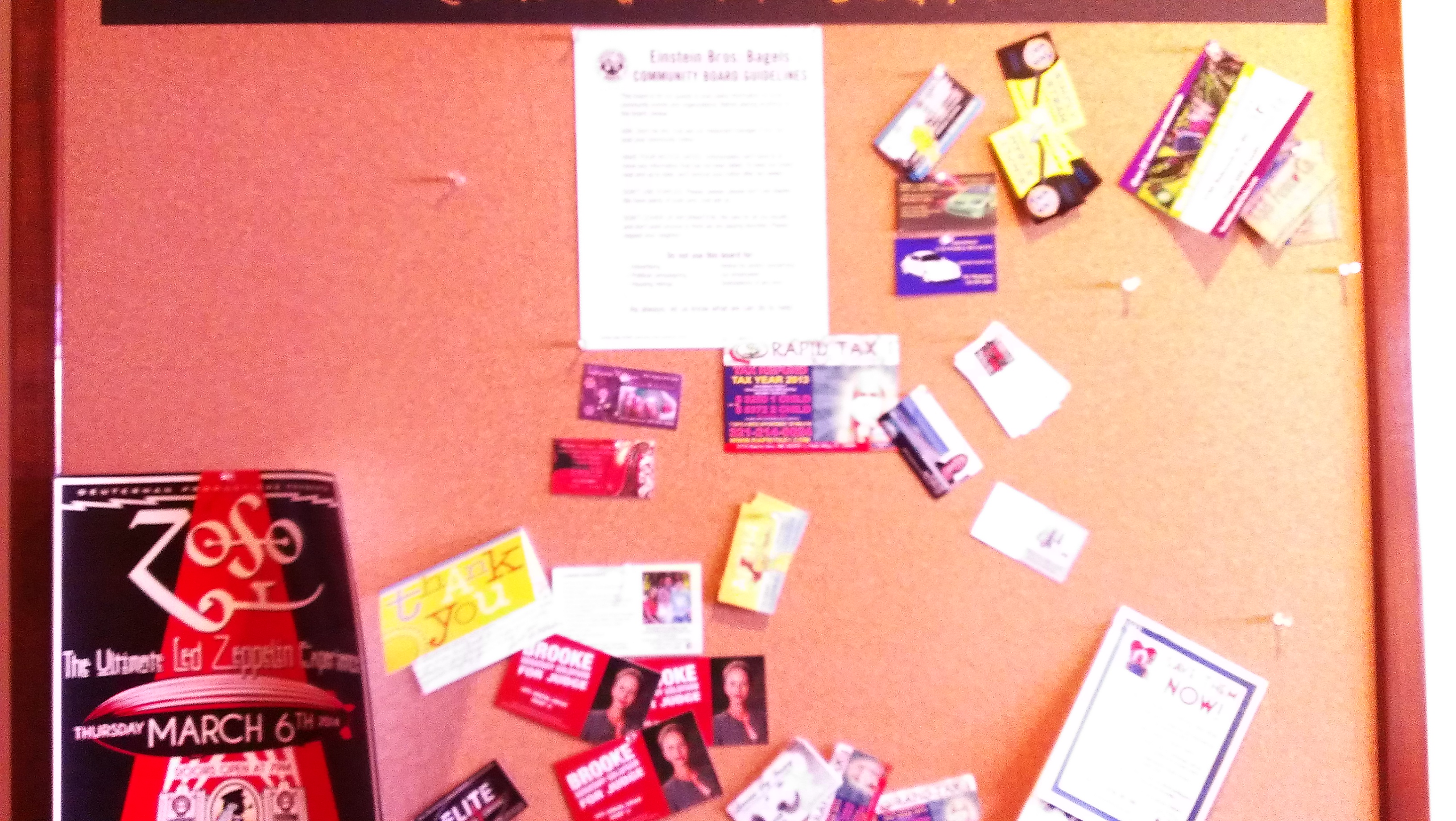
On my way in, I see the community board. The last time, there was barely anything on it. An announcement or two. And it was neat. Not now.

The fact that I can barely hold it (and why didn’t I go at the gym? Oh, yes, I was hungry and my blood sugar was dropping) doesn’t keep me from staring at the board and noting that most of the things on it are not supposed to be there, according to the big old sign smack in the upper-middle of it all.

OK. Bathroom. Then I can talk to the fellow at the register as I order my bagel and coffee.

Back out. No line. Here I am. “May I take your order?”

“I’d like a salt bagel please. Toasted, and coffee.”

“Anything else?” I look at his name tag. He is the manager. Perfect.

“No thanks. But I wanted to mention that there is a lot of stuff on the community board that doesn’t adhere to the guidelines.”

He looks at me as though I had said, instead, “Excuse me, but there is a dead body in the bathroom and your mom is standing over it with a knife. Oh, and he’s not got pants on.”

Slowly, with a great deal of emphasis on the last word. “What sort of things?”

“Lots of business cards. And political advertising for candidates. I saw that the sign said no advertising and no political campaigning.”

“I’m offended!” He says this as though I had said he mom hadn’t any pants on either. And I am quite well confused. I can’t imagine how I could have offended him.

“I’m confused. You’re offended? By the political advertising?”

“No, by you. Everything up there has been approved by management.”

“So, you’re offended? I really can’t imagine how I offended you.”

“Well, you did. I’m very offended.”

I’m not going to win this one, so I might as well have at it. “Well, you must be incredibly easily offended. Exactly what offended you?”

“Your suggestion that we did not follow the rules on the community board.”

“That offended you? My, you ARE easily offended. It says clearly no advertising. And no political campaigns.”

“That campaign is a non-partisan race.  And those business cards and advertisements are not for food. It only appIMAG3762lies if it is for food that competes with us.”

“Come with me, please.” I gave him a follow-me index finger and walked over to the board about four feet away, the order area being at the end of the long counter and just before the short hallway to the bathrooms, halfway down, on the right side off which is the community board. I point out the sign.

“No advertising. It does not qualify that in any way. This is full of advertising. No political campaigns. It doesn’t say unless it is a non-partisan race.”IMAG3763

“Well, it means that though. That’s what it means. You know, you could have just asked if you wanted your cards there.”

I cocked my head to the side. The way a puppy does when he’s confused. I find myself doing that quite a bit.

“Now I am offended” It is his turn to look confused. “You are telling me” (and I step very slightly closer to him) “that I am either illiterate or I am a putz!” I take care to pop my P like I’m trying to explode a microphone.

“I would not ask to put up a card because this clearly states no advertising. If I did ask, that would make me illiterate. If I wasn’t illiterate and I asked anyway, I would be assuming you would break the rule just for me and that would make me a putz. So which is it? Am I illiterate or am I a putz? Which one are you accusing me of?”

I walk back to the counter. He follows. Each of us on our proper side.

Grimly, he looks at me and asks, “Did you want anything on your bagel?”

“I’m not handing you any money! I won’t give money to a place that can’t even follow its own rules and has an illiterate manager. And NOW you can be offended, because that one I meant!’

I walked out. To the car. I get my phone. I walk back in, camera on.

He follows me. “I really can’t let you take pictures of this store.”

“Really? People take pictures when they check in on Facebook. There are pictures on Yelp. On your own Facebook page, people upload pictures. And how are you going to stop me?  Afraid some other corporation is going to copy your community board?” I take one picture. “Besides, how else will I spread this great story all over social media without a picture?” I take a close-up of the sign. I smile and walk out.

Back to the gym I go. I’m still hungry. But I know the bagels are no good for me anyway and now I certainly won’t be having any. Not today. Not tomorrow. Not soon, unless they are really really good ones.

No matter. Right is right.

But I sure could have used some coffee.
 
2 Comments

Posted by on January 24, 2014 in Culture, Education, Food, Social


Tags: , , , ,

Nightshirt

Nightshirt

Originally Published in Elephant Journal.
(For Lee, 9/8/13)

For the first few weeks,
once I would return to the bed,
I’d lie on my side
arm on your pillow
your nightshirt tucked
under my cheek,
One of the few pieces of your clothing
I kept. The body is a just a shell
You said. But your lab coat,
the suit you wore to your graduation,
your nightshirt.

The one you wore to hospice.
The one you were comforted in,
the one, the last one.
Your favorite,
cornflower blue
Bamboo fiber,
soft and light,
unwashed
the scent of you
still smooth upon it,
the smell of your skin-
the gentleness of
the small of your back,
the familiar comfort
between your breasts
where I would rest my cheek,
the collar that still
carried the nape of your neck.
Each breath, a calmative
against the cruelty
Of the sudden solitary sleep,
the life, a brain, that was built around
your existence
suddenly
without.

And, sometimes, I would sleep.
and sometimes not,
but over the days,
the scent diminished,
disappeared,
like your ability to walk,
speak, see, remember,
until little was left and,
fearing its loss,
as I still fear yours,
I put it in a plastic bag,
removed the air, closed it tight,
put it away in the dark.

A perfume, almost gone,
of days past,
that brings a flush or joy,
a smile, a sigh,
that, for fear of being used up,
isn’t used at all.

 
Leave a comment

Posted by on September 15, 2013 in Family, Poetry, psychology, Social


Tags: , , , , , , ,

Win a Copy of my Newest Book : Yom Kippur as Manifest in an Approaching Dorsal Fin

Want to win a copy of my newest book? Of course you do.  Goodreads is holding a give-away for ten copies. Just click on this link.

From the back-matter:

“Whatever ‘the Jewish experience’ might mean to the modern reader, Adam Byrn Tritt’s approach is uniquely his own. He is ‘observant’ in the sense that he carefully observes, as you would expect of a man who is, at essence, a poet. As a self-described ‘Jewitarian Buddhaversalist,’ he is aware that each tradition illuminates the other. This collection of essays and poems provides us with good talk. Conversation is the highest artform, and Mr. Tritt invites us in most kindly, with insight, erudition, humor, and compassion.”

—Wayne McNeill, author of Songbook for Haunted Boys and GirlsImage

Yom Kippur as Manifest in an Approaching Dorsal Fin explores—in essays, poems, and creative nonfiction—the tension between cultural heritage and contemporary society, between religion and spirituality, between the family you inherit and the family you create. From early-morning wrestlings with God to portraits of three remarkably different family funerals, from Kabbalist chants at a pagan bookstore to the humorous “What Do Jews Do on Christmas?,” Tritt’s writing taps into themes nearly universal in today’s world in ways that will resonate with readers of all backgrounds and faiths—or no faith at all.

 
Leave a comment

Posted by on August 20, 2013 in Books, Culture, Family, psychology, Religion, Social


Tags: , , , , , , , , , , , , , , , ,

Image

The Wheaton Test Or What I Need to Know About You Before the Second Date: With an Amendment Three Years Later Regarding how Completely Wrong I Was and a Further Amendment One Year Later that I was Not

Amendment
02/22/18

I wasn’t wrong.

Sometimes love alone isn’t enough.

Some people are set in their ways. Some people don’t fit. It doesn’t matter if it is one, or the other, or both, she, I, or us.

I think, in the end, I was sold a bill-of-goods. But it wasn’t she who did the selling – it was me. I sold myself on a dream, on a life I could have. This is on me.

I told my son, never feel badly about being a fool for love. If you are a fool for anything, let it be for love. And love her, I do.

Sometimes love alone isn’t enough.

Amendment
12/26/2016

There is a picture on my bedside table that was not there yesterday morning. It is a picture of a gloriously beautiful woman, sky and sea behind her, smiling. It is in a frame of gilt and funk and sparkle and it makes me smile nearly as much as the beauty in the photograph. It was a present from Arlene for Chanukah. And it is perfect.

Beside me, as I write this, is another picture, a drawing, actually, by Brian Andreas. We were in a gallery in Charleston, South Carolina. She was looking at Christmas ornaments, hand-blown globes, from Glass Eye Studios in Seattle. Each globe, multicolored, swirling, translucent, reflective, unique, blown with ash from Mount St. Helens. And she was going to buy one. The problem was that I had already gotten it for her, months earlier, in Tacoma at the Museum of Glass.

There they were, something I knew she’d want, right next to something I didn’t think I’d see anywhere but online or in a book. She recognized Andreas and how much I liked his work, how much it made sense to me, and asked me to walk away while she looked through them. I did, and visited with the gallery owner.

“I hate to ask this, but, she is looking at something I already got her as a surprise. So, please don’t let her buy an ornament.”To not sell something is not the best thing to ask a shop-owner. He listened kindly, I explained, he smiled.

That ornament, made with ash from deep within the heart to the Earth, from the heart that is the birth of all hearts, the hearth that is the mother of all hearths, is hanging from her tree. And I am looking at the print now.the-edge

They came to sit & dangle their feet off the edge of the world & after awhile they forgot everything but the good & true things they would do someday.

She had picked one of my favorites. Just like that. I picked what she would have gotten, she picked what i would have. We knew.

It has been three years and a few months since I wrote The Wheaton Test. And here is what I’m telling you – I was wrong. Wrong wrong. Not just a little wrong. Utterly wrong. Not fun-sized snack wrong. Elephant wrong. Blue whale wrong. The Earth is flat wrong. The kind of wrong that can leave one wondering if brains actually have any use if, after all, they can be that dreadfully wrong.

Here is what I wrote to Wil.

Good evening and happy Thanksgiving to you! I’m writing because I wanted to say that three and a half years after The Wheaton Test was published it is: 1) One of my most hit posts, 2) my most shared post, 3) is used on dating sites, if seems, as a litmus test and, most important of all 4) terribly and completely wrong and I am engaged (a few months now) to that very same young lady. What I’d have missed out on if I had taken my own advice! So, thank you. The ride would not have been quite as interesting otherwise. Blessing Always.

The reply was short and simple. “:-)”

Three years and then some. I have memories of my granddaughter, Sadie, at a year and a half old, sitting on the hearth (notice how close hearth is to heart?) of Arlene’s fireplace Christmas morning after a sleepover night so my kids could go out and have fun. Videos of her opening presents from her. Pictures of Sadie with Arlene’s kids, G!G! And Jules. Memories of wonderful moments on the beach, shared rainbows, amazing concerts. Memories of helping her eldest set off for college. And Arlene’s smile. Always that smile. And memories of kindnesses – kindness unsurpassed in any person I have ever met. I never thought I’d have new memories, domestic memories, memories with other than my own children, that would be important to me again. And here they are.

So, while she does now know who Wil Wheaton is, I know it also doesn’t really matter. I know, now, that, if we know something, we are often surprised others don’t. The knowledge we carry we feel is common. If we know something about quantum physics, we somehow feel it is not abstract, not uncommon. The same is true for literature, or popular music, or TV shows. Anything. Knowledge. Skill.  We can’t imagine others don’t know, can’t do, what we know and do.

So I was wrong. Or, rather, she was right. I draw that distinction because she is, to my recollection, nearly always so. When she tells me something, I may not get it right away (I am slow, I think), but given a bit to sink in, there is that moment of realization that she is correct. Now, even if I don’t get it, even if I immediately disagree, I won’t discount anything she says. Instead, I sit with it, let it sink in, roll around, because I know, given an hour, or a day, it will dawn on me not only that is is correct, but how as well. All I need to do is wait.

And wait with her I’ll gladly do. I will sit with her at the edge of the world and dangle my feet over, over into the nothingness, until all is forgotten but that which is good and that which is true.

All. Even Wil.

*****

Original Post
August 3rd, 2013

Sitting with a young lady, I was, at a Japanese restaurant. The kind where they cook the food at a table in front of you and you sit with people you don’t know and the chef makes noise banging salt shakers and scrapers and juggling shrimp and squirts saki in great arcs into the mouths of gulping diners. The kind that leaves one waiting an hour. But this time, we waited nearly two and a half. It gave us plenty of time to talk. Or try to. It didn’t go so well.

I tried physics.  No good. She tried current movies. No dice. I tried Eastern philosophy. No way. She tried popular music. No go. I mentioned Facebook. AHA!  Yes, we both knew Facebook, of course.

“Did you see the video today of a mother asking Wil Wheaton to give her infant daughter a pep talk? It was brilliant.”

“Who?”

Uh oh!  “Wil Wheaton?  You don’t know who Wil Wheaton is? You know, sort of like Nerd King.”

“Oh, nerd is a label. I don’t like labels.”

“Well, labels make it a bit easier to talk. You know, like saying mayonnaise instead of that stuff made with eggs, and going on to list all the ingredients. Agreed upon meanings.  As long as a label isn’t used as a pejorative.”

“What’s a pejorative?”

Uh oh! “Wil Wheaton. You know, Star Trek The Next Generation.”

“I never saw it.”

“But most people know who Wil Wheaton is.”

“I bet most people don’t. Go ahead. Ask.” She looked around us. Plenty of people to ask, for sure.

I did. Ten out of ten asked didn’t know.  I shook my head.  “Well, most likely, they wouldn’t be my friends.  She looked at me. It must have been the sight of my foot so tightly lodged in my mouth that did it.

I texted my friends. They did. They knew. Every one of them. She did the same. They didn’t. Every one of them.

We tried talking some more, once I dragged my foot from my gullet. But anything I wanted to talk about, I had to build background, step by step, first. That would have been fine, except she made it clear she didn’t care about any of it by saying, “I don’t care about that.”

Dinner was interesting. Nice young lady. We sat in her car and didn’t talk.

The next day, walking home from my office, I wrote these rules.

Over hot dogs at Mustard’s Last Stand, we edited them.

Craig put them on a poster.

Someone tweeted them.

Wil Wheaton got a hold of it. He posted it on his blog. “This is wonderful and I’m honoured to be included.”

It was shared and reblogged over a thousand times in less than two hours.

“Using this for all future relationships.” And “This. This and a thousand times this.” And “This is SACRED. Never Mind The Bible.”

“I’m well-beyond my second date, but I’m adopting this anyway. If not for my partner, just to make sure *I’m* following it.”

“I’m not sure if I would say all of these things about myself because I know myself. I know my insecurities. But I would like to be like this and I would like to think I’m at least a little like this. Maybe someday I’ll find someone to work through the little things and we can both appreciate the crazy, stupid, and amazingness of the world together.”

“The Wheaton Test is now one of my favorite things.” “Fabulous.” “This is perfect. Absolutely perfect.”

“These are like all the things I wish I could have conveyed but didn’t know how.” “This is beautiful!” “YES. All of this. All of it.”

And on.

Enjoy.

Use it in good health.

PS. What else did I write, other than this poster?  So glad you asked. Look on my blog (above) under books or look here.

The Wheaton Test. Or,  What I Need to Know About You Before the Second Date.

What else did I write, other than this poster?  So glad you asked. Look on my blog (above) under books or look here.

 
7 Comments

Posted by on August 3, 2013 in Culture, philosophy, Poster, Social


Tags: , , , , , , , , , , , , , ,