RSS

Category Archives: Religion

The Harmony of Broken Glass

A million years ago, I used to own a bookstore. The community had asked for it and even put up much of the money. In return, they’d receive a return on their investments when the store turned a profit and would have a local store that carried the things they wanted. All Lee and I did was to quit our jobs, invest our time and money and pour our hearts and souls into it. They gave us a list of the sorts of things they wanted, we stocked them and they pointed their browsers at Amazon to buy the books and drove to Wal-Mart to buy the candles and soon we were out of business and they could not quite figure out why.

We were in Gainesville, Florida, at the end of Sixth Street, where it met 441 at an acute angle just past the north-side of town. Our building was an old gas station built in 1906. It had the original brick foundation holding up the original cedar beams holding up the original pine tongue and groove floors holding up the original pine tongue and groove walls in which were held the original windows. Nearly one hundred years old the entire building was and it creaked and groaned and loved every step made inside.

The building had two main rooms. The front, the salesroom, was twenty by twenty and windows all around except for the front door on the south wall perpendicular to the street, and the door leading to the second room, right in the middle of the west wall with a large pane of glass, door to wall, on either side. The second room, twenty by forty, was solid wall on the north and east. Separated by glass from the front room and, on the south side, made of century old wood, plaster and glass. Mostly glass.

The windows were high and wide with broad sills. In the second room, three of them stretched from the front to the back. As one looked to the lower edges of any of the windows, as one looked to the grass below through the bottom of the pane, the world stretched, became bulbous, swirly. If you put your hand on the glass, you could feel it thicken as one got closer to the sill. Thin at top and thick at the bottom. Old poured glass windows – a super viscous liquid that slowly, over nearly one hundred years, poured towards its own bottom. Kids would love to sit there and stare though the bottom and watch the world wiggle, fatten, and wave. So did I.

This was the room we used for classes and workshops. Around its perimeter, it held rugs and t-shirts, dresses and scarves as well as other textiles, folded on tables, hung from frames, and tacked to the walls. So large, it was, we never had to move anything much for a workshop or fair.

We had bands too, and we’d serve coffee. We’d be open until eleven and many of the coffee drinkers would not purchase anything, so we figured the coffee would pay for the electric that evening, at the least. The coffee was in the small kitchen area off the large room and it was self serve as we were neither set up nor licensed for food service.

At first it was by donation. When we found the donation can with little money but filling fast with empty sugar packets and gum wrappers, we decided the honor system wasn’t working and charged a dollar for the cup. Not the coffee. Just the cup. All our mugs went behind the front counter. Folks could ask for one, pay their buck and drink all night if they wanted. On an average night we should have made thirty to fifty bucks from the folks who, otherwise, would not have spent a cent. Folks who came in and bought books and such, we’d happily hand a cup to. Everyone gets to do their share.

It wasn’t long before I started seeing people walking around with coffee in vessels I had never seen before. Little ones. Big ones, Even stainless steel thermoses and double-size travel cups. I’d ask for the buck for the night’s coffee and they’d show me their one quart mason jar, telling me they had brought it from home so no need to hand any cash over to me. I suggested, along with the cup, next time they should bring their own coffee, too. Late nights at the bookstore ended soon after that.

But the workshops continued. Authors, therapists, artists. Booktalks, dances, songfests. I taught a few myself, on occasion.

I had, over the few years prior, been doing a workshop on chants from the Kabala. I had been doing them, recently, at the local Unitarian Universalist Fellowship, at churches as far away as Greensboro, North Carolina, in the forests of Ohio and even in a hot tubs. So why not do one at my own store?

The night was set and we had a very nice turnout of over thirty people. Someone volunteered to watch the register and I set to work. Three rules only. These rules, along with the chants themselves, were taught to me by Rabbi Shelly Isenberg who was the Chair of the University of Florida Department of Religion. They seemed to work for him and they work for me.

Three rules. Everyone stands who is able to stand. I’m tired is not a reason for not standing. We always lose a few at this one. People walk out in a huff because they aren’t going to be able to sit and chant. No full breaths from a full body while sitting curled in a chair. Everyone singing. No gawkers. We always lose a few more at that. When I tell them we’ll be chanting for an hour or so, still more leave. I tell them it won’t feel like an hour. That they will wonder where the time went but people want fast, instant results and they want them easy. They want to slouch in a chair and attain enlightenment from watching other people sing for five minutes. Good luck.

The last rule is everyone comes to the center. I set up four chairs in the middle of what will be our circle and, at some point, each person comes to the center to sit and have the rest of us sing around them, letting them feel the sound, the vibration, the harmony. I often have a person help me make sure everyone gets their chance. I joke that I call her my shill. I tell them, at some point, I’ll be going to the center as well and, please, please, they should not stop chanting just because I have. Always people laugh at this. The twenty or so people who remained did exactly that – laughed. The group had been culled and we were ready to start.

The chants are short and simple. We learned the first one by listening to me say it once, then the group repeating after me. Then saying it with me. Then I sing it on my own and we sing it once together. That’s it. No lengthy process. Nothing written on paper until the end of the workshop. The first time I taught this I passed out the chants, with their translations, on paper before we started. Then, with the chants written down, people read them over and over instead of singing, looking at the paper the entire time.

People worried about losing the words. They always do. Don’t worry, I tell them. There is power in the tune itself. Hum, tone, sing dai de dai like we have all heard rabbis do. The tunes have lasted a thousand years. Two thousand years. There is power in the sound. Never worry about the words.

We sang our first chant, all in our circle, four times. It was practice, it was invocation, it was lovely.

Hineyni / osah (oseh) et atzmi / Merkavah l’Sh’kinah / Merkavah l’Sh’kinah

Hineni is “here I am.” Oseh (Osah for the guys in the group) et atzmi is “I make myself become.” Sh’kinah is, literally, the Presence, but a distinctly feminine manifestation of the divine presence, so “Goddess” is a good translation. But not a particular Goddess and definitely not, however, the word for small-g goddesses. That’s what Craig R. Smith told me, at least. And I believe him.

Here’s how Shelly translated it: Here I am! / I make myself / A chariot for the Goddess. I like that. That’s how I translated it then. That’s how I translate it now.

We learned the next chant.

Ana / El na’/ R’fa na lah. That simple. I sing it once through before telling them what it means. Please / Strong One, Oh Please / Heal The World (all)(Nature) Please.

Here is what Craig R. Smith says about it.

Ana and na’ both mean “please,” loosely. It’s somewhere between begging and pleading and a demand, so it’s closer to “oh please, NOW!” El means strong one. It’s the same root as other strong words. For example, the word “ayil” is a ram (strong one of the flock), “ayal” is a stag (strong one of the forest) and “eyal” is strength. R’fa is heal. Tradition teaches prayer need not be lengthy or elaborate. This is the earliest known Jewish prayer for healing, uttered by Moses as a petition on behalf of his sister, Miriam: “El na, refa na lah, God, please heal her, please.” ‘Lah’ is ‘her’ and the Kabalists say this is to be expanded to all nature.

*****

It is done four times, steady, rising, steady, falling, then starts over again, again, again, again, again. Ten minutes, twenty minutes. An hour. Voices rise and fall. Voices high and low. Melding, separating, harmonizing, combining into overtones no single voice creates. A circle of sound as, one by one, two by two, people come to the center, sit, vibrate throughout, breathe, heal. And all the while, a sound around it all, a tone at once over the overtone and under the lowest voice. It permeates and surrounds and whence it comes we’ve no idea.

An hour. An hour and a quarter. An hour and a half and the chant slows, quiets, takes longer breaths, then ends all at once as if by a cue, unheard and unseen. Silence.

What did you experience? I saw the colour blue everywhere. I could not stop singing. It was not my voice. I felt waves. I was connected. My body sang as I stood. I felt calm. Calm. No time passed.

Water passes around. Some sit, some pace. Some wonder what the sound was, that sound over the sound, that sound under the sound.

I walk to the far window, the window toward the back, for some space. To look out, to look down and see the grass wave through the thick glass and notice something new. Powder. Flakes. Chips on the wood sill. The caulking around the window is loose. The window, vibrating in the frame has loosed the old glazing. The window, vibrating in the frame, sang.

We gather again to say goodbye. A short chant only, easy to learn and in English. We make two lines facing each other, close to each other, holding hands with the person to my right, holding hands with the person to my left, close enough to hug the person I am facing, each line joining hands at each end. We are a circle pressed to a double line. We look into each other’s eyes and chant, then move to the right, look into another set of eyes, sing, move to the right.

Come let us light up our hearts.
Come let us light up our homes.
Breathe in,
And breath out
Making circles of love.
Oh, come, let us light up the world.

Move to the right, look into those eyes, sing, move, look, sing. Her eyes, his eyes, my eyes.

Full circle. No one ends. We go round again. All is quiet. All is done.

*****

The next day we came to the store a little before nine in the morning to discover the phone wasn’t working. In the very back of the building was a large room, concrete floored, with a separate entrance. It appeared to be a machine shop from the old gas station days and one could not get to it from the inside. I walked there now, through the front room, through the large workshop area, past the small office in the back we rented to a fledgling acupuncturist, out the back door and around to the right. I knocked on the door. This was the landlord’s office.

Michael Rose owned the building and the house next door. Actually, it was one property with two buildings. He also owned a new age store not far from us. On top of these ventures, he was the U.S. importer for Blue Pearl Incense. When he was in town he was a good landlord and a more than decent person. Usually, however, he was out of town. Often at an ashram in Sarasota or India or who knows. Today was unusual and he was in his office. But his phone was not working either. Together we walked around the building to look at the lines.

It was a calm summer. There was no storm the night before. And so we were quite surprised to see, before we ever got to the phone lines, a thick black wire hanging from the tall utility pole a few feet from our building lying slack from the roof.

The wires were intact leading to the house on the property, parallel to our store, so Michael knocked on the door to use their phone. The line from their roof was still attached to the poll. It was not long before a gentleman from the phone company arrived.

It didn’t take him long to fix it though he had to run a new, longer line. That seemed a bit strange. Why not just attach the old one? Would making it longer keep it from breaking?

When I asked, with Michael looking up at the new line, the repairman just shook his head. He said the building had shifted nearly two inches and that had put enough strain on the line to pull it off. How it shifted, he’d no idea. He’d seen this after floods or, more rarely, large storms. Our area is not known for tremors and, if there had been one, certainly there’d been more lines pulled off than just ours.

He left. Michael shook his head. Tall, heavyset, usually smiling, he stared concerned up at the roof. I told him I thought I might know what happened and asked if he would come inside and look at a window.

I lead him to it and he immediately saw the flaked glazing and the powder on the sill.

“We had a chant workshop last night. We wondered what the buzzing was.”

He breathed in heavily and out again, aiming at the window sill and blowing the powder into the air. He was more than familiar with chanting, with sound and with vibration. He also had been invited to participate. But, still I had not expected him to actually be happy.

But happy he was. His eyes squinted and his smile grew wide and he laughed.

“Fantastic. I wonder what other damage you guys did. Other than moving the building. Can you break it?” Can you break the window?”

“I have no idea. Why would I?”

“Do it. Break the window next time. I’ll replace it. It’ll be worth it if you can do it. I want to see.”

And so the next workshop was set but this time we called everyone we knew who would be the slightest bit interested. When they hesitated, I’d tell them the goal.

No, no charge. Just show up. Show up and sing.

Never underestimate the power of promised destruction. People came just for the opportunity to sing a window broken. People brought people. Small folk and thin folk with voices high and piercing. Big folk and squat folk with voices booming and deep.

More than forty people were there, in that room. We were not crowded and had space between us as we stood in one large oval. Four chairs were set in the middle. We were going to do this right.

Dusk came. Held in the air, a red thread could not be told from a blue one and so it was deemed night and we sang our invocation. It was livelier than usual but the invocation quieted the spirits and settled the energy.

Then, on to the chant. Many had been to the last workshop and knew the chant but we taught it from scratch. Why not? It doesn’t take long and I wanted everyone to get as much out of this workshop as possible. If we didn’t break a window, we should still all leave with something we learned and a story to tell.

Ana / El na’/ R’fa na lah. Ana / El na’/ R’fa na lah. Ana / El na’/ R’fa na lah. Ana / El na’/ R’fa na lah. Down low. Ascending. Up high. Descending. Down low. Ascending. Up high. Descending. Voices mixed, changed, created other voices. Forty felt like fifty, like eighty, sounded like a hundred. The space felt vast, the room felt small, people walked to the center, vibrated visibly, found harmonies. The pictures on the walls clattered. The hum was evident. Obvious. It was loud and came in waves, different this time. Higher, oscillating, changing. Was it one of the windows? Was it one of the two large panes of glass separating the rooms? Was it something else? No matter, we continued and continued and the sound gloried in its being sung.

Time past unnoticed, the ineffable cue was felt and we slowed, quieted, stopped. We sang our last chant, each looking into the eyes of the person across in a double serpentine bent at the walls. Again, it was quiet.

So quiet. We just stood there. No one wanting to talk. I asked no one to tell what they saw, felt, heard. I asked no one to share their experience. The silence told the story.

No one rushed to the windows.

But after a while I walked to the front window to look out and see the moon rising. I looked up to see it over the trees, bright and beautiful. I stood, staring through the window.

And what was this? In the high left corner, small small, a crack. Visible if one looked but nothing terribly noticeable. Still, a crack. We had done it. We broke the window. Not shattered, not busted, but broken nonetheless. In the end, I’m glad it was small. The perfect result in all ways. We did what we set out to do but the window could stay, as it had, for nearly a century. We could still see the grass wave, convoluted, from the thickened bottom. The glass, as originally placed, would continue on. Of that, too, I was glad.

Because, if you get very close, if you listen very carefully and very near, on a quiet quiet day, you can hear the recorded hundred years – the rumbling cars and trucks, shoes on raised wood floors, thunder and pelting rain, laughter, the harmony in the broken glass.

 
9 Comments

Posted by on November 20, 2009 in Gainesville, philosophy, Religion


Tags: , , , , , , , , , , , , ,

Appledance

I can’t remember having waited in a line this long. And certainly not holding this much. Not in DC waiting to get into the Capitol. Not in New York City waiting to get to the top of the Empire State Building. Not at the DMV. Maybe at Disney World, but I was twelve and that was Thanksgiving weekend. I haven’t been back since.

I am holding five bags containing a total of three pecks of apples while balancing a spaghetti squash and three jars of elderberry preserves. Lee is holding her purse. That seems fair.

Homestead Farms is crowded. With hayrides out to pick your own pumpkins from the fields, stands for freshly made caramel apples, squashes of various kinds still happily on the vines, and trees full of apples – Rome, Golden Delicious, Fuji, Stayman, and who knows what else. Now the apples are picked-clean but the pumpkins are still out there and the lines are crazylong with kids sticky, wheelbarrows full and parents camera-laden. Summer is full of berries, but fall is all pumpkins and apples.

I walk to a window. The sign above it says it’s for hayrides. I poke my head in front of the lengthy mass.

“How do I pick apples?

“All picked-out.”

“Just walk in?”

The gal behind the window, underneath the goat overpass, looks to be sixteen, maybe, and happy to be where she is. She repeats herself a bit more slowly as I might be hard of hearing or, perhaps, a moron, “The apples are all picked-out.”

“What if I pout and make sad eyes?” I draw a line with my left index finger from the outside corner of my left eye, down my cheek.

“Then you will be sad and still have no apples.”

“Good point, but can I go look anyway? I bet there will be at least one apple out there for me. Things are just like that.”

She smiles. “You might be right. Just for you.” And she points the way. No need to wait.

We walk between the barns and weighing stations to the orchards, find it empty of people, walk the rows, smell the fermenting applefall under the trees. Among the Fujis, at one of the trees, I reach my hand in, drawn deep inside. There is an apple for me. Just one. Huge. Monstrous. Forgotten. I pick it. It is red, perfect, without blemish.

As we walk between the rows of trees, the air is cool, the fall hues have set into the leaves coloring the trees and the ground, and I have a fresh apple in my hand, sweet and all mine.

I take a bite. It is hard to do. The apple is so large I can’t open my mouth wide enough, my teeth can’t get a purchase on it. It’s like biting a flat surface and proof my mouth is smaller than people tell me. As I eat the apple, small bit by small bit, feeling, chewing, my chin, my cheeks, my nose become apple-sticky from continued attempts to bite the sweet red crisp fruit. I am pulled in by gravity as much as taste and texture. I dance as I walk with my face buried within the globe. It is all I can taste. All I can smell. All I can see. I am consumed.

Lee, instead of dancing with me, is just watching and smiling. She doesn’t have an apple so she can’t have an appledance.

Though she certainly did dance with me the night before.

We’re in a partyroom, behind the skyboxes, at FedEx Field in DC. The event is the becoming a bar mitzvah of Matthew Gloger, son of my Sweetie’s cousin, Fran Gloger and her husband Mark. A beautifully well-done affair, comfortable and low-key, set in Matthew’s favorite place. First there was the tour of the stadium and the locker-rooms. I had never been in a stadium before, had never even sat to watch even a moment of a football game, let alone explored a stadium, played in its skyboxes, infiltrated its innards, walked its field. This is where the Redskins play, whoever they are. And this is where the entire population of the city in which I live could sit to watch them do so. After a walk on the field, there is dining and the dancing.

The dancefloor is twenty by thirty or so. Set up in the middle of the long hall, wall to wall, it separates the room in two. Against one wall are a DJ and a large white translucent screen with colored lights behind it. On the floor are two hired dancers – a tall black fellow and a short white gal – to make sure everyone is comfortable and to lead the partiers in line-dances and Thriller dances and whatever dances were popular then or now. Adults seem to congregate on one side of the dancefloor and kids on the other.

Much of the music is selected for a thirteen-year-old and his crowd. Music Matthew and his friends like. That makes sense. After all, it is his day. But through the night there often are slow dances or music of an age or type that calls the parents, who then flood to the dancefloor. Adults flood in from the dinner tables and skyboxes, kids flood out to the kid’s buffet and party-rooms, kids flood in, parents flood out, waves and waves until that rare moment when the music is right and waves flow in from both directions, flood to the floor and dance.

Lee and I dance to as much as we can and each slow song that is played. I dance with Lee, her cousins dance with us, her aunts dance with us, her mother dances with us. As long as I have known Lee’s mother, this is the first time I have seen her dance. Not that dancing with her is strange, though it is, but there is more to it. There seems, in that dancing, an acceptance of my presence I have not felt in the past.

Before one dance, as the music starts, I step aside to wave her through the crowd and onto the dancefloor ahead of me, a normal display of deference and manners.

She keeps her place in line. “No, you go ahead. You’ve been part of this family long enough.”

Is this acceptance? It seems so. It has been only a week since Lee’s father came to the same realization – that I am permanent. Our eighteen year old son, Alek, and twenty-four year old daughter, Sef, isn’t proof enough. Twenty-five years married to his daughter isn’t proof enough. What is? An electric bass and Elie Wiesel.

It is a week earlier and Lee’s mother and father are visiting. Her father, Lou, is taking a look at some of the minor changes we’ve made in the house over the past few months. He looks into my office. A computer desk, a laptop, couch, meditation cushion, bass, dulcimer, uke and amps.

“Is that Alek’s bass?”

“Nope. Mine.”

“Yours?”

Then, seeing the walls of books, he asks me something about “Night” by Elie Wiesel. He had just heard of it and is intrigued. He wants to know if I have read it. I have, and I hand him one of my copies.

“You have this?” One would think the answer was obvious, me just having handed it to him.

“Sure. And a letter from him on the wall. We had written to each other a few years ago.” I walked him over to it and he spent a moment reading. “Sef saw him in Washington but I have the letters. I think we’re each a little envious of the other.”

“Elie Wiesel sent you a letter?”

Again, one would think the answer was obvious. As he reads, as the evening progresses, it becomes equally obvious that, after nearly thirty years of knowing me, of dinners, holidays and occasions, he has just now, just today, at the age of eighty-two, decided he has a son-in law and not an interloper. Lee shakes her head. “He could have had that son-in-law the entire time.” True. True.

And so, as part of the family, I enter the dancefloor ahead of my mother-in-law.

There is Bob on the dancing with his daughter, Emma. Bob Phillips is married to Cheryl Levin, one of Lee’s cousins. Both are artists. She works in stone and finishes and interiors soft and hard, in mosaic and mural. He is a blacksmith who creates fences and gates that give one the impression one has shrunken to the size of an ant and is looking up at blades of grass with an occasional dragonfly having decided to alight and rest lightly. You expect it all to wave slowly in the next breeze. He manages this with wrought iron. Butterflies you would expect to float on the air but are the size of VW Beetles and made or iron. Doors, chandeliers and nearly anything else you’d want, Bob can render in organic perfection so one cannot tell where nature ends and art begins.

Years ago, on a visit to his studio in the Fishtown neighbourhood of Philly, when his thirteen-year-old Emma was five, he made and presented to me, three feet long, five inches wide, a question mark. He could not have known, during my earlier college years, the faculty and staff of Miami Dade Community College, where I was teaching, had presented me with a construction paper question mark and “The Order of the Grand Enigma” during an awards function my final year on faculty. And here was a second question mark to go along with it. Bob has been one of my favorite people since.

How many times have I met her cousins, her aunts and uncles, so much more friendly than mine, so much more accepting, so much more family, but I never was able to accept myself as part of that family, no matter how much they accepted me. Not until this trip. Not until last night.

We’re in the bar at the Marriott, sitting with Lee’s cousins. Her cousin Fran is not there, of course, since she is making last minute preparations for the festivities the next day, but Harriet, Cheryl, Robin and Jack are, along with their spouses, Rick, Bob, David and Lori. Everyone wants to hear how everyone is doing. This includes, to my shock, me. How am I’m doing? I mentioned the book coming out next year and the trial of finding an illustrator for “Bud the Spud.” I mentioned the book currently being worked on, the reprints and reissues, and the success of the practice, how much I enjoy managing it and how happy I am as a massage therapist and how it brought about my delightful extremely-early retirement from teaching.

Robin says she had no doubts and recalls a foot massage I gave her nearly twenty years ago as still the best one she has had yet. Harriet, in a simultaneous conversation I was not fully listening to, mentions a photograph I took of her daughter, Tedra, now finishing college. The picture, taken of her as a baby, is still their favorite, the one that captured Tedra. The one that shows best who she was and the essence that still is. I had been liked and respected and thought of fondly and I had not known. Or not allowed myself to realize it. I filtered it out.

And so I am grateful to learn this, to see them all here, to dance with them, to be part of this family. And I am glad to see Bob, on the dancefloor, with his Emma. He is dressed more comfortably than I, though I have removed my coat and tie, as have nearly all the men. We have removed enough garments to end up in the state of dress Bob started in, except he has on much more comfortable shoes. I make a note that I must give my shoes away before the next occasion. Emma is in a dress she made herself. All fruit – the top a print of raspberries, the middle strawberries, the short skirt blackberries. The shoes, Converse, are black and white. It was a formal function, after all.

The next dance is one for all the ages and I grab Sef’s hand.

“I’ve never seen Mom dance.” I can’t believe that, somehow.

“You’ve seen me dance.”

“Contra and English Country Dance. But I’ve never seen you dance without specific steps. You’re really bad at it.”

Lee butts in. “Everybody is. Just dance and don’t worry about it.”

A few years ago she would. Maybe a few years from now she will. But right now, at twenty-four, she won’t. She can’t. What she can do is still be embarrassed by her parents. It is an unsettled age when one may be more comfortable with oneself but one still cannot quite grasp aging, that one becomes more and more like one’s parents. Sef can certainly dance but dancing with me reminds her there are things she cannot do, things she isn’t as good at as she’d like. Perhaps.

And so she dances not quite with us, not quite apart from us. She dances with Lee’s sister, Fran, who dances no differently than Lee but is neither her mother nor father.

The song ends.

I walk over to Bob. “You guys are so cute. Dance with her while you can. She won’t be dancing with you long.”

“That’s what I figured. Maybe another year or two, God willing. Then, who knows?

We talk about our daughters, passing time, fazes and fads. People join and leave the conversation, Lee’s aunts, her cousins, Sef, Lee. Another song comes and we dance. Dinner comes. Dinner ends. We dance.

The next day we are at Fran’s house for brunch. A large comfortable home in Potomac. The gathered are mostly family. We nosh on eggs, lox, bagels, fruit. We talk. Sit in the back yard in the cool October air. Sit inside at the kitchen table.

Sef had left early that morning, taking a cab before seven to the Metro, the Metro to DC and an Amtrak to New York City. Then another train an hour and a half north to Beacon. She calls to say she arrived. It is a few minutes after one.

“Your mother isn’t budging.”

“Leave her alone. She never gets to see her cousins. She’s happy.”

“Oh, trust me. I wouldn’t say a thing. We’ll leave whenever she decides to or when she discovers the time.”

“Good.”

Of course, Sef doesn’t have to drive from Maryland to Central Florida.

But looking at Lee, she is happy. She glows. The entire time here she glows and from this happiness I will not move her.

Our plan was to get to Fran’s about eleven and stay for two or three hours. To leave by one or two, drive until seven or eight. That would put us in South Carolina and leave us an easy day’s driving tomorrow. It is now after three. The crowd has thinned. It is now after four. People have left for airports, for drives to Philly and New Jersey. It is now after five. Only a few of the cousins are left and we all sit in the kitchen. Lee talks about how much she likes the area, how much she misses the North, how we plan to become bi-locational, someday, somehow.

Some understand. Some don’t. But it’s cold. But it’s crowded. Who would not like Florida?

Fran mentions the time over iced tea and apple slices. Suggests that, as much as she loves having us, we have a long drive. Or we could at least leave early enough to go do something on the way we can’t do at home. Why not pick apples?

Pick apples? Well, yes! Lee loves the idea. So do I. Fran looks up the address for us. She goes there with her kids to pick berries, apples, pumpkins, squash. It is close by. I look at the time, say nothing.

We say our good-byes. This takes about half an hour while Fran reminds Lee that daylight will end sooner than she thinks.

As we drive, the parks are full of people playing. The sidewalks are full of people walking. Late on a Sunday evening and people are out being social, being active, being a community.

Turn by turn, we arrive at Pooleville, follow the signs and pull into Homestead Farms. It might take a while to find a parking space. But that’s ok. There are apples in my future.

 
4 Comments

Posted by on November 14, 2009 in Culture, Family, Religion, Social, Travel


Tags: , , , , ,

My House has no Spirits

My house has no spirits.

We don’t ascribe to all that can be read in the many books of feng shui that can be found in nearly any bookstore. I have a few on my own shelves, as well. But even those we don’t follow. Not really.

It seems what is right in one culture is not so in another. What one country, or one people, think is bad luck, not beneficial, may bring blessing in another. I, for instance, very much like exposed beams. The feng shui books tell me to cover them or, at the very least, to place a flute or staff in the rafters. They advise us in the use of fortune corners and love corners and corners for this, that and the other thing.

Nearly none of which we follow.

But we do follow the principles behind these rules, the concept of space and the flow of energy, the movement of people and air, light and sound in a home. And so, our corners are softened with long sticks of bamboo, a didgeridoo or a tall flute. None of our furniture protrudes past walls to block a walkway or into a hall, we don’t have our windows covered with furniture. Our kitchen table is not in view of the bathroom. That’s just makes sense if you think about it, but many homes have bathrooms right next to the kitchen. “Excuse me,” you say, getting up from dinner with friends, walking to the bathroom five feet away so the dinner guests can wonder whether that is the kitchen sink or your toilet running. Some guests won’t use a bathroom in view or earshot of the table. And the sound a toilet flushing is so very appetizing.

We do have a mirror in view, up high, at the top of the wall you see as you walk into the house. It confuses spirits who don’t belong in the house. Or so the theory goes.

Spirits. There is the central idea. The spirits of the house. What makes them comfortable and allows the household spirits to live in harmony with the house and the land and the more corporeal inhabitants? Find the answer to that and you have feng shui. And this is what the feng shui books try to tell us with their compasses and diagrams and rules. But the spirits in my house are not Chinese spirits. I need the spirits in my house to be happy, not the ones in China.

But my house has no spirits.

I came to this realization this evening while listening to a television program that had a brief reference to feng shui. It hit me, suddenly and strangely, my house had no spirits. And I started to cry. Just a little, but the tears were there and a deep sense of sadness within.

When we looked at this house, it was what we could afford. It was what we could get financed for. Not too old, newly refitted with the type of contractor-grade carpeting and paint and fixtures one would expect slapped into a home to make it salable. We weren’t blind to that. We needed a house we could move into then, not later, and didn’t have the money just then for repairs.

The house we wanted, twenty thousand more and needed twenty thousand in repairs, felt alive. We wanted it. But we had a month to move in unless we wanted to renew our lease for a year which removed that house as an option. But it was vibrant and alive. It had spirit. Or spirits. Or both.

So we bought the house ready to move into, the one we could afford. We said, before long, we’d make it ours. That was three years ago

So far, we ripped out the carpet. It became stretched and beyond usable within the first year. We cleaned the terrazzo beneath but still have not repaired the nail holes. We painted the master bedroom, but that was a year ago and we still haven’t removed some of the blue painter’s tape. We painted my office. We used the best canister vacuum on all the house’s carpets and floors alike, we had to get this place spotless. We bought a used but comfortable couch but that is it as far as furniture. We had many plans to green the home, to make it more ecologically friendly, but, other than the ducts and insulation, which were paid for by Florida Power and Light, and changing all the light bulbs, we’ve gone as far as we will. We compost, but there is no will to garden here. The plans for green are gone.

Gone also are the plans to close in the carport, to move a wall and enlarge the living room, to screen in the patio so we can enjoy dinner outside. Gone are so many plans I can’t even remember most of them. Many low-cost. It’s not for want of money. We just don’t care.

We don’t even want to put screws back into the light switch. There’s just no motivation. None.

And no spirits either.

We sensed something wrong after we moved in. My wife, perhaps, before we moved in. But we didn’t know quite what it was or even what to do with it. This seemed our only option. We took it.

And it feels strange. We lived in trailers we liked. We kept them well and fixed them, improved them, made the homes.

Our home in Gainesville, smaller than this by far, was alive. The land was alive. The trees were alive. We improved, changed and enlarged that home. Pulled carpet and placed wood floors. Made wood baseboard, hung our cast iron from hooks in the kitchen ceiling, built small wood decks at the front and back doors to catch the dirt as one came in, planted trees, built stone circles, hung parachutes, made gardens. The house was happy. The spirits were happy. We were happy. Still we miss that house.

But here? I think of the houses I have been in through Palm Bay and Melbourne. Some empty and void, some alive. Nice houses empty. Some not so nice ones, full of life. Vitality seemingly having nothing to do with the youth or state of the house.

So what to do? Toward the ocean? To a creek? Across town? We aren’t sure, but something has to change. Soon.

We miss the life. We miss the happy spirits. It’s time to move.

 
2 Comments

Posted by on August 5, 2009 in Culture, philosophy, Religion, Social


Tags: , , ,

Nor’easter, Part 3: Goodbye Monks, Hello Dalai

Nor’easter: Being a Whirlwind Snowy Trip to Pennsylvania, New Jersey and New York City or How Van Gogh and a Herd of Alpacas helped Lee get her Groove Back.

Second day: Morning. Goodbye Monks, Hello Dalai.

We rise a bit before seven and the first thing I do is look out the window to see the cars, pavement, roofs, covered in snow. I noticed, last night, the car had an ice scraper in the trunk. We may well use it soon.

We shower and pick out the day’s dress. Long johns for Lee under a shirt. Special thin long johns under her dungarees. For me, a long sleeve charcoal long john shirt with buttons, looks like a jersey, and generic long johns under my dungarees. Each of us has a leather jacket. We wanted our longer coats but there is only so much we could take on a plane. Slowly, surely, car travel seems much more the luxury than travel by plane. The luxury of time. The luxury of space.

We dress, all the while marveling, as we do when we travel, at the TV. Not so much the TV, of course, but the regional differences that can still be found in the programming. Different accents, different emphasis on different stories, more of one type of commercial than another. Local flavor can still be seen, though it is often subtle.

Of course, one of the big differences is not just due to the area but the area at this time of year. The weather reports suggest several inches of snow. There are ski commercials, farm commercials and commercials for various animal-related fairs as well. No idleness during the winter months.

We eat breakfast. Apples. Bananas. We know Rachel will be here at eight and we don’t want to be late. Today, we are hers for wherever she wishes us to be. And the first place to be is outside at eight.

And so we are. Gloved. Scarved. Hatted. I have leather gloves, a newsboy hat with a brim just big enough to keep the bright sun out of my eyes and a cashmere scarf I never get a chance to wear. Lee has gloves we just purchased for her, Thinsulate within, leather without, and a stocking cap. I tried to find her better gear, and find I did. But the interest was lacking. At least I managed to get her into a pair of hiking boots.

Standing in the lobby of the Eastonian, we see a car pull up. It parks, driver window open. It’s Rachel. Window open. Open. This is not starting out well.

Out we go to meet her. Her window is broken and will not roll up. Ok, we could have met her at her house. No problem. She tells us she’s used to it. She is dressed in a T-shirt and sweat shirt. Last report was it was 22 degrees. Lee tries to give her another sweat shirt for under it but, no thanks. Rachel says she is fine. Neither one of us believes her.

We walk over to our car. It is covered with a fine powdery snow. I open a door and nearly all of the powder falls to the pavement. We get in, Rachel pulling up the seat to sit in the back, and closing the driver’s door, shakes the remaining powder from the front and back windows. Lee does not want to drive but can’t sit in the back. She never can for more than a very short distance. Rachel is sure she can direct us from the back seat. Off we go. Where to turn? What is that? What does that mean? A new town and I am a kid – curious and fascinated.

The first stop is actually in New Jersey – The Tibetan Buddhist Learning Center in Howell, Washington County. It should be but a half hour away. It is listed as a monastery and welcomes visitors. According to the website, it is the home away from home, at least in the Northeast, of the Dalai Lama and it is where he does the bulk of his teaching in the US. There is a stupa there I have wanted to see and this snowy day is my opportunity.

But first, we must go through downtown Easton. This won’t take long and I drive slowly, even considering there is ice on the road. The buildings seem odd and it is a few moments before I realize it is simply because they are old. Old. Not in ill-repair. Not at all. But not modern. They have character and a scale more human than I have often seen. We drive by Lafayette College and it is quite a sight. Beautiful, up on a hill in the center of downtown surrounded by trees that must provide needed and appreciated shade in the summer.

At the very center of the downtown area, as per design and practicality, by the grace of fortuitous geography, on one side of the town square, where the Bushkill flows, is the old Crayola factory. Long moved to the outside of town and having significantly cleaned up its act, folks here used to be able to tell what color crayon was being made that day by the color of the Bushkill. Now the old factory building is called Two Rivers Landing. The Crayola Factory, a museum and activity center based on the much-loved company and product, takes up the bottom two floors. On the top floor of the three story building is the National Canals Museum.

The Northeast has the bulk of the navigable waterways in North America. Not the biggest rivers, perhaps, but the most, often the deepest, and easiest to get a ship down. Or, if not a ship, a boat or barge. Goods moved from place to place by water more than most people think. And, when there was no river, a canal could be built. The best known of these is the Erie Canal in New York, but there are many important canals and many still in use. This area long depended on the Lehigh, Delaware, and Morris Canals and the Lehigh and Delaware Canals meet right here in Easton. The Bushkill behind us, two canals within walking distance and the Delaware River but a mile away.

It is the Delaware we are headed toward now. On the way I notice there appear to be many more chiropractors’ offices and tattoo parlors than most places I have been. Any place I have been, actually. Often next to each other. Getting a tattoo must be more rough than I thought.

As we come over a hill, in sight are the Delaware and two bridges less than three blocks from each other. Also in sight, over the Delaware, is Phillipsburg, New Jersey. Rachel has me take the closest bridge, called the old bridge. “Is that its name?” No. I had asked about that the night before as well when first seeing the two bridges. The old bridge to Phillipsburg and the new bridge to Phillipsburg. No one I asked, and I asked quite a few at Tick Tock, knew the name of the other bridge or why there was a new one. And the new bridge cost seventy-five cents to cross leaving people to routinely shun it for the old bridge which crosses the Delaware just as well as the new one.

How can no one know the names of these bridges? There is really the excellent reason for this. The names are horrid. Not exactly names to trip off the tongue or lodge in one’s memory. The old bridge is The Easton-Phillipsburg Toll Bridge and is part of US 22. It does have a toll, it turns out, but only coming into Pennsylvania from New Jersey. The other bridge is The Northampton Street Toll Supported Bridge and it has tolls both directions. It should be noted the new bridge was damaged by Hurricane Diane in 1955 and later repaired so even the new bridge is not exactly new. Still, it is easy to see why the spans are called the New Bridge and Old Bridge.

Just before we get to the bridge there is a steep bank to the south and then to the east again with a rough rock wall to the south as the road circles around Lafayette College and cuts through the solid rock which rises on the sides of us as we sink to river-level. Roads cut through the land are common in this part of the country. They are called roadcuts, as a matter of fact, and are often studied by geologists, who let the roads folk do the work and then come in to study the strata uncovered and material left over. You can even find them in cities such as this one in Easton and right in the middle of Philadelphia. It is not strange at all to see rock walls on either side of the road, and amazingly close stones jutting out as though one sneeze at the wrong moment, one twitch of the hand, will leave a driver without a passenger-side mirror or a passenger side all together.

The rock wall, as we approach the bridge, drops suddenly just as the road curves, just when you think you might hit the jagged granite and slate, there is nothing but drop. Nothing but air and treetops as the land falls away.

“That’s called Cemetery Curve,” Rachel tells us.

“Why? Is there a cemetery at the bottom?”

To my surprise, the answer is yes. There is a cemetery at the bottom of Cemetery Curve.

“Did they name it for the cemetery or did they put the cemetery there because that’s where all the bodies piled?”

“You know, I’m not sure. It was probably easier just to leave the bodies where they landed. Less hauling.”

I’m thinking we might not make it to New Jersey.

Finally, over the bridge, the geography changes instantly as the geology does. Granite and slate becomes dolomite and pegmatite, pinkish in color, and there is less roll to the hills, fewer rocks cropping up. The buildings, as well, are more composed of wood, more clapboard than stone. That we are in a different place is apparent. We continue to head out on US 22 though Phillipsburg to Howell. Among the bedding stores, the auto repairs, hardware stores, marts, offices, shops and restaurants, we pass a foodstand, an old gas station by the looks, white, wood. This is the sort of place one stands outside of and orders while the people inside make the food. The kind of place people congregate round during fair weather. This is not fair weather but I am no less intrigued by Toby’s Cup.

The cup in Toby’s Cup is not for soup or coffee. The cup is a bun and this is a hot dog stand. Not a bun in the sense most people think of one. It is a steamed bun without opening at either end, forming a long cup, a trough, for the hot dog and a slice of pickle, sauerkraut, onions and various other condiments to be loaded into. The hot dog is not broiled, not boiled, not baked or steamed – it is deep fried in peanut oil until it screams and splits. A Splitter it’s called, not surprisingly. I saw this on Anthony Bourdain’s No Reservations special show on New Jersey and decided, if I found one, I’d try it for sure. Once. Just once. I would stop for one now, regardless of the early hour, if Toby’s was just open. Once. Just once.

As we drive, Rachel points to the north at a gap, a wedge cut in the mountains. Wind Gap. Wind Gap is where the Delaware used to flow, she tells us, dividing the mountains for millions of years millions of years ago until acted upon in a manner so startling and violent, the flow shifted miles away to the present location, now called Water Gap for clear enough reason.

But this is not correct, alas. This is an area where the North American and African continental plates meet. Many streams once flowed from the north to the south through this area. One by one, the streams eroded wider and wider beds through the soft lime leaving the harder rock, sandstones and conglomerates, much less eroded and formed these old, now rolling, mountains, part of the ancient, even by mountain standards, Appalachian chain. The widening creeks and rivers, one by one, found the crack, the cleft that divided the plates, and the rivers were “captured.” Over time, more and more rivers joined them, eroded the crack to a bed to a cleft to a gap.

As it is now, Water Gap is a mile wide from New Jersey’s Mount Tammany at 1,527 feet to Pennsylvania’s Mount Minsi at 1,463 feet. The Gap is about 1,200 feet deep from the tops of these mountains to the surface of the Delaware which, itself, is, at this point, 290 feet above sea level and fifty five feet deep.

And Wind Gap was and is for wind.

After a while we come to the monastery road – a sharp, sudden left turn on a snowy steep hill, and pass it hearing “there it was” from Rachel. Another quarter mile and we find a safe place to turn around and slowly make the right onto the road, winding up and up, my wife wincing at the drops and occasional small skids, past farms and stables and homes and then, on the left, Tibetan prayer flags. We turn in.

There are two buildings. One looks like a large home, in the back of the property. Perhaps in the back. There may be more land, much more land, behind it but I cannot tell. To the right is a large hall. At least it looks to be a single large open room, with a wrap-around porch atop stairs atop a hill.

But this is all dwarfed by the stupa, high, round and white in the middle of the icy field. It is the first thing we see as we enter the gate and it dominates the scene. We park in front of the hall in the gravel spot large enough for only half dozen cars.

It takes us a few moments to gather our warm things and, in the meantime, Lee notices, out loud, this place appears to be empty. We leave the car and carefully walk to the one hundred foot or so gravel path to the hall steps. In the distance, the door to the distant house opens, closes loudly echoed on the ice and down the stairs, across the field, a short, many-layered lady approaches, calling to us. She introduced herself as Diana Cutler. Later I would find her to be one of the first American students of the center and the one to whom administrative duties were passed when the monks, when the monastery, moved to New Brunswick and the Center, called Labsum Shedrub Ling – simply, The Learning Center, was gifted to the Dalai Lama.

In thick sweater and coat, jeans and hiking boots, Diana has crampons under her soles. “We don’t get visitors here in the winter.” She can’t say that anymore. She worries about us falling on the icy gravel and asks us to walk on the side where it meets with the dead grass. There are no monks here, she tells us. And she is headed into town to see her acupuncturist. But she has a little time and we can see the study hall and learning center. We walk carefully where she instructs us and hold the railing up the wooden stairs. The double colonial doors are not locked and she bids us leave our shoes outside and we enter.

Fifty by thirty feet, I am guessing. Doors to the left and the right. Meditation cushions stacked against the wall through which we just passed. In front of us, a large alter spans the center half of the wall we are facing. Next to it, on the left and the right, from altar to wall, are bookcases. It is cold in here. There is no heat. There is no provision for heat.

The altar has flowers, statues, candles, pictures, iconography, tankas, incense stacked in tall cans, all in a profusion of color and texture and the closer we get the more interesting, the more fascinating, the more diverse and complex it becomes. There are tiny household statues of stone and pewter. Small necklaces and strands of malas sent to spend time on the altar. Coins cover much of the surfaces that, from further away, seem empty. Much of the color and texture comes from cans of food, boxes of cookies, toiletries. Much of the altar is composed of mundane household items and, along with the statues and candles, it all fits, it is all beautiful and serene and holy. The canned peas are holy. The toilet paper is holy. The toothpaste is holy. The cookies are holy cookies. The razors holy razors. Sacred are the Ritz crackers. Sacred is the cheese. Holy is the mundane. We back up again and it all blends and all is holy.

I sink to my knees, prostrate, allow my forehead to touch the floor once, twice, thrice. I walk up, take incense, light it. Offer it. I leave a few dollars in a box. I fold myself again, to the floor, on my knees and sit. I am quiet.

Lee asks Diane where the monks have gone. Gone they are and gone they have been for quite some time. Once it was home to Tibetan Monks and Mongolian monks in a culture that was mixed so both would feel at home. Then Americans started to enter as well. Americans like Diane and her husband Joshua. Now everyone is gone but them. Gone. Gone by death. Gone by attrition. New monks heading to the cities to be engaged in the compassionate work of the world, easing suffering with hands as well as hearts, to work as well as meditate. Only Joshua and Diane Cutler remain. And, in 1984, the Dalai Lama asked the monastery in Howell, NJ to change the name to The Tibetan Buddhist Learning Center. Now, this is where the lessons are taught when the Dalai Lama is in the NE United States. But not in the winter. In the winter, it rests.

And so do the texts. They rest. The massive shelves hold them. A full third of the wall is covered by them with half one side of the altar and half on the other.

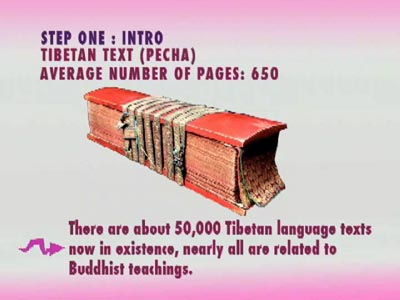
These texts are bound in cloth and are just under a foot long, three inches wide and about an inch thick for the smaller ones to four inches for the heftier tombs. Each has a flap on one end of a specific color. It’s the color that tells the reader the language from which the text is derived, and the further information on the flap tells the title and contents. One holds them or, more traditionally, places them on a small slanted stand, with the long axis from hand to hand, and flips the pages up. Tibetan is read from left to right. These are the books Richard Gere has been spending so much on translating and digitizing. These and others like them from other collections are being saved and translated, made available and read more widely than ever. Perhaps not better understood, but certainly read.

And there are hundreds here, at least. They are stacked long-axis-in on the shelves, which are arranged, further, into cubbies. Six to twenty-four books, stacked three to six high, are in each cubby and there are four to seven cubbies per shelf on seven shelves set atop a set of cabinets and reaching within a foot of the ceiling. They are organized by color. These are the sutras and commentary.

On the bookcase to the left are the sutras, all one hundred and eight, in red. Above them, to the top of the case are the Indian commentaries in blue. Those continue to the next bookcase and, then, above those are the books in yellow – the Tibetan commentary on the Indian commentary.

Diane has to get to her appointment so we start to leave and I turn around for a final look. Once out the door, I see the prayer wheels, again. Each like the next like the one before, each a black cylinder bidding us to open like a lotus. Om Mane Padme Om. May I open like a lotus. I go to the first one on my right. I have never spun a prayer wheel before and, as I do, Diane calls to me. “Start on the other side and walk clockwise.”

I start again, on the left side of the front doors, spinning each, walking, allowing my hand to contact the bottom of each, spinning it as I walk, the next, the next. I turn the corner and continue and I can hear the wheels turn, behind me they slow, the next one start, several turning at once. Each one spinning a prayer again and again and again. Coins are left here and there and I dig into my pocket with my left hand and leave a quarter at the next corner before I turn, not missing a beat. The back of the building, wheel after wheel and another coin to leave at the corner before I turn and the other side of the hall and another coin and then the last half side and the door again. Lee is smiling. She knows I have long wanted to do this. And smiling, we walk down the stairs, carefully, on our non-spiked hiking shoes. Rachel in her sneakers. Diane walks confidently, we, slow and haltingly, carefully, where the iced grass meets the gravel. We thank her and Rachel and Lee go to the car.

The stupa sits large and imposing in the field. Not the tallest in North America. Not the widest or most ornate, but it is the one I am at. There is too much ice to go there but I do regardless, slowly, carefully, crunching and balancing the two hundred or so feet into the field. This stupa was dedicated in 1984 to the founder of Labsum Shedrub Ling, Venerable Geshe Wangyal (1901-1983). And I stand at its base for a short time knowing those behind me are cold. So I turn around and tread to the car.

Once in, we head back the way we came, down and around the mountain, slowly on the icy road, to the main road back to Easton. Tony’s Cup is still closed. Over the Delaware, Rachel gives us directions to her house. Her mother wants to take us to see the sights of Jim Thorpe and some surrounding areas. Not having any idea what she is talking about, we happily give in to a new adventure seeing things we’d never heard of. She has a minivan and will drive. An easy day for us.

Arriving at her house, the garage door is open. Dogs are barking and can be heard all over the quiet, snow-covered neighbourhood. We enter the house to wait for her mom who has taken a half day off work. It is loud with five barking dogs that never cease. It is musty with animal, fur, aroma of cage. Lee exits and waits outside in the cold.

She enters again asking for paper. The answering service called with a new appointment for a new client. We had put off getting an answering service because of the expense. This trip made it a necessity and, searching the Internet, found a local one in Melbourne. The cost is sixty dollars a month. Much less than we had anticipated and added one more example of our not taking advantage of something because of our assumption it would be expensive. Before the day of vacation was out, we’d have three new patients. All while enjoying the Poconos. One day and the service paid for itself nine times over. So much for saving money.

Mom arrives. After a few minutes of hellos and explaining why Lee could not stay in the house, after making sure Rachel was dressed more warmly, we are all into her van and off to see Jim Thorpe. The road is leading up and up while the snow begins to fall.

 
4 Comments

Posted by on June 14, 2009 in Culture, Family, Food, Nor’easter, Religion, Social


Tags: , , , , , , ,

Poetry as Power: From Spellcraft to Statecraft

I have been asked by Craig Smith, he of “Notes from the Dreamtime” fame, to post my notes for a workshop I often teach.

He posted a blog entry called Poetry’s Power and thought of my workshop, which I am proud to say he has participated in twice.

These notes are designed not to be read at the workshop but as fodder for discussion. I tell participants that I am happy to read for an hour or two, but it is my desire I be interrupted at every turn with question, comments, poetry of their own. It is meant to create interaction and creative thought on the state of poetry, past and present. It is meant to open a few eyes and a few ears to the place of poetry in our culture.

So, imagine yourself in a group of ten, twenty or thirty people, all eager to listen and share.

These are the notes we never get through.

* * * * * * *

Poetry as Power: From Spellcraft to Statecraft
A workshop by Adam Byrn Tritt

It is difficult
to get the news from poems
yet men die miserably every day
for lack
of what is found there.

(William Carlos Williams, from “Asphodel, That Greeny Flower”)

From as far back as there are records, poets have been by the side of the monarch in court and in battle. The words of the poet were known to be magic and an insult from the poet could sway a battle. This post was often called the Jester. He spoke the truth, did so without fear and did so in rhyme. His words had power.

Words have meaning, rhythm and sound. Their power comes from the vibration of these three. But, sometimes, the rhythm and sound are all that is needed as these impart their own meaning.

Prayers are in the form of poems and songs. A rabbi taught me . . . if you don’t know the words, hum. There is power in the tune, in the rhythm and sound.

The difference between the right word and the almost right word is the difference between the lightning and the lightning bug


(Twain)

Poetry is just the right word, the right sound, the rhythm that conveys just the right feeling. In a spell, we want to create just the right vibration, at a state event, at a prayer, we want just the right meaning and to leave no room for a meaning other than what is intended. Poetry is meaning, sound distilled until there is no doubt left. Anything that is unsaid is as carefully crafted as what is said. Hence, poetry becomes powerful in its economy, its concentration and its intention and all of this is built on carefully constructed meaning and sound.

Spells are often placed in the form of rhymes. Poetry has power in the natural and supernatural realm. But as important as the poetry is, the poet is a position of even greater mystery. Our Monarchs and presidents have poet laureates. Chaucer was paid in wine. Our own national poet laureate is paid less than a beginning school teacher but is expected to compose and appear at affairs of state and the position so contentious an anti-laureate is voted upon as well. Only three US poets, Piercy, Walker and Angelou, make a living from their art. Yet, despite this, poets have honours of which other artists can only dream.

We will explore the power and place of poetry and rhyme in ancient and modern culture and religion and leave you exploring for yourself how we can use poetry in both our magical and ordinary lives, as though we should be able to tell them apart.

Poetry has power. I once taught at a public high school where poetry could not be taught without permission slips being signed. One child became upset about one poem. One parent called.

I was asked to head up a poetry reading at a book night at Barnes and Noble to benefit the school. I wrote this and dedicated it to our Principal.

Gather your permission slips, parents, teachers,
All school activities possess the possibility of danger, always
An unsuspecting student may come back broken,
Different, changed or
Not come back at all. Some tender child
May come back
Not a child at all.

Children know some activities possess danger,
We cannot wholly shield them. These are undertaken by
Brave students must have permission slips during
Such activities may result in loss, or gain
Unknown results.

Read the fine-print
Parents, your children may not come back
The same tender child may not return to you
As you remember.
Sign to state your contrition
Your baby might grow up different
Than you had anticipated. Beware.

(Adam Byrn Tritt)

Poetry is not to be taken lightly. It is not for the faint of heart.

Obviously, poetry is political.

The Chinese word for poetry, shih (詩), is composed of two idiograms. One, yan (言), means “word; language” & the other, szu (寺), means “temple, monastery.” Hence, poetry is a “temple of words.” Yan itself is composed of t’ou (頭) “above” (heaven, Tao), erh (二) “two” (earth, duality), & k’ou (口) “mouth” (pass). The mouth, the sound that connects Heaven and Earth. Poetry, The Temple of Words, the Great Connector. Shakespeare must have intuited the Chinese ideogram for poetry in A Midsummer Night’s Dream V.1.12 (1595):

The poet’s eye, in a fine frenzy rolling,
Doth glance from heaven to earth, from earth to heaven
And, as imagination bodies forth
The forms of things unknown, the poet’s pen
turns them to shapes, and gives to airy nothing
A local habitation and a name.

The Chinese words for culture is wen hua (文化) meaning “literary” or “transformation.” We see the Chinese looked at words, at poetry, as a definer of culture and civilization. They connected poetry to change, transformation and alchemy.

Muriel Rukeyser spoke of this as well, in her writing about the two different kinds of poetry: the poetry of the unverifiable fact, love, art, feelings, and the poetry of documentary fact, literal accounts of strikes, wars, barbaries. She said, in 1974:

The poet today must be twice born. She must have begun as a poet, she must have understood the suffering of the world as political, and have gone through politics, and on the other side of politics she must be reborn again as a poet.

And so, we have a calling. We have an art and talent with which one is born, a born magic, a way of seeing the world and words which is shaped—forged and tempered—by the world and then set out again. A natural skill honed. It is a synthesis of the gift of the gods, heaven, and the practices of men, of Earth. It is an alchemy.

As for alchemy, the poet Gary Snyder tells us:

As for poets
The Earth Poets
Who write small poems,
Need help from no man.

The Air Poets
Play out the swiftest gales
And sometimes loll in the eddies.
Poem after poem,
Curling back on the same thrust.

At fifty below
Fuel oil won’t flow
And propane stays in the tank.
Fire Poets
Burn at absolute zero
Fossil love pumped backup

The first
Water Poet
Stayed down six years.
He was covered with seaweed.
The life in his poem
Left millions of tiny
Different tracks
Criss-crossing through the mud.

With the Sun and Moon
In his belly,
The Space Poet
Sleeps.
No end to the sky—
But his poems,
Like wild geese,
Fly off the edge.

A Mind Poet
Stays in the house.
The house is empty
And it has no walls.
The poem
Is seen from all sides,
Everywhere,
At once.

Power has often been associated not with words, certainly not with Poetry, but with physical might and control over others. Again, Snyder tells us:

We all know that the power of a great poem is not that we felt that person expressed himself well. We don’t think that. What we think is, “How deeply I am touched.” That’s our level of response. And so a great poet does not express his or her self, he expresses all of our selves. And to express all of ourselves you have to go beyond your own self. The Zen master Dogen said, “We study the self to forget the self. And when you forget the self, you become one with all things.” And that’s why poetry’s not self-expression in those small self terms.

A poet is indeed a priest in a temple of words, that power is a voice linking heaven with earth. That is a poet’s real work. A poet’s work is to show us the ordinary in a way that makes it new and fresh, perhaps, even alien and to take the alien and show us how it is familiar.

Poem
by William Carlos Williams

As the cat
climbed over
the top of
the jamcloset
first the right
forefoot

carefully
then the hind
stepped down

into the pit of
the empty
flowerpot

And we value this. We value this after it is done, though we neither value the effort of the poet him or herself. How may poets make a living from poetry?

Williams still had to practice medicine. Most poets teach, or work at drug stores, newpapers. Few even work in the arts. E.E. Cummings, a staple in the cannon of American poetry, could not get his work published even. His mother had to self publish his first collection.

We honor poetry after the fact.


For the Young Who Want To

by Marge Piercy

Talent is what they say
you have after the novel
is published and favorably
reviewed. Beforehand what
you have is a tedious
delusion, a hobby like knitting.

Work is what you have done
after the play is produced
and the audience claps.
Before that friends keep asking
when you are planning to go
out and get a job.

Genius is what they know you
had after the third volume
of remarkable poems. Earlier
they accuse you of withdrawing,
ask why you don’t have a baby,
call you a bum.

The reason people want M.F.A.’s,
take workshops with fancy names
when all you can really
learn is a few techniques,
typing instructions and some-
body else’s mannerisms

is that every artist lacks
a license to hang on the wall
like your optician, your vet
proving you may be a clumsy sadist
whose fillings fall into the stew
but you’re certified a dentist.

The real writer is one
who really writes. Talent
is an invention like phlogiston
after the fact of fire.
Work is its own cure. You have to
like it better than being loved.

Part of this is because we forget how powerful words are. People only faintly recall the worth and power words once possessed. Words gave order and shape to reality: To know the name of a thing was to perceive its essence and therefore to master it. To name a thing not present was to summon it into being, so that the thing itself existed in the words for it.

“I was many things before I was released, ” sang Taliesin, a man thought by many to be the Merlin of lore. “I was a word in letters.” A name could be moved and manipulated and placed in new arrangements, and all of these activities would affect the object named.

The outward sign of the inner powers of a wise woman or man was the knowledge of words and names and the songs made from them. This was true of the celts and of the native American. That is why so many shamans and workers of magic prefaced their spells with transformation songs—verses that claimed they had taken the shape of everything in creation, from raindrops and starlight to bubbles in beer, and thereby had gained infinite understanding. Words were the bricks of all charms and incantations, all spells, riddles and conjurations. Look at the words we use. Spell from the German Speilan, or story. And Incantation from the word chant. In Hebrew, the one who says the prayers is the cantor, the singer the enchanter, the one with the incantations. He binds us to god with words even if the words are unknown to us.

Our own King Authur, JFK, had this to say about poetry and the Poet Laureate at his inauguration:

Robert Frost coupled poetry and power, for he saw poetry as the means of saving power from itself. When power leads man towards arrogance, poetry reminds him of his limitations. When power narrows the areas of man’s concern, poetry reminds him of the richness and diversity of his existence. When power corrupts, poetry cleanses. For art establishes the basic human truth which must serve as the touchstone of our judgment.

Poets have had the power to affect culture even while they are outside of culture and even when part of a despised minority.

Pope. Swift. Catholic, diminutive, sickly.

Mr. Pope

Mr. Pope did not demur
To attack a poet he’d scarce endure.
His whetted wit exposing flaws
With metric feet and raptor’s claws.
This wasp would sting at authors dim
Even those who feared not God, feared him.

(Adam Byrn Tritt)

Not respected. Not paid even when feared.

Not paid. But certainly valued even when reviled. Right up to, but, it may seem, no including present time, poets were outside rebuke. It was the poetry of Wilfred Owen and Sigfried Sasoon that helped bring what WWII was really like home to the masses and was as instrumental doing so as the verse of Phil Ochs was during Vietnam.

Suicide in the Trenches
by Siegfried Sasoon

I knew a simple soldier boy
Who grinned at life in empty joy,
Slept soundly through the lonesome dark,
And whistled early with the lark.

In winter trenches, cowed and glum,
With crumps and lice and lack of rum,
He put a bullet through his brain.
No one spoke of him again.

You smug-faced crowds with kindling eye
Who cheer when soldier lads march by,
Sneak home and pray you’ll never know
The hell where youth and laughter go.

Disabled
by Wilfred Owen
(First and last verses)

He sat in a wheeled chair, waiting for dark,
And shivered in his ghastly suit of grey,
Legless, sewn short at elbow. Through the park
Voices of boys rang saddening like a hymn,
Voices of play and pleasure after day,
Till gathering sleep had mothered them from him.

About this time Town used to swing so gay
When glow-lamps budded in the light blue trees,
And girls glanced lovelier as the air grew dim,—
In the old times, before he threw away his knees.
Now he will never feel again how slim
Girls’ waists are, or how warm their subtle hands.
All of them touch him like some queer disease.

There was an artist silly for his face,
For it was younger than his youth, last year.
Now, he is old; his back will never brace;
He’s lost his colour very far from here,
Poured it down shell-holes till the veins ran dry,
And half his lifetime lapsed in the hot race
And leap of purple spurted from his thigh.
One time he liked a blood-smear down his leg,
After the matches, carried shoulder-high.
It was after football, when he’d drunk a peg,
He thought he’d better join.—He wonders why.
Someone had said he’d look a god in kilts,

That’s why; and maybe, too, to please his Meg,
Aye, that was it, to please the giddy jilts
He asked to join. He didn’t have to beg;
Smiling they wrote his lie: aged nineteen years.
Germans he scarcely thought of; all their guilt,
And Austria’s, did not move him. And no fears
Of Fear came yet. He thought of jewelled hilts
For daggers in plaid socks; of smart salutes;
And care of arms; and leave; and pay arrears;
Esprit de corps; and hints for young recruits.
And soon, he was drafted out with drums and cheers.

Some cheered him home, but not as crowds cheer Goal.
Only a solemn man who brought him fruits
Thanked him; and then enquired about his soul.
Now, he will spend a few sick years in institutes,
And do what things the rules consider wise,
And take whatever pity they may dole.
Tonight he noticed how the women’s eyes
Passed from him to the strong men that were whole.
How cold and late it is! Why don’t they come
And put him into bed? Why don’t they come?

Dulce et Decorum Est
by Owen
(Last verse)


Bent double, like old beggars under sacks,
Knock-kneed, coughing like hags, we cursed through sludge,
Till on the haunting flares we turned our backs
And towards our distant rest began to trudge.
Men marched asleep. Many had lost their boots
But limped on, blood-shod. All went lame; all blind;
Drunk with fatigue; deaf even to the hoots
Of tired, outstripped Five-Nines that dropped behind.

Gas! Gas! Quick, boys! — An ecstasy of fumbling,
Fitting the clumsy helmets just in time;
But someone still was yelling out and stumbling,
And flound’ring like a man in fire or lime . . .
Dim, through the misty panes and thick green light,
As under a green sea, I saw him drowning.

In all my dreams, before my helpless sight,
He plunges at me, guttering, choking, drowning.
If in some smothering dreams you too could pace
Behind the wagon that we flung him in,
And watch the white eyes writhing in his face,
His hanging face, like a devil’s sick of sin;
If you could hear, at every jolt, the blood
Come gargling from the froth-corrupted lungs,
Obscene as cancer, bitter as the cud
Of vile, incurable sores on innocent tongues,
My friend, you would not tell with such high zest
To children ardent for some desperate glory,
The old Lie; Dulce et Decorum est
Pro patria mori.
“The Death of the Ball Turret Gunner,” by Randall Jarrell, was published in 1945. What did it do? Listen.

From my mother’s sleep I fell into the State,
And I hunched in its belly till my wet fur froze.
Six miles from earth, loosed from its dream of life,
I woke to black flak and the nightmare fighters.
When I died they washed me out of the turret with a hose.

Prior to this, most people actually did not know how the B-17s and 24s fought and protected themselves. Jarrell, himself, thought it was necessary, but also that the people in the war with the shortest life expectancy deserved to have their fates understood by the people for whom they fought. He did this in an obvious, yet amazingly poetic and political way. It was widely distributed. Poets enjoyed an immunity.

That immunity seems to be waning. In 2003 First Lady Laura Bush canceled a White House poetry symposium in fear of finding poetry and poets critical of the administration and its policies. She feared the invited poets would recite poetry against war. Laura Bush defended her actions citing her freedom of speech. A spokesperson for the First Lady said, “While Mrs. Bush respects and believes in the right of all Americans to express their opinions, she too has opinions and believes that it would be inappropriate to turn what is intended to be a literary event into a political forum.”

Poets around the world have cried foul. Two former U.S. poets laureate, Stanley Kunitz and Rita Dove, have criticized the cancellation. The result was, instead of a symposium at the White House with one hundred poets, a backlash, anti-war symposium with over 3,600 and a collection of poetry assembled on the topic of which I am delighted to be a part.

Far from showing a waning power, this demonstrates the power of poetry is still quite understood and, in some cases, feared. Kings, and would be kings, know what a poem can do.

“What are big girls made of?”
by Marge Piercy

The construction of a woman:
a woman is not made of flesh
of bone and sinew
belly and breasts, elbows and liver and toe.
She is manufactured like a sports sedan.
She is retooled, refitted and redesigned
every decade.
Cecile had been seduction itself in college.
She wriggled through bars like a satin eel,
her hips and ass promising, her mouth pursed
in the dark red lipstick of desire.
She visited in ’68 still wearing skirts
tight to the knees, dark red lipstick,
while I danced through Manhattan in mini skirt,
lipstick pale as apricot milk,
hair loose as a horse’s mane. Oh dear,
I thought in my superiority of the moment,
whatever has happened to poor Cecile?
She was out of fashion, out of the game,
disqualified, disdained, dis-
membered from the club of desire.

Look at pictures in French fashion
magazines of the 18th century:
century of the ultimate lady
fantasy wrought of silk and corseting.
Paniers bring her hips out three feet
each way, while the waist is pinched
and the belly flattened under wood.
The breasts are stuffed up and out
offered like apples in a bowl.
The tiny foot is encased in a slipper
never meant for walking.
On top is a grandiose headache:
hair like a museum piece, daily
ornamented with ribbons, vases,
grottoes, mountains, frigates in full
sail, balloons, baboons, the fancy
of a hairdresser turned loose.
The hats were rococo wedding cakes
that would dim the Las Vegas strip.
Here is a woman forced into shape
rigid exoskeleton torturing flesh:
a woman made of pain.

How superior we are now: see the modern woman
thin as a blade of scissors.
She runs on a treadmill every morning,
fits herself into machines of weights
and pulleys to heave and grunt,
an image in her mind she can never
approximate, a body of rosy
glass that never wrinkles,
never grows, never fades. She
sits at the table closing her eyes to food
hungry, always hungry:
a woman made of pain.

A cat or dog approaches another,
they sniff noses. They sniff asses.
They bristle or lick. They fall
in love as often as we do,
as passionately. But they fall
in love or lust with furry flesh,
not hoop skirts or push up bras
rib removal or liposuction.
It is not for male or female dogs
that poodles are clipped
to topiary hedges.
If only we could like each other raw.
If only we could love ourselves
like healthy babies burbling in our arms.
If only we were not programmed and reprogrammed
to need what is sold us.
Why should we want to live inside ads?
Why should we want to scourge our softness
to straight lines like a Mondrian painting?
Why should we punish each other with scorn
as if to have a large ass
were worse than being greedy or mean?

When will women not be compelled
to view their bodies as science projects,
gardens to be weeded,
dogs to be trained?
When will a woman cease
to be made of pain?


1 Comment

Posted by on November 30, 2008 in Culture, History, philosophy, Religion, Social, Writing


Tags: , , , , , , , , , , , , , , , , ,

Seven Questions for Craig Smith

Craig Smith is an author and web designer, a translator to and from dead languages, the well-respected and well-read author of the blog Notes from the Dreamtime, the translator of The Inclusive Bible and a shaman. Even better than that, he is my exceptionally good friend.

Craig has been interviewing interesting characters for some time now. But no one has interviewed him. While I could not believe such an oversight, I sought to correct it. The result is below.

Enjoy.

________________________

Late Monday night, Adam emailed me and asked, “So who’s doing your interview?” I replied that he was the first to offer. On Tuesday morning, these questions appeared in my mailbox. I replied that he was the cruelest human on the face of the planet.

His questions both terrify and exhilarate me, which I guess means they’re good ones.

1. You spend much of your time, it seems, as an editor. Thurber once wrote about editing, “Editing should be, especially in the case of old writers, a counseling rather than a collaborating task. The tendency of the writer-editor to collaborate is natural, but he should say to himself, “How can I help this writer to say it better in his own style?” and avoid “How can I show him how I would write it, if it were my piece?”

Do you prefer to be an editor or collaborator? Or do you play both roles or either role depending upon with whom you are working?

The latter. It depends entirely on the writer.

A good writer—that is, one who has a strong writing style and a good command of the language—needs minimal editing. Then the task is to find overt mistakes (which the writer in haste simply didn’t notice), and occasionally smooth over rough passages where the writer’s intent doesn’t come through clearly. I am very careful not to change their style, and yes, it’s very much the role of a counselor.

The vast majority of writers fall into a second class. They’re not great writers, they’re just writing as a means to an end. These I take a heavier hand with. For a while I got a reputation for being able to cut a piece in half without the writer even realizing he or she had been edited—”You make me sound so good!” is a comment I’ve heard more than once. For them, I honor the writing style they’re trying to establish, but which they haven’t quite succeeded in creating. For them, I am definitely more collaborative.

Occasionally I come across bad writers. Honestly, I want nothing to do with most of them. I don’t want to read them, I don’t want to correct them, I just want them to go away. A few are on the bubble, and if I like the individuals at all, I absolutely want to show them how I’d approach it if it were my piece.

2. You once traveled, though shortly, rather extensively across the U.S. Whether you were in search of something, drawn by something, or leaving something may be of debate, but travel you did, and you wrote about it rather extensively in your blog before stopping short. Many of your readers might think you stopped before a revelation or just at the point you found a portion of your travel unresolved.

A Zen monk once asked, “It is the same moon outside and the same person inside, so why not sit?” Does location really make a difference or is it the process of transition? What did you gain? What did you lose? What is stuck? Could you have done as well staying at home? Does changing location change the person?

“Many” of my readers? Really?

Did I stop just before some major revelation? I didn’t think I did, but maybe you’re right. I had gone all revisionist on it in my mind; I thought I had stopped writing about the trip shortly before I took that long break between last December and this April, but it turns out my last Big Trip post was in March of 2007. I was shocked when I realized that.

Let’s see, when last I left the story, I had just visited Little Bighorn and was heading toward Bozeman. And I guess I do view Bozeman as the gateway to the most significant part of the journey. It doesn’t feel like I’m afraid to dig deep and expose something important, but my behavior may be telling another story. I’ll have to look at that.

That said, each trip post takes a long time to write. At the time I remember thinking I wanted to do some lighter, faster, easier posts, to take a little break. But you and Indigo have rattled my cage long enough; I’ll have a new Big Trip post next week.

Not to put too fine a point on it, but that trip changed everything for me. You know how a lot of people personify Nature, talk blithely about the Web of All Being, and speak of divine immanence as being “the Goddess”? I knew all that, intellectually, but on the trip (somewhere in Washington, if I recall, but I haven’t checked my notes in a while) I had a palpable experience of it.
Does location really make a difference? I have no doubt that it’s possible to have any important growth experience in any number of ways. The same truth keeps knocking on our house until we let it in; sometimes it comes in by the door, sometimes through a window, sometimes down the chimney or up through the floorboards.

But for me, it was important to go out on my own, with two thousand bucks in my pocket (and no credit cards), in a car that really wasn’t all that road-worthy, to follow a quiet but insistent tug in my heart—a “calling,” if you will; to camp out in the national forests and wildernesses, searching for some essentially spiritual experience, rather than trying to go sightseeing; to be utterly alone with my thoughts and the world for an extended period of time. All of which I don’t think I could have gotten sitting at home.

“What did you gain? What did you lose? What is stuck?” Tough questions. I gained an understanding of the living, nonphysical energy that interconnects everything in the material world. I gained a hunger for greater personal and physical freedom. I opened the door just a bit to becoming more authentically myself and less what others expect me to be. I lost a parochial worldview, a limited image of who or what God is. I guess I’m still stuck in Comfortville (I laughed as I typed that, because everything in my life seems the opposite of comfortable): I don’t need to risk my life, physical or emotional, right now. I’m all initiation and no completion. As one of my favorite (and one of your least favorite) poets, T.S. Eliot, wrote:

Between the idea
And the reality
Between the motion
And the act . . .
Between the essence
And the descent
Falls the Shadow.

3. It has been argued that cues for discrimination that are obvious, such as gender or color, are of greater import than those which are not, such as religion or gender preference.
Is this so? Has discrimination affected you and, if it has, has this been your choice to reveal what could be occult and accept the discrimination as burden?

I don’t know that obvious cues for discrimination are of greater import as much as simply inevitable. When you can’t hide, the bigots have a more obvious target.

I came out in 1982, at the age of 26, shortly after my father’s death. I used to describe it as feeling a cloud of judgment over me had been lifted. In time I came to feel that my father had been a convenient excuse for my not being true to myself. On the other hand, when we decide it’s time to make a change in our lives, I think we probably use whatever tool or trigger is at hand to aid us.

For me it was all tied up (as just about everything is in my life) with my spiritual journey. I was wrestling with the realization that the God I knew intimately and the God of conservative theology (and much of society) were in conflict with one another. I knew that my God valued truth in the inner being above all else, so I knew I had to speak the truth about my sexuality even if it meant being damned for eternity: to save God, as it were, I had to be willing to give up God. And the moment I did, I knew that love and acceptance and was the ultimate truth, and nothing else mattered.

I can’t say I’ve faced a lot of discrimination. Some of it is because I’m not terribly fey (though I’m not terribly butch, either), so many people just assume that everyone is straight unless they announce otherwise. And I don’t wear buttons or have gay bumper stickers, and I tend not to announce it unless or until it comes up naturally. On the other hand, I tend to correct people if they make invalid assumptions about me, because (a) it’s nothing I need to keep quiet about, and (b) it’s no big deal. The older I get, the less I care what anyone thinks. To quote that old philosopher, Popeye, I yam what I yam.

In the ’80s, I lost dozens of gay friends or acquaintances—thirty-two to AIDS, one to a gay-bashing incident, two to drug or alcohol abuse. That was pretty awful. And I’ve seen lots of discrimination; I just haven’t been on the receiving end, except for having a few bottles (and epithets) hurled at me. Annoying, but not that big a deal—just some drunken rednecks.

So I don’t feel much of a burden, honestly. I once had a dream in which I was standing at the creation of the world, and God said, “This time, would you like to be straight instead?” I thought a minute then said, “No thanks, I’m quite happy the way I am.” It was a very satisfying dream.

4. Your religious and spiritual experiences are not quite within what we might call the common American experience. How do you define your present spiritual life? How have you come to where you are? Do you find your spiritual life effective? If so, are you more a spiritual materialist than purist—in other words, do you practice to build ego or to gain something, regardless of what that might be, or for the practice itself? Where do you think you are going with it?

I am an animist because I see all natural phenomena as alive. I’m a pantheist because I see God as synonymous with the material universe. I’m a panentheist because I see God as interpenetrating every part of nature and extending timelessly beyond it as well. I’m a Christian because for me Jesus is God enfleshed, and teaches us how we too can become God enfleshed. I’m an adopted Jew, a God-fearer who learned Hebrew to read the Bible in its original language because I wanted to know what YHWH was really saying. I’m a Buddhist because of the life and teachings of Siddhārtha Gautama, and the silence, and the kōans, and the still point. I’m a Hindu because I revere Ganesha. I’m a Yoruba because I was visited one night by the orisha Shango, the sky father, the god of thunder and ligntning. I’m a pagan because I honor the natural rhythms of the earth, the sun, the moon.

But beyond all those classifications, I am a shaman, because shamanism, stripped of its cultural overlay, is simply a toolbox. It’s how the human brain naturally accesses nonordinary reality. It’s plugging into the way the body and the psyche can be balanced and healed. And it’s what underlies all human religion and spirituality, the barebones of our Selves, if you will.
How have I come to be here? Wow. I guess it’s just a straightforward process of following where my heart and spirit have led me. I would say it’s a combination of the theological and psychic shattering that my coming out afforded, and working through decades of chronic depression until I came to understand myself and God (or spirit or the Universe or whatever terminology you want to use) and the world in a radically different way.

I’m not sure what an “effective” spiritual life would be. Does it give me comfort or meaning? Yes, definitely. Does it make my life work better? Yes and no. It doesn’t make me more “successful,” particularly as the world defines success, but it gives me tools to deal with many of the challenges I face, and gives me a context with which I can understand the world better. But I can’t honestly say I practice it as a means to an end, as a tool to get something or become something.

It all comes back to that ineffable Call, the music from the Piper at the Gates of Dawn. I’m like a dog snuffling the air, forever following the scent, wherever it may lead.

5. We all have traits that are annoying. Some of those traits, when found in another, are deal-breakers and we simply cannot abide them. What traits can you simply not abide in others? Which traits mean “I’ll not deal with that person,” and why? Which traits send you running? Of those traits, how much of each is found in you?

When I was a good deal less self-confident (and those of you who know me well will be rolling on the floor by now, because you know that deep down I am a mouse afraid of his own shadow), I was in a relationship with someone I believe has Narcissistic Personality Disorder. One day he gave me a collection of Jane Kenyon’s poetry, and told me to read a poem called “Biscuit”:

The dog has cleaned his bowl
and his reward is a biscuit,
which I put in his mouth
like a priest offering the host.

I can’t bear that trusting face!
He asks for bread, expects
bread, and I in my power
might have given him a stone.

He didn’t need to say so, but I knew I was that dog to him. And more often than not, I was given a stone instead of bread. Much has changed in me since then, and such cruel treatment—toward me, or toward anyone, frankly—is intolerable, and provokes a fierce reaction from me.
I can’t abide liars, though I understand the impulse all too well: the need to protect oneself at all cost, even when telling the truth might be so much easier in the long run.

And yes, the cruelty and the lying that I hate: both of these are parts of me. I don’t know that I hate them because they are in me; I know that I have worked hard to overcome them in myself, and so perhaps I am like an intolerant ex-smoker. I don’t know.

I am impatient and short-tempered with people who give poor customer service (I used to teach classes in how to go above and beyond expectations when dealing with the public). And I am intolerant of people I call “willfully ignorant,” who seem defiant in their lack of education or gentility. Perhaps this intolerance is a form of intellectual snobbishness, but I hope it’s because I love the language so much that when people abuse it, it’s like spitting on something sacred.
Occasionally I’ll run across people whose “vibe” makes me want to either run away or (more likely) do them bodily harm. I can’t explain it. It’s nothing they’ve done or said, really, or maybe it’s everything they do and say. It’s a reaction so visceral and so strong that I have to step outside myself and say, “What in the world is that about?” So far I haven’t found an answer.

6. Tell me about poetry. You say you are not a poet. Why have you said this?

Payback is so unbecoming, Adam.

I am not a poet because I am clumsy at it. (And don’t tell me that lots of people say they are poets who write perfectly wretched poems. Just because a mouse is in a cookie jar, it doesn’t make him a cookie.) I can sometimes shape prose with enough felicity that it sings; poetry needs a much sparer touch, which I don’t often have. Generally the best I can do is take a prose poem and break it into shorter lines.

What I think I do have is a poet’s heart. I think Deloney is a natural poet, despite the fact that his poems always look like paragraphs. Indigo Bunting sometimes comes up with phrasings that are breathtaking. I can see poetry in words. I can even edit poetry pretty well. But I think my natural element is prose. Maybe I just need a larger canvas to say what a poet can express in a few brush strokes.

7. We each have ways we make others suffer. Most of the time this is inadvertent or, at least, not on purpose. How have you made others suffer? Was any of it purposeful? How have you made yourself suffer? Are you doing so now? How and why? To what end?

I have been cruel. I don’t know if my cruelty made them suffer, or if they just shrugged it off. On the other hand, our actions have far-reaching consequences, and even acts of charity may have caused suffering, while acts of deliberate meanness may have brought someone to a new and better place.

I have certainly wanted to make a few people suffer, to make them feel what they put me (or others) through. I have wanted them to have a taste of their own medicine.
But me—ah, that’s the person I have been the cruellest to, both deliberately and inadvertently. I have a running tape in my head (I guess we have to change that metaphor now, don’t we? No one uses tape for recording things anymore!) that tells me what an enormous failure I am, how I always let everyone down, how I never live up to my potential, how stupid and petty and worthless I am. I think I am starting to hear it as old, worn-out programming, and I am trying to say “No, that’s not true,” and replace it with something that heals those old self-inflicted wounds.

Why is that programming there in the first place? Some of it stems from my childhood molestation. Most people who are abused spend their lives trying not to feel dirty and worthless. Some if it is habit—we keep repeating the things we’ve heard repeated over and over; we don’t question, don’t object. We’re sheep at heart, especially when the critical voice in our head is our own. We just say, “Yes, you’re right,” without questioning it. One of the blessings of meditation is that you get to see your thoughts as just thoughts, without attaching any value to them. You get to look at them dispassionately, then decide if you want to keep them or not. So I’m trying to rewrite the old self-destructive script, and I’m making progress. But I don’t know that I’ll be finished anytime soon.

 
Leave a comment

Posted by on September 19, 2008 in Culture, philosophy, Religion, Social, Writing


Tags: , , , , , , , ,

Seven Questions for Adam: An Interview by Craig Smith

I’ve known Adam Tritt for a few years now, though it simultaneously feels like forever and no time at all. He’s a kindred spirit with enough significant differences to keep things interesting. His blog, Adamus at Large, is where he publishes essays and poetry. He doesn’t post as frequently as any of us would like, but when he does, it’s an incomparable feast of words and ideas.

(Note from Adam: To make this as authentic as possible, I did no revision and answered all questions given without reservation and as the responses came to me. What you see is what was written the first time. I looked back at not one question. I wanted this to be as conversational as possible and not a prepared document.)

1. Why are you a poet?

I am not a poet. What a strange question. To call myself a poet would be terribly presumptuous and boorish. Not only that, but it would set up an unfair expectation and then I’d have to perform. Sit, Adam, sit. Show the folks how well you poe.

I am not a poet, I simply think metaphorically. I think in metaphors about everything. The contents of the world—whether we believe they originate from within one’s head, are a combination of that which is without and the experiences and expectations from within, or come wholly from within one’s head—always rumble around and find things to connect with. Everything is a metaphor. Since I don’t see terribly well and remember nothing of the visual world, I think in words. So I get a picture or a sound and I make them into words.

Well, enough of that and my head fills up, so I write. I can’t stand not being understood so I revise and revise and revise, cutting out everything that is not meaning because I’d hate for people to think something I didn’t want them to. My goal is to lead them to the same metaphoric feeling and understanding I experienced. By the throat, if need be. By the hand, if I can. Though truthfully, by the throat is much more fun.

The poetic model allows me to do this in a way that is deceptively short so people will read it. Otherwise I’d have twenty-six page essays.

I then put it out there for people to read, on the blog, in magazines, in anthologies, and in my own books, because part of me believes Descartes: I publish, therefore I exist. Besides, I like the fan mail and the undies that get thrown at me.

Of course, none of that explains why I also write twenty-six page essays.

Asking why I am a poet is very much like asking why I have two legs. I can’t help it. I’d have a prehensile tail if I could. My wife would love that. It would be like in Venus on the Half-Shell. But I don’t. So I have two legs. So I think metaphorically. So I put everything into words. It’s burden. It’s a pain. I’m simply built that way. It’s not my fault, I swear. I blame my temporal lobe. I once filled an entire sliding glass door with poetry. I write on my office walls. I write on people if they stand still long enough and give me enough exposed area.

2. Your first public reading was at a clothing-optional event, and you performed in the nude. And you’ve written about your visits to the local nude beach, and clearly have no problem with nakedness. On the other hand, you write about how you wrestle with body image, and seem to feel ashamed when you are battling weight. For me, being fat means I don’t want anyone to see me naked, even though I thoroughly enjoyed my one and only visit to a nudist resort, and am a closet naturist (I’ve even been skinny-dipping in my neighbors’ pool while they’re away, when I go over to feed their cat).

So how do you reconcile that dichotomy? How do you find the freedom to be nude with others even during those times when you feel discomfiture over the way you look?

Because I’m ornery. Because, unlike dancing, which scares me silly and I force myself to do, or parties, which scare me sillier and I don’t force myself to do, reading poetry at a clothing-optional gathering flies in the face of so many conventions I have no choice but to do it. I teach myself my fears are meaningless and my self-judgments are baseless and thumb my nose at society at the same time? Hell, where do I sigh up? Can I do it twice?

You can walk all the fire pits you want, jump out of airplanes hoping the chute opens, bungee-jump from any bridge you choose, but for sheer fright, read your poetry in front of a crowd while wearing nothing but glasses.

I always reserve the right to not reconcile anything. No need. What makes sense anyway? I am about as dysmorphic as a fella can get. I just got over yo-yo binge and starvation. I no longer run three miles because I ate a piece of bread. That ended last Thursday. A friend who knows me better than well (bless you Joyce) will notice the look in my eye as we are out to eat and take away the menu and order for me. It’s insane. And so, through all this, while I thumb my nose at the culture I live in I simultaneously thumb my nose at that part of the culture that lives in me and is discordant with my world-view, or at least the view I would like to have of the world.

In my mind, the more I push this particular illusion, the thinner it gets and, sometimes, I can see clearly through it and know it is untrue.

There is another part to this as well. I want the walls, those illusory walls between self and other, to disappear. I want the illusions to go away. I am happiest when I cannot tell self from other. That is a theme in my writing. That is a theme in my spiritual practice. That is a theme in my massage practice and in hypnotherapy. That is a theme in my life. Maybe I know it is true and I am working to make it happen, to experience it as much as possible and bring that to other people as well. Maybe I am just trying to convince myself that it is so. Which depends on when you ask me.

And let’s be clear—I do not seem to feel ashamed when battling weight. I have, in this area, a self-disgust that is deep and abiding. It’s open 24/7 and never takes a vacation. I am not sure where it came from and I’m not sure when it’s going, but my job, since I can’t seem to shake it, is to be happy anyway. Happy with the world around me. Happy with myself. My job is to thumb my nose, even from within, at anything that keeps me from being happy, at anything that keeps the illusion of separateness alive.

Besides, I am awesomely cute.

3. In both “Funeral, Expurgated” and “My Grandmothers Came from the Ukraine,” you talk about the quandary a writer faces over how much personal or familial information to reveal and how much to conceal or change to protect the innocent (or guilty). David Sedaris, when asked if his books should be filed in fiction or nonfiction, replied, “Nonfiction. I’ve always been a huge exaggerator, but when I write something, I put it on a scale. And if it’s 97% true, I think that’s true enough. I’m not going to call it fiction because 3% of it isn’t true.” And I can’t remember which writer says that the first duty of a writer is to kill his family—that is, write as if there were no one to offend, no one who would be upset if secrets were revealed.

So how have you struggled with the issue of “truthiness” in your writing? And what kind of fallout has there been among friends or relatives when you’ve revealed something that they would rather keep quiet?

Some of what I write falls into the category of New Reporting or New Journalism. Some into creative non-fiction. But, regardless of what I write, I have never let the facts get in the way of a good story.

Many have made the mistake of thinking every piece I write is true just because most of it is non-fiction. So the poetry must be as well. Sure, some of it is but much of it is not. Poetry can be creative storytelling just as much as any other type of writing. My daughter never gathered angels in a field. My wife never complained about her life over coffee as I dreamed of moving west. But with few exceptions, what I write is based on the amazement of that which makes up everyday life. So I did almost hit a wall while she was changing in the passenger seat and the monk did make the spoon stick to his nose. But just because most of it is true does not mean it all is. I reserve the right to tell a story from time to time.

Given that, those who read me know if you see a name in the essay, the account is true. Percentage? If you see a name, it happened. If you see my name, I reserve the right to make my life what I choose it to be. If that is after the fact, then that is just fine with me. My memory is fluid.

That said, there are some things I just don’t write. I don’t write things I feel will hurt a person or compromise them in some way. I have made that judgment incorrectly from time to time but I never set out writing knowing what I am putting down will hurt. I can’t do that. It’s not in me. Even if the person has done me harm, I won’t.

There is so much out there to write. There is no need.

As far a narrative therapy goes, that is the truest account, the most full exposition I can manage. Your example of “Funeral, Expurgated” is narrative therapy. So is “The Shadow.” I write them so fully, so completely there is nothing left inside and, in the end, the content is all without and not within.

Many fail at narrative therapy and are sure it does not work. But they just write it once and get it out in the immediacy of the moment. That is ineffective. To work it must be revised and revised and revised again, experienced over and over in the writing, pared down, blown up, filled and emptied until it is all truth as you see it, until it reads like drama and feels real to one and all. Then, and only then, is it out.

In the essay you mentioned I spoke about the potential fallout a writer can experience and the fear that can engender. My wife, I mentioned in the first paragraph or two, said she cannot grasp the bravery of writing in tha manner. Sometime, neither can I.

But I did not think I wrote anything that would hurt anyone. As my daughter had pointed out, if they thought what they did was wrong or embarrassing, then why did they do it? One would think they felt their actions just fine and so why not record them?

But I did hurt some feelings. After it was out for a while my mother calls with some confusing story about an email and a letter and whatnot. It took me quite a while to put the bits together and figure out it was about the essay. The feeling was, I gathered, that I had aired the family’s dirty laundry in giving the blow-by-blow account of the funeral days.

I have a very small family. Now, it is much much smaller.

4. A casual reader of your blog may be confused about your spiritual inclinations. Are you a Buddhist? A Jew? A Unitarian? A Pagan? How do you reconcile all your disparate beliefs? Or are they really disparate after all?

I am a Jewitarian Buddhaversalist Pagan. What could be more clear than that? I follow the shamanic elements in Judaism as well as in Buddhism but find Buddhism and Judaism are quite similar in their emphasis on tikkun and right action.

I am, of course, a panentheist. But I am also a solipsist and once attended a convention of solipsists where we spent the entire weekend trying to figure out which of us it was.

I spent ten years studying with the Center for Tao and Man. Master Ni told me I had the cosmic egg. What difference what I call it? OK, so I am a Taoist. I follow the watercourse way and sometimes that flows through Judaism and sometimes it washes me into the Thai Buddhist Temple where the abbot explains to me the deeper meaning of the Kol Nidre.

After many years of attempting to reconcile seemingly disparate paths, I have stopped any attempts at reconciliation. The result is that all things now seem much more similar and it becomes more and more difficult to see the space between them or recognize there are differences.

Besides, name one cantor who does not like to be accompanied by a rattle or drum.

5. Tell me about turtle shells.

[Note: I had a turtle shell that I brought out whenever I did any group shamanic work. Every time Adam was present, he clutched the shell as if it were a talisman or protective shield. And when I do energy work with him, particularly when I use quartz or amethyst crystals, he seems to find the shell soothing, since my energy feels “edgy,” for lack of a better word. It became clear one evening that the shell wanted to go and live with Adam.]

The carapace is the dorsal, convex, magical part of the shell structure of a turtle, though a turtle would argue it is concave. It consist primarily of the ribcage which is a strange concept because there is never any chance of the ribs escaping. The spine and ribs are fused to bony plates beneath the skin which interlock to form a hard shell when blue and yellow make green, locking freshness in. Exterior to the skin, the shell is covered by scutes, horny plates that protect the shell from scrapes and bruises. Underneath they are made of backhoes.

They are alternately named Don, Horace, or Filbert.

They are not like crystals at all.

They go wonderfully with a cup of papaya juice and Northern Exposure.

One called to me for a year before it ended up coming home with me.It was playing hard to get.

If you lie one on your stomach, you might not have seizures.

Turtles don’t mind.

6. A dear friend of mine named Geralyn said an old chum once told her, “You know what’s so wonderful about you, Schulz? You can’t sing worth a damn. But it never stops you!”

I know you love to listen to music—music of all genres, music that makes you think and feel, with a smattering of Broadway just for good measure—but I think you like making music even more. Singing for the joy of it.

I remember a workshop you conducted on chanting. It was something everyone could do even if they couldn’t carry a tune. And there’s that wonderful Yom Kippur piece you wrote where you imply that chant and prayer and incantation are different aspects of the same thing.

So what does singing give to you, or do for you, that other forms of creativity do not?

Everything sings. The Earth sings from beneath and around us. Everything on/in/apart of it sings. We come out of the Earth and go back into the Earth and, therefore are never apart from the Earth, and so we sing. Any part of a whole carries the nature of the whole. So I do a whole lot of singing.

I think everyone should. And, no, it does not matter if the person can carry a tune. Sing. We are made of an Earth that sings and it is a function of our bodies. We get caught in subjective notions of quality which we mistake for objective ones and which we then assign value to. People do not sing because they are not good at it. But we do many things we are not the best at. We don’t see people refusing to walk because so many other people do it so much better. So sing.

Music reconnects me to all that is around me. I can disappear as a separate entity—the illusion of disconnection evaporates—when I sing. When I am singing with others in harmony there is an experience that is ecstatic, in what I feel is the true sense of that state: I am outside of myself. The harmony creates a larger sound that is made of but is not simply the voices that create it. The harmonious vibration is larger than the sum of the voices. Larger and different. And that applies holographically from the macrocosm to the microcosm, and fractally from the microcosm to the macrocosm.

What is it that vibration does not do, is not made of? I remember someone wrote somewhere in some well-known book something about “In the beginning there was the word; the word was in God’s presence, and the word was God.”

Names, sounds, create things. And it is the naming that creates separation and, therefore, identity. It is my feeling that what wounds can also heal, and sound heals. Singing heals. Music heals. The cantor sings to the congregation the holy words. We chant holiness. Incantations create. All is sound.

Other forms of creativity are, for me, secondary. They are derivative. They pale. To learn to write I took music classes. My writing exists because I do not play an instrument well.

7. I actually went back and reread every single entry in your blog this evening. I teared up at a few, but mostly I smiled. Or sighed. I am honored to know you.

One of my favorites (though to pick even a Top Five would be next to impossible) is Day of the Manatees. There’s a quote by Henry Beston that we both like—in fact, we’ve emailed it to one another, forgetting that the other had already sent it to us—that goes:

We need another and a wiser and perhaps a more mystical concept of animals. Remote from universal nature, and living by complicated artifice, man in civilization surveys the creature through the glass of his knowledge and sees thereby a feather magnified and the whole image in distortion. We patronize them for their incompleteness, for their tragic fate of having taken form so far below ourselves. And therein we err, and greatly err. For the animal shall not be measured by man. In a world older and more complete than ours they move finished and complete, gifted with extensions of the senses we have lost or never attained, living by voices we shall never hear. They are not brethren, they are not underlings; they are other nations, caught with ourselves in the net of life and time, fellow prisoners of the splendour and travail of the earth.

If you’re a panentheist, then you believe that God (however you define the concept) interpenetrates every part of Nature. My friend Tim has a wood carving of a fish; on the side is painted the word COD, except that the bottom of the C curls in just a tad too much, making it halfway between a C and a G. It’s the God Cod. (Or, for the dyslexic, the Dog Doc.)

Speaking of dogs, here’s my second favorite zen kōan: A monk asked Zhàozhōu, “Does a dog have Buddha nature or not?” Zhaozhou answered, “Wú!” (Wú means “no” and “non-being,” and is also the sound of a dog’s bark.)

There doesn’t seem to be a question in there anywhere. Hmmm.

How’s this: Manatees. Dogs. Cod. Us. God. If all our separateness is maya—illusion—then do manatees bark, and does God swim in Turkey Creek?

Hafiz tells us:

Ever since Happiness heard your name
It has been running through the streets
Trying to find you.

And several times in the last week,
God Himself has even come to my door—
Asking me for your address!

If God can come to my door, I am sure God can swim in Turkey Creek.


Tags: , , , , , , , , , , ,

Like Water

My friend and publisher Craig Smith asked of me a task.

This is not a strange task, given I am studying massage and working in the medical field. It was not an unreasonable request, given the same. That it came over a Fuller’s ESB (Extra Special Bitter) at a local pub was a bit out of the ordinary but if I discounted that which came at uncommon moments and from non-ordinary directions, my life would be rather empty.

He asked me to work on his mom.

Without going into detail, his mom is old. Yes, that is rather a meaningless word. Old means something different at ten than it does at twenty. Vastly different at thirty than it does at fifty. I am forty-three and I consider her old. This is fully because she acts old. I have, in fact, no idea how many years she has been walking the Earth. I do know, however many years that is, discounting her infancy and the last few years, that number of would be minus a bit over three. She rarely ventures from bed and, then, with great difficulty.

He wants me to do massage for her. Her lower back is stiff and painful straight across. She has little flexibility and movement. Far too much time immobile has left her atrophied and less likely to become mobile each day.

She can’t get onto a massage table. A massage chair would be a difficulty. I suggested I was not the person for the job. Perhaps someone experienced in geriatric massage?

A few days later I asked a therapist who teaches at a local massage school. Ron is familiar with my work: I have given him massages in the past and we have had discussion on method, practice and philosophy.

I asked him about working on Craig’s mom. I suggested a few salient suggestions regarding technique or set-up. He did not disappoint me.

He suggested bringing in a straight-back chair and having her sit on that, the wrong way, with a pillow in front of her. Good idea. That would allow me to get to what I needed and still leave her feeling secure. It would be more familiar than a massage chair and easier to get into.

I went on to say I said I didn’t think I was the right person for the job.

I was quite surprised at the answer. He countered me with what, to me, is a compliment.

“You are exactly the person for the job. You are gentle and the energy flows through you. You are perfect for it. You’re probably just what she needs.”

Really? Gentle?

My touch is rather deep, but broad. It is slow and, I suppose, I can see that, though not light, being sensed as gentle.

But energy?

I said I never felt the energy flow and then, it occurred to me, what an idiotic thing that was to say. One only feels what one resists. A wire only notices the energy when there is resistance. A hose only notices the water when there is a block.

After all, if you notice your eye seeing, there is a problem. If you notice your breathing all the time, feel the air in and out, there is a problem. If you can feel your heart stomping in your chest, see a doctor. When things work right, they are invisible. When the country is run well, the emperor is never seen. So the Tao teaches us. So nature shows us. That which works as it should is not noticed, has no resistance. That which resists is worn.

I think that is why I never trusted the energy workers who shook and quaked and moaned when working. And I never figured the more hot the hands of a worker the better the work. In a way, that heat is a sign of resistance just like a cord with too much power for the gauge. It’s a sign of resistance.

So, I resisted the compliment, of course. But I was countered again, later, by another. Jennifer, my friend of marvelous intuitive power, trusted fully, implicitly and wholly, tells me the truth without hesitation or reservation. When she speaks, I believe. Jennifer agreed instantly. Agreed as though I should have known this all along.

So, I guess I’m the guy.

And why am I always the last to know? I guess I just never notice.

 
2 Comments

Posted by on July 24, 2008 in Nature, philosophy, Religion


What do Jews do on Christmas?

What do Jews do on Christmas? Well
in the United States,
at least,
we take walks,
move,
find a park
We go out to the few open businesses,
movies theater, Chinese food,
and know that most everyone we see will be Jewish,
or Atheist (though they may still follow comfortable family tradition)
or what have you, but not Christian.

Here, the temperature is in the 70’s
and we had a beautiful solstice under the stars
(we could see though the city-glow)
in our shirtsleeves
and on the 25th
we are at my sister-in-law’s
(Mother-in law, father-in-law, wife, daughter and son)
because she doesn’t want to be the only Jew at her home
as she gathers her husband’s family-
Southern Baptists all
and very concerned for the souls of the children.

We are there with my mother-in law
who was born Jewish
but who is sure America has made Christmas
a national holiday
we have to celebrate
or incur a terrible social wrath.
She wants to know if we are going to heaven.
(How the hell should I know?)
(Is it full of people just like this?)
Then the party is over,
everyone wishes each other Merry Christmas
over piles of presents given each other
in honour of the Christ child
and we gave one or two but look at all that stuff! And say goodbye.

 
13 Comments

Posted by on December 25, 2007 in Culture, Family, Poetry, Religion, Social


Tags: , , , , , , , , ,

My Grandmothers Came from the Ukraine

There seems to be quite a bit of traffic on my blog in the past few days. Much of it from Tel Aviv, a city I have never been to in a country I have never seen.

But I do have relatives there – relatives I see seldom, speak not much to and, most of whom, would not recognise.

*****

People tend to believe everything they read. Oh, they say they don’t, but they do. In newspapers, in books, in pamphlets, on the Internet. Especially on the Internet where it is easy to publish anything one wishes. And if it comes by email, all the more believable.

If it comes in an email, it makes no difference what the story, it is swallowed whole. Hoax, myth, legend – all true if it is found within your electronic inbox. And each time it arrives, it is true again.

Literature is true. Ask nearly anyone who reads a poem. They’ll tell you all poetry is autobiography as though no poet ever made up a thing, created a work of fiction, embellished, took license with a core of truth to make a whole that speaks the truth but did not necessarily happen. At least not how it was written.

My daughter complained about my last book. Not enough poems about her. Only two. In truth, there is only one. In truth, there are none.

My son complained there is more about his sister than about him. I told him there were exactly the same number of poems about him as her. Not one fewer.

I wrote a poem for a coffee company once. Skookum. About a man who is thinking of higher climes and better times as his wife of leisure rambles on and on. His coffee saves him. Once published, people thought my marriage was in trouble. I rarely drink coffee.

And so, the poem below is true. True for many and truer for some and but it isn’t real. Parts are real, parts are made up but the whole creates its own truth from the parts that are not.

So it is about me, but it isn’t.

Except for the last line. The last few lines. Those, you can take to the bank.

*****

My grandmothers came from the Ukraine.
Each one
Pushed, pushed
By swelling Cossack waves,
Night pogroms, burning homes and hoof-print graveyards.
Scattered, scattered.
One to Vienna, the other, Buenos Aires, Boston.

My grandmother in Vienna met my grandfather
And became my father’s parents,
Pushed, pushed
By the waves of Hitler’s Reich
In the Holy war against the Jews, Gypsies, Whathaveyou.
Galacia, Gdansk, London, New York, Israel, Florida.
Scattered, scattered.

My grandfather removed himself from Lisbon
At the Catholic’s strong suggestion
And ended up in Amsterdam, London, Buenos Aires,
Boston.

And I am Boston, New Jersey, South Carolina,
New Mexico, North Carolina, Minneapolis, Seattle and Canada.
Israel, England, Germany, Philadelphia, Florida.
And in no place do I belong,
Each place I needed to move from,
Pushed, pushed-
Economics, education,
culture bade me leave,

Browning pastures left for green and I
Unhappy in the next as the last
Moved on again, unattached
Unrooted, uncommitted and still,
In the back of my mind I’m planning where next,
Wherever I am inferior to where I might be.
I’m sure it will be better.
Scattered, scattered.

Yom HaShoah.
Day of Remembrance.
It should be enough to remember,
But it blows through my hollow bones
Like a winter bird in flight,
I scatter like a dried dandelion.
A personal Diaspora,
I shatter like crystal, dispersing light.

 
Leave a comment

Posted by on December 19, 2007 in Culture, Family, History, Poetry, Religion