RSS

Category Archives: Religion

The Labyrinth

The Labyrinth

I don’t often sleep through the night anymore. The sleep of the righteous eludes me. The sleep of those without care seems out of my grasp. My mind is rarely clear, my body rarely at ease. I dream. I dream of times when nothing has changed, to remember, sometimes in the dream, that things have changed, find myself wondering why I dream this again and again. Sometimes I simply wake into a world so different than I dreamt in that I am confused. Some days this lifts as I get out of bed. Some days this lingers into morning, into the day..

Some nights I dream about tests ungiven, forgotten, incomplete – about my job being in danger. These are dreams of safety, or fear of losing the same.

Some nights my dreams are pleasant. Calm. Happy. I tend to remember these. But, often, I wake after them, as I do after the unpleasant ones. And wake often. Many nights I look for five-thirty to come soon so I can end the succession, dream after dream, or the lying half-awake, half-asleep. But some nights, not often, but enough that I know they will come from time to time, I sleep through the night, and the dreams are good, joyous, or happy, and I am comfortable, and all things are right and I want sleep to go on, that state of ease to continue even after the sun has risen, so I can lie there where all things are fine.

This morning I did not wish to wake. And, after waking, wanted to write. But I did what I always do – wash, dress, make my lunch, go to work, put off the writing until there is time, til work is done, til papers are graded, til errands are run. Often, the writing, the event, becomes lost. The energy dissipates, the muse becomes tired of waiting, feels unwelcome, leaves, By evening, I cannot call her back, cannot recall the feelings, cannot retrieve the compulsion. This evening I can.

I don’t know why. Perhaps having kicked wheat again, perhaps having learned to not eat late, to eat lightly, but I have been more comfortable the last few nights and, last night, I slept. And I dreamt.

I dreamt I was in a labyrinth. Dark, but not too dark. Greenish gray blocks form the floors, the walls, the distant ceiling. Wide spaces to wander between the walls told me this was large. Gargantuan. The scope felt as though it was encompassing of all that I have known, all I have been told, all I have experienced and all I knew to be the world. And I was deeply within.

And all was fine. I wandered one way, turned here, came to a wall, walked back, knowing there was no wrong choice, no bad direction, but only experience, that there was no getting out, only being within, this way, that way, moving on. It was calm. It was comforting.

Then I was at a table, tea cups full, in easy conversation with Joseph Campbell. We were talking about the symbolism, the pervasive, archetypal power of the labyrinth, from Crete, to the tribes of the American Southwest, from European monasteries to the sulci and gyri of our own brains, we carry the labyrinth in our psyches and our bodies. We discussed, unlike the common idea of the journey to the center being a search to find oneself, the labyrinth being a symbol for life itself, that “our own path (we) make with every step (we) take,” for the journey that can be neither planned nor defined. “If (we) can see (our) path laid out in front of (us) step by step, (we) know it’s not (our) path,” It starts without our bidding and, most often, ends without our permission, with the space between one of chance, discovery, of choices and unknowable paths, each decision leaving us, like Frost, to take one road or another, knowing either one would do, knowing the differences was at once minor and profound, immediate and everlasting, that “way leads on to way” and, even if we were to walk back again, to retrace whence we came, the road we take is now walked by a different person that the one who first laid foot there, as each choice changes who we are. 

The conversation was pleasant. it was deep and comforting. it was the conversation I had always wanted with him but came not close enough to having.

Then I was back within the labyrinth. I was walking with Lee and we came to a place of decision – a crossroads – a choice of three ways. We could go left, or right, or continue straight. She stopped and looked at me and began to move to the right. I knew I had to walk on and I knew too she had go the way she had to go. And she did. I watched as she walked the first few feet from me, faded, gone. Nothing but an empty path and stone.

I was back again with Joseph. People have their own paths, he said. We can’t walk them. Even when we walk together, we are not on the same path. We can share space for a while, but when the path is clear, one must turn and nothing can stop that. That is something the labyrinth teaches us.

Then I was staring at the paths. Same as before. Left, right and forward. But I had a map in my hand. A plan. Turn this way, then that way. I knew how to go and I began to walk forward. Before I was through the crossroads the path in front of me became slowly solid, a wall forming where the path had been. My map was in my hand and my map was useless.

At the table with our tea again. Campbell leans a bit forward. Plans are fine, but take them lightly and be OK with letting them go. They may work for a while, but then we may find the way blocked and must discover ways around, or the way can sometimes disappear altogether. We must be willing to let the map go.

I wanted to lie here with this, to let it sit, but I felt the time I had was coming to its end, and the soft sound of the singing bowl told me it was time to leave my bed, to rise, and go toward my day. My day at a place I had never intended to be, doing something I never had planed to do.  Which, I know, is just another way of saying I am alive.
 
1 Comment

Posted by on November 3, 2015 in Culture, psychology, Religion


Tags: , , , , , ,

Collecting Stones

Collecting Stones

Today is the day I collect stones.

Years ago, far away, Jews, before they were Jews, back when they were a wandering tribe of anthropo-theists who believed in a single god they insistedGrave 1 was unlike any other, met the Canaanites, who believed in no such thing, before they merged, even back then, we buried our dead in the ground. At first this was in caves. Then, in the ground itself. In areas that were too hard to dig, too rocky, a body would be placed on the ground and stones would be heaped on and around the body. The community would bring stones and the more people who attended, the more stones would be piled. One could tell how important, or how loved, and they are not the same, by how high the pile of stones was.

Still today, the tradition continues. One can walk through a Jewish cemetery and see graves with stones on them. Someone comes to visit and leaves a stone. “I was here.” “People still care about this person.” Over srtre gravetime, the piles grow.

The Hebrew word for pebble is tz’ror—a word that also means bond. In the memorial prayer, El Maleh Rahamim, we ask the deceased be “bound up in the bond of life”—tz’ror haHayyim. By placing the stone, we show that we have been there, and that this person’s memory continues to live on in us, through us. And the practice is not kept to just Jews who have passed, but one may see pebbles on the grave of any beloved or respected. If you see pebbles, you know a Jew has been there. You know the person is loved.

Tomorrow I bury my father. Unlike my grandmother, whom I myself buried, my mother—and soon my father to join her—is “buried” in a supposedly waterproof concrete casket sunk in the ground over which a concrete lid is placed over which a marble lid is placed and secured with four large bolts. I shooed the workers away and secured the bolts myself. It was not the same, one shovel after another, but it was some closure. Tomorrow I will do the same.

bernstein graveWhat strikes me about this cemetery, other than the non-Jewishness of keeping a body from the elements, securing it from the waters, protecting it from the natural process that brings it back into the Earth, is this—a nearly complete lack of stones. Oh, the graves have stones. They are brought in, small ones, in pockets and handbags and baggies. But there are none to gather—as though the ground had been cleared, swept, scraped free. There should be a sign. “There will be no gathering of stones here. No. We have made sure of it.”

First breath. Last breath. In between, we collect stones.

And, so, today, I collect stones.

 
1 Comment

Posted by on July 6, 2015 in Culture, Family, Religion


Tags: , , , , , ,

Seven Questions for Adam: An Interview by Craig Smith

Seven Questions for Adam: An Interview by Craig Smith.


Tags: , , ,

Revival

There is a woman preaching to the river. Standing on the sidewalk, next to the new blue Toyota, gospel music blaring from the car speakers and open doors, she holds her Bible high in the air yelling to the dolphins, the cranes, the pelicans, and any tree that may hear. Any flower that may be blooming. Anyone.

She is a revival of none with a tent of clouds, looking to redeem the river, an evangelist for the fish, witnessing to the water, which, already holy, laps at the shore, listening, leaving, returning, receding, in no need of being saved.

No one listens. A few look, perhaps wondering from where comes the music so disrupting the call of the gulls, susurration of trees, the sounds of creation.

In white sneakers, dungarees and T-shirt of bright red, she holds a meeting to the open space. On her shirt, bright white letters front and back tell anyone who looks she is a Christian Soldier. Her short afro bounces as she jumps up and down. She is buxom and not slight, waving her arms in the air – the bible, flashing back and forth, thrust now and then toward the waves, black and shiny, as though it is sweating, like her, is held at the bottom, upright, so tightly, or so often, one can see the wear at the edge. The curling. The discoloration. And the cross on the cover has begun to wear faint.

 
Leave a comment

Posted by on March 24, 2015 in Culture, Religion


Tags: , ,

Varieties of Religious Experience

A drive. Arlene next to me, my hand on her knee. On the radio, I have playing the overture from Jesus Christ Superstar. It has stopped raining.

We are driving south on US1, between Rockledge and Eau Gallie. One would think, from the names, these places would be much more interesting, more exotic than they are. Rock Ledge to Rocky Waters. US1 here is all a limestone ridge along the Indian River, a one hundred and twenty-one mile brackish sound, much of it shallow enough to walk across, separate from the ocean by a spit of land in some places as narrow as a quarter mile. It is a beautiful river though, with very little in the way of buildings to break the view, and often this is a beautiful drive.

Today it is gray. The wipers take the mist off the windshield. We talk about seeing plays, about Hair and Godspell, ideas for the future, and all the while, the river to the left.

A faint rainbow was in the sky when we left her house. Now, it is a bright bridge in the sky, and arc of refraction that spans the river. We look. Arlene loves rainbows. And clouds. And simple things and never tires of natural beauty, never taking the world for granted, and she looks at the rainbow from clear end to clear end and smiles. She smiles. She smiles and nearly I forget the rainbow.

How rare to see the rainbow’s end, and how rare to see both, and so solid, so bright, so manifest I am sure we could start at one side and walk over it to the other, look down upon the river from atop the rainbow bridge, through the light, see the world and the water in the full prismatic array of the visible light spectrum, sit, sit, and watch the clouds drift through as we lie upon the light.

The perfect arc. Then, as we watch, a vine of lightning appears, spreads, grows, center to sides, seemingly slowly, filling the color encased space with bright branches.

Who else saw this? Arlene. I. Anyone else? Probably. Maybe not. But it was not, then was, then was not again. There is no proof. Just memory. And beauty. An engram deep and quiet and I, I fortunate to have it. I need no photograph. I was there. It was perfect. It was glorious. It was beyond what can be beauty and it was shared.

Once, on a morning walk, I saw a meteorite. The memory lies next to the rainbow.

A brief, bright exclamation burned above the earth.

Celestial arc-lamp.

Below, predawn sirens,
Traffic noise,
My own padding feet.

Ineffable
Transient
Passive
Noetic

William James wrote, in his 1902 collection of his lectures at the University of Edinburgh, Varieties of Religious Experience, that there are four hallmarks of religious experiences. They are ineffable, in that they are too great for words and cannot be described even though we may try. We may do our best in prose, poetry, paint, but we know we have not come close. They are noetic, in that they bring us to insight and contain truth, though we may be unable to speak what that truth is, we can feel it present. They are transient, in that they come and are gone. They do not last and cannot be captured. They are passive. We cannot control them. We cannot bring them on or replicate them. They seem a gift and we are powerless in the presence of them.

And, as such, this rainbow, and the sharing of it. This rainbow and lightning and the experience of it, is, in essence, an experience religious. I cannot do it justice in words, I feel the truth therein—it exists in my memory and in the memory of a shared moment and, in its time and space, I was powerless. I could experience it only and neither bring it, hold it, describe it nor own it in any way other than as a feeling, a memory and a truth.

But the religious experience need not be brought by only the extra-ordinary. There is spirit and beauty in the ordinary if we only pay attention. There is the mystical in the mundane.

Out of the freezer
Saved for iced coffee
Poured from a glass mug
Into a blender,
Add milk, sugar, cocoa
Put on the top and
Press the button.

Done
Top off and vessel lifted
Above the mug
Poised to pour,
Halt.
Stop, cease, stunned,
Beauty.

Crystals,
Icicles, horizontal,
Circumference to center
Fill the mug.

Glorious
Ephemeral
Evanescent

Pick up the mug
In awe of the
Quick miracle
Gaze transfixed,
Frozen pitcher raised.

Place the mug
On the counter
Instantly,
Crystals rain
Into the coffee film below,

I must write this.

How many miracles
Unnoticed,
Unappreciated,
Unknown.

How much beauty
Surrounding
Never seen,
Waiting,
Existing,
Gone.

It takes little convincing most people that coffee can be a religious experience.

Especially if it makes Arlene smile.


1 Comment

Posted by on July 30, 2014 in Nature, philosophy, Religion


Tags: , , , , ,

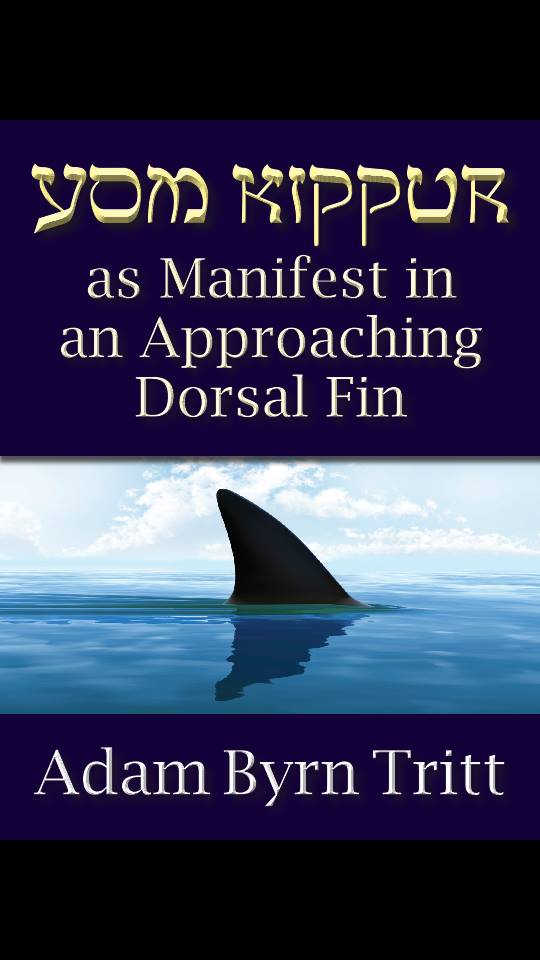
Win a Copy of my Newest Book : Yom Kippur as Manifest in an Approaching Dorsal Fin

Want to win a copy of my newest book? Of course you do.  Goodreads is holding a give-away for ten copies. Just click on this link.

From the back-matter:

“Whatever ‘the Jewish experience’ might mean to the modern reader, Adam Byrn Tritt’s approach is uniquely his own. He is ‘observant’ in the sense that he carefully observes, as you would expect of a man who is, at essence, a poet. As a self-described ‘Jewitarian Buddhaversalist,’ he is aware that each tradition illuminates the other. This collection of essays and poems provides us with good talk. Conversation is the highest artform, and Mr. Tritt invites us in most kindly, with insight, erudition, humor, and compassion.”

—Wayne McNeill, author of Songbook for Haunted Boys and GirlsImage

Yom Kippur as Manifest in an Approaching Dorsal Fin explores—in essays, poems, and creative nonfiction—the tension between cultural heritage and contemporary society, between religion and spirituality, between the family you inherit and the family you create. From early-morning wrestlings with God to portraits of three remarkably different family funerals, from Kabbalist chants at a pagan bookstore to the humorous “What Do Jews Do on Christmas?,” Tritt’s writing taps into themes nearly universal in today’s world in ways that will resonate with readers of all backgrounds and faiths—or no faith at all.

 
Leave a comment

Posted by on August 20, 2013 in Books, Culture, Family, psychology, Religion, Social


Tags: , , , , , , , , , , , , , , , ,

Link

Enter to win the Songs from the Well revised and Expanded edition, in paperback.

Enter to win the Songs from the Well revised and Expanded edition, in paperback, to be release on Yom Kippur, 9/8/13, along with my latest book, Yom Kippur as Manifest in an Approaching Dorsal Fin.

 
Leave a comment

Posted by on July 19, 2013 in Books, Culture, Family, Religion, Social, Suicide


Tags: , , , , , ,

My Book, Tellstones: Runic Divination in the Welsh Tradition, is an Amazon Bestseller

My First book, Tellstones: Runic Divination in the Welsh Tradition, is an Amazon bestseller. Of course, it took a fan writing me before I knew it. So thanks!

And thanks to all of you who have bought it. And thanks to all of you who have not bought it yet, but are about to.

Now, let’s work on making my other books hit the top as well. It takes all of us, and, if you are a writer, let’s support each other. Buy, review, and blog each others’ books!


My work, poetry, essay, creative nonfiction and more, can be found in various anthologies as well as my books, The Phoenix and the Dragon: Poems from the Alchemical Transformation (Smithcraft Press), Tellstones: Runic Divination in the Welsh Tradition, and Bud the Spud, which may be found at your local bookstore, Amazon, Barnes & Noble, Kobo and elsewhere, for you reading needs, whether you like to hold books in your hands or read them on tablets or phones or Kindles or Nooks or, goodness gracious – so many options.  You can find my author profile on Amazon and please find me as well at GoodReads.)

 
1 Comment

Posted by on March 8, 2013 in Books, Religion, Writing


Tags: , , , ,

Recognizing Kali in a Young Girl

This is the first poem of mine I had ever heard read aloud. I had wondered about my poetry, whether it was any good or not. Whether it was worthy of publication in any way.  I had been reading the works of my favorite poets, Piercy and Ciardi and Millay, wondering if I would ever like my own work as much. No, I was sure. No.

One late night, after a campfire and dinner with friends, driving from Jonesville back home to Gainesville, Florida, the radio on a local station, we listened to a show with a variety of music and poetry and prose. A poem came on, introduced not at all, without a title, and I listened, mind fixed solidly on the words and rhythm. This, this, I said to Lee, this is what I wish my work sounded like. I wish I could write like this.

A stanza or two in, I said this. Lee elbowed me, said, “but,” and I asked her to let me finish listening to it first. She elbowed me again and said, “That IS your poem.” I believe this was followed by an eye-roll.  And, yes, indeed, it was.

And it was as I wanted it to sound. Said what I wanted a poem to say. I had written something I would want to listen to.

And there went my excuses.

Recognizing Kali in a Young Girl

Sitting here by the side of a two-lane
watching no cars go by
and steam rise in plumes
from the gaping hood of my automobile,
my daughter and I on this lonely shoulder
sitting, waiting for help.
Waiting for assistance.

Standing to stare into the engine
in a testosterone ritual predating cars
and trucks and carriages,
carts and wheels,
I imagine an early progenitor of my gender
staring intently into the mouth of a horse
checking teeth, gums, breath,
looking at the legs and feeling he wanted to kick something
but having no tires available
grabbed the beast’s cannon bone with a sturdy hand,
checking for splints.

Bubbling and boiling,
maybe this car will never move again
and I’ll have no reason to sit within its space
confined with hope of forced conversation with the little girl
too old to want to talk with her father
and too innocent to know why.

Turning away from the beast
I look to the field:
wildflowers blooming
tall, short, colored like air and sun,
water and earth, dancing in the wind
with my daughter, swaying and swirling
with my daughter.

The old rabbis have said,
or so the Hassidic recount,
not a blade of grass grows,
not a leaf falls
that an angel does not make it so.
Classes of angels,
Cherubim, Seraphim,
cloud angels and insect angels,
grass angels and tree angels.
Angels, then, for sunlight and rain
and for home cooking and pizza joints.
Angels for taxes and funerals and sex.
Angels for car engines.
Angels for little girls.

And there she is,
crouching among the blooms,
picking iris and narcissus.
Harvesting angels.

(This poem, along with many others, can be found in various anthologies as well as my own book, The Phoenix and the Dragon: Poems from the Alchemical Transformation (Smithcraft Press), available, along with my other books, Tellstones: Runic Divination in the Welsh Tradition, and Bud the Spud, at your local bookstore, Amazon, Barnes & Noble, Kobo and elsewhere, for you reading needs, whether you like to hold books in your hands or read them on tablets or phones of Kindles or Nooks or, goodness gracious – so many options.  You can find my author profile on Amazon and please find me as well at GoodReads.)

 
Leave a comment

Posted by on February 7, 2013 in Culture, Family, Poetry, Religion, Social


Tags: , , , , , , , , , , , ,

Gin and Tonic

Some short time ago, I became interested in gins. Not just interested, but fascinated. I am not a tippler. I barely drink. A bottle of Plymouth gin I have is still more than half full and it is more than eight years old.

Gin, and gin and tonics, are nothing new to me. My Aunt Esther and Uncle Dave used to give them to me when I was four. Maybe even younger than that. But I could go years without one. I liked them, but no big deal.

But now I became preoccupied with gin. The differences in tastes, textures, bouquets. And, so I, with my friend Craig, looked for a place that had gins to taste and came up woefully short.

One place I called used to be a favorite more than a year ago. It was one of the last places I took my wife to eat before she died, before she was no longer able to leave the house, before hospice, before her death. Even toward the end, hard as it was for her to be out, to enjoy her days, they had great patience for her, for her needs, and for mine. I called with trepidation, but Matt’s Casbah, I thought, was a good bet for gin and, I had hoped, I could reclaim this place as a favorite happy haunt instead of only associating it with radiation therapy.

No, they did not have any different gins, the manager, Justin, told me. But rarely had he heard of anyone else interested in gin, and he happened to have a bottle of Smalls, a “boutique” distillery that produced, what he felt was a superior and different gin. And he remembered me, and my Lee, and asked if I would come in to have a drink with him, on the house.

I was delighted. Elated, really, and I did go there, to have a drink with Justin. I took Craig with me and we sat, happy, sharing a bottle of small-batch gin, fragrant, strong, viscous, with Justin. With our first sip, we toasted Lee. It was a small thing, but a great kindness, and it allowed me to reclaim something I had lost, and in that, I knew I could reclaim other places, other things, I had lost. Other things associated with pain could be brought back to joy.

Some days later, Jazmin handed me a National Geographic. In it was an article about dying languages she knew I would be interested in. It discussed languages and how they formed, and were formed by, a culture’s way of thinking. In one section it discussed Kazakhstan, and the word for juniper, which, of course, is the main flavoring for gin, coming from the word genièvre, French for juniper. It stated that the Kazahks burned juniper berries to allow those who have passed to move on, and those who were still alive, to live on. It cleared the souls who lingered for the rest of their journey.  Kazakhstan is the part of the world from which Lee, the doctor, the shaman, and her family comes and she but one generation removed.

And here I was, at the one year anniversary of my wife’s passing, fascinated, preoccupied, with gin, with genièvre, with juniper as distilled in spirits.

When the soul reaches, listen and lend it your hands. And gin is what I was reaching for.

Since then, I have tried many gins. Many awful, many wonderful. I found a bar in San Diego while there for a book signing that had over forty gins, Aero Club, and the barmistress set me up with a tasting. I described what I liked, and she set it up. All for a Jackson and a tip. Junipero, one of the first small distillery gins, made by Anchor Steam, the first microbrewery to make it big. Farmers Botanical Organic Gin. Smalls. Hendricks, well-known but under-appreciated. Others. Many wonderful. All different.

I feel much better. And, I know, so does she.


Have a Shamanic Gin and Tonic

When a friend or loved one’s passed
(we know the body doesn’t last),
but the spirit’s not moved on
of those whose time has come and gone,
or those alive are still bereft
over one who long has left,
there is a cure one can employ,
a special drink one can enjoy,
to clear the space and tears away
and free a soul who mustn’t stay.

Have a shamanic gin and tonic
served tall in a glass that’s cold and conic,
prepared by a shaman with a twist of citrus:
cinchona bark and a gin that’s viscous,
and cubes of stone that fizz when you drop ’em
(better than pills that appall when you pop ’em,
or capsules or tinctures or some New Age option
is tonic and gin, the shamanic concoction)
or cubes of ice—they’re even freezier
(they dissolve in the drink, and that is much easier).
Then sniff the bouquet of the herbs and the roots
or the leaves or the stems or the barks or the fruits
or the spirits of plants that the gin spirit suits!
Have one or two
with a friend or a few,
and beat a skin drum
or rattle bones some—
then slip with a buzz down a hole or a drain
to discover your lack or the source of your pain
or maybe the unattached bits of your soul
that keep you from feeling as though you are whole
that fled long ago and now can be found
safe in the keeping of leopard or hound
or in a small cave or hole in a tree,
and finding them now, you set yourself free.
Then bring them back home as you drum with your drink
(it’s really quite easy, just try not to think)
with the cubes made of stone
as you journey alone
in the land underground (or is it within?)
assisted most ably by tonic and gin.

And what herbs or roots or fruits should we add
that would be good—or by virtue of excess or vacuity of some constituent or actions or combinations thereof—would be bad?
Cucumber’s a wonder in high summer heat
but in juniper, gin should be more than replete,
and filled with the spirits that cleanse and abide
for clearing the home (or office or what-have-you) and sending them outside,
so inside and happy now people can live
without items disappearing or dishes crashing or things going bump in the night, and they can be happy and productive and get a good night’s sleep without antidepressants or therapy or a sedative.

So toast those now gone, or gone but still here,
and raise them a glass in celebration and cheer!
And don’t take to drugs or psychiatry or colonics—
just drink some shamanic ice-cold gin and tonics.

 
2 Comments

Posted by on October 13, 2012 in Family, Food, History, philosophy, Poetry, psychology, Religion, Writing


Tags: , , , , , , , , , , ,