RSS

Category Archives: Family

Funeral, Expurgated

My wife tells me she cannot believe what writers have to do. They must bare their souls, score their psyches raw and place what is inside, outside, on paper, in an artistic manner. And we must make it sound as though it was effortless and fun.

True enough. That’s the fun part. I think every writer is an exhibitionist to some degree and, perhaps, a bit of a masochist. Or martyr. Or minister. The act of writing, for me, must be sacred.

It also takes bravery to be a writer. This observation comes not from me but, again, from my esteemed helpmate, my goddess incarnate, she who is the Joy of the Universe and Queen of Creation: my wife.

She states she cannot imagine the difficulty of having scraped the emotion from the soul and then putting it out in public where the people will not only read of our own exterior and interior lives but those of others as well and then judge how artfully or entertainingly we have rendered them. How do we not hurt feelings, bruise hearts, hide that cause which is private while making public the effects? How do writers not end up either ineffective, with a social network intact, or effective and read but friendless and lonely? How do we not alienate our families and friends?

Who says we don’t?

I have struggled with this. How much to say? What to leave out? How does an essayist balance narrative with personal relationships? I have no idea but know I will struggle with this again and again in essay after essay. I expose what I need but leave out what does not move the concept forward, support the idea, make more clear the conceit and reality I wish the reader to experience.

But my idea of what needs to be exposed and what does not may be fully different than that of the person suffering the exposure. As a family member or friend is feeling left naked in the wind while I am thinking I did nothing more than describe his hat.

I am going to be brave now. It’s all I know to do. I’m sorry.

* * * * * * *

When I die I want to be dropped off a cliff.

Or left in a forest. That would be fine as well. Throw a party. Say what you will. Cry, laugh. Recall anything I might have done of worth. Remember anything I might have done or said that made you smile. Please forget any act or utterance of mine which might have caused hurt or pain as you’ll know it was not done of meanness or cruelty, but of the ignorance we all share as the fallible humans we are.

Make no marker. If my deeds are of worth, people will remember them. And the hunt to find my grave or remains may prove quite a cottage industry. On the other hand, if I have left nothing of worth no one will look for me. If I am not memorable, no marker will make me so.

* * * * * * *

It is Thursday night. The phone rings twice. Lee, my wife, answers it. It is late, nearly ten-thirty at night, and seldom does the house phone ring at any time but still less at this hour. Anyone we want to talk with has our cell numbers. Those phones are off now and this call is either a wrong number or important.

“It was your father. It sounds serious. He wants you to call him.” I do.

“I wanted you to know your grandmother is in the hospital. She is catatonic and the funeral will be anywhere from two days from now to two weeks. I’d like for you to be there”

I expect to hear more of her condition but he talks only of the funeral. I will be there and tell him so. I will go for him. There is no other reason.

A day passes and I look at my calendar, mark all the days a funeral would be an inconvenience. In the next two weeks is statewide testing at our school on that Monday and Tuesday and then two days of the same the week after. A writing conference the next weekend. I will miss what I miss but would rather not. I’d rather not go at all.

Monday comes and I ask about the bereavement policy of our school board. There is none. One takes sick leave. I fill out the forms in advance and leave them with the secretary. She gives me her home number in case I find, in the night or early morning, the need to drive south to Delray instead of to work or, when away, if I need to let them know I need extra days. Candy asks if I don’t want to leave now, to be there when my grandmother dies. No. That is not necessary. I don’t explain. She is kind, soft and I would guess knew her grandmother well.

Wednesday morning. Early and I am at school, as usual, by eight-fifteen. Monday was the first day of statewide testing. All day. Tuesday was the second. The next day for testing is the Monday to follow and finally I have the chance to teach. I have planned to introduce the concepts of archetypes and archetypal themes, characters and symbols and have the students search these out in a film before delving into written literature. I am teaching the first of five classes today and have barely finished one day of a four day lesson when my phone rings.

My wife has called, the front office secretary tells me, and it is important I call her back. Lee never calls me at work. I know what this is and, excusing myself to my students, call her. My grandmother died at eight-fifteen that morning.

I pause, wait, nothing. I expected not to feel much but nothing was much less than anticipated. There just wasn’t anything there. I say thank you, tell her I’m going to go to the office and let them know I need to leave as soon as is practical. I tell her I love her and put down the phone. My students are listening. The bell for second period rings and I leave the room, as the students do, to find the assistant principal.

Arrangements are quickly made and the AP, a kind, helpful soul, follows me back to my class where students are waiting outside my door. They know something must be up. We enter, I gather my things while I hurriedly discuss with Mr. Kaminski how to explain the lesson, written on the board, to the sub. I know I will have to redo this. He tells me not to worry and I grab my things and leave.

Off to my son’s high school five minutes away. I check him out and we head home to pack. We have no funeral clothes. What we have will do. Black dungarees, a black shirt and shoes for me, the same for Alek. All into bags. Bags into the truck. Truck onto the road south. It is barely edging toward eleven in the morning.

We drive. Alek asks me for no stories of her. He knows there are few to hear and he has heard them all. He has met her on a few occasions, his great-grandmother, but she knew little about him. She would talk to us continuously of her other grandchildren, the wonders they had produced and challenges over which they had prevailed. Alek would listen, politely. Always politely, quietly. She once offered him ten dollars to talk. What did he have to say? That is his memory of her. He is her second great-grandchild.

When my daughter was born, in 1985, my grandmother grilled my wife. There is no other word for it. It was the type of questioning often reserved for congressional hearings or associated with cop movies where the suspect sits, uncomfortable, in an interrogation room, under a bright bare bulb. What did she need, how much are such things? How hard was I working and why didn’t we have enough? In the end, she sent my grandfather out to the car to get the checkbook, wrote for a moment, enclosed it in a card, put it into an envelope and sealed, it handing it immediately to Lee. It was one hundred dollars. The total Sef received over time, given in one lump sum. All she’d ever give for her first great-grandchild.

My father would insist I visit, and we did. He would ask me to call and always I did, whether asked or not. The conversations were short, brusque. I would ask questions and she might answer or not. She would ask how we all were and the response to all my answers were either “That’s nice” for things that had gone well or “well, what can you expect” for anything that had not. As the years passed I learned never to mention anything that was not perfect and the conversations became deep with lies and facades.

“Call,” my father would say and then would tell me all about the land and buildings, the factory owned by my grandmother. He would explain of the inheritance and how much I could expect. That is one of my earliest memories involving her, in truth: his talk of inheritance and wills and the wrangling among him, his elder sister and younger brother.

I expected no inheritance. I never did. But I called and visited anyway because it was right to do so. I brought the children against their protests to sit in the uncomfortable, hard chairs, avoid the expensive antiques.

I do have some earlier memories of her and my grandfather. Some. I think of these as we drive to Delray on 95 and then the turnpike. The long childhood drive from New Jersey. Perth Amboy or Somerset. Interminable to a four year old, a five year old. Up to Rockland County, New York. To a large house on a hill. Steep, shallow slate steps up to a door on a wide porch. A kitchen door that swung either way. A closet with a door in the back and, behind that door, steep steps of stone through a narrow wood stairwell leading up to the attic and books. I sat up there, thinking I was in a secret place. It smelled of mold from the wooden walls, from the slate steps, the books. Moist and dank like a cave. Dark and quiet above the house feeling I was beneath it all. Today, I recognize that scent, that specific smell of mold from old books and wood. I smell it in caves. It is a comfort I cannot express and I don’t understand coming from the deepest part of the human brain, deep from the limbic system, the scent is warm and comfortable. My most fond memory of my grandmother is the smell of mold.

It was in this house, my mother told me again and again, she was offered ten thousand dollars to stop dating my father. Perhaps she should have taken it. It was in this house my aunt, my father’s older sister, accused my mother of wanting nothing from them but money. A strange accusation considering she could have taken the ten thousand and still dated my father but did not. My mother responded by slapping her.

That is all I know of that house.

My grandmother came from Austria. That is nearly all I know of my grandmother. She had money. She owned a furniture factory and she came from Austria.

At some point they moved to Israel. Then they moved to Delray, Florida, into a condo. My father would go up often on errands of a surreptitious nature. Anytime my grandfather wanted to buy something, he would have to ferret the money away and slip it to my father. Then my father would buy it and bring it over as a gift. A computer. A boombox. All were ‘gifts’ from my father.

If I were out with my father, regardless of the reason or destination, I would have to be quiet if my grandparents called on the cell phone. I do not know why this is. My father would mouth silent words. I cannot see well enough to read lips. He would not repeat what he said, ever, in any audible form so still I have no idea what he was telling me.

If we, my father and I, my parents and I, all of us and my children – regardless of the combination – if my father was there and we were going out to dinner, to a store, and his parents called, he would lie about our location or destination. He would tell me later his mother was never to know we spent money. How did she think my father’s house was furnished? Where did she think the multiple matching computers or identical matching half-dozen cell phones and the latest of whatever gadget was hot came from? She could not know money was spent and any money spent was a secret. Things purchased for my grandfather became tangible constant lies. Their condo was full of them. Nothing was his unless it was a gift.

Their relationships seemed always to contain this evasion. My father and his father. My father and grandfather and grandmother. Grandmother and grandfather. By extension, myself and my grandparents. Money was a thing to be hidden, not spoken of above a whisper. In their world, if you showed you had money, people would give you less. If you admitted to having spent any, they would withhold their gifts. From grandfather to father and I was expected to take my part.

We continue driving south passing the Palm Beach County line. West Palm Beach, Boynton Beach and it’s time to call my father and ask where to meet. Get off on Atlantic, left, Military trail, left. Look for the post office, left. Into High Point. Second stop sign, left, right. I call my daughter as she asked. She wants to go, for her grandfather. For her grandmother and for me but not for anyone else. She will not go until she knows I am there. I call her and she drives over from not far away. Boca Raton to Delray. From the mouth of the rat to the place of the kings. What does not sound better in Spanish?

I have parked but I do not know which condo it is. There are eight. Four in one section and four in another at right angles. All identical at this reasonable distance. I call my father to have him come out. I see him emerge from a corner unit and immediately begin to mouth words I cannot see.

He seems ok. I hug him and we enter the condo.

Once in I start to say hello. So does Alek. One by one. There is my uncle and his wife, Miral, a woman I have always liked. There is my aunt, Suki. There are some people I do not know. There is my mother. There is Erica, the caretaker, asking people if they want coffee, looking more after my mother than seems anyone else, Erika is the most animated person in the room and, other than my mother and myself, her French accent is the only speech that does not sound like New York.

There is my grandfather in the corner. My father is in the hallway mouthing words. I think he is telling me to say hello to everyone. Who can tell?

There is talk of the Rabbi. Talk of the Cantor. Who will do the service? My uncle is in from New Jersey. My aunt from Israel. My parents from down the road. Arrangements? No, it seems little has been done. A Cantor has been called. Or a Rabbi. I hear both terms over and over and she is due to arrive soon, was met with last night and is coming to help make arrangements.

They should be simple. A Jewish body is watched until it is in the ground. Prayers are said over it. My aunt and uncle are discussing the rules and traditions. I know as much about these as my uncle, more than my aunt who claims to know all and makes up what she does not, usually with a fanciful mixture of myth and absurdity.

Some rabbis will not do the service because the body is not being buried in a completely Jewish cemetery. Problems, problems. I hear there is no casket available. I ask about this, knowing better. No casket is needed. The body is washed and watched by the shomer. It may be watched by family as well. Within twenty-four hours it is in the ground unless that places it on the Sabbath. Then two days. A burial shroud is used or a plain box with holes in the bottom so the body can touch the Earth.

One of the people I do not know states how disgusting that is. “But worms will touch the body!” Exactly. Don’t hold on. Back to the Earth, back to dust.

My aunt talks about not holding on to the body, saying again and again, dust to dust, dust to dust.

So what is the problem with the casket? None needed. A plain one at best. We can build one from wood at a local lumber store. No nails may be used as it all has to disintegrate and decompose. Joints and glue. The casket was ordered? It is gold coloured says my grandfather. It has to have a crown.

I am confused at the mix of steadfast faux tradition and disregard of the same. The discussion continues.

It won’t touch the ground anyway, says my aunt. The casket will be in concrete, sealed. My father says it is watertight. An non-embalmed body in a fancy wooden box in a sealed, water-tight concrete underground vault.

Why underground then, I ask.

“A Jew has to be buried underground.” This I know.

My aunt continues to tell me, over and over, dust to dust, dust to dust. She’ll have trouble getting there in an underground set of Chinese boxes.

Why are they having trouble finding a rabbi?

My daughter arrives. She says her hellos. People ask me if this is my wife.

She whispers to me asking where the body is. Is it in the bedroom? No. But who is watching it? Strangers, I say. People paid to watch.

My aunt and uncle talk in Hebrew. No one understands them. The make their purpose obvious: they talk in Hebrew, these two native citizens of the United States, so no one will understand them. They talk and point.

My uncle says he needs to cover the mirrors. Shiva lasts seven days and during this time the relations closest to the deceased do not shave, shower, groom or care for themselves. Food is brought in for them, cooked for them. All their time, for seven days, is spent thinking of themselves and their relation to the deceased. This is a breather. Time off from the cares of the world for the sons and daughters, the siblings, the spouse, the parents of the deceased. They sit on stools, tell stories, sleep, think.

Mirrors are covered so they may not be vain, seeing themselves unkempt, uncombed, unshaven.

My aunt immediately looks at my daughter, thinking she knows little and tells her the mirrors must be covered because the soul will wander the house and get confused. She has melded Hebrew burial traditions with feng shui and my daughter tells her she is pretty sure it has to do with vanity and grieving.

The walls are mirrored.

We are waiting for the rabbi to arrive. Or the cantor. I hear both words mentioned again and again and do not know which to expect. It doesn’t matter as either can perform a funeral by Jewish and state laws. She arrives and is asked to take a seat.

She introduces herself and is referred to as rabbi. She is middle aged, well spoken, conservatively dressed and states she is a cantor. This is perfect, I think. The prayers will be sung instead of read, as they should be, as they were meant to be. She begins to detail plans. She is interrupted, in Hebrew.

My aunt and uncle are speaking Hebrew to talk to each in purposeful exclusion. My daughter, next to me, has remarked on the rudeness of this. This time it was ineffective. The cantor joined into the conversation. She is answered in English and my daughter whispers to me again noticing the proof these jaunts into Hebrew are no lapses but purposeful asides in front of their guests. My son has moved to the corner of the room, watching, quiet.

They have a problem with her – she is not a rabbi and the cantor explains she can do a service as well by tradition and law. Not in an orthodox service is the quick retort by my aunt. The cantor mentions their service is not orthodox. It is not in a Jewish cemetery, the body is in a fancy casket, it is in a vault. The conversation is fully, only, between my aunt and the cantor. Next to me, to my right, is my father. My uncle is across the small room next to my aunt. Next to my aunt, facing her, is the cantor. She is saying this:

“There are rules and then there are ways around the rules if you don’t like them. In my tradition we do not pretend to follow the rule and then find a way around it. We follow it or we don’t. This is not an Orthodox funeral. I am qualified. I have already done four this week so if you don’t want me to do this that is fine. You simply have to tell me. Now, if there is another reason you are not comfortable using me, please tell me now.”

“You are a woman.”

What does that have to do with it, is what the cantor asks. No matter. She stands and thanks them. She is upset. They knew she was a woman. They spoke with her on the phone. They knew she was a cantor or thought she was. At any point they could have called and confirmed her position in the religious community.

“I can give you the names of some other people you might be interested in asking but I would not wait.”

“Where are you going?” My aunt motions her to a seat again. “We don’t charge for seats.”

“You have made it clear you do not want me to perform this so there is no reason for me to be here.”

“Please, have a seat,” answers my aunt, slowly. “Let us figure this out.”

She sits again. They talk a while longer. It becomes clear the funeral will not be tomorrow. It will be the day after. Friday morning at eleven. I excuse myself stating I need to get something from my truck and walk out the door, into the parking lot.

Soon I am followed by my daughter. She asks me if I really needed something from my truck. She knows the answer. I walk over to my truck box, open it, pull out a box of my business cards and remove a quarter inch, ten or fifteen cards.

“See? I needed these,” I say, holding them up and smiling at her. My daughter is shrewd and there is nothing she does not see through.

My son comes walking out. He says they are nuts. He has never seen anyone treated so rudely. This is a bad example for him.

I want to apologize to her, for this treatment. I am use to it. She may not be. We wait.
Soon, we walk back to the condo and the open door.

I hear, as I approach, my aunt. “When do we need to let you know by if we decide to use you?”

“By the time I leave here. I’m not a yo yo.” The cantor gets up and walks toward the door.

“No no. Have a seat. We want to know what to expect when we find a rabbi.”

“You’ll have to ask them,“ she says and does not stop, walks by us as she exits, heads into the parking lot to find her car.

“I’m sorry,” I say to her back as she passes.

She keeps walking. “They’re nuts,” she responds, continuing on. Obviously she is not use to being treated this way and she has lost some of the composure she came in with. She slows and turns. Looks at me.

“You can see why I don’t visit often.”

She walks to her car a few feet away and gets in. “I can fully understand it” she says and shuts the door. We turn towards the condo.

Inside they are complaining she misrepresented herself as a rabbi, that a cantor would not do. I take my seat as before, so does Sef. Alek takes a seat as well. I listen.

Over to my father, to my right, I lean. I whisper no one has taken into account what my grandmother would have wanted. They argue, but not one person asks this question. He agrees this is a good point and asks me to say something. I tell him I’d rather not. I’d rather he say it. If I say it, there will be yelling.

“What?” asks my aunt. She has been prattling on in Hebrew but can’t abide being left out of a conversation. My father tells her, tells everyone I have made a good point. That we should listen. I state, aloud, I’d rather not.
“Speak,” she says. “We want to listen.” I am prodded and finally do.

“I do not hear anyone asking or talking about what grandma would have wanted. You are arguing over a rabbi while letting other traditions go. As you argue, the time to burial gets longer and longer. What did she want? What does grandpa want?

My aunt responds, loudly. She talks about how things are in Israel and still this has no bearing, seems to prove my point. No casket, she says. In 24 hours, she says. She says it is – and here she tosses in a Hebrew phrase – and then continues to talk in English but it makes no sense, disjointed as it is by a set of words I do not understand.

“Wait. I do not understand Hebrew. If you are going to talk to me it has to be in English.”

“I am speaking English. I didn’t speak in Hebrew.” She is raising her voice steadily with each sentence.

“Excuse me, but one thing I do know is English and that was not English.” Here I repeat the words in sounds as close as I can. My Uncle says she did not notice she used it, use to it as she is.

“That’s fine,” I say. “That I understand, but please don’t dismiss what I’ve said. Consider that if I said you did, I probably know English from Hebrew.”

She continues to talk, loudly, about Hebrew. Sometimes in Hebrew. No one says anything. I look at my father and say, aloud, “This is why I didn’t want to say anything.” I get up. It is about four in the afternoon. I have had enough.

Outside, myself, my children, we talk about where to go for dinner. My father follows and plans are made for dinner. All I want is quiet and a salad. Really, just the quiet would do.

Lee calls. She has arranged to be here tomorrow and should arrive by eleven. My mother will need her. I know this. Will I? Doubtful. Doubtful.

The next morning I wake early from my daughter’s couch, dress, walk. I eat breakfast, vegetable juice and herring I picked up the night before. Alek has eggs. My daughter has taken off the day. I call my father to find what time I should head up to Delray.

He’ll call me back soon. In a half hour. He is closing on a house, finalizing a contract. I’m not sure. I am supposed to wait.

We do. An hour. Two hours. It is nearing noon. We get ourselves ready to go. Repeated phonecalls are not answered and we leave.

A half hour later, nearing my grandfather’s condo, my phone rings. I am turning into the complex. You are leaving there? I’m just arriving? Why didn’t you call and tell me? No I’m not going to turn around and meet you at your house. That’s an hour the other way now. I hate driving here.

I pull in and we walk up to the condo. My father is outside. He is mouthing something. I think it has to do with going out for dinner but not telling anyone. Why? We don’t need to eat? Oh, with my brother and Amy. Why the secrecy?

Inside the house has been wrapped like a large roast from a butcher shop. It is all white paper on every mirrored surface. White butcher paper to the left and right. White butcher paper behind me. Directly in front of me, the glass cupboard reflects the entire room and I see myself, my children.

I say hello to everyone, hug my mother, my grandfather. There are people here I did not meet yesterday. People my age, younger. My cousins Duvid and Rom. Duvid comes over to say hello and introduces me to his wife, Arial, a gloriously charming and delightful woman. She is an acupuncturist in Hoboken and I know Lee will wish to meet her. Duvid is introduced to Sef and Alek. Erika asks if we want anything. Yesterday the coffee had no caffeine. Today, she whispers, she made caffeinated. Indeed, yes, please.

Sef, Alek, Duvid and I talk about music. He is a guitarist and has an artist’s soul. We discuss playing alone versus playing with and how sharing musical space is so hard for some who emphasizes personal ability over art. He and Alek discuss rock and Arial and I gab about New York, medicine, organic foods, health. She is a pleasure to talk with. They both are. I haven’t seen Duvid in nearly a decade. Before that, once. It was an afternoon when I diligently worked at convincing him he did not need his pacifier.

Duvid and Rom are not the cousins I hear of all the time. They are not the ones I was regaled about, compared to, measured against. There is no resistance here. We trade emails, phone numbers. Look at the butcher shop walls.

“It looks like we could sell add space. Or we should all autograph it.”

There is agreement. I pull out my pen write, tiny, at the very top corner in a space of less than half an inch “Adam was here.”

From a foot away, it is hard to see it as anything but a mark on the stark white. My uncle walks over, looks up and says, “Discrete.” It is. My name. Inobtrusive. Hardly there. Apparently easy to forget.

The day wears on and groups have formed. The siblings are off in corners discussing wills and arrangements. It seems continuous but more so regarding the disbursal of money, the purchase of the building than the burial of the body. Through this I hear snippets but try to not listen. Each person having received forty-two thousand, grandkids getting this or that, grandpa’s new Lexus immediately switched with one of the kids for his old one.

Through it all one person has not stayed long in any group. Everyone seems to know him but me and my kids. Irwin.

He appears to be in his seventies. Tall, broad, white-haired. He seems nice. He seems gentle. Who is he, I ask. Grandma’s brother married a girl, she died. This was their son. Soon after, he married his sister-in-law and then, sometime later, the brother died. Does that make Irwin my cousin? I think so. He talks with my parents before coming over to me. We speak. He seems oblique in his questions though fully friendly and comforting in a way no one else has been. He alone either does not know there is nothing to comfort or he alone needs comforting and has generalized that to me. To all.

The day moves on and we cousins talk more. No other cousins will be coming in. I shall not meet any of those I am held in comparison to. They will not come.

The funeral is at eleven tomorrow. We are asked to meet here at nine as that is when the limo arriving. I am not the only one asking why we’re all meeting here if the limo will only hold the siblings and husband. Most of us state we’ll be at the cemetery by eleven.

Evening is coming. It is nearly five and my daughter is hungry. My son is hungry. I probably am as well. My father mouths something and I tell him he’ll have to break tradition and at least whisper instead. He tells me they will leave first and then we can leave but don’t make it look suspicious. That we’ll have dinner with ‘your brother’ and Amy. They leave.

What is long enough to not look suspicious? What else am I supposed to do and what is wrong with going out to eat with my brother? There is no food in the house so everyone here is going out, as far as I can see. Frankly, no one seems to care.

A few minutes later my cell phone rings. It is my father giving me instructions. I ask, “Which way do I drive?” and immediately he tells me, “Don’t use the word drive.”

I have walked toward the front window. Out of earshot? Probably not.

He tells me, “If you use the word drive, they’ll know you’re going somewhere. Walk over to the window.”

“How did I get here? Of course I’m driving. Do you think someone will decipher a diabolical dinner plan from me asking what direction to drive, considering I don’t live here and drove two hours from Palm Bay?”

“I’m going to call Dana and find out where they want to go. I’ll call you back. Stay put ‘till then.”

We say our goodbyes and leave. In the car I call Dana. My father wants us to drive to his house and go from there because he wants to cruise around and look for a place we’d all like. That sounds like a warmed up version of Hell; Ft. Lauderdale traffic, back seat car-sickness and squabbling over what place is healthy and what place not. I suggest just picking a place and meeting. We agree this is a far better option and he suggests The Cheesecake factory. Just tell me where it is. Where? That far? What time?

Sawgrass Mills; third largest mall in the US. From the air it is shaped like an alligator. From the inside it is shaped like a mall. We are a bit early. We find the Cheesecake Factory and I walk inside to use the restroom leaving Alek and Sef outside in the courtyard of the Oasis section next to the Blue Dolphin entrance or the Pink Flamingo lot or something like that. When I come out everyone is there, gabbing about who was there today. I ask, “So what was up with Duvid getting married and no one getting an invitation?” Several people gasp ‘Oh Geeze” and my brother says that’s why he doesn’t give them any more than a hello and a goodbye.

“We just finished talking about that” he says.

“I’m sorry. How the hell was I supposed to know? It was an innocent question. They way people run lives in that (I am careful to say ‘that’) family I figured their wedding was the last thing under their control. I’m careful not to judge intent. I was just curious.”

“Well I don’t want to talk about it,” is his immediate reply.

Lee and I eloped. Actually, we reverse eloped. My parents said they’d throw us a wedding if her parents weren’t invited. Her parents said they’d throw a wedding if I wasn’t invited. We waited for a weekend both sets were out of town and got married.

There wasn’t even an announcement for my brothers. Not that I recall. I never thought about that. Not until now.

We hear our last name and file in.

It is eight-thirty in the morning. I am putting on the best I have and so is Alek. I had dress black pants, but Alek needed a pair for something and by the end of the evening he had ripped them beyond repair. Sef’s best is much better. South Florida has far better thrift stores.

We are into her car, feeling late at ten-o’clock. Driving up 95, we exit at Hypoluxo Road, go too far by three miles into Lantana, turn around, find the correct road and the cemetery with its length directly boarding the highway. It is ten-thirty. We have not eaten and drive a mile the opposite direction looking for something I want but should not have. A bagel.

We finally come across a Dunkin Donuts and, in a place you would think would be rife with delis, it is the best we have found. Inside. It is crowded to its seeming capacity on this Friday morning and we each get coffee. I get a bran muffin, not giving in to my wants, and each of the kids gets their bagel. Dana calls. How far away is it? What road is it on? Join us, I say. We are five minutes away but there seems to be too little time and we finish our breakfast and drive back to the cemetery.

Pulling in at ten ‘till eleven I see no cars we recognize. I park by the tent, as directed. The first tent. There are three. When my father said “We’ll be at the tent,” I knew that would be problematic. I asked which tent and he told me there would be only one. One? “Do they only burry one person a day?” I asked. This was a fair question asked in an unfair way, I grant. But this was the man who once hit me for insisting he was wrong when I asked what flavour ice cream was with no flavoring added. “Vanilla,” I was told. I said vanilla was a flavour. Wouldn’t it taste just like milk? For some reason that deserved my being slapped. I learned to ask questions in unfair ways.

We walked and found workers, asked them where Tritt was and they pointed to the large building close to the wall that divided those who had already found death from the eight lanes of those speeding toward it.

We walked. We entered. Lee called. She had called several times that morning, while we were waking, showering, dressing, to tell us she would be late, each time keeping me on the phone as I tried to rise, shower or dress, telling me in great detail why she would not be there on time. Finally, I said it was ok. She had no need to call to tell me she would be late as a device to take-up time so she would be late. It was a trip, for her, of just over one and a half hours.

So she called Sef. Sef was not as charitable and told her squarely if she got off the phone and stopped complaining about being late, she’d have been on her way. But what does she wear? It doesn’t matter. Bring clothes for later, yes.

Now we are waiting at five minutes to eleven and Lee tells me where she is, that she may be late. I let her know she is fewer than five minutes away and I will wait for her. Two men in black suits tell me the ‘family’ is in the office and will enter together. More people arrive. Lee arrives, hugs me and, walking the long hall between the twenty-foot walls of vaults, we go in.

In the front of the hall is an ornate, gold-toned casket. To the right of it, in the corner, is the lectern. There are seven rows of seats and ten seats to a row. The first row is empty, the second mostly full, the third, full from the far end halfway in. Behind, they are empty. In the last of the half-full row is my brother and we take our seats – I, next to my brother and Lee next to me. Alek and Sef sit in front of us with their second cousins.

I look for my mother and do not see her. Then, I do, at the end of the second row, thin, in a cap, small and frail, she looks to be a little boy. Next to her is Erica.

There is talking, quiet laughter, joking. Is she missed? It is hard to say. Not by her grandchildren, it would seem. At least not by all. Not by her great-grandchildren.

The two men in the black suits enter and ask all to stand for the family. We do and they enter, single file, my grandfather at the lead, on a cane, then my aunt, uncle and my father, last. They sit. We sit. The Rabbi enters.

He is dressed in black, black and black topped with a wide-brimmed black fedora. Behind the lectern he stands and starts by opening his mouth and pausing, says he did not know the deceased, pauses, looks at his notecard, and says, slowly, “Mrs. Tritts.”

He is corrected  by a voice from the assembled.  “Tritt.” But there are four Mrs. Tritts in the room: three living. One Mrs. Tritt not present. One Mrs. Tritt to be and one Miss. Tritt. I look around and see I am not the only person to notice this. I look at Lee and, turning, find her eyes instantly.

He continues to call her Mrs. Tritt, eulogizing five women in one. He talks to us about her being a daughter of the Jews and his sister and, therefore, knows her just the same. His sister, Mrs. Tritt. He starts with the prayers.

He reads them in English quickly. So quickly I can barely follow. He then says them in Hebrew because, he tells us, the soul understands its native language best. He says them at a speed that is ferocious and fluid so there are no divisions between the words, no melody, no rhythm. These are prayers and he says them as though they are a pharmaceutical insert, skimming out loud in search of some hidden important information. They are songs he reads like dosage instructions. He reads from the Song of Songs even faster as though there is a schedule to keep and melody would only serve to slow things down, beauty would only get in the way.

He calls up Irwin to give a eulogy. He has cards, prepared, he says, so he would not falter. He means it. He means everything he says and it is all beautiful. He doesn’t look at the cards, cries, talks about that which is lost, how good and kind she was, his love for his aunt, the matriarch of the family, her strength, her support. He means every word and I hold tears but they are not for her. They are not for her.

I turn and Lee is looking at me. She quietly says she has no idea who he is talking about but it isn’t the woman she knew. It isn’t the woman I know either. Not at all. She holds my hand. Irwin steps from the lectern, shaking his head. “I just loved her, is all. I just loved her,” as he moves to his seat. And the service ends.

The two men in black tell us it is time. We are to move to the graveside, at the tent. The family can take the limousine. The kids and I walk with Lee and Erica pushing my mother in turns. In two minutes we are at the grass and across a short field of six by twelve inch bronze plaques laid flat upon the ground, marking the heads of graves.

In the green field is a reflection of stark gray marble slabs longer each than a body, wider than a coffin, nine widths long and two across: an interruption of cloud in the grass. All but the last one, the side close to us. It is open and concrete. Next to it, the tent. About fifty feet further to the right a dull yellow backhoe. On the grass, attached to its shovel, by four taut chains, is a concrete slab and next to it, a marble one: another cloudy hole in the green earth. And all around, six by twelve bronze place-markers of people who were.

My mother stays at the roadside with Erica. We walk to the tent. There are folding chairs beneath it, three rows of six, and they sit on several pieces of plywood. Everyone sits. In the front row, my grandfather, aunt, uncle and my father.

The casket arrives on a draped cart pushed by men in blue workshirts. The cart is positioned over the open bunker and the drapes hide the hole beneath. The rabbi starts rapidly again and a switch is moved on the cart. The coffin descends slowly to settle into the pit.

Sef has stayed with me the entire time. My son, no further than arm’s reach. Lee at my side. My brother close. They all retreat. Lee tells me she is going to go stay by my mother, that she needs her and I have no doubt she is right.

I am by the grave, by myself except for the workers. Watching.

They move mechanisms at the wheels and the cart unlocks itself from the grave, is pulled away. The rabbi continues, holds a baggy of dirt from Israel that the daughter of Zion be buried in Jewish soil, in Florida, in this bunker, covered in marble. The workers leave.

The two men in black tell me I must move. Those seated under the tent, milling, pacing, they must move. The tent must move as well. The backhoe rumbling, suddenly, and the slab is leaving the ground, swinging from the bucket by its chains.

The tent is picked up and walked by its four corners, the chairs are taken away and I help fold them. The plywood is relocated from the graveside to in front of the backhoe tracks. More plywood, uncovered as the top sheets are removed, are relocated as well, making a narrow road for the tracks from where it sits to the vault.

I look into the hole. It is not right that she is not buried, that the full measure of soil there is only a baggy of Holyland. There is no shovel. There is no pile of soil. I ask the rabbi, “Is it alright if I throw some dirt in? It doesn’t feel right if I don’t.” His answer is, “Of course. “

I crouch over the grave, look down, reach to my right and grab a handful of sandy soil, talk quietly, drop grit as I speak.

“I don’t know why you never treated us the way you treated everyone else. Apparently you were very good to many people. I don’t understand. But I thank you for what you did give me. You showed me how not to treat people. I know how to be good and kind because you showed me what it was like when someone isn’t. How much it hurts. And thank you. If not for you, I wouldn’t have Sef or Alek. Here. Here is the only dirt in your grave by a relative. Just me. Goodbye.”

And with that, my handful rains down. I stand up, stand back as the men in the black suits ask me to watch out. Here comes the slab.

As I back up, Irwin comes up to me. I think of his words. My eyes begin to tear. “Everyone will miss her,” he says, and puts his hand on my shoulder.

I am surprised to be talking to him. I am surprised to be crying.

“That’s not why I’m crying.” I say this and am shocked I have spoken but more so over what words have come out, that I am being honest. I continue as he looks at me. “I hear how good she was to everyone and how wonderful and I want to know how come I was cheated out of that. Why did she treat us so badly? Why did everyone get this loving grandmother and we got nothing. I’m crying for me. Not her.”

He apologizes to me. He means it. Not for how I feel, but for his lack of understanding, for her. He continues. “I don’t know why she treated you the way she did. She wasn’t like that with anyone else but you and your brother and your mother. Your mother is a wonderful person. I know her and Franky a long time and I never understood it.” This he says shaking his head. “It was unfair and I never understood it.”

I appreciate this and he leaves me with a hug. My tears become sparse as my brother approaches to me. Irwin spoke with him as well and the conversation, while ending the same way, started quite differently. He had no idea who we were. We were never mentioned. Not by the grandparents. Not by my parents. Not in his memory.

He was amazed to see not because he was surprised at our presence but at our existence. After stepping on that with my brother, he was kind enough not to repeat it to me. That I found out later is of no consequence to his kindness and I will always appreciate his candor and restraint in a time of such difficulty for him.

I am shocked. How does a parent not mention their children? In forty-two years? My tears dry. They are used up. I am empty and, suddenly, much more alone.

The backhoe is over the grave, the lid, swinging, guided by workers, descends and my father talks to the men in the black suits about the guarantee of water-tightness of the vault. They explain there is no such guarantee. There never was one and especially not in Florida. Gaskets? No. Seal? No. His face drops. He wants her sealed and safe. Permanent.

I think fallout shelter. I think Ziplock. Tupperware.

One blue workshirt leans over to adjust the top so it lowers just right. He jumps into the vault to undo the chains and the backhoe retreats, beeping.

As it does, the driver misses the plywood and runs over plaque after plaque, hitting the corners, pressing them into the ground as it pops cadi-corners in to the air one after another until the row becomes a line of bronze diagonals. I had been doing my best not to step on the head-plaques.

Now comes the marble cover. It too is brought over at the expense of plaques and noise and I watch it put into place, positioned perfectly before I walk away. All is done.

Erica will drive the van back. My mother will ride with Lee. I have the kids. All back to my grandfather’s house. Twelve-thirty.

Once back, Erica is busy putting the food out, all cakes and sweets. I was told I need not bring anything. Nothing was needed or wanted. Food is supposed to be supplied for the people sitting shiva. I should have brought food anyway.

Here are cakes. Cookies. Breads and crackers. No food to sustain. Here are also cardboard boxes printed to look like wooden benches for the family to sit on. Within the hour my father has crushed one under him. Cakes, cookies and breads.

My brother walks by me, asks quickly, quietly for whom the funeral we attended was for. He did not know that woman either. He walks on.

We talk. I introduce my wife to Arial and they talk shop at the table about their practices, laws, medicine and get along well. There is wine and my aunt drinks one, two three cups nearly immediately. I know this because she counted them out loud and had five within the next two hours. It showed.

Erica is busy, stays busy, out of the way. The siblings have moved to the far, deep corner of the kitchen and are discussing in hushes. We talk with the cousins. There are others.

Soon, my aunt is drunk, the conversation is loud, my wife and children are hungry. It is nearly five in the afternoon. I say my goodbyes. Hug my mother, my father. Take my cousin’s email addresses and phone numbers, thank Irwin and say goodbye to Erica. We head to Lee’s sisters where we will spend the night.

We change. Where to go for dinner? The Whale’s Rib in Lighthouse Point, but five minutes away from the house. It is crowded, inexpensive, comfortable and, I think, what we need this evening. We sit, wait for our table and talk.

I ask Lee questions. I ask how parents neglect to ever tell relatives about their children, how a grandparent treats some grandchildren well and leaves others ignored.

I tell her, today, I feel cut loose. Today, I have less of a family behind me. Today, less of a family in my past, that fewer people care. I feel I was deluded. I feel the family I have chosen, a blessing, and those I was born with… I do not finish. I do not know how I feel. Maybe I do and don’t want to say.

I know my father as weak. Did he ever talk about the lack of parity? He seemed, always, to simply accept all as it was, to question nothing his family did. Perhaps this is unfair. I don’t know. I have been undefended, unmentioned, unknown. As though I was not there.

We sit. Lee talks to me and I am glad of it. I listen closely and ask her to write down what she has told me. I want to see it, to read it, again and again. To know it was not just me. She did and I include it here. It is a bit more than I had anticipated. It is unedited.

I felt I needed to add my two cents to your essay. I was a participant also.

How sad for her. How much hate can cheat you out of life. This poor, ignorant woman who was afraid her daughter-in-law was after her money cheated herself out of life’s joys and died bitter and hating. Although she lived to a very ripe old age of 94, she cheated herself from knowing and loving not only her grandchildren, but her great-grandchildren. How horribly sad for her. In her worry about being robbed, she not only cheated herself, but three generations behind her. She cheated my husband and his brother from having a grandmother who loved them. They also cheated themselves out of knowing their children, grandchildren and great-grandchildren. How sad is that?

My children, her great-grandchildren, who are lucky enough to know their great-grandparents, do not like them. They are duly compensated however in having the loving grandparents that my husband and his brother do not.

So who did she hurt with her hate? Let’s see…. Her son, his wife and their two sons. But the list does not end here. It also includes others in the family who are baffled by this hatred. The non understanding that was prevalent at her funeral. Questions unanswered as to why this had occurred.

Uneasiness all around by the few other friends and family members who showed up.

I think there were six of them.

She continued.

Erica was not in the kitchen the entire time. Part of the time she spent with Lee. Upset, she needed someone to talk with, to vent to. She knows Lee. Lee is not part of the family. Not by blood. Erica knows how she feels and Lee is safe.

Erica is angry. She ranted on and on about how the brother and sister treat my father like a dog. Dog is the word she used. Over and over. As we wait near the bar, Lee goes on, more and more. She needs this off her, out of her.

Erica was there when grandmother died. She was there for her last words.

Grandpa came near. To him she says, “I always knew you’d steal my money.”

And then, “Get away from me, you bastard.”

And she died.

There is a break at the bar. They have Guinness on tap. It is four dollars and a quarter a pint. Four and a quarter and far too many calories. I don’t actually need this. I order one.

The cliff is always closer than it appears

.
Posted by Adam Byrn “Adamus” Tritt
Labels: Culture, Family, philosophy, Social
10 comments:
Nanu said…
My dear, dear friend… I weep for you.
8:09 PM
werewulf said…
Oh Twin,

My Grandma Wills talked too much, all the time. She made jam and jelly and gave amazing cookie smelling hugs at the drop of a hat.

My Grandma Deemy was the cool travelling grandma. She was always going on trips to exotic places and bringing us back neat presents. She is the grandma who always came for Xmas until she got to old to travel. At that point I packed up my kids and travelled out to visit her every summer until she died.

My Great Grandma Davis was small and flexible. She was a bit scary because she was so old, yet she could stand on her hands at age 93 and do complete splits like a gymnast. I thought she was embarassing when I was 10 but I worshipped the ground she walked on because she was so danged interesting.

That’s all the grandmom’s I knew, but they were all worth having around. I am so SO sorry that you had such a sucky grandma. This is something I’m glad we didn’t have in common cause mine were stellar and amazing and it still hurts every day that they’re gone. Share them with me.

Love from your Twin
8:47 AM
Carolan Ivey said…
[[silent hug]]
3:49 PM
Anonymous said…
Thank you, Adamus. What an incredible story (and so very well written). It always amazes me what people will do to other people and how terribly they will treat others. It’s just inexcusable! — Chris (MrPher)
4:12 PM
Anonymous said…
It sucks to have such a grandmother. While mine wasn’t wealthy, she was just as nasty. I was not sad when she passed, other than I did not get to leave high school to travel to CA for the week my mother was gone. How is that for a callous teen?

I have two memories of my grandmother. The first being crushed when I met her, looking for a loving grandma like my friends had, I was greated with, “Fat thing aren’t you?” Always great words for a 7 year old.

The other memory was visiting my aunt when grandmother was too feable to live on her own any further. I saw her twice on that trip and she never said a word to any of my family other than my mother.

I don’t know the story, and probably never will. It doesn’t matter. As your wife so eloquently put it, a hate filled life hurts the hater much more than the person rejected. The rejection doesn’t envelope your life, the hate does and leaves one bitter and alone.

Dan from GoaD
4:55 PM
Anonymous said…
I keep reading this, again and again in total disbelief, and I was there!!!!! The experience was too surreal for the brain to interpret.
Lee
9:30 PM
Lisa said…
Hello dear friend….

I am saddened to read of your Grandmother’s loss…and also saddened not that she died but that she never really lived. I hope you are well. My love to Lee and the kids.

Lisa
9:32 PM
Anonymous said…
A horrible memory, beautifully written. You have true talent. Thank you for sharing.
5:14 PM
Avilyn said…
Adamus,
I weep, for the loving grandmother you never had. It is one thing to grow up not having or knowing family, but to know such bitterness from the family you do have is a hundred times worse. I am glad that you have built such a loving, caring family with your wife, and have broken the cycle your grandfather and father were in.
9:22 PM
Indigo Bunting said…
Wow. Wow.
7:32 PM

 
10 Comments

Posted by on April 15, 2007 in Culture, Family, philosophy, Social


Tags: , , , , , , , , ,

Passover and the Industrial Revolution

From my collection, Yom Kippur as Manifest in an Approaching Dorsal Fin.

Every Passover I bake matzah.
I wait until there is
Nothing left to do,
I wait for the lull
In the torrent of business and busyness
And preparation for the unexpected guest,
The soup is bubbling slowly
Covered, tsimis done,
Chorosth setting
And Passover plate
Covered, in the fridge
Next to the gefilte fish.

When there is nothing left to do
And everything is finished
I bake
I work as quickly as I can
Rushing, like of old
When there was everything to do
And nothing to be done but hurry.

I work to make bread
Matzah shemurah,
‘Watched matzah’
As of old,
Before the machines were invented,
Before 1838 and the rollers,
Before 1857 and the mixers and kneaders,
Perforators, machines of the
Industrial revolution.
In fewer than eighteen minutes
From flour to done,
Nothing can rise
But the realization of the mitzvah,
Purpose for preparation,
Intention
And prayers.

At a temperature I can comfortably reach my hand into
They bake.
Quickly
Like bare feet on desert sand.

When they are done
They have opened in the
Center, crisp and brown,
Heavy and thick,
Empty. Receptive…

This is not like the matzah
From a box.
My matzah is not a gigantic saltine
Stacked like x-ray plates
Or cards
Or slates.
Although…

When I was seven
I went on a field trip
Through the Jersey Countryside
To the clogged vessels of
Dense New York streets,
Sitting in the Yeshiva bus,
Staring down
At the faces in the unmoving cars
We slid, heated, halting,
Metal to metal cells, fuming forward.
Finally, stilled, we gratefully
Disembarked, stood and walked along

Delancey Street
The lower east side
Of Manhattan,
With my school class,
We visited a temple during minion
Sat separated
Girls from boys
On an austere balcony of
Dark woods and dark ages
Staring above the vaulted steps
At the dais of black-coated men
Listening to the song to their beloved
Carried with the audible overtone of the holy
And an undertone of confidence
The song was surely heard.

We were there for days or minutes
And fidgeted, fussed, squirmed
In the presence of the Universal King.
After, released of our confinement
Reconfined to sturdy lines to walk
On to the great mystery of the
Matzah factory.

Past the pickle barrels
On the sidewalks
Where for ten cents
We all got to dip our hands
And pull a half-sour
From the briny cask,
Close by,
And brick-built
Red and high-windowed
Was the matzah factory.

We entered though the loading dock
And never wondered if there was
A door, an office, a warehouse but
There were ovens
Vast and hot.

We stood on a balcony
Over the open factory floor,
Vats and vaults
Mixers and all over the smell of flour.
Rolling from the vat,
Poured onto a sheet, rolled into the ovens
Pressed by combs
For perforation
For ease of use

For profit
For Horowitz-Margareten,
Streit’s, Manischewitz
The Matzah Monopoly
For tables during Passover
For people to gingerly, slowly shop for
In Pathmark, Shop-Rite, Foodtown
Kids in cart, mamma picking her box
Of matzah, plums, salami
And, if she was in a hurry
It had nothing to do with
Evacuation, or the Pharaoh
Or Moses except that
We’d read it in the Haggadah
And break the matzah,
Ask the questions, dip the
Parsley, spread the horseradish
And bite.

The factory was hot with baking
And we left, sweating, drenched
Flour-powdered without and
Within, samples of matzah,
In a single-file exodus from the ovens.
Which, every Passover
I recreate in my kitchen.

The bread of affliction
Is my joy, my revolt,
My exodus and cry unto the wilderness
To my own kind –
“Let my people go.”

 
6 Comments

Posted by on April 1, 2007 in Culture, Family, Food, Poetry, Religion, Social


Yes, We have no Essay

This evening I attended a gala charity event. This is the sort of event I run from. Not only does it involve rich people and food, but it was focused on money and food and, mostly, food. At some portion of the evening I remember hearing the words Big Brothers and Big Sisters. It must have been for them.

Ah, but I am cynical, ‘tis true. I was asked to attend as a performer and perform I did, reading poetry in front of the Melbourne Auditorium, poking people into handing me money to shut up. And pay me for silence they did. It is amazing to me what people will throw money at.

Beth sang. Jack played guitar and I annoyed people with poetry. Evanne was the world’s tiniest mime and amazing as such. Against an invisible wall she pushed. I got behind her to lend the mime a hand and push her though. She was as solid against a non-existent wall as I would have been against the side of a building. The lady broke the laws of physics. Or she has super powers.

Becca made friends with a Marionette in the form of a blue duck. There really isn’t much else I can say about that.

Lee was there as a member of the Chamber of Commerce. She wore a dress. An actual dress. Her mother practically had to force her to take it last year. She refused repeatedly. Tonight she was glad to have it.

Putting it on took her a while. Makeup took longer. She kept messing up. I guess if one does something only once a year, at most, one cannot expect skill and proficiency.

Lee got to go in and eat. I stood outside reading poetry. It was in the forties. Did I mention that before? It was nippy. Lee kept coming outside to feed me tuna. By the end of the first hour, I felt like a pampered, but, nonetheless, outside cat.

Once inside, we found a table and staff started passing by us with trays. This must be the food, we thought. Chicken and tuna, coffee, tea, meatballs, salad. We grabbed what we wanted, tried some food, put some down, sat and talked as the crowd gathered, big band music filled the ex-hangarish room, black tie and coats arrived escorted by diamond necklaces, black gowns and couture.

There was music too, up on the stage. A band performed a mix of jazz, standardsand swing. It is a good thing Valerie wasn’t there or I certainly would have foundmyself up and dancing with those dozen or so of the few hundreds who were noteating what they could glean from the trays as they passed.

Then an announcement.

The procession of the chefs. What? One hundred and forty chefs would soon be bringing us thee signature dishes. So that stuff we had wasn’t the food? We tried comestibles we didn’t know existed, foodstuffs stuffed in other foods in combinations we thought un-natural. I don’t really know how much we ate because so much of it we tried a bit of and put down. Some was too good not to finish. Thank the gods the portions were miniscule.

We both start a cleanes on Monday.

While there I said something that made my wife smile. Let’s have a picture taken. You can see the results here. It is one of only a handful of pictures of us together. I actually like it, bless my heart.

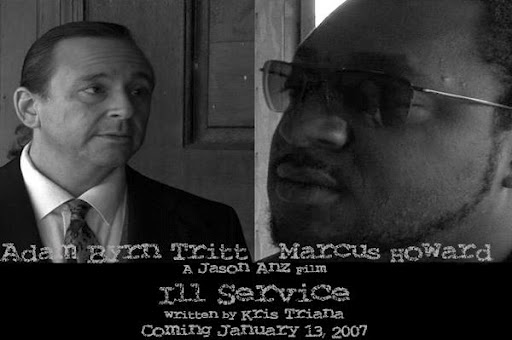
The picture you next see is a movie promotional poster for the last film I was in. When I see that poster, I think of a one and zero domino.

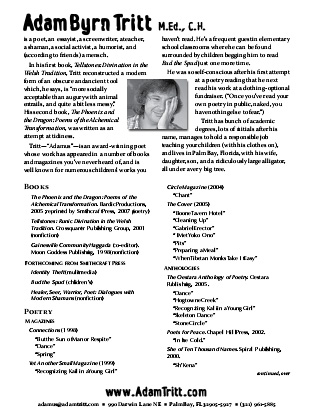
Next we see my new promo material. This was created by the pure benevolent genius of Craig R. Smith at Smithcraft Press who, I am delighted, proud, astonished, befuddled and amazed to say is my publisher. If you have a chance, visit his blog, Notes from the Dreamtime. If you don’t have the time, do it anyway.

It is worked up for the release of my upcoming book, The Phoenix and the Dragon: Poems of the Alchemical Transformation. I looked at this material and couldn’t help but to exclaim “who is this guy?” I further suggested, if I were him, I’d find this fellow and publish him.

When did I do all this? When did that happen? No wonder I’m tired.

All of it, I am delighted to say, done with good friends all along the way.

So, here is something you rarely see. Pictures of me, my wife, my son Alek, family, and those friends of mine who would stand still long enough to have a picture taken. Bless every one of them.

 
1 Comment

Posted by on February 18, 2007 in Family, Social


Gone SWIMming

I recently attended a winter camp in South Florida, way way out in the west of Palm Beach County, past the city, past the towns, past the paved roads and into the Everglades. A weeklong retreat sponsored by the Unitarian Universalist Association, it is called SWIM – Southern Winter Institute in Miami. Of course, this wasn’t in Miami but why let a fact get in the way of totally great acronym.

At the check-in table, I was greeted by a pirate who insisted he take my picture. In full plundering regalia of a tricorner hat, shirt open to the waist, short balloon pants and a lower limb that would have been perfect as one of four legs of a pine dining table, he appeared complete. With the exception of a missing parrot, he was the archetypal buccaneer. I will be honest here, my first reaction was “Holy Crap, that’s a real peg leg,” as I could not figure how he would fake something so realistic.

He wanted to take my photograph and gave me a half sheet of paper to put my name on. I did what he asked because, after all, he was a pirate, and was missing a leg and, more importantly, his parrot, so he was probably surly as well. I wanted to ask him if he was a Pastafarian.

I printed as carefully as possible (which means it was barely legible as he read, in a faint southern accent) “Yo Yo Ma. Because there is always room for Cello.” He looked up at me, slowly. My real name, he insisted, with what seemed a bit of quiet, fatigued humor. I gave in and, after lending my visage to the camera, went to set up camp. I’d be here for a week.

There were workshops and dances and games, evening community meetings, night-time coffeehouses and two in the morning kickball games and cookouts and it is not now my intent to report all that transpired within that week at this Pagan Holiday meets Geek Central. As I packed for my trip, it was my intent and I took my computer with me to do so but the plan fell to pieces because, frankly, I was enjoying myself far too much to step out of life and write about what I could instead be doing. I took notes and, now that things are boring again, I will relive the highlights only and you may, if you like, do so with me.

In truth, much the same thing happened day after day, games, dances, music, meals, so why write about them again and again. There was that peculiar joy of not being able to tell what day it was, not needing to keep track of the date and so, at completion, in memory, I am left with a soft-focused, diffuse feeling of enjoyment and delight over the entire week and need not attribute it to any particular time, episode, day or series of events. Joy ran into joy into joy.

I was there with my Lee, son (Alek), my dear friend Valerie and many people I had not seen in a year or more and others from as far away as the distant edge of the farthest island off the coast of British Columbia. From Wales and France and across the United States. All among the frogs and gators and our one drydocked pirate.

* * * * * * * *

Pop Psychology or My Life as a Made for TV Movie

It was nine-thirty in the morning and I was in the mood for some self-improvement. Lee had, after breakfast, gone off for a bit of a walk with her new buddy from the far side of a large island off the west coast of Northern Canada. But, in order for my self improvement to be fully appreciated, I needed my dear wife to be there and experience it, improving right along with me. So I walked off to look for her.

It was quarter to ten, hunting here and there, before finally finding Lee, She didn’t look ready to go to a workshop, lying, as she was, naked, on her stomach, in the sun, making a careful survey, with Jennifer’s assistance, of precisely how differently massage therapists from B.C practice as opposed to their Florida counterparts. She appeared to be deep into her study.

“Lee, do you want to go to a workshop with me?”

I know she heard me because, knowing she was concentrating, I knelt next to her, speaking loudly and slowly.

“Go away.” I know this is what she said, though it sounded very much like a mix of mumbling and cursing, but after twenty-five years, one learns. However, just in case, I asked, “Are you sure?”

Her next response was much more clear but I heal quickly. Off to the workshop. But, knowing how much more fun such things are with a buddy, I set off find Valerie first. Finding Valerie lying about naked isn’t terribly uncommon, but hopefully, not all of my friends were prone in the sun.

We spent a while, Valerie and I, looking for this class. It was called “Poncho’s Never-ending Workshop” and we had no clear idea what it was about. That was why we wanted to take it.

It was supposed to take place at the fire circle on the island. The island was maybe one hundred feet across and in the middle of a small lake surrounded by alligators and turtles, wiregrass and victoria lilies. One walked to the island by means of a three hundred and seven foot wooden walking bridge. (I paced it. I thought you should know.) It was empty.

We found others walking, seemingly searching, on our way back. Another workshop hopeful suggested the name be changed to “Poncho’s Never-beginning Workshop.” We walked and searched, hand shielding eyes against the ten in the morning sun.

We checked everywhere and finally found it, after long search, starting late on, of course, the island. We took a seat in the innermost row of three circles of long benches.

Once there, we were asked to tell everyone our name, loudly, clearly and then, applaud. We would all clap just because we were who we were. I, among the thirty-two people there (I counted them. I thought you should know.) spoke more than my name when my time came.

“Please don’t clap for me.”

“Why?”

“I didn’t do anything. I was born and I haven’t died. Neither one of these things is an achievement.”

People grumbled about attitude, how I should feel deserving, how I should do as the facilitator said.

“If I have done anything, it is that I am doing something different right now than the rest of you.”

Applause. I can’t win.

The facilitator, Poncho, told us we were going to learn to discover our fears and design our lives by what we discover. We were going to start by being honest. Poncho went on to tell us how nervous he was, how he hated speaking in front of groups. Even small groups like this. He was sweating and worried he wouldn’t do well even though he had done this many times and told us we should all strive, today, in this class, to be as honest as we knew to be. Applause.

I raised my hand, was acknowledged by Poncho, and looked at the mass of pop-psychonaughts. “I just want to point out that when Poncho was honest, you applauded. When I was honest, you grumbled and, and, I just want to point that out.”

I’m use to being stared at.

We were given a choice of “A Scary Movie of My Life” and “A Million Dollar Movie.” Each was a form with blanks to be filled in; a self-discovery Mad-Lib a full page long and we had, in pairs, five minutes each to complete these with one person reading the words and writing-in the dictated blank-fillers as the other person responded to the prompts. Once filled in, they would read like a 1950’s B movie trailer. I chose the scary one.

After it was handed to me, I nearly immediately changed my mind. Don’t I spend enough time thinking about all the myriad worst-case scenarios of my life? Not this time. Let me at that Million Dollar Movie!

We started work, Valerie and I, and were immediately shushed. This is because we were immediately laughing like a pair of weasel escapees from Toontown. Mad-Libs are supposed to be funny, right? We just couldn’t help it. Five minutes passed and we had barely begun. Time to switch. Five more minutes passed and we were supposed to be done with both and start reading them, one by one, to the thunderous power-clapping of the group. We listened to one or two and then, quietly rose and left, back over the bridge, our million dollar movies in hand.

Anyone know an agent?

* * * * * * * *

Sadam at the Head Bangers Ball

A week had passed since having my mugshot taken by a pirate and in that week I learned to dance. I don’t mean I became good at it. Certainly that is not the case at all.

I was asked to take a salsa class. I must have misheard but cannot now recall what I must have thought I was asked. It must have sounded quite a bit like salsa class but, surely, if I had heard correctly, I’d never have said yes.

Salsa is a violent sport. The way it was taught, the guy is in charge and he decides everything while the woman’s job is to make him look good. Salsa is the dance of misogyny.

Our teacher would pull and flip his partner, stating if he wants her head here, pointing to one side of him, he just shoves it there and it is her job to follow it through, though, in this case, it resulted in a very confused and rather “you must be kidding” stare from the quite taller than he, willowy lesbian he had chosen as his demonstration partner. I suspected, after having her head shoved sideways under his arm to change her position from in front of him to behind, she would need a chiropractor.

My partner was Valerie. She is a professional dancer. I didn’t know where my feet were at any given moment and happily let her lead.

The speed was ferocious but Val danced with me at half pace so I could attempt to keep up. She didn’t know how to Salsa and was learning as I was. Our teacher would come over to show us a step and she would immediately understand, nod, execute. I would wonder what he had just done and, if I recall, at the height of my frustration, began to pogo to a Tito Fuentes number.

Two classes of this and I begged out. Two more to go. No, please. No.

But there was contra dancing and I can contra, after a fashion. Turnabout seemed awfully fair and I asked Valerie to be my partner. She wanted to know if contra dancing is done to gunfire and ordnanced insurgency. Yes, I told her. Yes.

A gentleman wandered the hall from front to back. We had all been asked to form groups of four, two ladies and two gents, and put those groups in a line. This fellow, Sid, joined a group, left a group, joined the next, left it, in order from farthest to closest, appearing to be doing the contra equivalent of the moonwalk until he came to us and we were but three. What good fortune had befallen us?

A short introduction was given after a brief stroke on the fiddle. Here are the moves, we were told. Here is what they look like, we were shown. We copied what we saw. I didn’t do too badly. Poor Val. I had never seen her confused on a dance floor. But Sid did his best to help.

As the live music played a tune appropriate for the buckboards, Sid started to yell. He ordered her where to go, how to move and, to all appearances, he did not quite have the apparent command of the dance to carry such authority. Then, and this was not a dance move, he grabbed her arm and relocated her in a way hat was abrupt, at best and designed to move her to a designated spot. I thought, hey, it’s the Salsa again.

That was it. In the middle of a practice dance, through the music, Valerie stopped cold, looked at Sid, stared though Sid, and he became smaller and smaller as she told him just what would happen to him if he touched her again in a way that had nothing to do with dancing, that she was a professional learning a new set of steps and for goodnesssakes, she couldn’t believe he actually wore a pen-filled pocket protector to a dance!

The music continued but the dancing did not until Val had finished diminishing and emasculating her ever-shrinking partner. Then the music ended, started again and we were dancing, dancing, dancing, in and out and around and weaving with swings, promenades, dos-à-dos, allemandes and for two hours Sid behaved like a gentlemen, mechanical pencils clicking in time to the music.

The next day it was the talk of the camp. Someone had put Sid in his place. It was about time. It was about time. She was congratulated, thanked and, graciously, Val was the model of civility to Sid regardless the entire rest off the camp. But that they would hit the dance-floor together again was doubtful.

The next night was New Years Eve. “You are going to dance with me,” Valerie told me. What could I do but go to my wife. “Your’re going to dance with me.” I saw her face. “Right?”

“We’ll see,” she told me. I know what this means. If she is comfortable. If the people there are friendly. If she doesn’t feel claustrophobic. Lee hasn’t danced with me in years and I know it has nothing to do with me. We had not found a place she felt comfortable. But she had been comfortable there and I had high hopes.

But just in case, I did my best to find a way out. I told Valerie I’d happily dance if they play the music I like. I had seen the play list on the computer during a surreptitious glance and the mp3s were one after another hip-hop, rap, oldies, disco. I was safe. Away went the fear I’d have to dance. Away went the panic of the thought of being on the dancefloor, having to actually do something coordinated with this body as people watched. Away went my certainty I would look a total fool. I could ask for my favorite numbers and they’d never come up. I could make DJ requests ‘till the cows came dancing home and the cows would be dancing without me. So would Val.

“I’ll dance if they have ‘Don’t Fear the Reaper.’ And, ‘What I like about You.’ I’d dance to that. I’ll go request them.”

The dance was due to start within the hour. I walked up to the DJ. I made my requests and he said he’d see what he could do. I went a step further and asked if he’d play The Eagles’ “Get over It.” I offered to supply it as it was sitting on a flashdrive in my pocket. I knew it wouldn’t fit, would never be played and but would certainly demonstrate my sincere effort. I tried.

Why did I have a flashdrive in my pocket? The gods work in strange ways. “Sure I’ll take that.” I handed him the drive and he popped it in. He asked if he could look through the music and I, of course, told him it was fine. There is quite a bit of music but also books and documentaries and such and I’m sure there is nothing you’d be interested in but. “Fraggle Rock! Man, I can’t believe it. Can I take that?”

“Excuse me?”

“I want to play the theme from Fraggle Rock. And here is your Eagles song. Oh, and look at this. Some bluegrass. Hey, thanks. I was looking to mix up the music some.”

“Sure. Yes.”

Thanks.

Ten in the evening came and the music started in the hall that was crowded but not compressed. I had spent the week with these people and I was not as nervous as I had anticipated. Dancers filled the floor moving to a tune I did not recognize and had no desire to dance to. Loud with bass for no reason other than bass. Bass supporting nothing above it; a foundation with no building. I so very much dislike, boom boom music but, this time, I loved it. It meant I’d be safe. There is no way my requests would be played.

Suddenly, The Romantics pumped from the speakers. “What I like about you…” and I was pulled from my seat, lead by my arm, out to the floor and was wondering where my feet were as, certainly, they must be behind me somewhere, back at my seat, astounded to find themselves behind the action, at the wrong end of the chain of command. I was on the dancefloor with Valerie.

And having no idea what to do, I just started jumping up and down.

And looking to my left, Val was doing the same.

And looking to my right, my dear wife, dancing beside me. I nearly faltered in my disbelief. My wife, dancing. Dancing with me. I was flabbergasted. I was amazed. I was delighted and smiling larger than I can remember in an awfully long time. And, to my further joy, so was she.

Then the song ended and the next began but why sit down? Song after song and then, “Get over It” by The Eagles and what was there to do but headbang?

Apparently it was the right choice and we were all headbanging. My son’s friends came over to join us. All of his friends. Not my son, of course. Not Alek. I’m sure he’d rather have had his toenails pulled off.

Later than evening, Alek, quietly, when his friends weren’t looking (so he believed) walked over during a slow song and danced with Lee. One minute. Maybe two and there was that wonderful, rare, expansive smile again on Lee’s beautiful face as Alek spoke though his own smile, “There, are you happy now?” And she was. Quite.

“Don’t Fear the Reaper,” another request, made sure I had no excuse to sit. More headbanging. Then, suddenly, we were all in a line dancing the in the most appropriate way for anthem of nihilism – the hora. It seemed quite the right thing to do; to hora to Blue Oyster Cult. It still does.

I sat down when Michael Jackson was playing. I needed the break and it was now a little past eleven. People were dancing to “Thriller” and, it seemed, all doing the same dance as if choreographed. I was told latter, by Valerie, of course, this was the dance from the video. I had an idea.

“If I could get them to play ‘Godzilla’ by Blue Oyster Cult we could dance the same thing nearly. We could stomp Tokyo with our claws in the air.”

“Do you want me to request it?”

“No, please. No. I’m afraid he’ll have it ready to go.”

Headbanging again. “The Twilight Zone.” Lee, Valerie and I, and then a yelp and Lee was holding a thumb front of my eye.

“You hurt me.” But she was, incongruously, laughing.

I felt terrible and apologized. She laughed at her unlikely injury, told me she would show it to everyone though no-one would accept her story because who would believe I was dancing. And already it was swollen, turned black and blue. And she laughed even more.

A Salsa. I went to sit thinking Lee and I would take a breather. I turned to find myself, amazed, alone and, on the dance-floor, Lee, my Lee, in the midst of a meringue and I didn’t know, after twenty-five years together, I didn’t know she could salsa. How wonderful it is that I can learn new things about a woman I have spent so long with. What a joy.

Sid had approached Valerie. She was surprised and it showed, albeit briefly, as he asked her, as politely as anyone could ask, for her to dance. And, to her credit, she gave him his second chance and said yes. Off they went, dancing as the next song started and I rejoined my wife in the crowd.

It was nearing midnight. Another fast song and we bounced some more; up and down to a shred so fast I could barely keep up and on the wall a newspaper front page had been clipped and on it a half-page spread picture of Saddam Hussein hanging from a rope, lolling tongue and limp.

I froze. Instantly. I had not seen a newspaper in a week. I did not know this was to occur. Perhaps the person who posted it thought it right. Perhaps he or she thought it a service that we should be kept abreast of events. Perhaps he or she thought it appropriate for a double celebration; New Years and a hanging.

The music had stopped. A hand tapped me on the shoulder and gave me champagne. Lee. And that same hand clasped my free hand, led me away as the countdown started at ten.

* * * * * * * *

Broadway Name that Tune

I was the last morning and the last workshop before we were due to fill our packs, sweep the cabins and head back to everyday life in this first day of the new year and an unlikely workshop it was under any circumstances but especially for a retreat designed to revive the spirit and renew the soul. Broadway Name that Tune. Of course, I had to go. If I hadn’t, I’m sure Valerie would have wondered who had replaced her friend with a pod.

It was held in the spacious dining hall and three other workshops were there at the same time. One was by a life coach, another was a tarot workshop and a third was on Hinduism. We had one half of the dining hall which had all the tables, save ours, removed and the other half was being shared by the three other workshops. Down the center was drawn an accordion wall that did little to insulate for sound. You would be surprised how loud a tarot card can be.

It was facilitated by two supposed Broadway Musical experts and expert they certainly were. Kay and Tom created four sets of ten questions each. They would sing a line or two and we were to know the musical. If it was in a movie, we might be asked who sang it originally. I expected to bomb. If we knew the song, we’d all sing it. This made Broadway Name that Tune the slowest trivia game I had ever played.

I guessed with the most ridiculous responses. Yet, in the end my scrawling of “Oklahoma” and “Flower Drum Song” won me the first round. Even my guesses of “The Secret Policeman’s Ball,” “Ren and Stimpy” and “The Itchy and Scratchy Show” didn’t keep my dismal score from being significantly less dismal than the other six people. I had a better score than Val. That was a no-no.

The second round she and I were tied but overall I was still ahead by a few points. By the end of the third round she had learned to write smaller so I couldn’t read the answers on her paper.

Inexplicably, she was now winning.

By the end of the fourth round she was ahead by four points and was handed the prize. A perfect award for her: a compendium of Broadway tunes with music, words and history of the shows. She had won and it was time to stop competing and sing. Selection after selection from the book was sung with exclamations of I didn’t know this came from a musical from some one or two surprised participants prior to every other song.

Including “When You Walk Through a Storm.” Some showtunes show up in the strangest places. I knew this song was sung by the Lettermen and Gerry and the Pacemakers but I didn’t know it was from a show. When “Beautiful Dreamer” was sung, I pointed out it was featured in “Space 1999” when the aliens were putting Earthpeople to sleep in rather permanent ways. Many tunes, in fact, were used in science fiction movies and television. So when the question of what show “When You Walk Through a Storm” came from my answer was immediate.

“Hitchhikers Guide to the Galaxy BBC Mini-series. Eddie the Shipboard Computer sings it as two missiles from Magrathea are headed toward the ship. ‘We would like to assure you that the guided missiles currently converging with your ship are part of a special service we extend to all of our most enthusiastic clients, and the fully armed nuclear warheads are of course merely a courtesy detail. We look forward to your custom in future lives … thank you.’ And Eddie starts to sing and continues to until Arthur hits the Infinite improbability drive and one turns into a large sperm whale and the other a bowl of Petunias and all it wants to know…”

“What?”

“It was sung in a sci-fi comedy by a computer.”

Kay responded with her head shaking, “I know better than to ask if you are kidding. But it actually came from “Carousel” by Rogers and Hammerstein” and she commenced to sing:

Walk on, through the wind,
Walk on, through the rain,
Though your dreams be tossed and blown.

We all joined in.

Walk on, walk on
With hope in your heart,
And you’ll never walk alone,
You’ll never…

And the boys ran in. Two, including the pirate fellow. Boys, men, in their thirties or forties. Of course, over the last few days I had spent much time with Charlie and never a peg was in sight. He was chased into the room by Joshua. Up went Charlie held around the middle by Joshua, down went Charlie to the floor held around the middle by Joshua. Face toward the floor, hands on the floor, knees on the floor, and Joshua, holding him down unsteadily with one arm, reached under his dungaree hem for Charlie’s right ankle with the other and pulled. He pulled as Charlie struggled, laughed, struggled. Both laugh and we watched.

And his leg grew longer. As Joshua pulled, Charlie’s leg stretched, slowly, an inch, two, slowly, slowly, then, all at once, it simply pulled out of his pants and we gasped, song stopped dead, and Joshua got up and ran off with three legs as an arisen Charlie hoped after him with one.

Just as many legs went out as came in but not with the same people.

Mary Ann walked by, Charlie’s Mom, Coordinator for the camp, and said as she passed, as though it was commonly known, “They’ve been doing that since they we were ten.” She kept on walking. My mouth was, I am sure, still open because I know Valerie’s was. So were several others.

And I can’t remember what we sang after that.

 
2 Comments

Posted by on January 31, 2007 in Culture, Family, Religion, Social


Tags: , , , , , ,

The Shadow

Some people believe in a soul. Some do not. We, here in the West, seem to take the concept as a given, but it is far from it. Even those who do not believe in the full concept of the soul are forced to use the term as the best we have available in English.

For those who conceive of a center of being and call it a soul, it is often depicted as an immutable core, unchanging and unchangeable. It is the self, and it stays the self whether its bearer sees one lifetime or many, depending on the philosophy.

Others similarly think of the soul as the center of being, but do not see it as immutable. Quite the opposite, in fact: for them it is something dynamic, fluid, with edges uncertain, spreading, mixing. We are substance dropped into a pool and cupped back up again, with most of our soul back in the cup, but some of it still in the pond, mixing, and with some of the pond retrieved in the cup. Well. Pond. Ocean, Sea—all waters. All souls.

And, it is thought, by those who know the soul as changeable and inconstant, that the soul can diminish. A trauma may cause parts to flee to a place where shards dwell, where they forget whence or to whom they belonged. A fright may cause bits of soul to depart, hiding from fear and danger. A constant threat can cause the soul to shrink, and a suffering can cast a shadow on the soul that shrouds it all its days and nights until the last light departs the eyes. And perhaps even after that.

My own soul is not smooth. Its boundaries are piked, jagged. There are parts missing from its surface, leaving gaps, divisions, sulci. There are pieces missing within. And how did they leave? They flew as darts, as butterflies. Blazed off as sparks and fell as flowers. Left curled, like small children covering themselves for shame and protection as they fled.

And there is the shadow, large and deep, the companion of my soul. Behind, over, ever-present. My soul is slippery, transient, and I have a feeling it is within and sometimes without and, when without, larger than the body, not solid but substantial. And behind it still, the shadow, covering my soul, covering me.

* * * * * * * *

“Who knows what evil lurks in the hearts of men? The Shadow knows.” That is old. It goes back to 1930. Both the ego, in the person of Lamont Cranston, and the Shadow, the alter ego, were from Boston. He was from Boston as well. The Shadow could turn invisible, and I swear to this day, he did as well. Somehow he snuck up on me; I can honestly find no other explanation.

I wish the Shadow could have been there with him, to see what evil lurked there while it was only an idea, before it became manifest in action. Now the shadow of that act is everywhere around and even within me. I know this because now I can see the evil in the hearts of men. Even when there is none to see.

* * * * * * * *

I am fifteen years old. My parents have been in Amway for a while now. A year, perhaps. Maybe slightly longer. Amway has quickly become a constancy of meetings, rallies, product pick-ups, and tape deliveries. Our small home in North Miami is busy with the comings and goings of turning Plan A into Plan B with a seemingly ceaseless flow of people. Almost every day I come home to find people I have never met before. Most of them are in and out and never seen again, replaced by a new face the next afternoon. Others become fixtures. Leo Little, Maureen, and her husband, Pablo—“downline”—are so often present they might as well live with us.

Some of the “upline”—people to whom my parents are the downline—become fixtures as well. The downline mostly go to the upline, but in some cases the upline people came our home. One upliner in particular is seen more often at our home. And then more and more. He seems nearly ubiquitous. In retrospect, perhaps I should have seen that as a problem but, then, he was simply a friend of my parents. Dan Jacobson.

His last name might be spelled with an “e” instead of an “o.” Honestly, I don’t care. What I care about is he seemed to shadow my parents. There appeared to be no time he was not there. In the end he was practically sewn to them.

I do not blame my parents for working so hard at Amway. They wanted better, wanted out of the day-to-day and paycheck slavery. But I can only imagine what they might have accomplished if they had spent as much energy in other endeavors. My mother would not return to college for a degree. Too much time, she would tell me. Again and again I would ask her, “How much time will pass if you don’t?” She spent nearly two decades working Amway. I am not sure what she got of it.

I know what I got of it. Shadows.

* * * * * * * *

I am fifteen years old. I am in my family room. My parents are not here. Dan is, though. He has sat next to me on the couch and I think nothing of this. He has often been here, arriving before my parents. He is intelligent, and we talk from time to time as I rarely talk with those my own age.

I am being asked about school. I am being asked about one subject, then another, then still another. Somehow, the conversation leaves topics of the mundane and turns obliquely toward matters personal, but I am not opposed to having someone to talk with.

But as I speak—I seem to remember my voice getting soft, becoming somewhat sad—his hand moves to my shoulder. It is a comfort and an indication of understanding among those who know and trust each other. I am to trust this man, or so I would believe by how often my parents have him over, how continually he is in my home. All signs I should trust him. What it was, however, was distracting, as his other hand moved to my fly, began to fumble, to reach for the zipper, and I am confused, unsure what is happening, cannot believe the reality of what is occurring. It cannot actually be, and in moments, as the zipper begins to lower while he kneads through the dungarees, I come to the realization that he really is doing what I think he’s doing and I move back and away with a sharp, sudden start and he looks at me in disbelief and. . . . All else is shadow until the night.

* * * * * * * *

What happened next I cannot say. I remember nothing of the remainder of the day. Was it morning? Afternoon? None of this do I recall. Perhaps it made an impression upon on me insufficient to have warranted recall, or perhaps I have buried the memory and, then, not wanting to know that I have been party to my own duplicity, have repressed the memory of the suppression. Whatever the explanation, the rest of the day following the encounter is blank. Time seems not to exist until the evening, when I found my mother. I do not know if I told her after much thought, or thought not about it at all and informed her with an air of of-course-I-would-say-something. I do not remember if I told her easily, or with trepidation. But I remember the conversation, though my recollection is devoid of emotion: I remember it as though transcribed and given to actors who have been given the direction, “Dry, dry, dry. These words mean nothing. Say them. Just say them.”

In the kitchen, that afternoon or evening I tell my mother. I stand next to the open accordion door that separates the entrance of the kitchen at a right angle with the front door from view. It is messy, as usual. I relay the story. Is she upset? I cannot recall. What her emotions were I cannot recall. I can only remember her telling me that we must not tell my father. He might do something rash. He might do something to him, might hurt him. We would not tell my father to protect my father. She will talk to Dan. She will tell him what needs to be told. Nothing else was said, and my memory ends here.

Does he still show up at the house? I must imagine he does. After that, time passes. I am sixteen, meet my future wife. I am eighteen and leave home, go to college, move in with Lee, work at overcoming shame and hatred of my body. I am twenty and get married, become a father.

I hear stories. More people molested. He is divorced by his wife for cheating, and it matters not a bit if it has been with women, men, minors. I could not be the only victim; though he was unsuccessful with me, surely others were not, are not able to stop him, choose not to fight, not stave off. Surely some give in. What is the chance I would be the only one? But still, no one said anything. I did what I, at fifteen, was supposed to do: told. I gave the adults the chance, was asked to say nothing. I trusted them, and more people were hurt.

Some years pass. I am in the car with my father in Ft. Lauderdale. How many years later? Ten? Has a decade passed? I don’t know, but I have decided this day I will tell him. Time has come and gone and he will know now.

It is difficult but I blurt it out. He looks placid. Tells me he knew. Didn’t you do anything? No. What was there to do? He was a business associate. Why cause trouble? Why say anything else?

I don’t. I am silent. I am silent for a long time.

Home, I tell Lee. She can believe it barely as much as I. It is a long time before I speak with my father again. His presence has the substance of shadow.

* * * * * * * *

Gainesville. Some years later. My home near the university. My father calls and we speak. All of a sudden, he says, “Oh, and Dan says to say Hi. He’s in Boston.”

For a moment, I cannot speak.

I think. Slowly the answer seeps from my mouth. It has been years and years and now this breach. I cannot imagine I have just heard what I heard, cannot imagine it was said. Said by my father. I hear the answer as I slowly, quietly, say it.

“Tell Dan to take a gun, walk to the center of Boston Commons, put it in his mouth, and pull the trigger.” And immediately, loudly, away from the mouthpiece, “Lee, it’s for you,” and put down the phone, immediately exiting the house. I walk.

Before widespread cellphones, which I might not have taken with me regardless, I had no way of telling Lee why I walked out. No physical way. No emotional way. I could not make my mouth speak. A way for her to reach me would have been no use. I could not have spoken. I don’t think I could have been held, stopped, slowed. I walked for two hours. Where, I don’t fully remember. The neighborhood, the woods, University Avenue, 34th Street.

Upon arriving home my wife looks at me. She had a short conversation with my father and tells me he had no understanding of what he did, what he said. She says some unkind words about him, then some even less kind. Then, she just looks at me and asks if I’m OK. I am not. I have come home only because I didn’t want to further worry her, as she is my light while the outside world was reducing to shades of gray and the inner world to shadow.

* * * * * * * *

I have been asked to go on a trip. To make the trip affordable, I’ll have to share a room with a fellow. No. I’d rather not. Deep, deep inside, I do not trust this man I have not met.

I have few male friends. This is not a surprise to me. I wish I did, could, but I cannot bring myself to trust them.

While I have managed to forgive much which I have gone through—most of what people might have done to me, in error, on purpose—I cannot seem to, have not been able to, forgive this one man and, perhaps, my father as well, for having allowed this person to, what? Live? Exist? No, that isn’t it. I have not forgiven him for giving what appears to me a nod to the action, for not telling me it was wrong, for acting like nothing happened.

Something did happen. In my mind, it happens again and when it does, my soul shrinks, shards fall, parts of living soul die, fly, shrivel. The lights dim and I am again covered by shadow. It is shadow all the time.

 
3 Comments

Posted by on December 10, 2006 in Family, psychology, Social


Tags: , , , , , , ,

Nothing Funny about Hardee’s

I worked at a Hardee’s once. Just once. And by this I don’t mean I was once employed at a Hardee’s for a while. I mean what I said. I worked there once.

Whenever I see a Hardee’s I think of tough times and tougher financial difficulties. And whenever we are in the grip of some financial trouble of some such, which is often, I think of Hardee’s as well. I think of it quite a bit. Rather amazing since there isn’t an item on the menu I’d consent to eat, but there you go.

It was the summer of 1986 or 1992 or the fall of 96 or some such year and season when affairs of the financial sort were rather on unsolid ground and milk and bread were scarce, which was not entirely bad as we are allergic to dairy and wheat, but their scarcity was not a matter of famine so much as the assets to purchase them. Thus, rent was scarce, gas was scarce and scarce also were all manner of niceties and many without-which-life-is-not-so-niceties.

We had a child of one or five or four.asd Or one of six and one a newborne. I am not sure; it could have been either or both as such were the stretches of time we were with little or without.

And we lived in a trailer or perhaps married-student housing outside Gainesville, Florida and frequented the farmer’s market on the opposite outskirts buying what we could of what was left of the greens and fruit when the good stuff of the morning was gone. We spent $25 a week on food much of which consisted of spaghetti and rice and beans. We foraged and I would bring home lambsquarters and rapini. I learned what mushrooms could be picked and which to be left alone and made an error here and again, discovered when the onions were best to pick, grew vegetables in the city.

We gave up a car we could not afford, took a housemate, argued over nothing that had to do with anything except money and lack.

We discussed and planned. We looked for work. I applied at Wal-Mart. I was turned down as overqualified for any starting position because I had an AA in Education or a BA in Psychology or some such degree. The non-starter positions would go to those with experience and I had none. I was over and under-qualified.

Seven-eleven offered me six dollars an hour but I lost the position to a man with a PhD. I was unhireable as a waiter for reasons of which I am still unclear.

Finally I was offered a position at Hardee’s by the son, a manager, of a man with whom I taught at Miami Dade Community College as a paraprofessional or tutor or aid. Fast food? I had to think about it. We were in desperate times and still, fast food I had to think about.

“There’s nothing wrong with it. I know it’s not what you want but it’s better than starving.”

That’s my wife talking. She says this before I go off to job interviews. I see her point. The harder it gets to find work the more I agree but still, fast food is not quite what I had in mind when I started college. I went to Miami Dade and FIU, not Burger King University.

So I listened to my Sweetie. Things were hard enough then without arguing and, of course, she was correct. Completely. Utterly. So I could only reply, “But fast food? Holy crap that’s disgusting. Maybe I could dig ditches or…” I don’t remember what I said but it was quite like that. Besides, I am sure I would have been told I was well overqualified to dig ditches, bale hay, plant trees or anything else remotely physical. Sure enough, it seemed having gone to college ruined me for making any sort of living in the real world. In college I was fed a line.

We had even tried to immigrate to Australia. We were told by the Aussie consulate they needed skilled labour, not teachers. They had plenty of people with degrees. Could people with degrees wire buildings or frame homes or lay pipe? I was actually asked that. I said I imagined they could and if they took us we would frame or wire or lay anything they liked. It was a solid no.

And so, after listening to my wife’s sage advice (“It’s better than starving.”) I called the son of the friend and made an appointment. It was for that afternoon or the next morning or later that night and before I went I asked if he knew I had a degree. He did and assured me since his father said I needed this, and badly so, it would be fine. I was relieved or troubled or aggravated or disappointed or all of it and happy and unhappy both.

I drove the few miles, “Dust in the Wind,” by Kansas, on the radio. It is a habit the Universe is happy to support by playing it for me every time I go on a job interview. That or “It’s the End of the World as We Know It” by REM. Both set the proper mood.

We met. It was a Hardee’s. What more to say? I was hired just because, filled out the forms and was told I could start at eleven. Eleven to two. Morning to afternoon? No. Night to morning. What? Night to morning. Eleven at night to two in the morning. I experienced a palpable sensation of the weight of my heart rise to my throat while I felt the same fall to my stomach; two weights simultaneously shift apart and both, I knew, were heart.

So I left, a bit stooped, tired of struggling, defeated, smaller. I headed to a thrift store for the proper coloured blue pants. Found several pair too small and several too large and opted for one that was only a size too big or maybe too small, but they were three dollars and that cinched the deal so it didn’t matter they were too short. I took them home and, with them and my Hardee’s shirt, sat around and waited for night to come.

Evening came quickly and the hour I was to leave dragged me along through the night. I dressed, put on sneakers and left. When Thoreau wrote “The mass of men lead lives of quiet desperation,” he was leaving for Hardee’s.

I arrived and walked in, was greeted by the assistant manager, given a tour of the machines and the headphones, some matters of protocol, how to run a cash-register that had no words, only pictures and then was shown how to make change. Apparently word had not got out I was overqualified. I pretended to mistake the quarters for nickels. I didn’t want to disappoint.

There was a steady stream of customers to the counter, past the window. People glossy and pale. Over-sized people ordering over-sized food. All night and into the morning, food they knew, one had to believe they knew, was not good for them and too much of it. Food Addicts. Food-porn.

There were better things to do and better food to be had. Real, honest food. Not fake food but food with actual nutrition behind it. Food that didn’t just look like food, masquerading as food. Food that would be good for them, body and soul, and not leave them empty. Food with production value. Food that would make their lives better, bring joy to their bodies, make them stronger. Food they could tell everyone about and bring home to their grandmothers. Real food. There were more meaningful culinary relationships to be had with non-virtual food. Food-porn.

That was the general. I remember few of the particulars.

I burnt the french-fries because the fryer handle was hot because no-one could find the handle for the basket.

I made several milkshakes on a machine somewhat like a stand-blender. It had several mechanical teats. Put the cup under teat one for a combined dairy and non-dairy colloid. Put the cup under teat two for some other such solid-fluid. Squirt in the flavoring of chocolate or vanilla or strawberry and then stick it up under the mixer and hold it while you press the button but make sure the cup is up all the way and then push it higher because it isn’t. If you don’t, the mixer will high-speed tangent flavory sluice all over to whatever distances the walls are unless there is something else in the way such as, perhaps, a customer.

I hope none of them were going anywhere after dinner.

Around midnight, I was put on drivethrough. It had the speaker we all know drivethroughs have. But it was augmented by the workers leaving out syllables here and there. You all suspected drivethrough workers did this and I’m confirming it. I know why they do. It makes the job bearable. Nothing makes the time pass like keeping people in a hurry waiting and making hungry people do without. Especially if they are wanting to give you money.

Even better when they are high and there was plenty of opportunity to have at it with folk too high to know they were being had. Fish in a barrel. Fish in a barrel. Yet, they were outside, driving around and I was inside, serving them suicide.

Suicide is what many of them asked for. I thought they were talking about the hamburgers. I didn’t get it the first few times and many of our higher customers, not having full verbal facility and agility became irate. Overheard, a co-worker came over and explained, in a voice fully matter-of-fact, suicide is all the sodas mixed together. They were asking for a carbonated syrup mélange. Whatever PepsiCo makes, yes, I’ll have that.

Suicide was a good thing to order and I started welcoming the drunk and high folk. If I messed up their orders, fixed the burger wrong, missed one of the sodas and so saving them from a successful suicide, made a bit of a mess, they tended not to notice so much. High people were great because I was messing up more than not. This was due to a mixture of apathy and grease. Both were everywhere I was, surrounding me at first but, by the end of the evening, the beginning of morning, they sat, solidly, inside.

I slipped and fell. Twice or thrice or more and I dropped things or didn’t and hurt myself and sat upon the greasy floor for a moment or sprang up from embarrassment. I grabbed handles and appliances to steady myself to rise but they were grease-glazed as well. There were no mats and nothing to absorb the grease but the food. I certify the food was more than adequate to the task.

I dropped things because my hands were greased. I dropped the wrong things because I had picked up the wrong things because my glasses were opaque with a think and growing film of animal fats and vegetable oils. I could see nothing. Is that a ten or a twenty or a one? Pictures on the register were as useful as words and Braille would have been of more use. No sight, no footing, no handholds. I wondered just how much grease was in my lungs, how much my skin had absorbed, how deep in my ears my eustachian tubes were filled with animal sludge. How far up my sinuses were the cavities of my skull coated with the vaporized lipids. Fat was everywhere inside and out. I just wondered how much. I sometimes wonder how much is in there still. Like Oklahoma sand, Hardee’s fat is everywhere.

Time crawled. When I fell, I crawled too. Finally, two in the morning. I was told it was time to leave. No overtime allowed. What a shame.

I walked to my car and greased my door handle, then greased my seat and greased my steering wheel. I drove looking over my glasses which is only slightly safer than driving with my eyes closed. I didn’t hit much – just a curb or a mailbox or some students during mating season. I found my way home.

I greased the doorhandle to my home and walked in. I left my sneakers at the inside of the door. My wife was up, waiting, in the bedroom. I told her I was going to take a shower.

I’m sure I left grease-tracks as I walked toward the bathroom. There, I turned on the water in the shower and left a mark on the handle. I have always disliked showers too hot or too the water too hard… I know I’m sensitive so I read up on Best Water Softener Reviews. This time, I turned it up and let it get hot. I stepped into the shower, grabbed the Dr. Bronners and soaped myself. It took quite a bit for even this castile soap to start cutting through the grease but, after a while, a lather began to rise. Then I took my clothes off.

As I did Lee entered. I looked at her, or, rather, toward her. Then I took off my glasses, rubbed them with soap and put them aside and looked at her.

“You were wrong. There are worse things than starving.”

We talked long that evening and soon moved to a locale more economically viable. We moved to North Miami or Kendall or South Miami and with my father’s help rented an apartment or a duplex or a house with friends. Times change and episodes as difficult as this have been far too frequent but, happily, consigned to memory each one. But you still won’t find me in a Hardee’s.

I have been known, though, to fill my cup under every soda spout in the line. Syrupy, sweet and fat-free.

 
3 Comments

Posted by on November 23, 2006 in Culture, Family, Food, Social


Tags: , , , , , , , ,

Aspirin as an Effective Treatment for Writer’s Block

Writing is easy: All you do is sit staring at a blank sheet of paper until the drops of blood form on your forehead. – Gene Fowler

Writing is easy. It is not simple, but given the time and a life, or an imagination, or, better, both, there is sufficient fodder for writing. William Sansom told us “A writer lives, at best, in a state of astonishment. Beneath any feeling he has of the good or evil of the world lies a deeper one of wonder at it all.” This is true. Given such astonishment, all there is to writing is looking at the world with that astonishment, discovering what of that experience is communicable and putting the words into an order words have never been in before to say something no other person has ever said or say it in a way that has never been done so a reader can see something completely new in a way which makes it feel familiar or something familiar in a way that appears to make it astonishingly new. That is it. That is all. The hard part is finding the time.

Most writers do not write full time. As perhaps one of the most important professions over the ages, it is one of the least paid. Poets would be within the court of the king but serve at his pleasure. So we now serve at the pleasure and vagaries of the public. We have bridges and streets named after us but rarely do we get paid in a way that allows us to write and write and write.

To pay the bills, to give my wife the time needed to get her practice off the ground, I teach writing at a public school. A public middle school. Five classes a day and sometimes seven. I train students to pass state tests. That is my job.

I cannot do this. Instead, I prepare them for college, for Advance Placement classes, teach them to do literary analysis and critique, to think. We read Plato, Alan Watts, Bradbury. We barely open our textbooks but we write poetry, publish poetry, win contests and, in the end, gain some of the best writing scores ever seen by this state. From parents and students, I receive thank you cards, presents, pictures. From administration I receive time-outs.

In between, I keep records, meet deadlines, appear mean, being cruel in order to be kind. I tell them no, no no, when the school rules tell me I must, to students who do not want to be in class, in school. I tell them they may not go to the bathroom, must make their bodies slave to a clock, be chained to the forty-seven minute increments and a chime, we separate things not naturally separated and learn this now, that then and stop at a bell. We become subjects of conditioning and divorce our bodies from nature, marching in four minutes from class to class.

I eat at certain times, as do they. I use the bathroom after holding it too long, as do they. I switch gears at the sound of a bell, like them. And, like them, never do so smoothly or wholly. I hold off drinking and hydrating so we can get through classes, as do they. They are training their bodies to do what mine does not, live by a clock and all day, I think, as I teach writing and hold my bladder, what I want to be doing is writing and drinking. Water and words.

I hate this. It is detestable. It feels criminal, violent. Friends tell me I should be honoured to teach. I am so honoured I can barely purchase a house in the county in which I teach. I should be enthralled to make such an impact on my student’s lives. I am but need not be in such an environment to be effective. They tell me to be happy I make such a difference in their lives. I tell them to get the degree and do it themselves if they think it so important.

I cannot not meet the needs of my students. I don’t not know how to do something in a way other than well, no matter what it requires. The weird students flock to me. The writers stick to me. I’d stop today. Now, if I had the chance.

You must do it, I am told, because you love kids so. I am told this repeatedly. No, I answer. I do it for the money. Mind you, I would teach for free any children who wanted to learn and had interest. But the job I do for the money. I get quizzical looks, strangely cocked heads on people suddenly looking like confused puppies attempting to understand a strange new word. It pays better than adjunct work at the community college. It pays better than private schools. I had never planned on teaching in the public schools but then I had not thought of my wife in medical school. I went to college for an advanced degree. It was not the one I wanted but it was the one available where I was at the time and would fit my work schedule. I was going to travel Asia with my Sweetie and teach English as a Second Language. Then she decided to go to med school. I took on teaching because, it seems, there is only thing I was qualified to do by my degree: teach.

More time is needed. It will end, I’m told. I’d like to believe that but it certainly feels as though it will not. I am trying to give it more time, but frustration wins over patience. The day to day absurdity seems to pummel any sense of equanimity into paste where one day looks like the next, and each is a place I don’t want to be.

I think of leaving, going to Europe or Japan. But, what about the books I’m working on? The theatre I hope to create? I cannot afford a second household, have found work which pays only what I make now or less and this is not enough for a another home, no matter how modest. I look for work where I live but incomes are low, will not allow time for writing. Even with the few weeks-off teaching appears to give, I find I must take classes, gain credits, recertify. If anyone tells you teachers have scads of time off, tell them it is a fallacy. Then kick them.

And I must write. I do so early in the morning before school. I get up and write. I do so at night. On weekends. Hold poetry readings, perform, record poetry, write essays, write plays and do all this around teaching school. I must, or else all I do is teach and shall find I have become nothing but a teacher; else I have given up what I am, to live in order to work only. Otherwise I am but an income and, at that, not a great one.

And I am exhausted. Still, I know I will not give up that which is congruent with my self to become fully incongruent. Yet, I go to bed at night, thinking, feeling, if I did not wake, it would be not so bad. If I did not wake, I would not have to go to work.

I wake in the morning wanting to say, starting to say, with my head on the pillow, “It is a new day, with a new sun. I can make this day what I choose it to be…” but always come up short and, despite my best efforts, silently exclaim, desperately, “Crap, I have to do this again.”

I think things I should not. I wonder, do we have aspirins in the house? How many? A bottle? Two bottles? How much would be enough? I could calculate this but am afraid to learn just how little.

I didn’t know aspirin could kill. My daughter taught me that and paid the price with an ulcer. She took half a bottle. Too many and it would have been enough. How many for me? I think how easy it would be to take them and lie down, enjoy fully my sleep knowing it would not end in classes the next day, the same damn thing again and again and again. The same pressure over and over. To get into bed knowing there were no more staff meetings, professional development plans, parent conferences. Sometimes, I am hard pressed to see why this is a bad idea. Sometimes is more and more often.

My doc tells me it is the epilepsy. That it drives one a bit crazy, especially if one is a control-freak. I’ve read up on this. Epileptics tend to be very physically healthy. They live to ripe old ages but often do not make it with their minds fully intact. If they do not make it, it is often due to suicide.

I use to say I could never end up famous. As a poet, I just was not crazy enough. Look at the really famous poets and one will discover most of them are off more than a bit. Drugs, disease, mental illness. Perhaps there is hope for me yet?

I have not mentioned this to anyone. People ask me how I am. I answer fine. I have, at times, given rather strange responses to that question only to hear, “Glad to hear it,” “That’s great,“ and the ubiquitous, under-meaning “Good.” All rather funny after answering “I lost my head to a marauding swale,” “Deplorable,” or simply “Tired.”

The question is asked pro-forma. When asked the question “How are you” in any of its many similar forms, people are expected to answer in the positive or, if not positive, to give light, short, nearly cliché complaintive responses. “Ready for the weekend.” “I need a vacation.” We all are liars. Anyone asked who actually, honestly answers the question is looked at blankly, the way we look at and listen to a developmentally disabled adult while we think how we can’t wait to escape. We consider them a bit off, fringy, whining, needy. When asked how we are, we can lie or whine.

But I am high-functioning and this is not always to my advantage as I get the job done and done well regardless of how I feel. Depression does not decrease that functioning or, if it does, such decrease is not of any noticeable amount as to call attention to my health or well-being. I can appear cheerful, calm, happy. And so it goes.

On occasion a friend notices I am not as well as I seem, as together as I pretend, asks why I said nothing. I answer that I did not want to seem as possessing any of the above mentioned qualities. I do not want to be needy, whiney. I am chastised. Told the question was asked sincerely. I have no doubt. Told I am wrong to dissemble and that it does not give the friend a chance to help. Told such behaviour is selfish. True, perhaps. I believe the sincerity of what is said. Yet, in answering truthfully, what is gained? Are any problems solved? And if others then worry? How shall that be a help? How shall I knowingly worry friends with that which they cannot help, cannot change?

And so I have not. Until, perhaps, now. I have written this. And what should be done with it? I should do the equivalent of burning it, trashing it by hitting the delete key, by not saving. Don’t save it, don’t save me. Maybe I should actually print it and take the physical being of the words and paper, burn them and send them skyward as wisps and smoke to disperse into air, thinner and thinner till naught can be seen of it above and what is left upon the ground is unrecognizable as anything but that which once was.

Perhaps I should put it away for a year, look at it then and see what time has wrought, imagine how I could feel as I did, laugh or sigh. And if I feel the same way, cry over my old words for all the good they have done me. Or publish it before I change my mind.

Sixty-eight five hundred milligram tablets.

 
1 Comment

Posted by on August 25, 2006 in Culture, Family, Social, Suicide


Tags: ,

St. Adamus Day or The Slackers Jubilation.

It is my birthday party today. I just got this email:

In order to take no chances in offending the Gods (and or Saints) I have duly
pronounced the Ode to St. Adamus this morning. In my underwear of course
and toasting with a large glass of ice water (it’s hot here!) I’ll say it again on Friday just to make sure that the word goes up on high that I am a follower!

This is from a lady who, unlike me, is not afraid to admit she is wonderful. I’m learning. I’m a slow learner. Here is my response.

See, it’s a movement!

And I’m going to take a page from your book and proclaim, to everyone far and near, as they arrive, welcome to “me and all my awesomeness!”

A movement it is. St. Adamus started quite a few years ago and is now celebrated, though that may be a bit too energetic of a word for it, by lucky, lazy observers in many locals. Here is this year’s invitation:

You are invited, you lucky person you, to The Feast of
Saint Adamus

August 5th about 6pm

This year, we shall hold the feast at the sacred shrine. The shrine is located at Darwin Manor House at Peepton Hill, The Lap of Luxury (Palm Bay).

The Feast of Saint Adamus, also known as the Slackers Jubilation, is a newly created Ancient Tradition. Being traceable as far back as the necrotic period, records have indicated this to be one of the most hallowed of days, significant for the sheer number of people who kept the Holy Day, which comes as no surprise when one discovers the truly devout celebrants were required to do nothing more than lounge around in their underwear and snack.

Held on the Eve of the Ides Of August, or the Saturday night following the anniversary of the illustrious Saint’s day of birth, or whatever day is most convenient, during the dog days of summer when Canis Major rides high in the night sky and inertia and laziness prevail, when things seem dead and doing anything, exerting any energy for any reason, seems not only useless and futile, but impossible, The Feast of Saint Adamus festivities consisted of a costume party and pot luck. In ancient Mesopotomy, prizes were often given for the best Feast of Saint Adamus costume and usually went to infants and slave girls. This begins to make sense when one looks further into the customs of this most advanced, civilised culture and discovers that an ancient Mesopotomus hardly ever wore anything more than underpants, and infants and slaves less.

Food offerings consisted of gifts of leftovers brought in adoration of Saint Adamus. Anything hanging around the house would do, as long as it took little or no preparation, bespoke of no creativity and left hardly anything to clean up or wash. Utensils were considered an abhorrence to Saint Adamus, unless they were made of candy and entirely edible. Of course, in true homage to this beloved saint, as yet, no-one has ever taken the time or initiative to create these.

One must remember, the hallmark of the Celebration of Saint Adamus and the Feast bearing his name is that nothing special happens. A sort of Super Sabbath, celebrants are required to do nothing more than pay homage to their saint and each other by bearing witness to our mutual inertia. And let us do as the pious have done for centuries uncounted. This Feast of Saint Adamus, let’s get together and do nothing.


No-one ever goes to the trouble of coming in costume. Good. Some do come in their underwear. Excellent. Some come dressed and in their underwear: wearing it outside, on their heads, stuffed in, overflowing from, pockets.

When someone does manage to follow the rules, I find a prize. Since I never plan for this – it would be too much trouble – I just pick something off my shelves – candles, knickknacks, a flute – and hand it to them. I have too many things anyway.

People circumvent the rules by all sorts of strange means, like religions everywhere. Can’t use an elevator on the Sabbath? Just turn it on to stop at every floor from Friday afternoon to Saturday night. Can’t drive to temple? Drive mostly there and park down the street. Letter, not spirit. Likewise, people tend to make… Well… Here is another email:

Oh I have made something sinfully good for your party

My response:

As long as it’s a leftover. You can’t make something ‘special.’ then you
aren’t bein a slacker!

(Thank you)

Re-response:

It’s leftover. I made it yesterday 😉

What am I to do? One of the reasons I chose leftovers was to keep people from working to out-do each other. Also, I wanted a party that was not based in food, delectable, delicious, diet-shattering delicacies need not arrive. I want to talk, not chew, sing, not drink. You get the idea.

So, I started cooking in advance or picking up food I liked. Food, most likely, only I’d be eating. Not that others can’t enjoy them if they like. But, chances are, I’m the only one who’s going to drink the kvas and eat the cold-smoked mackerel. Today, I am smoking a rather large, a bit over a foot long, beef tongue. Smoking it means it’ll still be pink. As a centerpiece, I have a feeling that will keep a fair number of delicacies off the table I’ll be eating from.

A few hours of delight and pleasure need not end in extra pounds. I am serious. Really.

Besides, I’ll be far too busy throwing out Mardi Gras and being entertained by the masses there to celebrate the awesomeness that is me. Unless they read the Ode to St. Adamus, which, of course, is recited every year.

Ode to St. Adamus

A man named Adamus, a saint,
Had but a single loud complaint:
His workload nearly made him faint-
His time was not his own.

The other saints, he’d explicate,
Had time to sit and contemplate,
Philosophize and meditate,
Or solve an ancient koan.

But he alone of all the bless’d
Got not a single moments’ rest
He’d end each day dog-tired and stressed
His hands worked to the bone.

This sorry state continued ’til
The tired saint had had his fill
I need a day to just sit still!
The neighbors heard him groan.

Amidst the papers in his room,
A lovely thought then pierced his gloom
A way he might escape his doom
And find the time to zone.

To each saint is a feast assigned
And patronage of those whose kind
The saint’s good works were most aligned
With, when his works are known

Saint Adamus then beamed with glee.
It seemed that he would soon be free
His own feast he would now decree
Ere one more hour had flown.

A day of utter laziness
Steeped in the summer’s haziness
A break from all the craziness
Would be its general tone.

And so it is at August’s peak
When heat runs high
And will runs weak,
We gather, some relief to seek,
And sit around like stone.

Mind you, this was not written by me, Oh, no. It is by Jeannette Westlake. See, I have fans. It’s a movement.

I think I’ll need more knickknacks by the end of this evening.

Room for one more, Honey

 
3 Comments

Posted by on August 5, 2006 in Culture, Family, Food


Tags: , , , , , , ,

Circle Game

I was told, recently, I was too old. It is the first time I had been told this and, I must admit, I did not like it.

I am in the best shape I have ever been, am healthy and, it seems, according to one source, too old. One of my favorite lines in music comes from “Poems, Prayers and Promises” by John Denver.

Still I have to smile
It turns me on to think of growing old
For though my life’s been good to me
There’s still so much to do

On a ride today to South Florida. Ft. Lauderdale. My son opted to go along. I did not ask but he offered and I was glad for the company.

I grabbed a disk of music titled Sing-a-longs I had made a few months ago. We were on our way.

Against the bright sun I put on a pair of Solar Shields, wraparound polarized lenses since, in the car, out of direct sun, Transition lenses do not live up to their name and become all noun and no verb.

Alek will soon be fifteen. In one month. His sister will be twenty-one soon thereafter. I was there when they were born. It was yesterday. This has all been said before and it is what parents go through. This is nothing new.

The disk played. “Landslide” by Fleetwood Mac. I sing to nearly everything. I did not make it through as a lump formed in my throat, pressing against my voice, down and down. It was the live version and Stevie Nicks dedicated it to her father. I was glad for my sunglasses as my eyes began, slightly, to moisten.

Can I handle the seasons of my life?
I don’t know…..I don’t know

Well I’ve been afraid of changin’because I’ve built my life around
you
But time makes you bolder, even children get older
And I’m getting older too….

Next came “Circle Game” by Joni Mitchell.

And the Circles, they go round and round
And the painted ponies go up and down
We’re captive on the carousel of time
We can’t return, we can only look
Behind from where we came
And go round and round and round in a circle game.

I was a gonner. The lump threatened to take over possession of the entire upper half of my body and my dark glasses now hid tears.

So the years spin by and now the boy is twenty
Though his dreams have lost some grandeur coming true
There’ll be new dreams maybe better dreams and plenty
Before the last revolving year is through.

We were on our way to visit my father. He has been spending time with his parents. His mother does not remember him and his father needs some relief. Four generations and the Great-grandmother is the child again. The Great-grandfather consoled by his son, the son’s mind moved from his worries by his son and my son keeping me company so, after all is said and the doors are closed and we are on the North road again, he can tell me it’s ok.

As we return, Katell Keinig sings:

Lay me down in a wooded field
Plant a bush above my head
Lay me, lay me down
Don’t go writing on my grave
I’ll have it said it all before the end
Lay me, lay me down.

And when we’re all dead
They won’t philosophize
Or feel regret
They’ll remember us when we said
We had one hell of a life.

The song ends and I turn the radio off. We talk and do our best to leave nothing unsaid. There is no time like now.

 
Leave a comment

Posted by on July 6, 2006 in Culture, Family


Tags: , , , , , , , ,