RSS

Category Archives: Family

Nor’easter, Part 3: Goodbye Monks, Hello Dalai

Nor’easter: Being a Whirlwind Snowy Trip to Pennsylvania, New Jersey and New York City or How Van Gogh and a Herd of Alpacas helped Lee get her Groove Back.

Second day: Morning. Goodbye Monks, Hello Dalai.

We rise a bit before seven and the first thing I do is look out the window to see the cars, pavement, roofs, covered in snow. I noticed, last night, the car had an ice scraper in the trunk. We may well use it soon.

We shower and pick out the day’s dress. Long johns for Lee under a shirt. Special thin long johns under her dungarees. For me, a long sleeve charcoal long john shirt with buttons, looks like a jersey, and generic long johns under my dungarees. Each of us has a leather jacket. We wanted our longer coats but there is only so much we could take on a plane. Slowly, surely, car travel seems much more the luxury than travel by plane. The luxury of time. The luxury of space.

We dress, all the while marveling, as we do when we travel, at the TV. Not so much the TV, of course, but the regional differences that can still be found in the programming. Different accents, different emphasis on different stories, more of one type of commercial than another. Local flavor can still be seen, though it is often subtle.

Of course, one of the big differences is not just due to the area but the area at this time of year. The weather reports suggest several inches of snow. There are ski commercials, farm commercials and commercials for various animal-related fairs as well. No idleness during the winter months.

We eat breakfast. Apples. Bananas. We know Rachel will be here at eight and we don’t want to be late. Today, we are hers for wherever she wishes us to be. And the first place to be is outside at eight.

And so we are. Gloved. Scarved. Hatted. I have leather gloves, a newsboy hat with a brim just big enough to keep the bright sun out of my eyes and a cashmere scarf I never get a chance to wear. Lee has gloves we just purchased for her, Thinsulate within, leather without, and a stocking cap. I tried to find her better gear, and find I did. But the interest was lacking. At least I managed to get her into a pair of hiking boots.

Standing in the lobby of the Eastonian, we see a car pull up. It parks, driver window open. It’s Rachel. Window open. Open. This is not starting out well.

Out we go to meet her. Her window is broken and will not roll up. Ok, we could have met her at her house. No problem. She tells us she’s used to it. She is dressed in a T-shirt and sweat shirt. Last report was it was 22 degrees. Lee tries to give her another sweat shirt for under it but, no thanks. Rachel says she is fine. Neither one of us believes her.

We walk over to our car. It is covered with a fine powdery snow. I open a door and nearly all of the powder falls to the pavement. We get in, Rachel pulling up the seat to sit in the back, and closing the driver’s door, shakes the remaining powder from the front and back windows. Lee does not want to drive but can’t sit in the back. She never can for more than a very short distance. Rachel is sure she can direct us from the back seat. Off we go. Where to turn? What is that? What does that mean? A new town and I am a kid – curious and fascinated.

The first stop is actually in New Jersey – The Tibetan Buddhist Learning Center in Howell, Washington County. It should be but a half hour away. It is listed as a monastery and welcomes visitors. According to the website, it is the home away from home, at least in the Northeast, of the Dalai Lama and it is where he does the bulk of his teaching in the US. There is a stupa there I have wanted to see and this snowy day is my opportunity.

But first, we must go through downtown Easton. This won’t take long and I drive slowly, even considering there is ice on the road. The buildings seem odd and it is a few moments before I realize it is simply because they are old. Old. Not in ill-repair. Not at all. But not modern. They have character and a scale more human than I have often seen. We drive by Lafayette College and it is quite a sight. Beautiful, up on a hill in the center of downtown surrounded by trees that must provide needed and appreciated shade in the summer.

At the very center of the downtown area, as per design and practicality, by the grace of fortuitous geography, on one side of the town square, where the Bushkill flows, is the old Crayola factory. Long moved to the outside of town and having significantly cleaned up its act, folks here used to be able to tell what color crayon was being made that day by the color of the Bushkill. Now the old factory building is called Two Rivers Landing. The Crayola Factory, a museum and activity center based on the much-loved company and product, takes up the bottom two floors. On the top floor of the three story building is the National Canals Museum.

The Northeast has the bulk of the navigable waterways in North America. Not the biggest rivers, perhaps, but the most, often the deepest, and easiest to get a ship down. Or, if not a ship, a boat or barge. Goods moved from place to place by water more than most people think. And, when there was no river, a canal could be built. The best known of these is the Erie Canal in New York, but there are many important canals and many still in use. This area long depended on the Lehigh, Delaware, and Morris Canals and the Lehigh and Delaware Canals meet right here in Easton. The Bushkill behind us, two canals within walking distance and the Delaware River but a mile away.

It is the Delaware we are headed toward now. On the way I notice there appear to be many more chiropractors’ offices and tattoo parlors than most places I have been. Any place I have been, actually. Often next to each other. Getting a tattoo must be more rough than I thought.

As we come over a hill, in sight are the Delaware and two bridges less than three blocks from each other. Also in sight, over the Delaware, is Phillipsburg, New Jersey. Rachel has me take the closest bridge, called the old bridge. “Is that its name?” No. I had asked about that the night before as well when first seeing the two bridges. The old bridge to Phillipsburg and the new bridge to Phillipsburg. No one I asked, and I asked quite a few at Tick Tock, knew the name of the other bridge or why there was a new one. And the new bridge cost seventy-five cents to cross leaving people to routinely shun it for the old bridge which crosses the Delaware just as well as the new one.

How can no one know the names of these bridges? There is really the excellent reason for this. The names are horrid. Not exactly names to trip off the tongue or lodge in one’s memory. The old bridge is The Easton-Phillipsburg Toll Bridge and is part of US 22. It does have a toll, it turns out, but only coming into Pennsylvania from New Jersey. The other bridge is The Northampton Street Toll Supported Bridge and it has tolls both directions. It should be noted the new bridge was damaged by Hurricane Diane in 1955 and later repaired so even the new bridge is not exactly new. Still, it is easy to see why the spans are called the New Bridge and Old Bridge.

Just before we get to the bridge there is a steep bank to the south and then to the east again with a rough rock wall to the south as the road circles around Lafayette College and cuts through the solid rock which rises on the sides of us as we sink to river-level. Roads cut through the land are common in this part of the country. They are called roadcuts, as a matter of fact, and are often studied by geologists, who let the roads folk do the work and then come in to study the strata uncovered and material left over. You can even find them in cities such as this one in Easton and right in the middle of Philadelphia. It is not strange at all to see rock walls on either side of the road, and amazingly close stones jutting out as though one sneeze at the wrong moment, one twitch of the hand, will leave a driver without a passenger-side mirror or a passenger side all together.

The rock wall, as we approach the bridge, drops suddenly just as the road curves, just when you think you might hit the jagged granite and slate, there is nothing but drop. Nothing but air and treetops as the land falls away.

“That’s called Cemetery Curve,” Rachel tells us.

“Why? Is there a cemetery at the bottom?”

To my surprise, the answer is yes. There is a cemetery at the bottom of Cemetery Curve.

“Did they name it for the cemetery or did they put the cemetery there because that’s where all the bodies piled?”

“You know, I’m not sure. It was probably easier just to leave the bodies where they landed. Less hauling.”

I’m thinking we might not make it to New Jersey.

Finally, over the bridge, the geography changes instantly as the geology does. Granite and slate becomes dolomite and pegmatite, pinkish in color, and there is less roll to the hills, fewer rocks cropping up. The buildings, as well, are more composed of wood, more clapboard than stone. That we are in a different place is apparent. We continue to head out on US 22 though Phillipsburg to Howell. Among the bedding stores, the auto repairs, hardware stores, marts, offices, shops and restaurants, we pass a foodstand, an old gas station by the looks, white, wood. This is the sort of place one stands outside of and orders while the people inside make the food. The kind of place people congregate round during fair weather. This is not fair weather but I am no less intrigued by Toby’s Cup.

The cup in Toby’s Cup is not for soup or coffee. The cup is a bun and this is a hot dog stand. Not a bun in the sense most people think of one. It is a steamed bun without opening at either end, forming a long cup, a trough, for the hot dog and a slice of pickle, sauerkraut, onions and various other condiments to be loaded into. The hot dog is not broiled, not boiled, not baked or steamed – it is deep fried in peanut oil until it screams and splits. A Splitter it’s called, not surprisingly. I saw this on Anthony Bourdain’s No Reservations special show on New Jersey and decided, if I found one, I’d try it for sure. Once. Just once. I would stop for one now, regardless of the early hour, if Toby’s was just open. Once. Just once.

As we drive, Rachel points to the north at a gap, a wedge cut in the mountains. Wind Gap. Wind Gap is where the Delaware used to flow, she tells us, dividing the mountains for millions of years millions of years ago until acted upon in a manner so startling and violent, the flow shifted miles away to the present location, now called Water Gap for clear enough reason.

But this is not correct, alas. This is an area where the North American and African continental plates meet. Many streams once flowed from the north to the south through this area. One by one, the streams eroded wider and wider beds through the soft lime leaving the harder rock, sandstones and conglomerates, much less eroded and formed these old, now rolling, mountains, part of the ancient, even by mountain standards, Appalachian chain. The widening creeks and rivers, one by one, found the crack, the cleft that divided the plates, and the rivers were “captured.” Over time, more and more rivers joined them, eroded the crack to a bed to a cleft to a gap.

As it is now, Water Gap is a mile wide from New Jersey’s Mount Tammany at 1,527 feet to Pennsylvania’s Mount Minsi at 1,463 feet. The Gap is about 1,200 feet deep from the tops of these mountains to the surface of the Delaware which, itself, is, at this point, 290 feet above sea level and fifty five feet deep.

And Wind Gap was and is for wind.

After a while we come to the monastery road – a sharp, sudden left turn on a snowy steep hill, and pass it hearing “there it was” from Rachel. Another quarter mile and we find a safe place to turn around and slowly make the right onto the road, winding up and up, my wife wincing at the drops and occasional small skids, past farms and stables and homes and then, on the left, Tibetan prayer flags. We turn in.

There are two buildings. One looks like a large home, in the back of the property. Perhaps in the back. There may be more land, much more land, behind it but I cannot tell. To the right is a large hall. At least it looks to be a single large open room, with a wrap-around porch atop stairs atop a hill.

But this is all dwarfed by the stupa, high, round and white in the middle of the icy field. It is the first thing we see as we enter the gate and it dominates the scene. We park in front of the hall in the gravel spot large enough for only half dozen cars.

It takes us a few moments to gather our warm things and, in the meantime, Lee notices, out loud, this place appears to be empty. We leave the car and carefully walk to the one hundred foot or so gravel path to the hall steps. In the distance, the door to the distant house opens, closes loudly echoed on the ice and down the stairs, across the field, a short, many-layered lady approaches, calling to us. She introduced herself as Diana Cutler. Later I would find her to be one of the first American students of the center and the one to whom administrative duties were passed when the monks, when the monastery, moved to New Brunswick and the Center, called Labsum Shedrub Ling – simply, The Learning Center, was gifted to the Dalai Lama.

In thick sweater and coat, jeans and hiking boots, Diana has crampons under her soles. “We don’t get visitors here in the winter.” She can’t say that anymore. She worries about us falling on the icy gravel and asks us to walk on the side where it meets with the dead grass. There are no monks here, she tells us. And she is headed into town to see her acupuncturist. But she has a little time and we can see the study hall and learning center. We walk carefully where she instructs us and hold the railing up the wooden stairs. The double colonial doors are not locked and she bids us leave our shoes outside and we enter.

Fifty by thirty feet, I am guessing. Doors to the left and the right. Meditation cushions stacked against the wall through which we just passed. In front of us, a large alter spans the center half of the wall we are facing. Next to it, on the left and the right, from altar to wall, are bookcases. It is cold in here. There is no heat. There is no provision for heat.

The altar has flowers, statues, candles, pictures, iconography, tankas, incense stacked in tall cans, all in a profusion of color and texture and the closer we get the more interesting, the more fascinating, the more diverse and complex it becomes. There are tiny household statues of stone and pewter. Small necklaces and strands of malas sent to spend time on the altar. Coins cover much of the surfaces that, from further away, seem empty. Much of the color and texture comes from cans of food, boxes of cookies, toiletries. Much of the altar is composed of mundane household items and, along with the statues and candles, it all fits, it is all beautiful and serene and holy. The canned peas are holy. The toilet paper is holy. The toothpaste is holy. The cookies are holy cookies. The razors holy razors. Sacred are the Ritz crackers. Sacred is the cheese. Holy is the mundane. We back up again and it all blends and all is holy.

I sink to my knees, prostrate, allow my forehead to touch the floor once, twice, thrice. I walk up, take incense, light it. Offer it. I leave a few dollars in a box. I fold myself again, to the floor, on my knees and sit. I am quiet.

Lee asks Diane where the monks have gone. Gone they are and gone they have been for quite some time. Once it was home to Tibetan Monks and Mongolian monks in a culture that was mixed so both would feel at home. Then Americans started to enter as well. Americans like Diane and her husband Joshua. Now everyone is gone but them. Gone. Gone by death. Gone by attrition. New monks heading to the cities to be engaged in the compassionate work of the world, easing suffering with hands as well as hearts, to work as well as meditate. Only Joshua and Diane Cutler remain. And, in 1984, the Dalai Lama asked the monastery in Howell, NJ to change the name to The Tibetan Buddhist Learning Center. Now, this is where the lessons are taught when the Dalai Lama is in the NE United States. But not in the winter. In the winter, it rests.

And so do the texts. They rest. The massive shelves hold them. A full third of the wall is covered by them with half one side of the altar and half on the other.

These texts are bound in cloth and are just under a foot long, three inches wide and about an inch thick for the smaller ones to four inches for the heftier tombs. Each has a flap on one end of a specific color. It’s the color that tells the reader the language from which the text is derived, and the further information on the flap tells the title and contents. One holds them or, more traditionally, places them on a small slanted stand, with the long axis from hand to hand, and flips the pages up. Tibetan is read from left to right. These are the books Richard Gere has been spending so much on translating and digitizing. These and others like them from other collections are being saved and translated, made available and read more widely than ever. Perhaps not better understood, but certainly read.

And there are hundreds here, at least. They are stacked long-axis-in on the shelves, which are arranged, further, into cubbies. Six to twenty-four books, stacked three to six high, are in each cubby and there are four to seven cubbies per shelf on seven shelves set atop a set of cabinets and reaching within a foot of the ceiling. They are organized by color. These are the sutras and commentary.

On the bookcase to the left are the sutras, all one hundred and eight, in red. Above them, to the top of the case are the Indian commentaries in blue. Those continue to the next bookcase and, then, above those are the books in yellow – the Tibetan commentary on the Indian commentary.

Diane has to get to her appointment so we start to leave and I turn around for a final look. Once out the door, I see the prayer wheels, again. Each like the next like the one before, each a black cylinder bidding us to open like a lotus. Om Mane Padme Om. May I open like a lotus. I go to the first one on my right. I have never spun a prayer wheel before and, as I do, Diane calls to me. “Start on the other side and walk clockwise.”

I start again, on the left side of the front doors, spinning each, walking, allowing my hand to contact the bottom of each, spinning it as I walk, the next, the next. I turn the corner and continue and I can hear the wheels turn, behind me they slow, the next one start, several turning at once. Each one spinning a prayer again and again and again. Coins are left here and there and I dig into my pocket with my left hand and leave a quarter at the next corner before I turn, not missing a beat. The back of the building, wheel after wheel and another coin to leave at the corner before I turn and the other side of the hall and another coin and then the last half side and the door again. Lee is smiling. She knows I have long wanted to do this. And smiling, we walk down the stairs, carefully, on our non-spiked hiking shoes. Rachel in her sneakers. Diane walks confidently, we, slow and haltingly, carefully, where the iced grass meets the gravel. We thank her and Rachel and Lee go to the car.

The stupa sits large and imposing in the field. Not the tallest in North America. Not the widest or most ornate, but it is the one I am at. There is too much ice to go there but I do regardless, slowly, carefully, crunching and balancing the two hundred or so feet into the field. This stupa was dedicated in 1984 to the founder of Labsum Shedrub Ling, Venerable Geshe Wangyal (1901-1983). And I stand at its base for a short time knowing those behind me are cold. So I turn around and tread to the car.

Once in, we head back the way we came, down and around the mountain, slowly on the icy road, to the main road back to Easton. Tony’s Cup is still closed. Over the Delaware, Rachel gives us directions to her house. Her mother wants to take us to see the sights of Jim Thorpe and some surrounding areas. Not having any idea what she is talking about, we happily give in to a new adventure seeing things we’d never heard of. She has a minivan and will drive. An easy day for us.

Arriving at her house, the garage door is open. Dogs are barking and can be heard all over the quiet, snow-covered neighbourhood. We enter the house to wait for her mom who has taken a half day off work. It is loud with five barking dogs that never cease. It is musty with animal, fur, aroma of cage. Lee exits and waits outside in the cold.

She enters again asking for paper. The answering service called with a new appointment for a new client. We had put off getting an answering service because of the expense. This trip made it a necessity and, searching the Internet, found a local one in Melbourne. The cost is sixty dollars a month. Much less than we had anticipated and added one more example of our not taking advantage of something because of our assumption it would be expensive. Before the day of vacation was out, we’d have three new patients. All while enjoying the Poconos. One day and the service paid for itself nine times over. So much for saving money.

Mom arrives. After a few minutes of hellos and explaining why Lee could not stay in the house, after making sure Rachel was dressed more warmly, we are all into her van and off to see Jim Thorpe. The road is leading up and up while the snow begins to fall.

 
4 Comments

Posted by on June 14, 2009 in Culture, Family, Food, Nor’easter, Religion, Social


Tags: , , , , , , ,

Nor’easter: Being a Whirlwind Snowy Trip to Pennsylvania, New Jersey and New York City or How Van Gogh and a Herd of Alpacas helped Lee get her Groove

Nor’easter: Being a Whirlwind Snowy Trip to Pennsylvania, New Jersey and New York City or How Van Gogh and a Herd of Alpacas helped Lee get her Groove Back. First day: Afternoon and Evening. A Long Day’s Journey into PA.

My diabolical plan has worked. When my daughter was just old enough to reach the counters, open a fridge, use a can opener, I started cooking for her less and less. She learned to get a piece of fruit, make soup, pour cereal into a bowl she used a stool to get off a top shelf.

When she was adept at feeding herself, I started to feed her brother less as well. Soon, she was getting him a piece of fruit, making him a bowl of soup. Soon, he learned too. Anything they would need to live on their own, I slowly withdrew, let them take over.

It worked. Twenty-three years later, I am finally going on vacation. Without them.

*****

“What do you mean you’re going to Allentown without me?”

“We’re going on vacation. School starts before we get back.” Alek is seventeen and in his second year of college.

“You’re going to visit MY girlfriend. Without me.”

“Don’t worry, we won’t talk about you. I brought the naked baby pictures instead. Besides, Mommy has never met Rachel’s mom or dad.”

“But without me?”

“I want to see alpacas. Rachel works on an alpaca farm, right? Think I can get a tour?”

*****

I bought tickets on Allegiant Air. Fifty-nine dollars each way. Not bad. With the tax and charges, the fee for the bag, reserved seats so my wife and I would know we’d be sitting together, the added charge so we could change our tickets if need be, the total came to over four hundred dollars. We were flying into Allentown, Pennsylvania. Arriving at what the tickets said was Allentown International Airport. The return tickets were for Lehigh Valley International Airport. Strange, I thought, for the tickets to be for two different airports. Strange, but not quite as strange as an airport with two different names.

We are packing. It is eighty degrees now. It will be in the thirties, if we are lucky, when we arrive early in the evening. Packing for that requires bags that squeeze all the air out to vacuum-pack more clothes into a suitcase, the one case we paid thirty dollars to check, than we would during warm weather. We’re packing long johns and sneakers. We’ll be wearing our hiking boots, carrying our gloves, scarves and hats. I bought a messenger bag just for that purpose so I’ll know where all our things are, passports included, in case we decide to drive north to Canada. All the easier to walk through New York than having my pockets stuffed full of items. All the easier to stow under an airline seat.

The tickets are out of Orlando Sanford International Airport. Don’t confuse this with Orlando International Airport. Sanford is a half-hour further away, one fifth the size and ten times easier to navigate. I figure our two airports with nearly one name is as confusing to folk up in Allentown as their one airport with two name is to us. We’ve picked Rachel up from Sanford twice before. The first time, she walked out of the plane, looked around, turned to see what was beyond the windows. This was not Orlando.

Alek doesn’t want to be without the car. He doesn’t drive. He just wants it to stay in the driveway so it looks like someone is home even though the two motorbikes pretty much take care of that. No problem. It would be seventy-five dollars to leave the car at the airport anyway. No problem. We’ll take a shuttle.

No shuttles. Not to Sanford. It would be one hundred and fifty dollars to get one to go there. No problem. We’ll rent a car.

Thirty bucks for the car and fifty dollars to drop it off. Fifty? To drop it at a location where they rent cars will cost me fifty dollars? No problem. We’ll. We’ll… I have no idea.

Craig offers to drive us. Shelley offers to drive us. As a matter of fact, Shelley and Matt will be using their trip to Sanford as an excuse to go to nearby Mount Dora, elevation one hundred and eighty-four feet, to spend time with Matt’s Grandmother and Great grandmother. And they’ll pick us up four days later, thus ending their vacation. And the trip will be fun.

Shelley is a trip all on her own. A patient of ours, now a friend, I dare say, I met her at a Food Not Bombs picnic. Next thing I know, we were heading to Playalinda, she, Matt, Jazmen and Rhiannon. Then she was a patient and soon we were bartering for services. Help cleaning and filing for acupuncture and massage therapy. Everyone thought they are getting the better end of the bargain and was always a bit worried about evening it out, which is how barter should work. Any day Shelley had an appointment, any day we would see her dreaded (as in hairstyle) head walk through our door was a day Lee and I would be smiling. Now she is the office assistant and we can’t imagine the office running without her.

*****

The plane leaves at 4:20. Shelley and Matt arrive at our house at noon and the drive is two hours. The car is cramped but comfortable, the trunk nearly full before our one suitcase, one backpack and one messenger bag made their way there. At the last moment Lee decided the computer had to come, could not be left home. We had talked about getting a netbook but could not see spending the money on it for one trip. I am sure we will see this as an error in short order. She needs her email, to look up directions, do whatever it is Lee does with computers that, after these many years, I often still do not understand.

We are on the road with Shelley and Matt. Lee is excited. More than I had come to expect. More than I would have understood. It is surprising, delightful, enlightening and delicious. So excited she does not even seem to mind sitting in the back as we make our way up Interstate 95 to State Road 520. We need very little leg room and this is a good thing. On the road, suddenly, Lee exclaims, nearly squeals “This is so exciting. No destination and no time to be there.” This is only the second trip we have ever taken together, by ourselves. But each trip we have taken, and there have been very few over more than the last quarter century, has been on a timetable, at the summons or control of family, attached to an event, a wedding, bar mitzvah, funeral. This one has no event, no place to be and no time to be there. Only a time by which we must be on the plane to leave.

We exit State Road 520 for 417, and then, fifteen minutes later, get off and follow the signs for the airport. Exit, turn right. Next set of lights, turn right. Just under three miles later, after three signs telling us the Orlando Sanford International Airport is closer and closer, we see a large ground-level, curved the full perpendicularity from street to street, silver sign with silver letters announcing the airport to the left. It is quite hard to read and, at first glance, we think it is introducing us to the entrance of an industrial park.

We are in, follow the signs, park. Shelley and Matt come in with us and, when they know we are safely where we are supposed to be and the incoming plane is arriving reasonably on time, we all hug, we give them our thanks for the trip, wish them a good visit with their family, and they are on their way to Mt. Dora. We go to check in and collect our tickets. The cattle chute awaits.

Only we are not sure where to enter. We have long experience with such chutes. Many years queuing at The Rascal House and other Jewish delis – parties of one form a line here, two here, three here, four here, parties of five or more here please, mind the poles and no ducking under please – and we’re pros at following the taut ribbons as we inch closer, closer to the official at the end. This time, instead of an overstuffed pastrami sandwich on rye with half-sours and coleslaw, maybe a knish, at the end is a ticket to Allentown.

But where is the entrance? As we look, a uniformed man is moving the entrance to the queue, pulling one pole, then another. Four feet this way, then that. Entrance to one side of it, then another and, after each set of movements, holding his hand up, bidding us wait. The line forms behind us as the line between the ribbons becomes shorter, the end further and further away, backs to us, now facing us, now away from us again. Finally the end is in place and we are told we can have the pleasure of waiting with the others.

There is a gal behind us, a few people removed. She is not right. Deformed in a way I cannot describe, barely noticeable. I ask Lee to take a look and she does. Disturbed shen, she tells me. Her spirit is disturbed and it shows on her face. Not all physical deformity manifests from disturbed shen but all disturbed shen shows up on the body. An unbalanced cover may hide a glorious spirit but unbalanced spirit always shows up in an unbalanced body if one just looks carefully enough, is sensitive enough. Of course, this is a discussion we have had before. She has explained shen to me on various occasions. Shen, chi and jing being the three essences of the body in Chinese medicine. But, in this case, the shen was palpably disturbed, pressing on me from behind. The line moves quickly on.

Our Internet-generated passes are exchanged for actual airline tickets and we are on our way to sit quietly for an hour or so before boarding. Time to get out the laptop and watch a movie. Or maybe an episode of Dead Like Me.

No “Dead Like Me.” It’s on the external drive at home. Lee looks for “Dexter.” She’s never seen it and has just downloaded a few. Where are they? On the external drive. She cleaned her computer out and organized her hard drive. Nothing to watch on the computer. No problem. There is always YouTube.

We try logging on. A log-in screen instantly appears and that is as far as we get. No log-in. Failed. Again and again. We try everything we know but each is met with failure. Username and password. Guest guest, log-in. Airport name. All the usual public wifi log-in methods. Nothing. Time for a walk. We leave our things at the chairs. No worries. While this may not seem prudent to many, we never do worry about our things and they are always there when we return. Computers in airports. Purses on carseats. No worries.

And time for a walk there was. An hour or so and we walk the airport three times back and forth, seeing the same sights again and again noticing how much, how little, changes in fifteen minutes.

Back to our seats. We pull out an MP3 player. I have a video, “The Blue Buddha: Lost Secrets of Tibetan Medicine,” we had been wanting to watch and, being a narrative the sound quality was such we could easily share headphones, Lee gets the right and I get the left. I had meant to pick up a headphone splitter but that trip to Radio Shack simply never happened.

As we get ready to listen, a portly woman with a badge walks up to us and asks if we’d mind taking a survey and hands us each a form about a third the size of an 8.5 x 11 sheet of paper. It has questions and check-boxes.

“Why is there no public Internet?”

“There is.”

“Then how do we get to it?”

“The username is Guest.”

“And the password?”

“That depends on how many people are using it. It only supports twenty people at once so it can be anything from 01 to 20.”

I didn’t even ask how we’d know the difference between attempting to log-in if it were over the twenty person cut-off and simply not knowing if we were logging-in correctly.

“How are we supposed to know this.”

“Yes, it would be nice if there was a sign.” She agrees. Good for us.

We fill out the surveys. Handing them back, a look at the badge tells me she is the airport manager. It would be nice.

But consternation and the surveys have taken a bit more than a quarter hour and it is quite near time to board. We walk the forty or fifty feet to the door and wait in line. It isn’t long before we are seated, by sections, and we’re putting our things in the overhead compartment. Our seats are the two inside seats, row 32 of 45. Lee next to the window and me in the center seat. I put my hat and messenger bag on the aisle seat. Within the bag is my wallet, other documents, maps, MP3 player, scarf and gloves.

We sit and wait. We wait. I fumble with my bag and take out the MP3 player, open my earphone case and unwrap the earbuds. Tiny and white, they shut out all outside sound. I use them with my Nintendo DS when I study Japanese or listen to my MP3 player in public. I rarely do either in public. I feel it impolite to shut the outside world out. Or, at least, to appear as though I am. I’d rather just do so without appliances. Even when walking I use open earphones that allow the outside world in. All the better for not getting hit by cars.

Around me, people are fumbling with bags, removing other’s luggage, rearranging backpacks belonging to people they have never met. Placing bags in overheads far behind them over as yet empty seats. Arguments break out sporadically, grow, arc, die.

A flight attendant walks into the cabin, up the aisle and to the center of the plane about five rows shy of us. “The plane should have departed fifteen minutes ago. The sooner you all get seated, the sooner we can think about departing.”

She does nothing about the arguments. Moves no bags. Stops no rearrangement. She is part stewardess and part superego. Part attendant and part schoolmarm. She is here to facilitate travel and, perhaps, for our safety, but certainly not for our comfort. And if we don’t take off because of our own shenanigans, she gets paid all the same. She is tapping her foot.

She turns to go and ducks into a row of seats to allow a woman to pass. This woman, to really pass in comfort, would need a row of chairs removed as well. I lean over to Lee.

“She’ll be sitting next to me.”

“Are you sure? Of course you are.”

“Positive.”

She checks her ticket. Looks around, down to me. Waddles forward, targets her spot, stands next to me. I move my hat and messenger bag, place them below the seat in front of me.

She sits in her seat. She also sits in my seat. She also sits in the aisle. I move closer to Lee.

The flight attendant is closing up shop and readying for takeoff. She has told several people to find space for their bags or to hand them to her to have them checked. She has removed one bag that was obviously too large for the overhead compartment when a passenger was removing several other passenger’s bags to mash his into place. She’s asking us to take seats. She’s tapping her foot again. She looks in my direction. Walks over.

“Ma’am, I believe there is a seat you would be more comfortable in over here.” Bless her. She moves her to a pair of empty seats a few rows forward. I can move my right arm again.

“You need mountain-time, don’t you?” Lee asks in a rhetorical whisper. “How far are the Poconos?” Not far from Allentown. Not far at all.

The engines whine louder, higher. We are told to shut our electronics off. I put my earphones in. The hope is I can pay attention to a lecture by Watts while we are taking off. It is a hope. I turn the player on.

“Please remove your headphones for takeoff.” She is talking to me. I nod. I pull the earbud from my left ear. When she walks by again, I tilt my head, still listening to Watts in my right.

The plane is moving. My plan becomes quite academic as the talking in my right ear falls into the far background. I want to yell for everyone to peddle. Seriously, I do not believe planes can get of the ground regardless of my understanding of the physical laws and properties involved. Peddle. Peddle. I am gripping the armrest. Shaking. Rocking. Tilting. Up. Up, Faster. Climbing. Losing, gaining and losing my stomach. This is not good for my nervous system at all. Not at all. I grab Lee’s knee and fear I have left a bruise. The plane levels out and I begin to breathe more calmly. More evenly. I am exhausted. Spent. Wrung out. We have been in the air fewer than five minutes.

Drink carts go by. I take nothing and shut off my MP3 player, put Watts away with the earbuds so I can hear Lee. Looking through the papers in the seat-pocket in front of me, she and I spend a few minutes laughing at the Allegiant Air goodies for sale.

A flight attendant walks into the cabin and, holding the microphone, tells us there is to be a raffle. While another attendant walks up and down the aisle taking money, she explains how it works. A fifty-fifty raffle. Some tickets win prizes. What prizes? The same die-cast planes, hats, can cozies, Mickey keychains and junior pilot wingpins we had just been laughing at with such contempt.

Five tickets for five dollars. Ten tickets for eight dollars. Twenty tickets for I stopped listening. This seems so absurd, I can only laugh as it moves forward. The tickets are going into a trashbag. Why not a barf bag? I go to offer mine but Lee stays my arm.

As the attendant comes through with the tickets and bag, people paying less attention than even I am are putting their plates and cups into the bag along with the tickets. Reminded again, over the speakers, the trashbag will be coming around later, this is the ticket bag. The next person deposits her crackers.

The attendant with the mic lambastes us for not buying enough tickets. Other flights had nearly one hundred percent participation. Why not us? Do we not understand a fifty-fifty raffle? A few more tickets sell. Lee is reading and I put my earphones back in, resume listening to my lectures.

She comes by and, pretending my ears are hermetically sealed, toss in Lee’s cup and can.

On and on she talks, berates until the tickets are pulled, one by one. With each kitsch distributed, she asks us to cheer. “Cheer like you won the lottery.” Why? To impress the people outside the plane listening? The fifty-fifty won (one hundred and forty-five dollars) and finally it is over.

The window is becoming more reflective. I can see more inside behind me than outside as we travel north and the sky becomes darker, darker.

The woman in front of me has a book full of diagrams. My imagination takes over without so much as a simple “May I?” and the diagrams detail methods of Satanic worship. They are devices of torture. I stare harder and harder between the seats until, finally, it clicks – they are diagrams for creative ways to make one’s bed.

Staring past Lee, the window supplies me with an overlay for the sky behind it. Courtesy of Google Maps, it details what I am looking at – what cities, what geologic features, what main roads. Touching the window, I call up information on the map such as population, elevation, sites, factoids and ephemera. None of it is correct, of course, because it is all in my head.

The cart comes back around for the refuse, cans, cellophanes, cups, paper plates. The light comes on to tell us to buckle the seatbelt I never unbuckled. The plane begins to descend. I press the floor heavily feeling for brakes, hurt my fingers on the armrest, let slip an audible series of heavy panting and a small yelp as the plane touches the ground. We have landed.

Off the plane. In the terminal at Allentown. I am immediately struck that the people look normal. Not normal as in I expected they’d look different than those back home but look, surprisingly, the same. No. They look different than the people at home and appear in a way my mind registers as normal. These people look real. They look right.

We grab our luggage and rent our car. Not the subcompact I had requested but an “upgrade” to a car I don’t want. A Pontiac G6. Too big, too low, too fast and too fancy. We walk outside to get it and, before we even get to the door, I wish I had gotten out my gloves. I toss the scarf around my neck. Lee is smiling. It’s cold. It is blissfully cold.

 
2 Comments

Posted by on April 25, 2009 in Culture, Family, Nor’easter, Social, Travel


Tags: , , , , , , ,

The Boy Ain’t Broken

As a father of a teenage boy and, in times past, a teenage girl, I am well and used to having a house that, from time to time, is composed of kids. Wall to wall kids. Kids piled on the couches, on the chairs, pressing against the walls, filling the kitchen. Daytime, nighttime, all the time.

Often there will be teens sleeping over. Nearly always my son will ask and rarely have we had any reason to say no. One teen, three teens. If they fit they can stay. Once in a while, though, someone will sleep over we weren’t prepared for. Alek will come in late with a friend too tired to drive, or not feeling well and, as we get out of bed in the morning, as I amble into the living room to stretch or Lee grumps into the kitchen to make coffee, we’ll be surprised by a kid on the couch. Sometimes both couches are full-up with teens supine.

If we see them, we’ll go back and put clothes on. Sometimes they see us first. Our house, right?

One of Alek’s best friends is Tyler. Tyler is great. He can hang around our house anytime he likes as long as he likes. Two years ago, Alek had two friends name Tyler. The way Alek and his other friends differentiated one from the other was to call this Tyler, the Tyler who is still around, the Tyler Alek travels with and skates with, Gay Tyler. The description was not inaccurate and was suggested by Gay Tyler. When the other Tyler disappeared, for good reason, Alek tells me, Gay Tyler became Tyler.

For some reason Tyler likes me. I have no idea why. He did before I met him. Alek tells me my reputation, spread word of mouth student to student, made it from middle school to high school and a bit beyond. He introduced a sixteen-year-old Tyler to me like this:

Tyler: Hi, Mr. Tritt. (I had to break him of the Mr. Tritt habit. He calls me Adam now.)

Alek: Dad, this is Tyler. He wants to date you.

Me: And who doesn’t?

Across from our bedroom, Lee has an office that doubles as a guestroom. Some nights, when Lee feels restless, she’ll leave our room for fear of waking me, go in there, open the bed, turn on the TV and go to sleep. Sometimes she sees it coming, unable to quiet her mind, and will open the couch to a bed before we go to sleep. I tell her not to worry about waking me, but she does.

Last night was one of those nights. It was an exhausting day starting with a ludicrously early start. Our son was out for dinner and a local band and Lee and I were in bed by ten. Not normal for us at all but it seemed a good idea.

Sometime during the night, Lee woke and could not get back to sleep. The next minute, to the best of my three-in-the-morning extrapolation and recollection, looks like this.

Lee gets out of bed. She walks across the hall, knows the couch has been laid out, pulls up the blankets, lies down, covers herself. Moves toward the center of the bed.

That’s the extrapolation. Here is the recollection.

I hear a scream. I wake. Wonder. Hear another. Was it Lee? Was that two screams from different voices? Jump out of bed. It’s coming from Lee’s office. It sounds like two voices, definitely. Lee is standing there, I flip the light on at the door, she is in front of me. In front of her, sitting up in the bed, against the wall, panting, is Tyler.

Apparently, Tyler was too tired to drive home and, not wanting to bother us by being in the living room in the morning, thought sleeping in the guest room would be the polite, proper thing to do. Good thinking. Right he was.

But we had no idea. Lee crawled into bed and, when she moved over, rolled onto Tyler.

Did I mention we do not sleep with clothes on? I’m almost certain I did. If your picture of the event did not include that, let’s replay it.

A naked Lee crawls into bed and rolls over onto (remember his original name) “Gay” Tyler. She then jumps out of bed, and stand there. I run in and stand there. Have it now.

Lee’s just looking at him. Someone has to say something. Might as well me be.

“Tyler? So,… did she… fix you?”

I don’t think so.

 
6 Comments

Posted by on January 25, 2009 in Culture, Family, Social


Tags: , , , , , , , , , ,

Sledge-O-Matic

I once entered a contest for Gallagher tickets. It was a lark, really. Just for fun. I didn’t put much thought into it. Really, I didn’t care if I won or not. I just wanted to see things get clobbered with a huge sledge hammer.

The contest was for the best smashable item and this would be tested, by some fellow from a local radio station, in the parking lot of a local music store (corner of 34th street and Archer Road in Gainesville, Florida), with a sledge-o-matic.

I had to work that day because it was a day, you see, that fell between Sunday and Saturday. And I would barely get there in time, across town, to wait in line to have my property hit with a twelve-pound block of wood on a stick. I was hopeful it was the sledge-o-matic with the hole in the center so I could see the contents of my still not-chosen choice squeezed skyward through the center of the block.

I needed to stop at the grocery store. I had nothing at home to smash. Our food budget was small. Smaller than small. We went to the farmer’s market on weekends and spent twenty-five bucks on vegetables and some fruit. We then spent about five on rice and beans at Wards. In between we’d pick pears (I knew some sandpear trees no one else seemed to know about) and forage for lambsquarters, rapini and mushrooms. But this was special. This was recreation. So I headed to Food Lion by way of home as, late in the day, my sweetie decided to come along.

As I raced into the house to put my stuff down and usher her into the car, she grabbed a small item off a shelf. I hadn’t the chance to see what it was as it dropped into her cavernous shoulderbag. I didn’t ask as my mind moved back immediately to the pressing time.

At Food Lion. What to buy? A banana. Not bad. Someone must have thought of that. Grab it anyway. A bar of chocolate. No, not a good one. Cheap stuff. Grab it. Wine is messy. And red. Grab it. Glass? No. A box. A box of wine. Yes. A box of wine and I’ll need some suntan lotion. Smelly stuff. Cheap and smelly. Do we have a basket in the car? I think we do. Excellent. Twelve dollars and change? Honey, have two dollars? Cool. Let’s go. Car trunk. Junky basket. Everything in. Five blocks down the street. Where is the crowd?

It was quarter to five. It ended at five. We were it. Us, a manager/handler/media person, a fellow from a local radio station and a basket of cheap crap. One of them looked like he’d been in an all-night food fight.

“Where are the people?”

“It was over at four-thirty.”

“Over? Crap! Listen, I just got off work. Please don’t let someone win just because he is unemployed and I’m not.”

He smiled. “Good point. What do you have there?”

“A redneck picnic on the beach.”

“Holy crap.” He looked, surprised, at the selection. “Do people come that redneck?”

“As a social worker, I can confirm, yes, they do.”

“Let’s take them out of the basket though. Is that a box of wine? Not a giant juice box?”

“Box-O-Wine for sledge-o-matic. And a banana, crappy chocolate and cheap suntan lotion.”

He put them on the pavement, box of wine first, on its broad side, the chocolate on the box of wine, the banana on the bar of chocolate. Lotion next to it on the box.

He made a constipated face. Raised the block-topped pole, dropped it with enthusiasm and I had definitely not stepped back far enough. I was covered with a mash of colour nondescript, fouled winey-rotten-grapy-banana cocoa-butter alcohol-breath and any car speeding by would have caught a whiff big enough have sworn it had been spewed back in an alcoholic spasm after a night of binge drinking and munchies. The chocolate chunks were a bonus.

He shook his head. “Holy shit. I wouldn’t have thought it’d smell that bad.” He was covered afresh with tropical drunken upchuck..

“Man, that was awesome. But it wasn’t the best we had so far. Close. The smelliest. Maybe the most creative but not the best smash.”

My wife walked up. Opened her purse. Took out a small crystal clock. Solid crystal with a clock movement. She put it down in the epicenter of the tropical miasma.

“What’s that?”

“That,” I told him, “is a clock given to me by my mother-in-law.”

“What am I supposed to do with that?” I can’t hit that with this.” He pointed down to the clock with one hand and held his sledge aloft with the other.

“Why not?”

“But why?”

“Did I mention it came from my mother-in-law? This is the woman who offered to pay for our wedding if I stayed home. Did I mention her pet name for me is artificial meat?”

He stared at me. “There will be glass everywhere. Everywhere. I just can’t.” He paused. “Here.”

He reached into a pocket and pulled out four tickets. Two weeks thence at the U of F Theatre for the Performing Arts. Four tickets.

I have no idea where that clock is. Garage sale maybe. Long gone.

 
7 Comments

Posted by on January 7, 2009 in Family, Gainesville, Social


Tags: , , ,

Benjamin Franklin Broke My Alarm Dog

Tomorrow morning at 6:03, the invisible hand of Benjamin Franklin will reach to my bedside and wake me from a sound sleep.

I am in my office, the floor littered with books. I call it research. Next to me, flowing over the recliner, is a wild dog.

I had no idea she was a wild dog when, a year and a half ago, we strolled the aisles at the pound. All we knew was, of all the cages and all the pens, of all the dogs, this small fawn-coloured pup, at eight months old, breed unidentified, was the only creature that was silent. She watched us as we walked up and back, as we inspected the dogs for the one that pulled at our hearts. We passed her by. She was too old.

But my son kept returning to her, staring at her through the kennel chain-link. At that time it had not occurred to me she was the only silent pup there- the only dog not making an unholy racket. We had walked once through, looking at Corgies, Beagles, far too many Pits, Catahoula after Catahoula after Catahoula, and there was this one dog I could not identify and, still, second time through, silent, to which my son lingered closer and closer. Of course she was still eight months old so we walked again, fully planning, at least I was, on coming back to the pound once a week or so until the right dog arrived.

It was my birthday week. August of 2007, and I was about to turn forty-three. We were finally settled in our new old home, in a new practice, retired from an old job and marketing my new book. I wanted a dog.

It is never a good idea to get a dog. Never the perfect time. Just like a child, that perfect time does not exist, never comes. But the opportunity did, my son and I were ready and, it seemed, absolutely, my wife was not. So all the stars aligned in as nearly perfect an order as they get and so we found ourselves at the pound.

And he kept going back to the fawn-coloured eight-month-old unidentified pup.

We grabbed a leash and opened the door. She sat there. We put the leash around her neck and she sat looking up at us. Silent. It seemed she wanted to be carried. She, already a bit too big for that, I, bending at the knees because I do love the sound of creaking so, we walked out to the yard—a father carrying his too-large child. Once there, once down, she walked by my side. When I ran she trotted right with me until I found myself on my back, flat, staring at the sky,head slightly ringing, my leash-arm straight behind me. Fawn-coloured eight-month-old unidentified walked over and stared into my face. Apparently, she had decided to stop mid-trot and have a liedown. At the door in from the yard, she stopped to be carried again and looked with disdain at the other dogs. Never a sound.

“What kind is the mute one?”

“We don’t know.” This was the Pound-mistress talking.

“The paper on the kennel says Lab question mark. She’s not a Lab.”

“Nope. But we have to write down something and we have no idea.”

“The paper also says she is untrainable, incorrigible, does not know her name, and is an escape artist. Can you tell me anything good about the dog?”

Pound-mistress explained to us they must, by law, write what the owners say when the dog is dropped off. But, and she moved close to my left ear, this family kept the dog out all day and let her in only late at night, never trained her, never called her by name. It was her opinion she was a good dog with no training that got stuck with a bum family.

We left, knowing what was going to happen. We should have pulled her papers and plunked the cash but I wanted my wife to see her.

And we looked back at her as we walked from her line of sight.

I planned on soft-selling the dog, working my wife up to a trip toward Eau Gallie and the pound with promise of old pottery and fresh fish. Instead, my son got to her first, with the pound open but one more hour after she got home from the practice. He told her we were going to the pound because it was only fair, Daddy says, for her to see the dog we’re getting. This resulted in the need of much more in the way of promises extracted from both I and my son.

Fine. In the car. Grab a Philly steak sub knock-off. On the way we talked about the description on the kennel door and what Pound-mistress said about fawn-coloured eight-month-old unidentified.

Get to the pound, walk in the second time that day, into the building and quickly past the cats at which my wife sneezes and itches, out to the dogs and to fawn-coloured eight-month-old unidentified.

The noise was awful. The barking, whining, howling. All but her. All but fawn-coloured eight-month-old unidentified. She sat at the kennel-front and looked at my wife.

“She is eight months old,” says Lee.

“Yup.”

“At least she’s a mutt.” My wife insists on mutts.

“No idea what she’s made of. Just random dog.”

We opened the gate and repeated the carry-out to the yard. She behaved perfectly, silently. When Lee noticed fawn-coloured eight-month-old unidentified never made a sound, that was all it took. Sixty dollars on the counter, come back in two days, a sad look back from my son and an even sadder look at him from fawn-coloured eight-month-old unidentified.

The sign on the door said her name was Dusty. A common, nondescript name. Alek called “Dusty” and fawn-coloured eight-month-old unidentified perked her ears straight, sat at attention with the widest eyes I had yet seen on a dog.

Two days later we picked her up, groggy from the morning’s spaying, and she was cuddled home.

Within a week she was housetrained. With the help of Robert at Petsmart, we got training to train us to train her. Within a few weeks she walked with us, ran with us, leash or none. She sat, stayed, came and laid down. And in this time, she still did not bark.

I remember the day she did start making noises. It was late afternoon. Someone in the house was laughing. It did not sound familiar. I peeked into Lee’s office and nothing on Stargate seemed the least funny. No surprise there. I asked Alek but he said he’d heard it too and was looking for the source. He, too, thought it was his mother laughing. Dusty followed us.

Giving up, we each went back to what we were doing, Dusty in Alek’s room this time and I again heard it. Alek, running from his room, looked up at me and said, “That was her,” pointing to our dog, “and that is the strangest sound I have ever heard.”

When she is satisfied after a meal, and she eats sparingly, never gorging, she’ll spread flat on the floor and a low, guttural sound, not a growl in any way but from someplace deeper, more bass-rumbly, will resonate the room. When she wants something, she will open her mouth and high-pitched whistle talk to us. If she could manage to make it any louder I am sure the few remaining bits of household crystal I have not already broken myself would shatter. If we forget to feed her, she will stand by her bowl and whistle. If there is low water, she will nose it and whistle. When we come home with bags, she will not jump us but will instead back off, sit at the couch and, when the bags are down, lay back over the couch arm, belly up, and whistle for us to pet her.

Once, on a morning walk, Dusty and I passed a student of mine. I had been out of teaching for some months then and my neighbourhood is full or ex and barely-ex students.

“Mr. Tritt.” I can’t get them to stop calling me that. “Is that your dog?”

“Sure is.”

“You have a Dingo?”

“I do?”

Apparently she had been studying Australia and was more than a little surprised to see a dingo walking with last-year’s English teacher. More and more people asked us the same thing. A bit of research, a check with people who should know and, sure enough, we have ourselves a wild dog. Once upon a time I wanted a wolf. I’ll take my dingo dog any day.

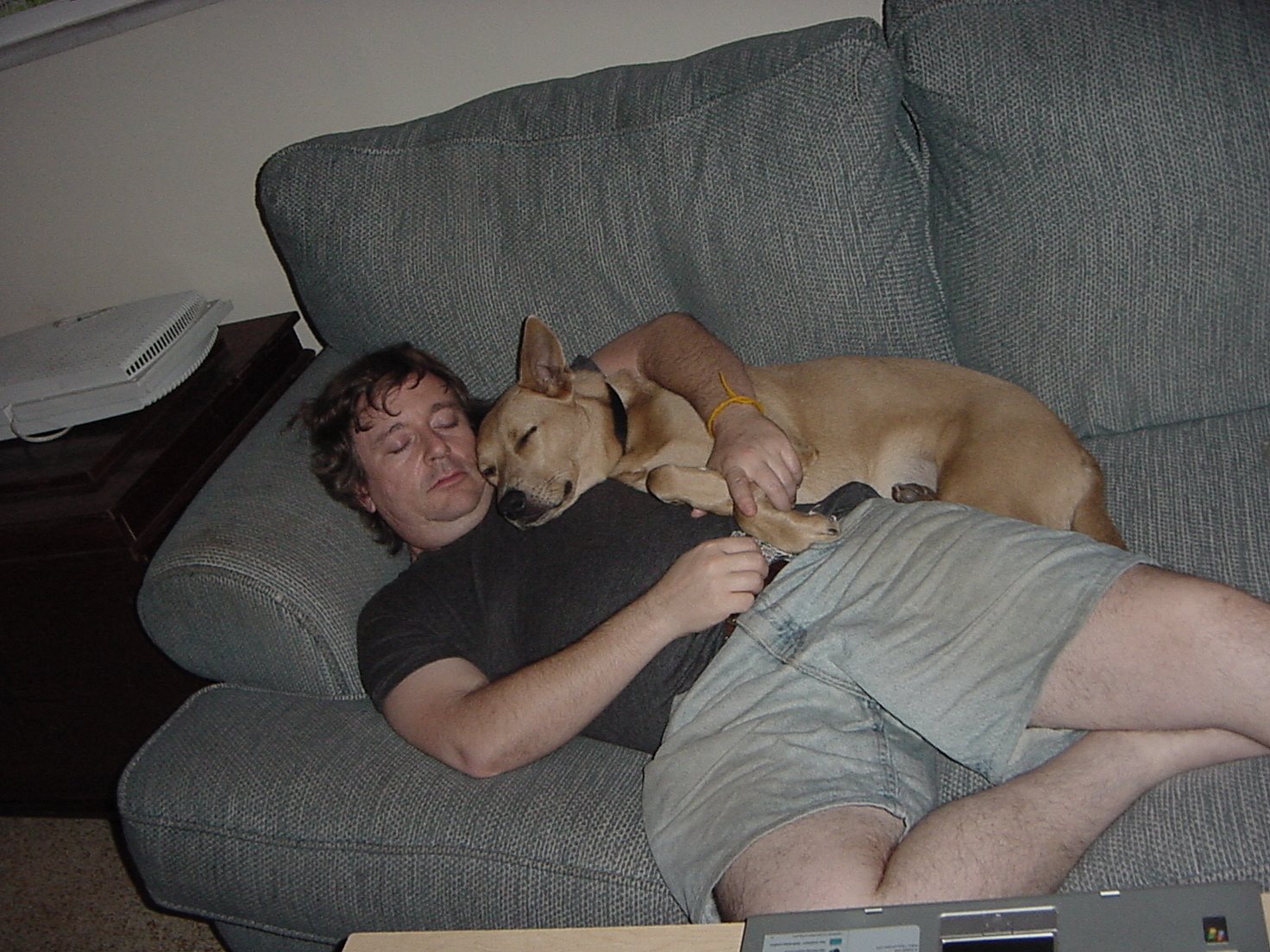
Far from being a baby-eater, she is the most gentle of creatures. She will instinctively sit with the infirmed, laying her head on a lap, patiently allows little ones to pet or pull or poke. She seems to have no preference for any particular member of the household and will become mopey if any one of us is away for too long. If one of us is not feeling well, she is nearly impossible to move from the sick one’s feet. When Lee had a week-long flu, Dusty was in the bedroom doorway all day and slept next to her, half under her, under the bed, all night.

She will walk through a crowd with ease and not give other dogs the time of day no matter how much they bark. She has barked on occasion but rare enough that, when she does, we listen, we get up, we see what’s there.

Dusty the Dingo Doggy went from being a good dog to great dog to wonderful companion we look forward to coming home to, one that can stay in the house by herself, will walk out the back yard when the gate is left open only to sit on the front porch and wait for us to remember we had forgotten to let her in. She plays ball with herself, tossing it into the air and catching it again on the way down.

And there is one more thing she does—Dusty wakes us each morning. As the sun rises, as it starts to colour our south windows, she walks into our room, whistles, puts her front paws on the bed and jostles Lee’s hand with her nose.

Neither of us has ever been a fan of alarm clocks. This is perfect for us. Up with the sun, more day in each day, awake in plenty of time to eat, shower, dress, do what needs to be done and get what needs to be got. No jingles, jangles, bells or chimes. A whistle and a paw.

Each day she wakes us, slipping slightly more than thirty seconds later toward the Summer Solstice and back as the Winter Solstice approaches.

And then came Benjamin Franklin and he screwed it up.

We are big fans of Franklin. My wife from Philly and I from his quotes, quips and scientific queries. There is more to Franklin than most know. Sure, he was a notorious womanizer but, as seen for the times and locations he lived, that seems to detract little from establishing libraries, the Postal Service, and newspapers as cultural standards. It does not detract from the creation of bifocals, which I steadfastly refuse every time I get my eye checked (the ophthalmologist checks them both but I’m not sure why he bothers—I think just look to see the other one is still there), the flexible catheter (which I also have no experience with), the lightning rod, the Franklin stove, the odometer, and more and more. He invented the Glass Harmonica, an instrument of ethereal aural beauty (which, in the early days gave off lead dust, but I accept that we all suffer for our art).

As people who would be happy if our televisions got only Discovery, History, and the Science Channels, that means quite a bit. “Well done is better than well said.” Ben, I agree.

But one thing he did that is fully, forever unforgivable was the creation of daylight savings time.

To be fair to Franklin, he did not really invent it. He suggested though, while living in Paris, Parisians should be awakened each morning by bells and cannon-fire so the stay-ups would tire earlier in the evening and conserve candles. He published this suggestion anonymously.

But the idea was taken up again, later, by William Willett who started pushing the idea in London in 1905. While good for local business that feed from late-shoppers, the original idea of saving candle-wax is no longer quite as valid as once was. Electrical savings are found to be nonexistent with usage simply shifted to the dark morning hours in summer and dark night hours in winter in an economy that does not work simply dawn to dusk. And international commerce certainly suffers, though not as much as agrarian economies still tied to daylight.

In the past, clocks were simply adjusted through the year to divide the day into twenty-four equal parts. The hours got a little longer or a little shorter and things ran quite fine that way.

We think with all our technology we can’t run that way now, but with some areas on DST and others not, we still become fully fouled up. Even in areas that do use DST, there are pockets that do not and time zones that opt out which, this month, are an hour behind and next month are not. Some US counties even opt out.

I say, make six a.m. the time when the sun comes up. We can certainly make clocks that can handle that. If the day is a bit longer, we have a few extra inter-hour minutes between five and six am. If shorter, fewer, but six comes when does the sun.

That way my dog would not be broken.

She was waking us at 7:16, then 7:15, 7:15, 7:14 and, the next day, gently, whistly, at 6:13. Daylight savings time had ended. This morning, as the sun peaked in through the windows, it was 6:04. Next week it will be before 6:00. Come DST again our dog alarm will move ahead one hour and, try as we might, we can find no dial or button to adjust her.

 
8 Comments

Posted by on November 21, 2008 in Culture, Family, History, Nature, Social


Tags: , , , , , , , ,

A Better Wife

I am posting this, originally a response to a post on Route 153, a blog by a woman I know only by the name Indigo Bunting. She lives in Vermont, several universes from here, and is an editor friend of an editor friend. That is a double editor. I’m not going to argue with that. So when Craig said try writing short form and Indigo suggested posting my reply, a bit long, to her blog entry “Girl” as an entry of my own, I complied. I know what’s best.

“If I didn’t define myself for myself, I would be crunched into other people’s fantasies for me and eaten alive.” Audre Lorde

My wife claims I am a much better wife than she.

I am not sure she has worn anything but dungarees in over two decades with the exception of three occasions. I can recall each of them. One wedding, one bar mitzvah and one charity event. I wish to point out that wedding was not even our own. To that we each wore dungarees and t-shirts. If I count pagan festivals, over the course of the last twenty-five years I think I might actually have worn skirts and such more often than she. Makeup? Ha! Cooking? My territory.

Sewing the holes in the clothes? Mine (after she threads the needle for me).

Her shoes are as sensible as can be – Merrels made for standing. The blow drier is never used except by my son. She is a pick the clothes from the pile, wash’n’go, no frills cheap-date of a gal I adore more than the bright stars and the loamy Earth.

And I don’t dare take her into a lesbian bookstore or I need to fight to keep her. I do this as often as I can.

If there were continuum for gender-behaviour, with guyishness staff and girlishness distaff, my Lee would be a bit right of center. I would be a bit left. It all balances out to who the hell cares.

But she does like her purses. Stone Mountain, Dooney and Bourke, Coach. She looks and looks and looks but never bought. She tells her patients they need to ditch their purses and use backpacks. She follows her own advice on this.

Last birthday she decided to treat herself to a purse she had long wanted. A Stone Mountain bag. She spent nearly two hundred on it. She used it for two days and returned it. Not worth what she spent. She was cured.

Then, a few months ago, I found at a local auction a Prada bag. I grabbed it for $35.00. She is delighted. She has her girlie-bag. It is a back pack, of course.

As far as myself, well, I don’t build, I do garden a bit but I do not do lawn work. Fix the house? HA! My father and wife, many years ago, got together and sold all my powertools while I was on a trip. For my own good, they told me. I didn’t argue. Of course, that is the same way I ended up moving in with my wife. That is a different story.

I love opera, but I always retranslate the songs. They are all about cows and barnyard life.

I would rather have a migraine than watch football. Really. I find them less painful and more interesting. They also don’t last as long.

I’ll play soccer but watch sports? Like on a TV? No thank you.

I use the same Jansport backpack my wife complained I overpaid for, at $35 dollars, when my daughter was three. That was twenty-three years ago.

I don’t tinker with my car. I sold my truck a few weeks ago. The truck festooned with breast cancer awareness magnets and a sticker that said “Real men change diapers.” You know, a real guy truck.

Not fitting into a set role makes it easier to allow other people not to fit into roles either.

Ok, now to rebuild what feels to be my diminishing masculinity, I’m going to go tell my wife to cook something and have her get me a beer.

I’d better go buy some beer first. And make dinner reservations.

 
1 Comment

Posted by on September 14, 2008 in Culture, Family, psychology, Social


Tags: , , , , , , , ,

I Love Creosote

I love creosote. Not just the smell, which many people, if not most, find hard enough to believe, but the feel of it as well: the tacky frictional darkness under the fingertips. I love the smell of it as I roam the lumberyard, search out the scent, get closer and closer to a board with just enough of it to get my hands on, my nose close to sticky yellow.

The feel of creosote is harder and harder to find. The smell, though, is not so difficult to come by. On the occasions my wife will drag me to a big-box home improvement store, for it is she who likes the gadgets and tools, not me, I will wander to and stall in the lumber area casting for whiffs of it. If there is an exterior lumberyard, all the better because the outside temperatures tend to drive the creosote to the surface and, if not the creosote entirely, the scent, certainly.

This has been my habit as long as I know. I remember if from Sunday station wagon lumber drives with my father as he would choose boards, plywood, two by fours for whatever project was next on his list. Back then there was more creosote to smell as it was used much more than today, much less discriminately. It was everywhere, oozing from the wood, down the stacks, to the ground. The lumberyards stank of it if I could to, it was heavenly.

One might think these memories are why I love then scent so. Association of a smell with a pleasant memory. True, smell is our deepest, most primal sense, nestled far within the limbic system, the part of the brain we share with lizards. Scent will bring an emotional response more easily and to memories more distant, more faint, than any other sense and it can do so even if the memory itself is lost. The emotional content is still there and scent will bring it back.

But it cannot be so with creosote. These forays to the lumberyards would be followed by build-time where I would be conscripted to help measure, which I never did well, cut, where the sound of the saw would have me doing as I do today – picturing myself falling on a whirring blade, losing bits of my body. Later, as he worked through the night, I, tired, would never hold the light quite right, shine it in the right place. The hammer and power tools would have me holding my ears. Home projects often ended in violence. None of this comes back as pleasant. I never looked forward to trips to the lumberyard. Except, of course, for the creosote.

My brain likes the smell. I like it. Love it. Always did. And that attraction to the scent must, somehow, be separate from those experiences.

When I lived in Gainesville we had an apartment near a wood treatment plant. Koppers would take lumber and pressure treat for exterior use, in playgrounds, in buildings, for gardens. In Gainesville they made utility poles and marine pilings. This involved copper and arsenic. This involved creosote.

Never mind the ninety-four acres of Cabot/Koppers is one of the top superfund sites in the United States. Never mind one could grow a garden in the area but was strongly suggested to not eat the produce one grew there. I could smell the creosote so it was all fine.

Still, today, if there is a roof being tarred, I will linger. If there is a road being resurfaced, I will open the windows of the car or raise the visor of my helmet and breath deeply. Still.

I also like camphor.

 
2 Comments

Posted by on September 13, 2008 in Family, Nature, Social


Tags: , , ,

This I Believe

About two weeks ago, riding in the car with my wife, we were listening to about the only station, locally, anyone is likely to find in our car – NPR. After the story about the upcoming political conventions the series “This I Believe” aired another in its weekly essays. I have written for the project, which can also be found in print, and while I cannot say I listen faithfully or find every one of the essays a treasure, a few stand out. I can remember hearing them and (this is the important part as a writer) they had an effect on me. As a writer, I could not ask for more praise or better praise. The sheer beauty of writing aside, if a work is forgotten, if a reader is not affected, then the sound and glory are nothing.

My favorite is by Penn Jillette and is called “There is no God.” As much a fan of Thoreau as I am, I cannot help but wish he had written this. It seems to be what he was trying to say through much of his time at Walden Pond. The essay is transcendentalism without the deism. It is a wonder of words and I am appreciative.

What we heard that afternoon in the car was by Sufiya Abdur-Rahman and is titled “Black is Beautiful.” It echoed so much of what I had written on the topic of the dark and lonely side of the headlong rush to assimilation and the expectation that we should all want to fit into a homogeneity so stark that we should have trouble telling each other apart. I am not a fan of Hyphenated-American-ism but what is wrong with have identities? I guess I am more a tossed salad American than a melting pot American.

I was moved to write Ms. Abdur-Rahman. It was rather hard to find contact information but I managed to do so by looking her up on MySpace. I sent a note to her from her MySpace profile.

Ms. Abdur-Rahman,.

I am writing to thank you for your essay on NPR.

As a second generation American, it has been my belief we need not be like everyone else to be an American. Indeed, it has been pointed out, and I feel truthfully, the differences among peoples are one of the things that have made this the amazing country it is. I applaud you essay for pointing out we can be, and should remain, who we are at our core.

I am Jewish. I was raised in the North and now live in the South. I have taken my children to see the Civil Rights Memorial in Montgomery to look upon the names of the heroes there and have pointed to the names of the six Jews next to the rest of those who fought for freedom. I have shown them the my parents took pictures of, when we moved to Miami, that said “No Niggers, Jews or Dogs Allowed.” I have explained that giving up our heritage means giving in. And we held on despite my daughter’s high school beatings for being a dirty Jew, the head start teachers command our son should learn to be a Christian so he can “pass” when he needs to, my own difficulties attaining academic posts because I did not attend the right kind of church.

We moved here during WWII. It was my feeling, after having lost two-thirds of my family, that it would be a slap in their faces to assimilate. My parents though, my grandparents, said “assimilate.” They spoke Yiddish. My parents understood it. I can do neither. Now my daughter, 23, and I are relearning what we lost. We have a long way to go.

Your essay brought the importance of that back to us. I applaud what you are doing and bless you for your struggle.

Adam

Adam Byrn Tritt

Did I get a response? You bet. It was quite a heartfelt note back and I shall not share it here. If you want a note from Sufiya, write her yourself.

 
2 Comments

Posted by on September 5, 2008 in Culture, Family, History, philosophy, Social, Writing


Tags: , , , , , , , , , , ,

Seven Questions for Adam: An Interview by Craig Smith

I’ve known Adam Tritt for a few years now, though it simultaneously feels like forever and no time at all. He’s a kindred spirit with enough significant differences to keep things interesting. His blog, Adamus at Large, is where he publishes essays and poetry. He doesn’t post as frequently as any of us would like, but when he does, it’s an incomparable feast of words and ideas.

(Note from Adam: To make this as authentic as possible, I did no revision and answered all questions given without reservation and as the responses came to me. What you see is what was written the first time. I looked back at not one question. I wanted this to be as conversational as possible and not a prepared document.)

1. Why are you a poet?

I am not a poet. What a strange question. To call myself a poet would be terribly presumptuous and boorish. Not only that, but it would set up an unfair expectation and then I’d have to perform. Sit, Adam, sit. Show the folks how well you poe.

I am not a poet, I simply think metaphorically. I think in metaphors about everything. The contents of the world—whether we believe they originate from within one’s head, are a combination of that which is without and the experiences and expectations from within, or come wholly from within one’s head—always rumble around and find things to connect with. Everything is a metaphor. Since I don’t see terribly well and remember nothing of the visual world, I think in words. So I get a picture or a sound and I make them into words.

Well, enough of that and my head fills up, so I write. I can’t stand not being understood so I revise and revise and revise, cutting out everything that is not meaning because I’d hate for people to think something I didn’t want them to. My goal is to lead them to the same metaphoric feeling and understanding I experienced. By the throat, if need be. By the hand, if I can. Though truthfully, by the throat is much more fun.

The poetic model allows me to do this in a way that is deceptively short so people will read it. Otherwise I’d have twenty-six page essays.

I then put it out there for people to read, on the blog, in magazines, in anthologies, and in my own books, because part of me believes Descartes: I publish, therefore I exist. Besides, I like the fan mail and the undies that get thrown at me.

Of course, none of that explains why I also write twenty-six page essays.

Asking why I am a poet is very much like asking why I have two legs. I can’t help it. I’d have a prehensile tail if I could. My wife would love that. It would be like in Venus on the Half-Shell. But I don’t. So I have two legs. So I think metaphorically. So I put everything into words. It’s burden. It’s a pain. I’m simply built that way. It’s not my fault, I swear. I blame my temporal lobe. I once filled an entire sliding glass door with poetry. I write on my office walls. I write on people if they stand still long enough and give me enough exposed area.

2. Your first public reading was at a clothing-optional event, and you performed in the nude. And you’ve written about your visits to the local nude beach, and clearly have no problem with nakedness. On the other hand, you write about how you wrestle with body image, and seem to feel ashamed when you are battling weight. For me, being fat means I don’t want anyone to see me naked, even though I thoroughly enjoyed my one and only visit to a nudist resort, and am a closet naturist (I’ve even been skinny-dipping in my neighbors’ pool while they’re away, when I go over to feed their cat).

So how do you reconcile that dichotomy? How do you find the freedom to be nude with others even during those times when you feel discomfiture over the way you look?

Because I’m ornery. Because, unlike dancing, which scares me silly and I force myself to do, or parties, which scare me sillier and I don’t force myself to do, reading poetry at a clothing-optional gathering flies in the face of so many conventions I have no choice but to do it. I teach myself my fears are meaningless and my self-judgments are baseless and thumb my nose at society at the same time? Hell, where do I sigh up? Can I do it twice?

You can walk all the fire pits you want, jump out of airplanes hoping the chute opens, bungee-jump from any bridge you choose, but for sheer fright, read your poetry in front of a crowd while wearing nothing but glasses.

I always reserve the right to not reconcile anything. No need. What makes sense anyway? I am about as dysmorphic as a fella can get. I just got over yo-yo binge and starvation. I no longer run three miles because I ate a piece of bread. That ended last Thursday. A friend who knows me better than well (bless you Joyce) will notice the look in my eye as we are out to eat and take away the menu and order for me. It’s insane. And so, through all this, while I thumb my nose at the culture I live in I simultaneously thumb my nose at that part of the culture that lives in me and is discordant with my world-view, or at least the view I would like to have of the world.

In my mind, the more I push this particular illusion, the thinner it gets and, sometimes, I can see clearly through it and know it is untrue.

There is another part to this as well. I want the walls, those illusory walls between self and other, to disappear. I want the illusions to go away. I am happiest when I cannot tell self from other. That is a theme in my writing. That is a theme in my spiritual practice. That is a theme in my massage practice and in hypnotherapy. That is a theme in my life. Maybe I know it is true and I am working to make it happen, to experience it as much as possible and bring that to other people as well. Maybe I am just trying to convince myself that it is so. Which depends on when you ask me.

And let’s be clear—I do not seem to feel ashamed when battling weight. I have, in this area, a self-disgust that is deep and abiding. It’s open 24/7 and never takes a vacation. I am not sure where it came from and I’m not sure when it’s going, but my job, since I can’t seem to shake it, is to be happy anyway. Happy with the world around me. Happy with myself. My job is to thumb my nose, even from within, at anything that keeps me from being happy, at anything that keeps the illusion of separateness alive.

Besides, I am awesomely cute.

3. In both “Funeral, Expurgated” and “My Grandmothers Came from the Ukraine,” you talk about the quandary a writer faces over how much personal or familial information to reveal and how much to conceal or change to protect the innocent (or guilty). David Sedaris, when asked if his books should be filed in fiction or nonfiction, replied, “Nonfiction. I’ve always been a huge exaggerator, but when I write something, I put it on a scale. And if it’s 97% true, I think that’s true enough. I’m not going to call it fiction because 3% of it isn’t true.” And I can’t remember which writer says that the first duty of a writer is to kill his family—that is, write as if there were no one to offend, no one who would be upset if secrets were revealed.

So how have you struggled with the issue of “truthiness” in your writing? And what kind of fallout has there been among friends or relatives when you’ve revealed something that they would rather keep quiet?

Some of what I write falls into the category of New Reporting or New Journalism. Some into creative non-fiction. But, regardless of what I write, I have never let the facts get in the way of a good story.

Many have made the mistake of thinking every piece I write is true just because most of it is non-fiction. So the poetry must be as well. Sure, some of it is but much of it is not. Poetry can be creative storytelling just as much as any other type of writing. My daughter never gathered angels in a field. My wife never complained about her life over coffee as I dreamed of moving west. But with few exceptions, what I write is based on the amazement of that which makes up everyday life. So I did almost hit a wall while she was changing in the passenger seat and the monk did make the spoon stick to his nose. But just because most of it is true does not mean it all is. I reserve the right to tell a story from time to time.

Given that, those who read me know if you see a name in the essay, the account is true. Percentage? If you see a name, it happened. If you see my name, I reserve the right to make my life what I choose it to be. If that is after the fact, then that is just fine with me. My memory is fluid.

That said, there are some things I just don’t write. I don’t write things I feel will hurt a person or compromise them in some way. I have made that judgment incorrectly from time to time but I never set out writing knowing what I am putting down will hurt. I can’t do that. It’s not in me. Even if the person has done me harm, I won’t.

There is so much out there to write. There is no need.

As far a narrative therapy goes, that is the truest account, the most full exposition I can manage. Your example of “Funeral, Expurgated” is narrative therapy. So is “The Shadow.” I write them so fully, so completely there is nothing left inside and, in the end, the content is all without and not within.

Many fail at narrative therapy and are sure it does not work. But they just write it once and get it out in the immediacy of the moment. That is ineffective. To work it must be revised and revised and revised again, experienced over and over in the writing, pared down, blown up, filled and emptied until it is all truth as you see it, until it reads like drama and feels real to one and all. Then, and only then, is it out.

In the essay you mentioned I spoke about the potential fallout a writer can experience and the fear that can engender. My wife, I mentioned in the first paragraph or two, said she cannot grasp the bravery of writing in tha manner. Sometime, neither can I.

But I did not think I wrote anything that would hurt anyone. As my daughter had pointed out, if they thought what they did was wrong or embarrassing, then why did they do it? One would think they felt their actions just fine and so why not record them?

But I did hurt some feelings. After it was out for a while my mother calls with some confusing story about an email and a letter and whatnot. It took me quite a while to put the bits together and figure out it was about the essay. The feeling was, I gathered, that I had aired the family’s dirty laundry in giving the blow-by-blow account of the funeral days.

I have a very small family. Now, it is much much smaller.

4. A casual reader of your blog may be confused about your spiritual inclinations. Are you a Buddhist? A Jew? A Unitarian? A Pagan? How do you reconcile all your disparate beliefs? Or are they really disparate after all?

I am a Jewitarian Buddhaversalist Pagan. What could be more clear than that? I follow the shamanic elements in Judaism as well as in Buddhism but find Buddhism and Judaism are quite similar in their emphasis on tikkun and right action.

I am, of course, a panentheist. But I am also a solipsist and once attended a convention of solipsists where we spent the entire weekend trying to figure out which of us it was.

I spent ten years studying with the Center for Tao and Man. Master Ni told me I had the cosmic egg. What difference what I call it? OK, so I am a Taoist. I follow the watercourse way and sometimes that flows through Judaism and sometimes it washes me into the Thai Buddhist Temple where the abbot explains to me the deeper meaning of the Kol Nidre.

After many years of attempting to reconcile seemingly disparate paths, I have stopped any attempts at reconciliation. The result is that all things now seem much more similar and it becomes more and more difficult to see the space between them or recognize there are differences.

Besides, name one cantor who does not like to be accompanied by a rattle or drum.

5. Tell me about turtle shells.

[Note: I had a turtle shell that I brought out whenever I did any group shamanic work. Every time Adam was present, he clutched the shell as if it were a talisman or protective shield. And when I do energy work with him, particularly when I use quartz or amethyst crystals, he seems to find the shell soothing, since my energy feels “edgy,” for lack of a better word. It became clear one evening that the shell wanted to go and live with Adam.]

The carapace is the dorsal, convex, magical part of the shell structure of a turtle, though a turtle would argue it is concave. It consist primarily of the ribcage which is a strange concept because there is never any chance of the ribs escaping. The spine and ribs are fused to bony plates beneath the skin which interlock to form a hard shell when blue and yellow make green, locking freshness in. Exterior to the skin, the shell is covered by scutes, horny plates that protect the shell from scrapes and bruises. Underneath they are made of backhoes.

They are alternately named Don, Horace, or Filbert.

They are not like crystals at all.

They go wonderfully with a cup of papaya juice and Northern Exposure.

One called to me for a year before it ended up coming home with me.It was playing hard to get.

If you lie one on your stomach, you might not have seizures.

Turtles don’t mind.

6. A dear friend of mine named Geralyn said an old chum once told her, “You know what’s so wonderful about you, Schulz? You can’t sing worth a damn. But it never stops you!”

I know you love to listen to music—music of all genres, music that makes you think and feel, with a smattering of Broadway just for good measure—but I think you like making music even more. Singing for the joy of it.

I remember a workshop you conducted on chanting. It was something everyone could do even if they couldn’t carry a tune. And there’s that wonderful Yom Kippur piece you wrote where you imply that chant and prayer and incantation are different aspects of the same thing.

So what does singing give to you, or do for you, that other forms of creativity do not?

Everything sings. The Earth sings from beneath and around us. Everything on/in/apart of it sings. We come out of the Earth and go back into the Earth and, therefore are never apart from the Earth, and so we sing. Any part of a whole carries the nature of the whole. So I do a whole lot of singing.

I think everyone should. And, no, it does not matter if the person can carry a tune. Sing. We are made of an Earth that sings and it is a function of our bodies. We get caught in subjective notions of quality which we mistake for objective ones and which we then assign value to. People do not sing because they are not good at it. But we do many things we are not the best at. We don’t see people refusing to walk because so many other people do it so much better. So sing.

Music reconnects me to all that is around me. I can disappear as a separate entity—the illusion of disconnection evaporates—when I sing. When I am singing with others in harmony there is an experience that is ecstatic, in what I feel is the true sense of that state: I am outside of myself. The harmony creates a larger sound that is made of but is not simply the voices that create it. The harmonious vibration is larger than the sum of the voices. Larger and different. And that applies holographically from the macrocosm to the microcosm, and fractally from the microcosm to the macrocosm.

What is it that vibration does not do, is not made of? I remember someone wrote somewhere in some well-known book something about “In the beginning there was the word; the word was in God’s presence, and the word was God.”

Names, sounds, create things. And it is the naming that creates separation and, therefore, identity. It is my feeling that what wounds can also heal, and sound heals. Singing heals. Music heals. The cantor sings to the congregation the holy words. We chant holiness. Incantations create. All is sound.

Other forms of creativity are, for me, secondary. They are derivative. They pale. To learn to write I took music classes. My writing exists because I do not play an instrument well.

7. I actually went back and reread every single entry in your blog this evening. I teared up at a few, but mostly I smiled. Or sighed. I am honored to know you.

One of my favorites (though to pick even a Top Five would be next to impossible) is Day of the Manatees. There’s a quote by Henry Beston that we both like—in fact, we’ve emailed it to one another, forgetting that the other had already sent it to us—that goes:

We need another and a wiser and perhaps a more mystical concept of animals. Remote from universal nature, and living by complicated artifice, man in civilization surveys the creature through the glass of his knowledge and sees thereby a feather magnified and the whole image in distortion. We patronize them for their incompleteness, for their tragic fate of having taken form so far below ourselves. And therein we err, and greatly err. For the animal shall not be measured by man. In a world older and more complete than ours they move finished and complete, gifted with extensions of the senses we have lost or never attained, living by voices we shall never hear. They are not brethren, they are not underlings; they are other nations, caught with ourselves in the net of life and time, fellow prisoners of the splendour and travail of the earth.

If you’re a panentheist, then you believe that God (however you define the concept) interpenetrates every part of Nature. My friend Tim has a wood carving of a fish; on the side is painted the word COD, except that the bottom of the C curls in just a tad too much, making it halfway between a C and a G. It’s the God Cod. (Or, for the dyslexic, the Dog Doc.)

Speaking of dogs, here’s my second favorite zen kōan: A monk asked Zhàozhōu, “Does a dog have Buddha nature or not?” Zhaozhou answered, “Wú!” (Wú means “no” and “non-being,” and is also the sound of a dog’s bark.)

There doesn’t seem to be a question in there anywhere. Hmmm.

How’s this: Manatees. Dogs. Cod. Us. God. If all our separateness is maya—illusion—then do manatees bark, and does God swim in Turkey Creek?

Hafiz tells us:

Ever since Happiness heard your name
It has been running through the streets
Trying to find you.

And several times in the last week,
God Himself has even come to my door—
Asking me for your address!

If God can come to my door, I am sure God can swim in Turkey Creek.


Tags: , , , , , , , , , , ,

Graduation Speech

I graduated massage school this week. I was asked to give a speech at the graduation.

So here is what I said on Saturday, August 16th, 2008. Three minutes and fifty-two seconds.

*****

Good afternoon.

I have never attended one of my own graduations before. Primary, secondary, high school. None. College. None. Confirmation of neither graduate nor postgraduate degrees ever moved me to attend a graduation. Never have I desired to attend a graduation. Not until today.

Twenty-six years. That is how long I have waited to arrive at this point. While some of these students have seen the ink barely dry on their GEDs, some of us have had one, two or even three careers before coming to this point. For some, this has been a dream a long time coming.

In my case, I had spent a quarter century in public service as a social worker and, then professor and teacher. As an eighteen year old I sat with my wife dreaming about when we would have a practice together, a holistic center, not knowing what our roles would be, but knowing what we wanted to do there. Then came work and children. Actually, children first. I got degree after degree as they became useful or increased my income or opportunity. But none did I want for the sake of my soul.

And so, twenty-five years later, by a fortunate turn, by hard work, by the grace of my wife, who, without doubt or exception, is the single most incredible woman this Earth has ever been graced to see, I was able to enroll, finally, in a program that, in her words, made my heart sing. The thought of practicing massage therapy did make my heart sing. So I cast my die, said goodbye to teaching and picked up study instead. I set my sights to get through this program. That was it. The first day I was asked who I was and to tell a bit about myself. I answered thus. I am asocial, not terribly nice and I am here to learn. Leave me alone. My classmates may agree with me, depending on who you ask.

A year later. Twenty-six years total waiting, and I am a hair’s breadth from working with my wife in our own practice. A dream we have had for more than half our lives. I am of more use than I have ever felt, more settled in my body than I have ever been and, closer to realizing our dream than ever before.

Further, I have discovered an interest in and have been exploring indigenous and shamanic bodywork practices and plan to continue studying and using then in my practice. Why? Because it is healing for me. Because I believe it healing for my clients. Because it makes my heart sing.

Now, each day I wake I can look forward to a short ride down the street, to being with my wife in a practice we dreamed about for so long and so long ago. That is what the last year has brought. That is what this school has helped bring to me. It is now up to me to take this and do something grand. Something that makes my heart sing.

I suggest you all do the same.

*****

My wife referred to it, over and over, as the white trash show. Tears were flowing everywhere. There was hooting and hollering. I was congratulated, by Craig for the skillful way I kept my eyes from rolling. Lee and Craig kept each other company, and sane, during the proceedings.

I was called to speak. Before I could I had to remove the box of tissues from on top of the lectern as I could not be seen behind it. Jennifer was not there, which emptied part of the meaning of the graduation for me, but I would read the part written for her anyway. I owe her that much, at the very least.

I spoke. But so did anyone else who wanted to and at great length. One kept referring to palpation but defining palpitation. Still, I am not sure what either was doing as the topic of a graduations speech. The last speaker was autistic. I am not sure what she said but it involved quite a bit of breathing.

There was theme music. “Brother Can you Spare a Dime” and “I Got Plenty of Nothing.” That is still beyond my ken. The owner of the school gave us each an extended Christian tract.

Midway through I left the students and joined my wife. The entire affair took nearly two hours.

Afterwards, I had a beer.

 
5 Comments

Posted by on August 17, 2008 in Culture, Education, Family, Social


Tags: , , , , ,