RSS

Category Archives: Culture

Gravity and How the World Sinks

Malabar Road as I approach Jupiter Boulevard in SE Palm Bay. I am driving east toward US1 and the Indian River and the Atlantic Ocean. While the road boasts a Wal-Mart, Home Depot, Publix and every other shopping convenience one could want, except a decent place to buy produce, and no good cheese shops, and no book stores and… Ok, Big Box Alley is what it is, behind this road it is all residential so one sees plenty of people walking and biking up to Malabar Road and over to the ice cream shop, Subway, movies, library. Adults and kids, couples with dogs, friends in sweats, teens on bikes. Lots of kids on bikes.

As I cross a canal, I see to the right a bike with a middle school child stopped on the sidewalk bridge. Strange. Middle school kids on bicycles are not stationary spirits but creatures of motion and here is one stopped, looking behind him, which leads me to scan the area around him. At thirty miles per hour on a crowded road this is not what I should be doing.

I look behind me, out the passenger side and back windows of my truck and behind the child on the sidewalk. About ten feet behind him is a child, smaller, sprawled face down, prone, head arched up, looking forward. I cannot tell if he is laughing or crying but his mouth and eyes tell me he did not expect to be where he is now. Behind him, but a foot or two, is a bike – sideways, flat and not in anyway the position one would expect a bicycle to function. Neither bicycle nor boy look right. Gravity.

I should stop. He may need help. Car after car is driving by. He lays there. The boy ahead straddles his bike, body forward, looking backward. More cars go by as the distance between the prone child and I increases and I continue to think I should stop; turn around and go back, turn around and pull over, get out and see if he is ok.

But what if he is? What if someone gets the wrong idea? People are funny these days. Will the help be welcomed? Refused? Feared? Isn’t the most important thing that I try and do what is right regardless? And there is a police car a few lengths behind me. Surely I needn’t go back now because the officer will see the fallen child and stop, check to see of he is ok, help him up, take him home if needed.

The Palm Bay police car drives by. Drives by. Drives by? What if I stopped and the police saw me with the child? Would that have stopped them? What would it take for the police to stop?

I am well past the child. I did not do what was right and allowed fear to keep me from doing the right and compassionate action.

I pass Wal-Mart and am cognizant I have done wrong. I chastise myself. Is the child ok? Upright? Still flat upon the sidewalk?

I have been in the same position. No-one stopped to help me. This is how the world sinks. In increments. One fear at a time.

 
1 Comment

Posted by on October 30, 2006 in Culture, philosophy, Social


An Obscenity

Danny Rolling was executed today and they want to know what I think about it.

It is 4:34 in the afternoon. I am in the office of Jeannette Westlake, acupuncturist and herbalist extraordinaire, when my cell-phone rings. Normally I would not bother to reach for it, sitting there having my pulse read, discussing how my week has been, how I’ve slept (very little), what my energy level has been (very little), and how much I like my job (very little), but I felt the need to answer it, knew I needed to, and reached for it. I did not recognize the number but it was a Gainesville area code. I flipped open the phone.

Hello?

Is Adam Tritt there?

Yes. And who is this?

Miles Doren with AM850. I spoke with your wife earlier and was wondering if she got to you before I did.

Why, yes, she did.

Oh, good, then you know why we want to interview you. Is this a good time?

No, actually. I have no idea.

But I thought she got to you before I did.

She did. About twenty-five years before you. But I doubt you want what she wants. You don’t, do you?

Oh, I see… (pause, extra long) I wanted to ask you a few questions about the Student Memorial on the 34th Street Wall.

Again? Why? Have they measured how thick the paint is again?

No. They are executing Rolling today.

Are they? I don’t keep up. Why would I?

It is a reporter from Gainesville. It is a bad time. He wants to interview me about Danny Rolling. I have no desire to talk about him again. Again and again. Again.

I’ll have to call you back. Will a half hour be ok? Just in time? Oh, you want to talk with me before he dies. He has less than two hours. I see.

His death has been scheduled. I think of how some feel God calls a person home at a certain time, pre-determined. We do the same. At a little after six this afternoon, in Starke, Florida, we will do what some say only God should. We will commit the act profanus. We will be obscene.

My appointment has finished and I am in the truck and on my way to a peace rally. It is being held in front of a candidate meet and greet. It is at least twenty minutes away and I call the reporter back after plugging in my earphone.

Yes, I am the person who created the student memorial. No, I didn’t do it alone. Paul Chase lives in Gainesville still. Call him. No, I didn’t know Rolling was being executed today.

●●●●●

I have ceased writing. I feel teary and stop to call Paul. It is a few minutes after eleven and too late to be calling and I call anyway. I need to talk, vent. I feel he would understand. He painted the wall with me. I want to tell him how the interview was. How they talked of Rolling continuously. I want to tell him they didn’t understand how I could be against his death, any death. Treated me as though I, whom they had called, had suddenly blackened the names, darkened the day of their celebration. How the interviews ended in awkwardness and the semi-silence of the confusion of a person not hearing what they expected to hear and not knowing what to say in response.

He doesn’t answer and I leave a message. I write more and soon go to bed but it takes me longer than I hoped to sleep.

●●●●●

There were small memorials all over the city. Terse, frazzled, at once jangled and quiet with desperate attempts at safety, small rings of candles, tiny altars, flowers and wreaths were everywhere. People were doing their best to deal with the murders: five students in 48 hours – senseless, absurd, heinous, brutal, in-human.

We sat in an apartment in Corey Village, married student housing for the University of Florida. Paul and Dulce, Myself and Lee. Two couples. There is a wall nearby people had been painting on for years. Graffiti, signs, birthdays, slogans, political, social, comic. The 34th Street Wall was the city’s billboard and the police turned a knowing blind eye to the midnight artistry and the rest of the city stayed clean and clear. It was there we decided to place our memorial. It is there. The memorial is still there. That was 1990.

Somehow, after the memorial, people stopped arguing so much about whether the wall should exist. It was as if Tritt’s panel had become something the town needed.

When the city last resurfaced 34th Street, the plan to widen the bike lane would have required tearing out part of the wall. Instead, the DOT’s Busscher said, officials opted to narrow the median to protect the graffiti.

Sixteen years later, the black-and-white panel hasn’t changed much. New students, who were toddlers when the murders occurred, seem to know not to paint there, even if they don’t know why. (Kelly Benham, 2005. St. Peterburg Times)

We got flack from our wives. The expense. No-one had gas or grocery money. How long would it take? Do you know how? Isn’t it illegal? We don’t have money for food let alone bail. We took the flack. We also took the Honda Spree, both of us on it, to Wal-Mart at nearly eleven at night and bought mistake-paint of whatever colors were there for a dollar or two a gallon, some brushes, a roller and a pan. We spent $11.25, put it all in the milk crate behind us on the scooter and all of it 49cced back to the 34th Street Wall. It was nearing midnight.

More questions. All this is available in newspapers and on television. It was on CNN and 20/20, The St. Pete Times and Tampa Tribune, Miami Herald, Ft. Lauderdale Sun Sentinel, Gainesville Sun, The Orlando Sentinel, The Alligator (where it tore apart the staff and ended potential careers), manifold college newspapers. USA Today, Florida Today. It is in them again and again and again.

My son, 2006, at Palm Bay High School in Melbourne, learned about me in history class, in law class.

At the tenth anniversary, 2000, I was invited back to Gainesville by Keep Gainesville Beautiful and the Tenth Anniversary Foundation. I was thanked in public by officials, by Lt. Sadie Darnell, then spokesperson for the Gainesville police. Privately, later, I told Sadie (who is now running for Sherriff of Alachua County… You go Sadie!) it set a bad example, having me at a golf course function, thanking me in public for an act of vandalism. I was cried over by the families of the five. Why did I do it they wanted to know. It was the thing to do. There was no question.

It was just right. Our thought was the city needed a focus; one place for tears and altars and vigils, one place to pool energy. The wall was recognized and it would be. It would last a week, maybe, on this wall of the ephemeral and the transitory, before being painted over, reclaimed. Maybe not even that long. It would be enough.

We rolled on the black paint at the selected spot; the crest of the wall as it follows the hill at the south wall of the U of F Golf Course on one side, and, on the other side of that serenity, a main artery of the city and one of its busiest streets. Rolling on the midnight paint in the pre-morning darkness. We painted a twenty foot section. Occasionally a car would go by and we would lay low. We didn’t know there was no need.

Then, a large white heart on the right. A red heart in the center of that. The five names on the other half of the wall. It took us until nearly four in the morning before we finished our rough painting, under the heart, “We Remember.” We cleaned up and went home. Paul to Corey Village and me, taking my scooter back to my trailer at Windmeadows. It was the thing to do. There was no question. It was enough.

The next morning there were flowers at the wall. More by the end of the day. By the evening, there were wreaths, candles, altars. People taking pictures.

No. we didn’t expect it to stay. It never did, never does. In the space of a week, with the memorial still at the wall, part of it had been painted over with something rather callous telling us “People Die.” True enough. But, by mid-day, it had been repaired. People were taking it upon themselves to keep the memorial intact. We knew people who kept paint for just that purpose. Across from the wall was Spanish Trace apartments. Residents would notify the right people if the memorial was defaced. It would be fixed by day’s end. A month had passed. We were astonished. An actual group had been formed. They called themselves “Keepers of the Wall.”

In a year, we could barely believe it. Phone calls, interviews, pictures and I told one reporter I actually had thought of painting over it myself. Why? Time to move on, to not have murder as the central focus of the city. And who had a greater right to paint over it than me? But the wall belongs to the city and they had taken the memorial as their own. As long as they took care of it.

And every time they did, it was just a little different. Neater this time, an extra heart another, Always changing slightly.

Five years past. It was still there. People had come and gone, stewardship had passed from person to person, care was taken that care was taken. Fraternities took keeping it up as a social concerns project. Families made it their business to keep the area neat. And then, the father of one of the victims asked the city for permission to do what had never been done: make a portion of the wall permanent. It was granted.

A permit was issued to allow, actually allow someone to paint on the wall. And not just paint, but build. A coquina shell frame was created around the memorial. Our handiwork, the continued handiwork and labour of care was covered with a protective clear coating that would allow any paint put on it to be washed off. The ephemeral had become permanent. The transient, stagnant. That is never a good idea.

It cost quite a bit. And someone made more money off it than they should have and sold the family an inferior coating. It leaked. Water got in. In a few years, it was in need of repair. The Ten Year Anniversary Foundation was created. They needed money and lots of it. And this time it would be done right.

I was asked to take part in the repainting. They said they wanted the continuity of having me help strip the old paint and repaint the memorial anew.

I met some of the parents, grandparents and siblings and there were more pictures and interviews and scraping and chisels and the paint came off in sheets and chunks nearly an inch thick. How many layers of paint in the space of nearly forty years of constant covering and recovering? Well, for the central section, thirty years. Thirty. An inch thickness of paint, nearly two inches in some swollen sections, comes off and cover the sidewalk. Over the space of a weekend, done.

The wall is prepared. I am asked to take a brush and paint. I do, making a brushstroke, then another, then handing it off to a family member, a Paules, a Taboada. I have done what I was asked and I am finished, but for the new set of pictures and interviews.

Now it is sixteen years. The reporters are calling me again.

This is a radio interview.

How do you feel knowing Rolling is about to die?

I turn my phone over and look at the time. 6:10.

I feel terrible. No, I do not believe in the death penalty. It is not a deterrent. No, I feel it is an example of the power over structure and this is accepted so in our culture that those with more power feel it is acceptable to wield it over those with less, as Rolling did over those five students. Silence.

What he did is beyond horrific. And not one person would say he isn’t sick. Torturing someone and slowly bringing about their un-natural death as they wait, a passive participant in their own end. No good person would do what he did. No good person would torture someone with the fear and knowledge of impending, un-natural death. Worse yet to have that scheduled, planned. Who could live with that? A day? A year? Sixteen?

No, Ma’am, I’m not saying how could Rolling live with that. I am asking how could we? If no good person would do that, what are we? What are our laws? What does that make us?

So you don’t feel he should die?

I don’t believe we should kill him.

But what about the families?

She wants a specific answer. I am not following the script and she is pulling at anything she can to elicit the sound bite that will work for her; the one that will do the job. A place for my voice has been scheduled, blocked out, set aside and what I’m saying simply isn’t going to do. I does not fall within their plan and the reporter seems upset I am not validating her belief of what I should believe. And she sounds astonished I feel as I do. That I could feel as I do. Do I get angry? Yes. No, it should not have anything to do with my stance. We are to temper our feelings with knowledge. Why else be human?

Someone once told me something about the angels of our better nature. It stuck.

The families deserve more than revenge.

I tell her while I disagree, I hope it brings them closure. I hope it brings them peace.

6:12

●●●●●

Rolling has been in the execution chamber for some twenty minutes. Two intravenous tubes have been inserted into his arms by the execution team; one in each arm. These tubes feed through a wall into an anteroom where the executioner is located. He is on a heart monitor and strapped to a gurney as saline solution begins to flow through the tubes.

Sodium pentathol, at two grams, comes next. This is a short acting barbiturate. It is designed to render the inmate unconscious. Florida has had botched lethal injections. The best laid plans…

The warden gives a signal, the execution team begin with another flushing of saline and then pancuronium bromide is administered. This will paralyze the diaphragm and lungs.

More saline. Then potassium chloride. This interrupts the electrical signal of the heart and it stops beating. The syringes are numbered in order.

●●●●●

At 6:12 the reporter asks if I have anything else I’d like to add.

Yes. In the time I have been speaking with you, you have talked about no-one but Rolling. You talk as though it is wrong of me to not want his execution. The real shame is you keep talking about Rolling, but you never, not once, mentioned the names of the students. Not one time did I hear any of their names. You are more interested in celebrating his death than their lives.

Let us put their names here, right now. Sonia Larson, Christina Powell, Christa Hoyt, Tracy Paules and Manuel Taboada.

I am reminded that, in Lancaster, Pennsylvania, recently, two students, Quakers, were murdered. Young children. The Quakers reached out not only to the families of the slain but to the family of the slayer. They honoured the lives of the children by supporting peace. This is not supporting peace. This is perpetuating violence and the students deserve more than that. They deserve better than that. Their families deserve better than that. They deserve better than a wall and vengeance.

“I feel like I should have a sign placed on me saying that I remember Christa, but not with this killing.” (Bonnie Flassig, Gainesville resident now and then and a neighbour of Christa Hoyt)

I turn over my phone to glance at the time. 6:14. At 6:13, Danny Rolling was pronounced dead. While I spoke. We killed a man while we talked of him. Obscene.

I think maybe that interview did not make it onto the air.

Good. Maybe they’ll stop calling.

 
16 Comments

Posted by on October 26, 2006 in Culture, Gainesville, philosophy, Social


Tags: , , , , , , , ,

Yom Kippur as Manifest in an Approaching Dorsal Fin

It is Yom Kippur. A Monday. I have taken the day off work to walk, meditate, think. I have taken the day off work so I could go to temple the night before and not worry about the time, the hour, how late it was getting, when I would need to get up.

We asked our friends to go with us. In our back yard, playing with clay, our conversation set on cognates and religion. I mentioned the Buddha of compassion, Amitabha, and the other name for him, Amida. How the Amidah is the name of a prayer of compassion during Yom Kippur. How it relates to the fruit, almonds, as the ancient Hebrews saw the almond as a symbol for watchfulness, promises and redemption. How the part of the brain which we know to be the seat of our ability to see things in a global, compassionate way is called the amygdala, from the Greek ‘amugdale,’ meaning almond. Craig started talking about the Kol Nidre prayer and, being Craig, translated it for us and we sat, transfixed, as often we do listening to Craig. Lee, Evanne, Beth and I, listening to Craig.

Of course we listen to Craig. He, translator of dead languages. He, who juggles biblical text back and forth from language to language, from meaning to meaning as though the passages are but palm-sized bean bags. He, of the three books of translations. Yes, we listen when he speaks.

As we talked, we discovered he had never been to temple, had never actually listened to the Kol Nidre. Neither had Beth nor Evanne and that, of course, was not a surprise, growing up in the Midwest: Ohio and Nebraska, Methodist. Right then, we asked if they’d like to go with us this Yom Kippur, to the Kol Nidre service; the only one we go to.

They were surprised. Craig said he was honoured. Evanne agreed with a clear look of shock on her face. Beth asked if we’re sure it was ok and told us how special it was to be asked; how appreciated it was.

That was months ago. We asked the small, local temple if we could come and bring three guests. No problem. May we have their names and do they have any departed they would like Yizkor candles for? Yes. We were set to go.

Erev Yom Kippur arrives. Lee is under the weather and cannot go. She asks that I go anyway and I resist but she does not want to disappoint our friends.

Evanne worries whether she should have her hair covered. Beth is concerned she looks like a ‘goy.’ Lee tells her, jokingly, that she should proudly announce she is a shiksa. I suggest against it and let them know it is an honor that they are going and the congregation would be overjoyed they are there.

They are worried. No need to dress well; not for this congregation. But they do and Beth’s heels put her so high above me she has to bend over and I must tip myself up on my toes to kiss her on the cheek.

Both wear black, notice their shoes are made of leather, point out they have worn black and now discover the color of the holy day is white. No-one will be following all these rules. No-one will notice.

Evanne, married, wears a scarf on her head, long and flowing, tied into her hair, nearly as long, nearly to her thighs. She could be Golda and Tevye’s shorter, forgotten daughter. She could be from the shtetle. No-one will guess she isn’t Jewish. Beth actually looks Jewish and no-one tells her this. How to explain what that looks like?

Craig fits in perfectly but is wearing shoes for the first time in, perhaps, more than a year. I offer him one of my tallit (prayer shawls) and a kipa I think will fit him well, gold and silver. He tells me he is honoured to be invited and I am privileged to give him my tallis to wear.

We arrive, are greeted, take prayerbooks and I search for a large print version, find one, enter, find a place in the pews close to the front. Myself, Evanne, Beth and Craig. I leave space to my right, where Lee would sit, where I would be able to see her.

We talk, discuss translation, Craig notices the Kol Nidre is not translated literally and, a game of telephone, shows me the text clues by showing Beth who shows Evanne who shows me, differences in font, serif versus sans serif, that tell a careful reader what is a translation and what is a paraphrase.

This congregation, Mateh Chaim, has, as yet, no home. And, yet, we have been welcomed even though we swell their ranks and available room. Even though there are non-Jews among us who need not be here. The congregation is growing and hopes to have one, but there is, in thoughtful congregations, a balance between the need for a building and the needs of community; the understanding an edifice takes money many of the people here tonight don’t have. It is the only congregation in Palm Bay. It meets tonight in a Methodist church. Behind the portable ark, containing the Torah, is a twenty-foot cross. It is not the building that makes a congregation.

I do not mind this so much. We talk, quietly, as we would before any service. Evanne tells us she is glad to see me misbehaving as usual as it puts her at ease.

Misbehaving? I ask. She answers I have said ‘ass’ twice since sitting down in the pews. She says it like this: “You said a-$-$ twice since sitting your a-$-$ down.” Silly. Anglo Saxon not allowed for a Methodist?

I think, momentarily, of our Yom Kippur in North Carolina. We were alone. No-one around us had an understanding. I listened to Kol Nidre on Internet Radio.

Joel Fleishman had a similar experience on the television program Northern Exposure in an episode called “Shofar, So Good” (1994) when, on Yom Kippur, he was visited by Rabbi Schulman. Our program opens with Joel, physician to Cicely, Alaska, carbo-loading in preparation for his day of fasting. He is attempting to explain Yom Kippur to the ever-interested residents as they eat at The Brick, the inn and tavern, and has little success. This is mostly because he has only a tenuous, superficial understanding himself. He knows the words, he knows the rules and proscriptions, takes care to keep the fast, not wash, not to care for personal convenience, to give the day up to feeling keenly, sharply one’s place in the world and relationship to God and our fellows. He sees the holiday as a noun with a set of rules, not a verb with a set of tools. To Joel, it is no longer a living tradition and he does not know what to do with it. On top of this, he is lonely for those who know his tradition.

Our Good Doctor Joel, while in the midst of his fast, was visited by the Good Rabbi Schulman who, as surprised as Joel, was lifted by a shaft of light and deposited in Cicely to help Joel understand what Yom Kippur is really about and Dr. Fleishman begins the process of making amends. It is a journey, a Hebrew Dickensian vision quest, which starts with the Good Rabbi occupying the space of the top head of a totem pole. Jews, after all, are tribal too.

Not too surprisingly, the members of the cast who understand Yom Kippur best are the shamans.

But I am not alone and I revel in this. Craig tells us the history of the Kol Nidre. The actual translation, the ‘Kol Nidre Controversy’ surrounding just what the proper place and ramification of the prayer is.

Kol Nidre means “All Vows” and it absolves us of vows and promises made that we needed to make to survive but knew were wrong. It apologises and gives release from the many times we said Yes when we wanted to say No, but did not because our jobs, food on the table, roofs over our heads, our safety, our security meant we had to say one thing, do one thing, when another was what we knew was proper.

He explains, my teaching middle school is my Kol Nidre. My giving grades, requiring students to do what they have no desire to, that is my Kol Nidre. When I teach them to pass a test when they want to learn creativity. That is my Kol Nidre. When I do that which I must to put bring food and security, when I do not call those around me on their actions because I must protect my job, that is my Kol Nidre. When I do not, can not, must not act in accordance with my true self; my Kol Nidre. When I do something I must instead of write and create. Kol Nidre.

Evanne points out that is exactly what the abbot at the Thai Buddhist temple told me, that I was doing what I needed to and need only recognize that and the needs of fitting into our community and of survival and taken into account in the realm of Karma.

Yet, even those vows I take seriously. I uttered them. And so the Kol Nidre also protects us from ourselves; we make this prayer because we take vows so seriously we consider ourselves bound even if we make them under duress or in times of stress when we are not thinking straight.

The Rabbi, Fred Natkin, walks up to the bima (stage) and we look around. No fashion show here. Women in pants, men in dungarees, vests. Hats instead of kipas. I have done this as well as it is more comfortable, does not fall off, shades my eyes when reading. Many women have Tallit and that is a sure sign of a rather liberal welcoming congregation.

The service starts and it is with great participation of the congregation, coming up to the bima, sitting down again after hugs and kisses. Always each moment, each prayer ends with hugs and kisses among all those on the bima. Evanne asks me if this is important. Among many liberal congregations, this is common, important, this contact and affection. I say it is a fitting way to end a prayer to love each other and who are we to argue, and I lean over and kiss Evanne on the cheek.

The congregation prays, meditates, responds, the rabbi sings, chants.

The time has come for the sermon. The rabbi speaks of science fiction. Reads a letter written by him to the neighbouring Moslem congregation offering aide and friendship after a shooting into the mosque this week. He is offering for the descendants of the two sons of Abraham, the children of Isaac and the children of Ishmael, to make peace and fight together for justice. The Jewish high holy days and Ramadan started the same day. We have the same goals. The president of the congregation writes his thanks, appreciation and friendship in a letter to the newspaper, thanking the rabbi and congregation. He reminds us we must make the world the heaven we wish it to be. It is our job and what we are chosen to do. That we do not pray for peace, but pray to be peace. That Judaism is a religion of verbs. The prayers re-commence.

The Kol Nidre is sung. There are two tunes for this prayer. I was taught by a rabbi there is magic in the tunes themselves, in the music, so, if one does not know the words, hum, dai de dai, la la la, and that is good and will do the trick. But I want to sing and this is the other tune, the one Lee knows. It is the Sephardic tune, I believe, the one from the Mid-East and not the Ashkenazic tune of Eastern Europe and Eurasia. I do my best. Craig knows the words but does not sing, unfamiliar with the tune even more than I. Evanne, somehow, reads more loudly than others, seems to fit, sounds clear and I am frequently amazed by this.

More prayers, meditations, the Amidah and call for compassion. I feel this prayer as I did the Kol Nidre and look for my wife, see the empty space. I think of my own Yom Kippur Prayer. And when I have trouble following along, I recite it to myself:

We open our mouths to proclaim how beautiful the world is, how sweet life is and how dear to us you are, Lady, Mother of All Living.

We stand here today to remind ourselves that we are all part of this web of creation. We are all linked, so that what any of us do affects all of us, and that we are all responsible for the Earth, and each other. We have chosen to be here today as a symbol of our commitment, our awareness of this connection.

Even so, we forget our promises and our duties.

We gossip, we mock, we jeer.

We quarrel, we are unkind, we lie.

We neglect, we abuse, we betray.

We are cruel, we hate, we destroy.

We are careless, we are violent, we steal.

We are jealous, we oppress, we are xenophobic.

We are racist, we are sexist, we are homophobic.

We waste, we pollute, we are selfish.

We disregard the sufferings of others, we allow others to suffer for our ignorance and our pride.

We hurt each other willingly and unwillingly.

We betray each other with violence and with stealth.

And most of all, we resist the impulse to do what we know is good, and we do not resist the impulse to do what we know is bad.

All this we acknowledge to be true, and we do not blame the mirror if the reflection displeases.

Lady, help us to forgive each other for all we have done and help us to do better in the coming year. Bring us into harmony with the Earth and all Her ways.

So mote it be!

In this prayer, we admit we are not perfect and proclaim we will make good on our mistakes even if we are not aware we have made them. We all make such mistakes. Such is the friction, the dukkuh as the Tibetans call it, of life. And we must have the compassion for others to apologise, to make amends, person to person. If we do not, we cannot go into the new year. If they do not accept, the guilt is on their heads if, and only truly if, we have honestly done our best to make amends.

We must also have compassion for ourselves and the ways we have transgressed against ourselves. Such is the message of the Amidah and Kol Nidre; we can start over and do better. Such is the message from Amida, Amitabha.

And we are cognizant we have made mistakes we are unaware of individually. For these, we say a prayer and ask forgiveness not of God, but of each other and offer our forgiveness as well.

More meditations, kisses, hugs. The Mourner’s Kaddish and I quietly remind those with me this is what they gave those the names of the departed for. I think of those I have lost and feel keenly the empty space next to me, where my wife should be, and move slightly over more, closer to Evanne, leaving more room for my absent wife as though I was looking to be able to see her as I sang, but could not find her. I am missing her and think, sadly, at some point this space will be open, open and empty and not fillable. Thus says this prayer.

And with this, service ends. Craig mentions how so many of these prayers have been taken, nearly without change, for Christian services. Beth feels the continuity with the Methodist services she is familiar. We exit, putting our books back as we do, and head back to the house.

Lee greets us outside still not feeling well but wanting to be social to a degree. I am grateful, and tell my friends so, that I was able to go to temple with those I love even when my own dear was at home. I was able to share this evening with them, this prayer, this holy day. I am grateful to them and happy.

They had said it was an honour to be asked. That night they repeated their gratitude and surprise. It is I who am grateful. It is I who am honoured. It is I who am, again, surprised, amazed and smiling. I hold them both and say thank you, then smile as they drive away.

Today I stay home for Yom Kippur. I do not go to temple, however. I plan to write, run, walk, meditate, remain quiet.

I get ready to go to the beach. On days like this I am reminded of some of the perks to living in Florida. It is October and I am going for a run on the beach. My ancestors would already be cold, wearing thick coats and would have long collected the winter wood. I will be running by the waves wearing as little as I can get away with. I say to Lee, listening, that it is too hot to wear dungaree shorts, the only kind I have. I have two swimsuits, both old, hardly worn but seeming worn, nonetheless, elastics given up their ability to stretch, become brittle.

I have not purchased any in years and told myself I would not until my weight was down to where I wanted it. I might have to go back and revisit that idea. They were too small for years and I would not go to the beach. Now they are too big and are unfit, do not fit, I put on the one with the best elastic. My wife shakes her head. No? Why not? Does it have a lining? No. She tells me I have lost weight and that will lead to needing a lining if I am planning on going running. She does not want me to be uncomfortable or, worse, injure myself, telling me the fat I use to have kept some things in place and, without that weight, I’ll want that lining as I go jangling up and down. I put on the other suit and it falls off. It has a cord, I pull it tight. It still hangs a bit and I’ll need a new suit soon.

I go off to Melbourne Beach and leave everything, including my sandals, in the car. Keys, wallet, glasses. I put about fifty cents in the meter and get one hour and fifteen minutes for my coins. I did not take sunscreen so I leave my shirt on, planning to take it off if I get too hot.

It is bright, clear, brilliant and the beach is quiet and nearly empty. I head to the shoreline and walk, briskly, south.

I practice an exercise as I go called the Walk for Atonement. At-one-ment, removing separation. Becoming one with what is around me, with the world and all that is in it. With time and space. If we felt at one with all things, who would we, who could we, hurt?

What is our place in this world? What is our place, in context to all that is? I walk. With my steps, I contemplate spans of time. A day. What does a day feel like? What does it feel like to exist a day? A year. How does a year feel? Ten years. Can I feel ten years? How plastic I am. How much one can change in ten years.

I do this every year. From then to one hundred. This year, I add fifty years. Fifty years. I am approaching that and can feel it. It is not far beyond my span now and I can understand that in a personal context. One hundred years. What does that feel like? I have and had relatives nearly that old. One thousand years. I can understand this historically but what does it feel like? I am uncertain. My place in it is, or can be, nearly a tenth. But how much a part do I actually play? My grasp on it is tenuous. Ten thousand years. Again, historically, I have an idea. Personally, it is too vast, too long. I have no context. What is my place in that span of time? Nearly none. One hundred thousand? None. None at all. A million?

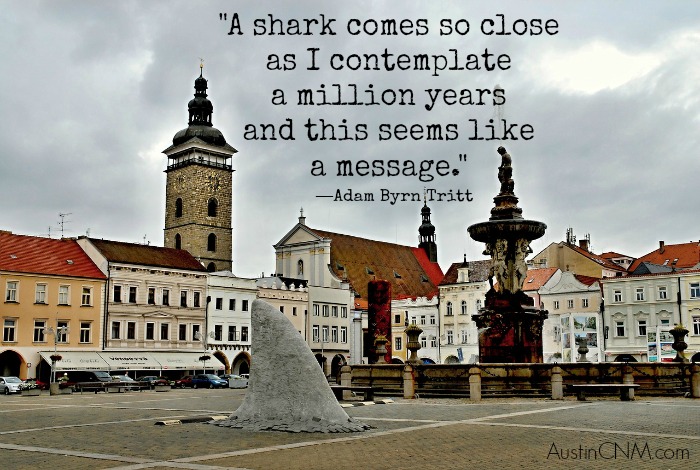
yomkippurshark_acnmAs I reach a million, I see something I have never seen but which is astonishingly familiar in the water a scant twenty feet from me: a triangular dorsal fin, a triangular tail fin, both moving gracefully in the water so close if I wanted to, if I were fool enough, I could walk out to it and barely have my calves half covered by ocean. This is amazingly close for a shark.

I stand and watch. This is an interruption in the flow of the meditation. Or is it? A shark comes so close as I contemplate a million years and this seems like a message. It feels like a hello from distance of time and I can see, now, what that million years looks like. I cannot go to it so it, instead, has come to me. Today.

I am aware of a person next to me, fewer than a few feet away. “Is that what I think it is?”

What else could he be asking? It is safe, I imagine, to answer in the affirmative. “Yes.”

“I was going to go swimming.”

“Still going to?”

“I just moved here. This is my first time at the beach. Are they out there all the time.”

“Are you asking me if there are always sharks out there or if death is always fewer than twenty feet away and swimming around us.”

He stares at me.

“The answer is yes to both. You’re just getting to see it today. Welcome to Florida. If you plan on hiking instead, remember, we’re the only state with all four kinds of venomous snakes.”

He walks off.

I continue my walk. With each step I think of a person I have wronged. I apologise. With the next step, I forgive myself as well. I do this until I can think of no more people but I am human and I must have hurt more people than I think by simply the act of living. I apologise, with each step, contemplating the many ways we hurt each other and never know it, cannot help it. And, when this is done, forgive myself.

As I continue to walk, I think of each person I know has hurt me. I forgive them. It no longer matters. In the span of time, what could it matter? If they have not admitted guilt, what does it matter? I forgive them. I forgive them all. If I have thought badly of them for the wrong they have done, for this, even, I apologise and forgive myself.

Why carry guilt? Why carry anger? Why carry a careless word? Of what use is it in the span of years? A million years and how long am I here? There is a shark in the water.

Gate gate paragate parasamgate bodhi svaha. Gone, gone. Beyond gone. Past beyond gone. There is enlightenment.

I start to run. Barefoot I pad the sand beneath me. Step by step following the mean line of the surf. If the waves come in further, I lift my legs higher, pull up my knees, splash as each sole descends. This varies my running, changes the muscles used, increases my activity.

With each footfall, I think of a year of my life. A year. Each time I pad the sand beneath me; grains millions of years in creation, millions in erosion. Each step, a year. I run out of years quickly, in a matter of half a minute. I think of my potential lifespan and run them out in another half minute.

I think then of the people I love and run them out, each step a year of life. My family, less than a minute each, like the blink in time they are, we are. My friends, a minute. I think of those I know, enjoy the company of, gone in minutes and I do this consecutively but I know it is all concurrent, all gone, more or less, in the steps it takes me to run out mine. I think of those I don’t like. All gone too. No different. All the same. We are a set of footprints. We wash away.

I wish all people happiness and the root of happiness. I wish all people freedom from suffering and the root of suffering. Even those I don’t like. Especially. Now, before I become invisible among the sands. Now, before I wash away.

I have run out of people. I have not run out of beach. I continue, watching the evannebirds skitter the foamline as I splash and make impressions which are instantly gone behind me as the tide washes out. I run and am not tired. How much further?

I expected to run for a few minutes. I thought, how long can I run before I need to turn back? How far can I go before I know I am half-spent and turn around to run back or all spent and must walk my way back? But neither point comes. I run.

I run easily, no pain, barely sweating, my heart slow, my breathing calm. It was not long ago I would run five minutes and be exhausted. I would run and walk and run and walk in alternate minutes. Now I am easy and feel free and comfortable, open. How long have I been running?

I choose a point in the distance; a home among the many but different in colour than most and decide to run to that, then turn around. On the return I can sense no reason to be heading back but my desire to return to my writing. Still, I am not tired, not worn, my breathing slow and full.

I see the salmon hued building that signals where I started. There is the boardwalk, invisible behind the sea oats and dunes. I run up to the ramp and there I stop.

Once to my car, I look at the meter. I have been gone more than an hour and a quarter and it flashes at me. I have run for much of that time. I have run for nearly an hour. It is not a marathon, but it is an amazement, an accomplishment and I have a sudden keen sense I have not eaten anything today but half a cup of milk. I am not fasting. I cannot fast. It is bad for my health and is, therefore, forbidden by Talmudic law. Certain people and people under certain conditions, according to the Talmud, may not fast. I have brought nothing by way of food with me and across the empty street is a Coldstone.

I get my things from the car, brush off my feet, put my sandals on, put another quarter into the meter and walk over. What could make this day more perfect than adding an ice cream?

There is a Starbucks, on one side of it and, on the other, Bizarro’s Pizza. There use to be café here Lee and I ate at once; had lunch with Jeannie, Joseph, and Connor on our first visit to Melbourne. It left with Frances, or Wilma or one of the September storms to visit in 2004. The building is still empty, partial.

I walk into Coldstone. It is slightly after twelve and it feels as though there have been few customers today. I ask the young lady behind the counter for plain ice cream with no fat and no sugar. They have ice cream with no flavouring; simply the taste of milk, crystalised, thick and solid. No sweetener. Why would milk need sugar? She is happy to oblige and what size? One cup. A small.

Would you like anything in that? No. Wait, yes.

Please, if you would, some almonds.

 
7 Comments

Posted by on October 3, 2006 in Culture, Religion, Social


Tags: , , , , , , , , , , , , , , , , , , , , ,

My Skinny Self

My daughter called last night. She was fired from her job and, certainly, it was one she needed firing from. It is best for her, a talented physical trainer, to not rely on a job at the counter of a pizza joint, organic pizza or not,

On top of it, she has a cold. A bad one. So, all around, she needed her Mommy and decided to come up even though it would be only over night.

She arrived at about seven in the evening. I took her out to a Chinese buffet/Mongolian grill where she ate mostly raw vegetables and fish. I took a few things in small quantities I should not have, would normally not have, and left most of what I took, eating a few bites, enjoying, sometimes, the flavour and /or texture and leaving the rest. After a quick trip to the grocery for eggs and milk, my wife treated her for her cold, my daughter laying on her back, on the couch, acupuncture needles erupting from her stomach and legs like sparse, corse hairs. After, her backed was cupped to relieve her congestion. All this after a listen through a stethoscope to make sure she was not about to have pneumonia.

Later that evening, me on my laptop, Lee on hers and my daughter on hers, she looks at us and says, “Is this what we’re going to do?”

It’s a Sunday night, 10:30. What to do with work the next day? With a daughter with the flu?

When she calls, she complains because we are always out, never home. “Are you out with your friends again?” Many of my friends are her age or thereabouts and this appears to upset, or, perhaps, just confuse her. She asks me where her mother is. She did not answer her phone. Out, I answer. Without you? Why?

We have lives.

But you didn’t when you lived in Miami.

Yes, I know. That’s why we like it here so much better.

So now, late on a Sunday night, we are relaxed, quiet and now, now she wants us to have a life.

The next day, she is treated again in Lee’s office. Then we take her to a gentleman for Live Blood Cell Analysis. He takes a drop of blood, looks at it in a scanning microscope and recommends olive leaf, black cherry extract and vitamin e as well as a way to drop some stress besides exercise.

My daughter is a dancer and trainer. Athletic, her body fat is about five percent. Low for a female, even for an athletic one.

While the chemist is talking with her, I notice an body fat analysis machine. An impedance model made by a company with an excellent reputation for medical devices. An Omron. The same company that makes my pedometer. I pick it up finding it easy to figure out: press the button for height/feet and it changes. Press for height/inches and it changes. Gender and age was the same. Hold he handles and press the ‘start’ button with your thumb. It took me less than half a minute and, of course, I expected ominous, horrific results.

Friday evening: Craig tells me I’m thin. He tells me even since my birthday, I have gotten thinner. I say I’m working on it. He answers that I am past working on it. I take this as a compliment, but, trust Craig as I do, still cannot believe it.

I mention this in an email thread from/to a WW friend in Maryland. Wulf, my twin, she of the same hight/weight/birthday/sci-fi collection/proclivities/etc… and she tells me I should believe him.

And, she continues, if I don’t believe him, how about my friends which whom I go to Playalinda Beach? Do they tell me that? I should believe them.

Yes, I say, they do. And I don’t.

And here I am, two days later, with an Omron Body Fat Analyzer in my hands and it is calculating, calculating, calculating… It seems to take longer than setting it up and it reads, finally, sixteen percent. What?

Sixteen percent. The chemist, Richard, he of the Natural Foods Coop, Café, Naturapathic School says he is not surprised and it is quite accurate.

What’s normal, I ask. Fifteen to eighteen percent is considered low to high normal for a guy.

Sixteen percent. I am doing something right. Maybe the belly and chest are in my imagination. (Evanne says everyone loves boobs. I still think they look better on her than me.) Maybe a cruel trick of heredity but, in any case, this is incontrovertible. I have been wrong.

The diet changes, exercise, attitude – it has all worked despite my seeing otherwise. I have worked for these results but did not believe them possible. I have been working, extending continuous effort for something I did not actually, in any way, believe I would accomplish. And then, there it is. Here it is in front of me and I am amazed. As though it dropped from the sky, I am amazed.

In a way, my success leaves me not knowing what to do. I succeeded? How is that? Just through hard work and dedication?

What else will I be surprised at success in? Selling a book? Producing a play? Can I do these things even if I do not believe I can? Is belief a necessary part of work? Do I need to believe to succeed? It would appear as not.

And despite the evidence, in the face of so much proof, why is it I believe I cannot?
My skinny self wants to know.

 
3 Comments

Posted by on September 26, 2006 in Culture, Social


Tags: , , , ,

No Ma’am, I am not Gus Grissom

2:31 am: My head is on the pillow, all is still. Blessed exhaustion and quiet but for the hum of the fan. The house is quiet and, finally, so am I.

2:28 am: Stargate is on…again. The same episodes as earlier today. Yesterday. I’m halfway through the show and I’ve had enough. I’m going to try again. Off to bed.

1:13 am: At this hour I should be sleeping in my bed but every time I close my eyes my room spins instead.

I’m hungry. I have waited two hours since last I ate and can barely believe I’m still wanting food. But I go to the refrigerator and find a container of brown rice, fill it with chicken broth and put it, along with a baked chicken leg, in the microwave. I put it on low so the circuits will not blow as the air conditioner is on in the conservatory and, in our Lisa Douglas fusebox, the air conditioner and the microwave equal more than ten.

I feel funny eating so late. I’ll regret this. I know, but I must assume physical stress causes hunger. Extreme physical stress seems to have caused extreme hunger. I want protein and protein and more protein. I tell myself tomorrow I’ll be careful, eat better, eat lightly but for now, I want meat and bulk. I want something that will hold me down.

12:10 am: I don’t know why I am waiting to go to sleep. Normally I’d be up late on a Friday night, but with my stomach upset, with my head hurting from side to side, perhaps I should have been in bed sooner. I’m stuffed, fatigued, in pain, still hungry (how can that be?) and every time I close my eyes I see a screen, black on either side and my head swims. Enough. I’m going to bed.

9:39 pm: Home. I’m headed to the fridge. I want more meat. I can barely believe it but I do. Chicken. White meat. Diet Pepsi I brought back with me. On to the couch. Lee is watching Stargate, as I would expect and I can’t really think of anything I’d like more right now than to lie on the couch, a near mirror opposite of Lee, and watch bad sci-fi with her. I’m queasy. My head hurts. My shoulders hurt. My neck hurts. Everything just plain hurts. Sore muscles. Physical stress? Emotional stress? Fatigue? But it feels great to be lying here, picking at the chicken, watching my sweetie watch Stargate.

9:18 pm: Our plans did not quite work out. Jack is quiet, watching TV. I could spread myself on the couch, splay myself on the carpet. I could but I will not. I feel welcome but tonight I feel a bit extra. Since I do not normally feel this way at their home, I figure something is up and, perhaps, feeling uneasy, queasy and unsteady I figure it is the right choice to go home. I say my good-byes and take my leave, driving home in the extra-sub-urban darkness. I later found Jack’s grandfather had taken ill.

7:43 pm: I arrive at Evanne’s, Jack’s and Beth’s home. Jack is not home. How is my day? I tell the truth as I have been asked but do not wish to sound whiney. I leave out a bit but tell how I feel. My stomach has calmed a bit. It still is not right, but it is no longer playing twist and shout and I am grateful for the improvement. Jack comes in some minutes later, seems tired. This is understandable. He sits on the couch, is asked by Evanne if he wants to play Changeling, he states he is not quite in the mood, is tired. This is why I had come here tonight. No that I ned a reason to visit with these fine people, but, tonight, I’d rather be sitting at home, quiet, watching television, still. So very still.

7:13 pm: I am leaving for Evanne’s. It is Jackanalia, Jack’s birthday week and I have been asked to come over and play Changeling as a surprise for him. I said I would go and on any other day I’d have no doubt about going, but I feel so terribly unwell, I do not know how I will drive there, sit there, play there. But this is his birthday and what he wants so off I go. On the way I stop for a bottle of diet coke. They are on well water and I am not use to drinking water that tastes of sulpher.

6:42 pm: Thumping wakes me. Not my heart but a larger drum from outside. My son’s bass drum. He must be practicing with friends. It is ok as I need to wake up anyway. I rise, dizzily. I am supposed to be at Evanne’s at 7:30. I am going to be late.

Lee says she saved some dinner for me. Dinner? Yes, I could eat more. A small piece of flank steak, about four ounces, the size I would normally eat. An ear of corn from the co-op. It is a rarity Lee cooks and this is wonderful. The corn is barely done. It is wonderful anyway. The steak is barely warmed and it is wonderful especially. It is covered with garlic salt which means Lee had this on her plate. Especially incredibly wonderful.

4:12 pm: I arrive home. Woozy. Nauseas but the aching in my head is beginning to subside in some remote locations. As I make my way to the door I hear the high commands of Invader Zim so I know my son is home, on the couch, and, as I enter, approach, I ask him to please, oh God please in all that is holy and right and proper in the world, if you have any compassion and decency and humanity, turn it down. It sounds like this. “Volume, please,” except that it is muffled and slurred. He looks at me and asks if I’m ok, that I don’t look ok. I answer “Bus, seventy kids. F-14 simulator. Headache. Nauseas and… Hungry?”

Yes, I am hungry and no-one is more surprised than I am. I want protein. I want something dead that use to get around on its own and decide its own fate. I want meat. I eat the contents of a can of salmon. I eat some turkey. Beef jerky. I see a piece of chicken from the other night and it is gone. If it walked , flew or swam, I want to eat it. This isn’t right. I think of the volume of food, of the calories, the effect. I wonder if physical stress does this, if this isn’t the right thing to do, give in to this as need and not gluttony. I am still nauseas but no more so and still hungry and not less so.

My wife arrives home, looks at me and puts me to bed.

3:50 pm: The bus pulls up in front of Stone Middle School. I get off last as I am in the back, walk wavering, slowly across the parking-lot to my truck. People wave, say goodbye, ignored. School isn’t out for ten minutes. Teachers cannot leave until 4:15. I should get the CD from Susan. I looked forward to that all day. I don’t care. I can’t. Not about that. Not about the time. I drive slowly home. No radio, windows open in the ninety degree day.

2:38 pm: The bus is loading and I am asked to get on first and do what I did this morning; sit at the back and not let the kids do the same. I do so, nearly lying down. It is noisy as the kids load. I am out of discipline. Maria takes care of what needs taking care of while sitting next to me. We talk a bit on the way from NASA to South Melbourne as the kids get louder and louder.

Sean is poking girls, complaining they are talking about him afterwards. A kid next to him keeps shouting how he is a crazy white nigger. Crazy and white, I have no doubt. Stephanie keeps trying to sit upside-down. She is wearing a skirt and this seems to be just a bad idea all around.

Sara sits in front of me. She seems protective. She has come to me in the past wanting help with poetry, writing, wants to see my books.

It is a huge bus. It waves and sways around curves, on entrance and exit ramps, corners. As it rolls down Palm Bay Road, it rocks and I feel once more and I will lose anything in my stomach. Everything.

Maria is still talking, Sean is still poking, I fight sleep. Chaparones are not supposed to sleep. My eyes close and I am woken at the school.

2:30 pm: We exit The Astronaut Hall of Fame and Space Camp and head to the bus. The heat feels wonderful. I have never been so happy to be so hot. It is delightful, comfortable, embracing and life-giving. I want to vomit. I want my head off but at least I am warm.

I am walking, not too steady, to the bus. Beside me a mother of one of the students. She looks at me, asks if I want Tylenol. I say bless you and accept two Extra Strength Tylenol. Who needs water? We mill at the bus waiting for the signal to board.

2:24 pm: Last stop. The conference room. I am shivering. It is the same sixty-two degrees in there it has been throughout the rest of the complex. There are rows of chairs facing the front table. On it, shuttle tiles, torches, vices. I walk to the back of the room and sit on the blue carpeted floor thinking it more stable than the chairs. Under me the floor twists and heaves. I ride it.

The students are told of all the wonderful jobs available in space and science. What they can do for NASA. How they will be the next astronauts. What amazing opportunities they have living as close to the world’s spaceport and how, with education, they can take advantage of those opportunities.

Tiles are heated on the front, glow red and furious bright. Students tough the back of the two inch thick blocks. They are amazed it is cool to the touch. The front becomes cool enough to touch within seconds of removing the flame. The students line up to touch. One calls me and I go, holding on to whatever is available as I wait in line.

When the line is done, we file outside. Outside.

2:04 pm: The door swings open and light, bright and painful, enters. I turn away and my head swims. My body seems to move the opposite way as my head feels as though it is continuing to turn. The old man walks to the opening, looks at me and says, “You need to sit a bit. The next person can wait.” He is right. I do. But soon, not more than a minute, I get up, grab the doorway, pull myself out. Walking into the bright light, toward the glass door, steadying myself. I do not want the students to see me ill. I’m not sure I have a choice.

Mr. Science Teacher looks at me closely, “O Man, you don’t look so good. Are you ok? If I had any idea it’d do that to ya.” He would have what? Stopped me? I should have stopped myself. I lean on the railing. Ms. Ramirez is heard in the distance and she tells us it is time to round up the kids and head to the conference room.

1:57 pm: I have waited an hour. Perhaps a bit more. The glass door opens and I am ushered in and to one of the small booths. Inside, it is no more larger than the space needed for a small chair and the person sitting in it. The chair faces front and toward a small screen. Next to the screen, one on either side, are two handles facing up. I sit within and fasten the seabelt. Below is a floor and an up-slanted foot rest joining the floor to front wall. It is made of dimpled metal and my feet rest comfortably there. A moment or two passes, I look ahead and see a sign above the screen: Keep eyes open at all times. I look ahead and below the screen and next to it, a large red button. “In case of distress or ailment, press this button and the simulator will slowly come to a halt.” Next to this was the same list of ailments I read outside. I have none of these? Why should I not ride? The door closes and it is a solid darkness.

The screen lights up and voices are heard. I had not noticed the speakers. It is a radio-voice from a virtual f-14 pilot and I hear we are about to take off and, jerking, not smoothly, I move. I spin, I know, but spinning this did not feel like. I reach forward and grab the handles and they do not give, do not move.

I feel consumed by the screen as the voice tells the tower he is ready for liftoff and the ground, which does not look remotely real in the monitor, falls away as the sky becomes wider and takes more of the screen. I feel as though my stomach has left me, choosing to attempt a stay on the round whilst I rise into the air. Unfortunately, my stomach did not make it out and I am more than astoundingly aware of it.

I do not listen carefully to the voice. For a moment I tried to loosen my grip on the handles. I could but felt them move toward me and decided I might not be able to get them back on and so left them, tightening my grip. It says something about a mountain and it comes into view, about not being able to avoid it and it comes closer and then lurches down and to the side. I am stamping the floor against the four G’s, plastered against the wall , beating it with my shoulder, elbow, voice as I discover I am making noises quite unbecoming, quite undignified.

This continues. The fake sky spirals as the ground circles coming closer and I can feel my head spin, hear myself whimper, still beating the right wall, the floor, the surface behind my head.

Six minutes, I think of hitting the red button but do not, cannot, will not. Six minutes long and I decide I will stand it, must stand it but will pay or this and the sky opens wide again as the ground fully falls away and I hit the back wall with my head again and again and again.

I have no idea what the voice says. I do not remember a thing of what happens on the screen and do not pay attention with my mind but my body accepts every fiction and reacts despite my knowledge of slow rotation and slight temporary tilt. I do not know what happens but I am panicked and ill and sorry and sore and want out, an end, stillness and quiet and light and all I have is noise and twisting and nausea and brightness in the solid claustrophobic dark and then I see the ground come close and level and coming fast and then slowing and then the screen image is still and something is different though I am not sure but I believe we have stopped.

12:43 pm: These kids keep cutting in line, but they are my kids, kids I’m in charge of and, of course, it is they who should ride so I let them in. They are not sneaky; some even ask. The sign says the ride is six minutes long and it takes two people at a time. I count the people in front of me. Eighteen. Nine times six and I can see I might not get my chance. I wait patiently and talk with my partner in chaperonedom, the science teacher, he of the mid-thirties and sixth career, ninth professional job, ex-cop and E.P.A. inspector. We move forward the distance of two middle-schoolers at a time. Our speed: twelve middle-schoolers and hour.

12:40 pm: I have spent a half hour or more in the museum. It is not that large and I have been here before. It is a static exhibit and nothing has changed. What is different is the time I have and it seems there is plenty. I walk toward the one exhibit I know, in my heart, in my gut, I should be walking away from. I tell myself it is jus because most of my young charges are there, in line, waiting patiently, well behaved and calm. It is a glass enclosed room about fifteen by fifteen. Within is a whirler of industrial proportions with a computer in the center, a pivot above that allowing for spinning and at either end a small fully opaque chamber big enough or a person in a chair. The chambers are on servos that allow them to rock out and in as they spin around the center as dictated by the program. The device spins slowly. It is the F-14 Simulator.

The sign says it produces four Gs. How much can that be other than four times the pull of Earth’s gravity. It’s spinning so slowly. It is nearly mesmerising. It looks calming. People go in and six minutes later they come out and no-one looks worn or upset or any worse than upon entering. People say it was fun, enjoyable, cool, neat, and I’ve nothing to do and find myself in line.

12:30 pm: Lunch is over. The students are given time to investigate the museum on their own terms and I, with my twelve kiddies and my teacher-partner enter the dim from the bright through corridors and doors and find ourselves in a hall of spacesuits, faces in monitors, touch-screens and hands-on science. Two small halls of exhibits. I read what there is to read. Make a spaceman balance in the center of a small tank of water, play a virtual game, learn of the Apollo One mission, read about Gus Grissom and how he was scapegoated by NASA, then died, burned alive inside the Apollo 1 capsule, along with two others as a result of a failsafe device to prevent the very mistake he was supposed to have made in his earlier flight. In short, they made he door so it would not open from the inside. Later his ‘mistake’ was found to be a design flaw which had nothing to do with him.

Grissom was an engineer who, even after that event in the mercury capsule, went on to create designs that were used and are still used in spaceflight. He is the reason NASA stopped naming individual capsules and named only overall missions and gave flights numbers. He called his 1961 capsule Liberty Bell Seven not because of his love for liberty but because he said the design would cause it to sink like a giant iron bell. NASA took a dim view.

His Mercury space suit is on display in the hall while a battle rages over who gets to own it. His family wants it to tour the country. The Smithsonian and NASA want it to stay just where it is where it can be seen only by those who can afford the pretty pennies. Forty years and Grissom is still making waves.

You go Gus!

12:00 pm: Lunch. Out of various coolers come lunches, all packed in their clear bags. Each with a name. The children sit on the bleachers in the room we have been in all morning. I don’t see the need for the coolers. Sixty-two degrees.

These kiddies are eating monstrous things. One has brought nothing but a bag of Cheetoes and another a bag of Fritos. These both had to be, of course, in large plastic bags. A bag in a bag. Cokes, Gatorade and cookies. A few have sandwiches and fruit.

I have my bag. I eat my apple, my carrot. I drink my bottle of water and then have my Cliff Bar. I walk my empty bag with it’s empty bottle, empty wrapper, apple core and carrot end to one of the two fifty-five gallon trash barrels which are the only reason, both I and the children have been told, a student may move from the bleacher and the shame of their terrible lunches is even greater as the barrels fill further and higher with huge quantities of food untouched now become trash.

11:30 am: The children have been lined up in front of a harness attached to a chain attached to four rows of three long springs each – twelve springs: three in line attached to three in line attached to…- and then a series of chains, pullies and then a winch attached to a track which runs forty feet and all this a four foot wide, six inch thick mat running under the track. Me and my twelve and Mr. Science Teacher. Our guide, Diane, shows us this will allow us to feel one-sixth gravity. She puts on the harness, much like the kind stuntmen use to fly, much like a wire-harness. She puts it on and tells us all the girls will have no trouble with this but warns the boys may find this more than slightly uncomfortable, and, as she says this she pulls a strap tight and we all see exactly what she is talking about.

She demonstrates the methods astronauts use to move in lower than Earth gravity as she sidles, hops and skips. She shows us how to pick up and object and bend in low gravity.

A boy goes first and confirms the discomfort, then a girl, then I lose track until the tallest of our group goes and there is little room left near the winch as the gears pull the chains and there is little left between the springs and the winch by the time it is high enough, taut enough for him. It dawn on me: this does not work. Most of the kids have their feet barely on the ground, touching it with their toes as they hang there. Even under low gravity, they would actually be in full contact with the surface. With a computer, they could enter the weight of the child, the compensate with the pullies for an accurate one sixth of the weight. But she just ups the child into the air until their toes dangle dragging the mat. For a half hour they flip and flop and hip and hop and bounce. The girls giggle. The boys seem to wince.

11:00 am: We sit in the bleachers in front an eight foot diameter gyroscope with a seat. We are given a lecture about the Multi Axis Trainer. We are told why it exists. How NASA was afraid a capsule could spin and twist in different axis and the astronaut within would need to withstand it and bring it under control. Thus, a Multi Axis Trainer.

The sign says if I have a heart condition, back problems, vertigo, pregnancy and some other such difficulties I should not ride. This is a ride? And I was not aware pregnancy was a ‘difficulty’ but who am I to argue with NASA?

The first child is strapped in, shoulder straps, leg straps, feet on the foot plate which is a new addition and the reason for such is without it the feet tend to fly around a bit. I’m glad Diane mentioned that. I’d hate to see the kid’s feet flying around.

We are told the way the device spins the center of gravity remains the center of the body so the abdominal area does not actually move very much. We’re told because the movement does not stay stable, because it does not continuously move in the same direction, the ears do not cause the rider to become dizzy as they would simply spinning. It appears true as the lever is pulled, the seat sways back and forward a bit, Diane walks out of the small cage surrounding the MAT, closes the gate, walks to the side and turns a throttle. The outside ring turns, the seat begins to move, the center ring begins to move as well, the seat begins to flip this way then that and spins, the inner ring turns in response to the other two and the seat moves no way more than one revolution. Hair, long and unbound, flies here and there, red flames blown by a fickle wind, the child screams. The child is smiling.

She comes off and appears no worse than when she got in. A thirty second ride. One minutes with strap-in and strap-out. The next goes, then the next all through the twelve of us and then, “Come on Mr. Teacher. Do you want to give it a try?’

I walk up, empty my pockets and a student, one I initially did not trust, takes my digital camera and tells me he’ll get my picture. All my belongings are on the bleacher but Diane is right there and I worry a bit anyway.

I enter the cage, am strapped in, I ask about epilepsy, am told it is not a problem, I ask about any number of things and am told I have only thirty second and if I want to try it now is the time and I say go ahead. Diane pulls the lever and the seat sways back, feeling like a swing that has gone too high, come back down and I say, quickly, “That’s good.”

“So you are ready?”

“No, I mean that’s good. That’s enough. It was fun. No ride. Out please.” And I realize I am about to become very much a spectacle and I also realize I don’t care and as I think this, I am being unstrapped.

I pick up my things, all still there after less than half a minute, my camera is handed back. There was no time for a picture.

10:00 am: I have six of the kids. Mr. Science Teacher has six and he is to be in another section of the Shuttle simulator. The kids have tags around their necks and have been given flight designation which tell them what their jobs are. Before coming here they have been given materials to read which helped them understand what those designations mean and what they entail.

We enter a hatch to a small room with a bank of screens. Behind us are ladders attached to the opposite walls which lead to hatches in the ceiling. Each leads the same place: the flight command center above us. Four of the kids go up there. I look up the ladder and decide to stay down here in the science center.

The other six students are in mission control in another room in this hanger.

Our guide shows the kids how to do the experiment when the script calls for it, to take the blood pressures of the flight crew, change the carbon dioxide filtration unit. The entire simulation experience is scripted and the kids each have a script to follow. Each has a microphone and an earpiece and can communicate with the others through these devices even though the space is small enough they could hear each other at a hush. I suppose, in space, no-one can hear you whisper.

I watched them follow the script right through the landing, as seen through a screen. They were proud of themselves, doing the experiment, changing the canisters, guiding the shuttle in.

While I watched them talk, crawl through hatches, ascend and descend, I had nothing to do but stand there in the six by six my eight space. I looked at the controls. I looked at the intercom. I looked at the thermostat and saw it was at sixty-two degrees. In the small box of a room, all metal and moving air, it was sixty-two. No wonder I was chilled, stiff. We were told to wear long pants but I would have worn long sleeves as well.

Later they got to see that the simulation was programmed to work smoothly but to record, as well, what the results of their flight would have been. The alternate results showed a rather large mess on the runway.

9:30 am: We pull up to The Astronaut Hall of Fame and Space Camp. As we exit the bus, we are escorted into a large hangerish room off of which all the other smaller rooms are connected, in which is the shuttle simulator, the multi-axis trainer, moon walker, space walker and other devices are.

Each child is asked his or her designation and are given a name tag and with that designation on it. Mission Control, flight crew manager one, flight crew junior, science crew, other designation I am not close enough to hear.

We are divided up and I am given my group of six and my companion, MR. Science Teacher, who has six as well. We are walked to the Shuttle Simulator and are met by our guide, Diane.

8:30 am: Our bus pulls out of Stone Middle School. I have not been in a bus this large. It rocks and sways. As we pull out the driver tells the students not to scream. Particulary the girls. Then he tells the boys not to give them anything to scream about. I sit in the back with Maria and watch them, many still tired, squirm and talk, sleep and poke.

Each turn we come to feels as though we are about to fall over. I figure this must be stable or Space Camp would not be transporting kids again and again and again. Still, it certainly does not feel that way.

Maria is talking. Curriculum, skin cancer, reading, skin cancer. She shows me her leg where the lymph glands were removed this last Summer. That’s what she did on her Summer vacation. Maria gets sick more now, it seems.

Maria is a native of Brevard County but looks like she would come from Upper Michigan or Wisconsin. It looks like the sun is not her friend. In the end, it wasn’t.
As we pull in, Maria is still talking. I have no idea about what.

8:15 am: The Science Department Chair meets me and thanks me for taking this on in such short notice but that there is no time for talking and, taking my hand, pulls me from Susan and toward the bus. I was asked only yesterday. I’m not een clear on where we are going. It’s called BLAST which stands for Brevard Something And Science Something.

None of these kids are my students, she knows. Mine are with a substitute. But the chapparones all failed to show and to go on a field trip one must be fingerprinted now, thanks to the Patriot Act. The schools board will not pay for the fingerprinting and few people want to pay the sixty dollar fee.

So here I am. I put my lunch, packed as directed, in a clear bag, in the large red cooler marked TEACHERS and mill. Ms. Pebbles runs up. She has been recruited just this morning to attend.

The bus driver is old. Rather incredibly old. Or at least he looks that way. The bus is huge and looks new and shiny white and is not a school bus but belongs to Space Camp. For some reason, they use their own buses and the cost is included in the camp or, in this case, the field trip. As we are a science school, each child gets to go. I am told this is through a grant of some kind and some other schools are involved.

Some students who are suspended had to be brought back to attend this and will be out again after the trip. Why, I ask. It has something to do with the grant and the superintendent himself said it had to be that way. Chalmers, I think his name it.

“Mr. Tritt, would you board first?”

Sure. I get in and see the back is a long bench seat from one side to the next. Prime real estate for kids to fight over, fall under, do things in behind the other seats where they cannot be seen. I walk all the way back and stand in the center directly in front of the bench. As kids come in they ask if they can sit there. Each on asks and I point to their seat. I don’t want to sit in that one, I’m told, and I point anyway. Most sit. A few I have removed until they comply. Not sitting with friends? Well then, board with them next time. Saving a seat? Nope, not this time.

Maria enters and walks to the back and I am now not alone.

There are about seventy students. The door closes and the bus starts.

8:11 am: I arrive as school, sign in and make my way toward the bus. On the way there, Susan finds me and hands me a yellow padded envelope and tells me it’s a present. In it is the first Big White Undies CD. I have been looking for this. Back in Gainesville, I use to see them play all over. I MCed a fundraiser or two with them, saw them play with Phish. I never had to pay but also never had the money to buy a CD.

I am overwhelmed as I look at it and Susan tells me she like the other one so much when she found this one she got two so I could have it.

Last week, I gave her Matter by Big White Undies to borrow. I never do that, let people borrow CDs or books, but I did for her. She loved it, telling me what I knew already, that there was not one bad cut on it, that it was formidable, concerted and tight. The songs were thoughtful and literary while the music was light and joyous. That is is an amazing recording.

Do I have something to listen to it with? No Susan, I don’t have a portable CD player and, if I did, I’d not be toting it with me on the field trip. She tells me she’ll hold it for me and I can get it from her when I get back this afternoon.

 
2 Comments

Posted by on September 22, 2006 in Culture, Education, History, Social, Travel


Tags: , , , , , , , , , ,

Crop Circles

I have a crop circle in my front yard. I awoke this morning to spiraled grass in two opposing adjoining sweeps, long and low on the wet mat of the soil. Six feet wide and here, in Palm Bay, on my one-eighth acre parcel, in my front yard, crop circles. And the cars go whizzing by. It is a private showing.

My front yard has not been cut in two months. We have decided to replace, pull out, do away with the non-native plants and allow the native to return, take over. It is a small thing to do and of little effect – my small home with the yard of native plants among the weekend mowers, gas trimmers, electric weed-eaters, leaf-blowers, grind-metal edgers. It is small and incredibly conspicuous.

Sections of the lawn have been pulled of grass and the naturally growing succulents of our area have retaken the sandy soil. Long red fleshy pencil-stems cover the ground and they are covered by small, puffy fat-needle green leaves and, they, spotted with small flowers in red, purple, yellow, blue. Sun mimosas trail, gather, subsume the open land, sending legs here and there of delicate leaves and up into the air, stalks of purple and pink puff-ball flowers. All together, a glorious mat of green leaf and rainbow flower not but six inches at its highest point and no need to mow, no need to cut, no need for gas fumes, exhaust fumes, chemical fumes or weekends spent in service of grass.

But the sections which have not been pulled, they grow wild, high and green, full and deep and talked about as the neighbours walk by. The grass grows four feet high, some topped with red flowers, large purple blooms arrive every morning and, by the afternoon, fall to create a speckled three-dimensional star-map of fading violet, suspended within the net of interlacing leaves. Florida poinsettias, orange jasmine. Plants and flowers I do not know the names of and do not want to know by name. They are, somehow, more natural, more real for my inability to place a name on them. Who am I to tell the flowers what they should be called?

And, in the midst of this, crop circles. And why not? One does not find crop circles in mowed yards. Faeries do not visit the space between mowers and clippings. But mine? Four feet high? Why not? Why not nocturnal visitors in the moistening pre-dawn patting out waves of elegance and delight in the spindles and leaves? Why not?

This is what I get for not mowing. This is what I get for inviting the invisible to my home. This is what I get for opening myself to the stares and quiet talk of my neighbours. I get crop circles. I’m fine with that.

 
1 Comment

Posted by on September 2, 2006 in Culture, Nature, Religion, Social


Aspirin as an Effective Treatment for Writer’s Block

Writing is easy: All you do is sit staring at a blank sheet of paper until the drops of blood form on your forehead. – Gene Fowler

Writing is easy. It is not simple, but given the time and a life, or an imagination, or, better, both, there is sufficient fodder for writing. William Sansom told us “A writer lives, at best, in a state of astonishment. Beneath any feeling he has of the good or evil of the world lies a deeper one of wonder at it all.” This is true. Given such astonishment, all there is to writing is looking at the world with that astonishment, discovering what of that experience is communicable and putting the words into an order words have never been in before to say something no other person has ever said or say it in a way that has never been done so a reader can see something completely new in a way which makes it feel familiar or something familiar in a way that appears to make it astonishingly new. That is it. That is all. The hard part is finding the time.

Most writers do not write full time. As perhaps one of the most important professions over the ages, it is one of the least paid. Poets would be within the court of the king but serve at his pleasure. So we now serve at the pleasure and vagaries of the public. We have bridges and streets named after us but rarely do we get paid in a way that allows us to write and write and write.

To pay the bills, to give my wife the time needed to get her practice off the ground, I teach writing at a public school. A public middle school. Five classes a day and sometimes seven. I train students to pass state tests. That is my job.

I cannot do this. Instead, I prepare them for college, for Advance Placement classes, teach them to do literary analysis and critique, to think. We read Plato, Alan Watts, Bradbury. We barely open our textbooks but we write poetry, publish poetry, win contests and, in the end, gain some of the best writing scores ever seen by this state. From parents and students, I receive thank you cards, presents, pictures. From administration I receive time-outs.

In between, I keep records, meet deadlines, appear mean, being cruel in order to be kind. I tell them no, no no, when the school rules tell me I must, to students who do not want to be in class, in school. I tell them they may not go to the bathroom, must make their bodies slave to a clock, be chained to the forty-seven minute increments and a chime, we separate things not naturally separated and learn this now, that then and stop at a bell. We become subjects of conditioning and divorce our bodies from nature, marching in four minutes from class to class.

I eat at certain times, as do they. I use the bathroom after holding it too long, as do they. I switch gears at the sound of a bell, like them. And, like them, never do so smoothly or wholly. I hold off drinking and hydrating so we can get through classes, as do they. They are training their bodies to do what mine does not, live by a clock and all day, I think, as I teach writing and hold my bladder, what I want to be doing is writing and drinking. Water and words.

I hate this. It is detestable. It feels criminal, violent. Friends tell me I should be honoured to teach. I am so honoured I can barely purchase a house in the county in which I teach. I should be enthralled to make such an impact on my student’s lives. I am but need not be in such an environment to be effective. They tell me to be happy I make such a difference in their lives. I tell them to get the degree and do it themselves if they think it so important.

I cannot not meet the needs of my students. I don’t not know how to do something in a way other than well, no matter what it requires. The weird students flock to me. The writers stick to me. I’d stop today. Now, if I had the chance.

You must do it, I am told, because you love kids so. I am told this repeatedly. No, I answer. I do it for the money. Mind you, I would teach for free any children who wanted to learn and had interest. But the job I do for the money. I get quizzical looks, strangely cocked heads on people suddenly looking like confused puppies attempting to understand a strange new word. It pays better than adjunct work at the community college. It pays better than private schools. I had never planned on teaching in the public schools but then I had not thought of my wife in medical school. I went to college for an advanced degree. It was not the one I wanted but it was the one available where I was at the time and would fit my work schedule. I was going to travel Asia with my Sweetie and teach English as a Second Language. Then she decided to go to med school. I took on teaching because, it seems, there is only thing I was qualified to do by my degree: teach.

More time is needed. It will end, I’m told. I’d like to believe that but it certainly feels as though it will not. I am trying to give it more time, but frustration wins over patience. The day to day absurdity seems to pummel any sense of equanimity into paste where one day looks like the next, and each is a place I don’t want to be.

I think of leaving, going to Europe or Japan. But, what about the books I’m working on? The theatre I hope to create? I cannot afford a second household, have found work which pays only what I make now or less and this is not enough for a another home, no matter how modest. I look for work where I live but incomes are low, will not allow time for writing. Even with the few weeks-off teaching appears to give, I find I must take classes, gain credits, recertify. If anyone tells you teachers have scads of time off, tell them it is a fallacy. Then kick them.

And I must write. I do so early in the morning before school. I get up and write. I do so at night. On weekends. Hold poetry readings, perform, record poetry, write essays, write plays and do all this around teaching school. I must, or else all I do is teach and shall find I have become nothing but a teacher; else I have given up what I am, to live in order to work only. Otherwise I am but an income and, at that, not a great one.

And I am exhausted. Still, I know I will not give up that which is congruent with my self to become fully incongruent. Yet, I go to bed at night, thinking, feeling, if I did not wake, it would be not so bad. If I did not wake, I would not have to go to work.

I wake in the morning wanting to say, starting to say, with my head on the pillow, “It is a new day, with a new sun. I can make this day what I choose it to be…” but always come up short and, despite my best efforts, silently exclaim, desperately, “Crap, I have to do this again.”

I think things I should not. I wonder, do we have aspirins in the house? How many? A bottle? Two bottles? How much would be enough? I could calculate this but am afraid to learn just how little.

I didn’t know aspirin could kill. My daughter taught me that and paid the price with an ulcer. She took half a bottle. Too many and it would have been enough. How many for me? I think how easy it would be to take them and lie down, enjoy fully my sleep knowing it would not end in classes the next day, the same damn thing again and again and again. The same pressure over and over. To get into bed knowing there were no more staff meetings, professional development plans, parent conferences. Sometimes, I am hard pressed to see why this is a bad idea. Sometimes is more and more often.

My doc tells me it is the epilepsy. That it drives one a bit crazy, especially if one is a control-freak. I’ve read up on this. Epileptics tend to be very physically healthy. They live to ripe old ages but often do not make it with their minds fully intact. If they do not make it, it is often due to suicide.

I use to say I could never end up famous. As a poet, I just was not crazy enough. Look at the really famous poets and one will discover most of them are off more than a bit. Drugs, disease, mental illness. Perhaps there is hope for me yet?

I have not mentioned this to anyone. People ask me how I am. I answer fine. I have, at times, given rather strange responses to that question only to hear, “Glad to hear it,” “That’s great,“ and the ubiquitous, under-meaning “Good.” All rather funny after answering “I lost my head to a marauding swale,” “Deplorable,” or simply “Tired.”

The question is asked pro-forma. When asked the question “How are you” in any of its many similar forms, people are expected to answer in the positive or, if not positive, to give light, short, nearly cliché complaintive responses. “Ready for the weekend.” “I need a vacation.” We all are liars. Anyone asked who actually, honestly answers the question is looked at blankly, the way we look at and listen to a developmentally disabled adult while we think how we can’t wait to escape. We consider them a bit off, fringy, whining, needy. When asked how we are, we can lie or whine.

But I am high-functioning and this is not always to my advantage as I get the job done and done well regardless of how I feel. Depression does not decrease that functioning or, if it does, such decrease is not of any noticeable amount as to call attention to my health or well-being. I can appear cheerful, calm, happy. And so it goes.

On occasion a friend notices I am not as well as I seem, as together as I pretend, asks why I said nothing. I answer that I did not want to seem as possessing any of the above mentioned qualities. I do not want to be needy, whiney. I am chastised. Told the question was asked sincerely. I have no doubt. Told I am wrong to dissemble and that it does not give the friend a chance to help. Told such behaviour is selfish. True, perhaps. I believe the sincerity of what is said. Yet, in answering truthfully, what is gained? Are any problems solved? And if others then worry? How shall that be a help? How shall I knowingly worry friends with that which they cannot help, cannot change?

And so I have not. Until, perhaps, now. I have written this. And what should be done with it? I should do the equivalent of burning it, trashing it by hitting the delete key, by not saving. Don’t save it, don’t save me. Maybe I should actually print it and take the physical being of the words and paper, burn them and send them skyward as wisps and smoke to disperse into air, thinner and thinner till naught can be seen of it above and what is left upon the ground is unrecognizable as anything but that which once was.

Perhaps I should put it away for a year, look at it then and see what time has wrought, imagine how I could feel as I did, laugh or sigh. And if I feel the same way, cry over my old words for all the good they have done me. Or publish it before I change my mind.

Sixty-eight five hundred milligram tablets.

 
1 Comment

Posted by on August 25, 2006 in Culture, Family, Social, Suicide


Tags: ,

Body Modification

I was sitting with a friend of mine the other night. She’s a model on a site called Suicide Girls that specializes in chicks (her term) with tattoos and piercing and whatnot. What makes her stand out, aside from some obvious attributes (I’m not saying and no fair guessing) is that she actually has no body modifications.

So we were talking about piercings and tattoos and rivets and brands and hollyhanna I’m not getting any of that stuff done. I mean, I get tired of the colour of my sofa let alone want permo-pics penned on my pecs. Please!

Still thinking… do I really have no body modifications? Aside from the pain and anticipation, or, rush or whatreasonhaveyou people have for getting body mods, for the most part, once done they are done.

I do have a body modification. It’s a doozey too. Lots of folks do. And it is hard won, took much more than money, required dedication and grit, trial, vigilance, error, review and introspection.

It required physical labour, sometimes sacrifice or denial, always commitment. If going from a size 40 to a size 30 isn’t a body modification – if going from a double extra large to a small isn’t a body mod – if flattening one’s stomach, gaining biceps, and getting our bodies to the point where they can walk miles and miles non-stop when we started not being able to negotiate a set of stairs without huffs, puffs and frequent rests isn’t a body modification, then I don’t understand the concept.

And it takes not a moment, not a pinch, it doesn’t happen when one is drunk and isn’t discovered done in the morning. It takes a commitment to make it happen and a lifetime to keep it that way.

Sometimes I screw up, miss exercise, eat something I should not, feel it slip, worry it won’t last. Sometimes the lapse lasts a day, a week, and then I regain, restart and know I learned something, must cut myself some slack. It can be scary. This is not for the faint of heart. It is not for the squeamish, it is not for the week.

If this is you, congratulate yourself – you are doing one of the hardest things anyone can. You increased exercise, which is not a natural thing, and you have decreased food, which we all need and often goes contrary to what our bodies want. Buck up! You are amazing.

You are modifying you body and your life.

If this is you too, All Hail Us!

 
2 Comments

Posted by on August 18, 2006 in Culture, Food, Social


St. Adamus Day or The Slackers Jubilation.

It is my birthday party today. I just got this email:

In order to take no chances in offending the Gods (and or Saints) I have duly
pronounced the Ode to St. Adamus this morning. In my underwear of course
and toasting with a large glass of ice water (it’s hot here!) I’ll say it again on Friday just to make sure that the word goes up on high that I am a follower!

This is from a lady who, unlike me, is not afraid to admit she is wonderful. I’m learning. I’m a slow learner. Here is my response.

See, it’s a movement!

And I’m going to take a page from your book and proclaim, to everyone far and near, as they arrive, welcome to “me and all my awesomeness!”

A movement it is. St. Adamus started quite a few years ago and is now celebrated, though that may be a bit too energetic of a word for it, by lucky, lazy observers in many locals. Here is this year’s invitation:

You are invited, you lucky person you, to The Feast of
Saint Adamus

August 5th about 6pm

This year, we shall hold the feast at the sacred shrine. The shrine is located at Darwin Manor House at Peepton Hill, The Lap of Luxury (Palm Bay).

The Feast of Saint Adamus, also known as the Slackers Jubilation, is a newly created Ancient Tradition. Being traceable as far back as the necrotic period, records have indicated this to be one of the most hallowed of days, significant for the sheer number of people who kept the Holy Day, which comes as no surprise when one discovers the truly devout celebrants were required to do nothing more than lounge around in their underwear and snack.

Held on the Eve of the Ides Of August, or the Saturday night following the anniversary of the illustrious Saint’s day of birth, or whatever day is most convenient, during the dog days of summer when Canis Major rides high in the night sky and inertia and laziness prevail, when things seem dead and doing anything, exerting any energy for any reason, seems not only useless and futile, but impossible, The Feast of Saint Adamus festivities consisted of a costume party and pot luck. In ancient Mesopotomy, prizes were often given for the best Feast of Saint Adamus costume and usually went to infants and slave girls. This begins to make sense when one looks further into the customs of this most advanced, civilised culture and discovers that an ancient Mesopotomus hardly ever wore anything more than underpants, and infants and slaves less.

Food offerings consisted of gifts of leftovers brought in adoration of Saint Adamus. Anything hanging around the house would do, as long as it took little or no preparation, bespoke of no creativity and left hardly anything to clean up or wash. Utensils were considered an abhorrence to Saint Adamus, unless they were made of candy and entirely edible. Of course, in true homage to this beloved saint, as yet, no-one has ever taken the time or initiative to create these.

One must remember, the hallmark of the Celebration of Saint Adamus and the Feast bearing his name is that nothing special happens. A sort of Super Sabbath, celebrants are required to do nothing more than pay homage to their saint and each other by bearing witness to our mutual inertia. And let us do as the pious have done for centuries uncounted. This Feast of Saint Adamus, let’s get together and do nothing.


No-one ever goes to the trouble of coming in costume. Good. Some do come in their underwear. Excellent. Some come dressed and in their underwear: wearing it outside, on their heads, stuffed in, overflowing from, pockets.

When someone does manage to follow the rules, I find a prize. Since I never plan for this – it would be too much trouble – I just pick something off my shelves – candles, knickknacks, a flute – and hand it to them. I have too many things anyway.

People circumvent the rules by all sorts of strange means, like religions everywhere. Can’t use an elevator on the Sabbath? Just turn it on to stop at every floor from Friday afternoon to Saturday night. Can’t drive to temple? Drive mostly there and park down the street. Letter, not spirit. Likewise, people tend to make… Well… Here is another email:

Oh I have made something sinfully good for your party

My response:

As long as it’s a leftover. You can’t make something ‘special.’ then you
aren’t bein a slacker!

(Thank you)

Re-response:

It’s leftover. I made it yesterday 😉

What am I to do? One of the reasons I chose leftovers was to keep people from working to out-do each other. Also, I wanted a party that was not based in food, delectable, delicious, diet-shattering delicacies need not arrive. I want to talk, not chew, sing, not drink. You get the idea.

So, I started cooking in advance or picking up food I liked. Food, most likely, only I’d be eating. Not that others can’t enjoy them if they like. But, chances are, I’m the only one who’s going to drink the kvas and eat the cold-smoked mackerel. Today, I am smoking a rather large, a bit over a foot long, beef tongue. Smoking it means it’ll still be pink. As a centerpiece, I have a feeling that will keep a fair number of delicacies off the table I’ll be eating from.

A few hours of delight and pleasure need not end in extra pounds. I am serious. Really.

Besides, I’ll be far too busy throwing out Mardi Gras and being entertained by the masses there to celebrate the awesomeness that is me. Unless they read the Ode to St. Adamus, which, of course, is recited every year.

Ode to St. Adamus

A man named Adamus, a saint,
Had but a single loud complaint:
His workload nearly made him faint-
His time was not his own.

The other saints, he’d explicate,
Had time to sit and contemplate,
Philosophize and meditate,
Or solve an ancient koan.

But he alone of all the bless’d
Got not a single moments’ rest
He’d end each day dog-tired and stressed
His hands worked to the bone.

This sorry state continued ’til
The tired saint had had his fill
I need a day to just sit still!
The neighbors heard him groan.

Amidst the papers in his room,
A lovely thought then pierced his gloom
A way he might escape his doom
And find the time to zone.

To each saint is a feast assigned
And patronage of those whose kind
The saint’s good works were most aligned
With, when his works are known

Saint Adamus then beamed with glee.
It seemed that he would soon be free
His own feast he would now decree
Ere one more hour had flown.

A day of utter laziness
Steeped in the summer’s haziness
A break from all the craziness
Would be its general tone.

And so it is at August’s peak
When heat runs high
And will runs weak,
We gather, some relief to seek,
And sit around like stone.

Mind you, this was not written by me, Oh, no. It is by Jeannette Westlake. See, I have fans. It’s a movement.

I think I’ll need more knickknacks by the end of this evening.

Room for one more, Honey

 
3 Comments

Posted by on August 5, 2006 in Culture, Family, Food


Tags: , , , , , , ,

Playing at Playalinda: Mindful Self-indulgence at the Beach.

Playing at Playalinda: Mindful Self-indulgence at the Beach

We planned another day at the beach, Evanne and I. The last day at Playalinda was enjoyed so much that another day was planned on the way back from the first. It certainly lived up to its name: beautiful beach. Evanne pulled out her planner: a notebook with self-drawn calendar inside. Evanne’s keeping of a calendar has been the best thing for my social life. That is what I told her in the car. I misspoke. Social, yes, but artistic more-so, as every time we are together feels like an artistic expedition. It is not that I use Evanne’s scheduler. I need no calendar on paper and keep it, instead, in my head. But others do not and it has always been a difficulty. They must check their calendars, look at their schedules, get back to me later. Evanne knows now with the flip of a page. So, yes, I misspoke. With Evanne’s do-it-yourself dayplanner, we can work in tandem. With a date picked, Beth was called to make sure it was a day she could make it, or arrange to, and it was done. Thus, our day was set.

A trip for five was in our thoughts. We had just heard about a shipwreck and wanted to investigate; knowing Evanne’s husband Jack would be as interested as we. I looked forward to the mile or so walk up the most unspoiled seashore in Florida to the derelict, supposedly on the shore. My wife, Lee, may or may not go for the walk but was definitely up for an afternoon of laying out on the sand, wading in the water, enjoying her Atlantic Ocean. A trip for five and, as today, not a single bathing suit would be packed.

And for two weeks this was looked forward to. We would leave at ten to keep Beth out of the afternoon sun.

During the next two weeks, times changed; later, earlier, who can go, who might be working and but week was left.

We spent the week painting my son’s room. This had been planned for over the last two months and the time was here. By ‘we’ I mean Evanne and Alek from a design by Alek. I was tapemeister. I can be trusted with masking tape. Paint is another story.

Black squares, red squares, black and white checkerboard walls, graffiti ceiling, a black wall full of Mindless Self Indulgence. That is to say, the wall is covered from top left to bottom right with lyrics written in silver Sharpie. It was amazing, the process of taping, painting and moving a room from stark to startling in three days. What was more amazing was to watch the process of Evanne writing on the wall, word by word, letter by letter. Just as startling, no six inch square section of the lyric wall does not contain a curse-word, an expletive, a derisive term. I measured.

Pictures were taken, digital, emailed to his friends. They think it is cool and can hardly believe his parents, us, allowed the room painted in such a way. My son thinks it would be more cool if we thought it was less so. He’ll have to deal with that. My wife thinks it’s cool. I think it’s cool too but I don’t get the lyrics. I understand the parodic nature of the band. I get it as anti-pop. But I also don’t see the artistry, why anyone would want to look at it day after day after day. The world from which that music would come is not the world I’d want to live in.

I too have started writing on my walls. In silver Sharpie. Our back room, that which use to be a shed, is painted in dark swirls blue as new denim, dense as cirrus clouds. It is the conservatory of our manor home and it contains two drum-sets, a dulcimer, a base guitar, an amp, four full floor to ceiling bookcases, an old sofabed, a fifty-year-old Castro Convertible table. It is ten by nine and slowly, the walls become home to a hypergraphic storm of poetry and prose.

It was two weeks ago I had said, in an off comment, if I lived alone, I’d write on my walls. I said this again, later, to Evanne, Evanne said this to my wife. Surprised, Lee thought this was splendid. Why not?

Soon, we’ll start on our bedroom: denim, patched walls. Rivets and seams. Lee has already picked up a denim comforter. On the walls will be the signs for the directions. Painted around the room, emerging from the fictionalized aging of the denim, within the discoloration over time, a part of the creases from wear, the Eight Auspicious Symbols of Tibetan Buddhism. What do we constantly face? What do we take in through the eyes, in what do we immerse ourselves? What do we make ourselves and what do we become?

Lee is talking about a wall of hieroglyphs.

She is also saying she can’t go to the beach. She has taken patients for that day originally scheduled for a day she had to drive to South Florida. We are four.

Friday comes, Jack is called to work. Ultimately, this is a good thing for him. Construction, remodeling, building and rebuilding is decreased here. This is recent. It is hurricane season. So now we are three and it is time to leave. Driving together, in Beth’s car, we are lost, end up on US1, much like old Florida, roadside attractions, rustic shops, antique malls, flea markets. Scrub and river. Forty-five minutes and we find our way. We drive to the last lot as Beth, a biologist by training, cannot believe there is so much unspoiled, conserved land. We must come back to hike. We must return to the sanctuary. We will, but on to the beach.

As usual, the parking lot for the clothing optional section, the last section, is the most crowded. It is next to one of the many small domed observatories dotting this coast, used to track launches. A white two story bubble with a mohawk crest, surrounded by a fence. We see them everywhere here.

We look to use the restrooms before unloading the car: three chairs, a small plantable umbrella, and a cloth bag stuffed with two horseblankets, some towels, extra clothing and our water. The bathrooms are composed of a room the size of two port-a-potties with a slanted toilet embedded into the stainless steel wall. Next to it is a lever coming out from the floor, extending upward about three feet and slightly off ninety degrees; long enough to reach my waist. The ladies bathroom, and I have this on authority only, contains a spider large enough to require a personal name, wide enough to play frisbee with. As a result, I guard the men’s room door while it was occupied Evanne. It has two locks. I guard it anyway. There are few honours left men these days.

We have taken sneakers with us and small bags to hold our clothes. We grab those and the umbrella, take out the blankets, put back the chairs. Off we go, walking past the observatory, giving it a wide berth. NASA is close by, fences everywhere, guardposts. Our boys in the government, here to help. A wide berth.

The beach is crowded, especially considering the distance one must travel to get to this beach, to the end of this beach, to the last lot at the end of this beach. We walk toward the water and the cooler sand, north, out of the crowd and, at a place Beth and Evanne decide is a great spot for a blanket, settle. Down the blankets are lain, out comes the umbrella, Evanne opens it and I grab the handle quickly as she is jerked suddenly northward. I take the umbrella to make exactly the same error in case anyone did not see it the first time. Shall we open it into the wind, she suggests. Absolutely. Into the ground, no hammer, rocks gathered, sand piled around the base and, when all is done, we have earned an oblong patch of shadow large enough to keep the one o’clock sun off a toy dog.

And, by the time I have the sand piled around the umbrella pole, the clothes are off and the ladies sit, looking out to the ocean. How easily one can get use to a new way. No trepidation. I’ve nothing to do but join them.

I pull the sunscreen from my bag and make sure it is available, visible. I am reminded we should watch each other to make sure no-one burns. I don’t forget the spots I missed last time. You are parental just when you need to be, I am told. A compliment. Appreciated.

Into the water. It feels cold to start and warms slowly. I know the temperature of the water has not changed but only how I feel it, perceive it. We become accustomed to a thing. Our perceptions change. Our senses adjust. Plain becomes beautiful, cool becomes warm and the change has been us, not the thing itself. But, in the end, who can tell. With no external witness, it is the location of two points in an otherwise empty space. Which one has moved and in what relation to the other cannot be told. Reality is plastic.

Beth walks out. At an inch shy of six feet, thin and long, the waves wash around her, take no notice. Evanne and I get knocked over again and again, washed in, washed out. We are buffeted and I turn to the side, grab Evanne’s hand to keep her from falling back as she is hit by another wave. Beth stands tall in the distance; we are getting buried on the sand. Still, the hot air, warm water, cooling breeze, open to the world, even with feet covered, sand over my ankles, I am in bliss and, then I am on my backside and washed over by a wave.

So we walk. We think of getting our sneakers, putting them in our bags with some clothes so, if the shipwreck is found, we can climb, clamber, explore. Instead, we opt to leave them behind taking only one small bag and a camera, choosing the freedom to walk unfettered, unburdened. And walk we do. A mile, two, three. No shipwreck. Then, darkness at the surf’s edge. Rolling rippled darkness visible through the sand. Tar? Stone? Stone is unlikely here on this central Florida shore. I reach down and feel for the texture. It is not stone but gives gently, dense and spongy. A fingernail comes up with softness under it. Softness and moistness like soil, compost. This is wood; sea-soaked, decomposing wood. We have found our shipwreck and there is nothing here to explore. We walk it and it is visible over a hundred feet long, look out and it is wide by at least forty, disappearing into the waves. We walk on.

And walk. We pass all people, everything. There is nothing in sight made by a human. Nothing to hear but waves, birds and our own laughter. We are alone on the beach from which we are separated by nothing. Evanne says something I do not remember but it results in a hug, my arm around her waist for a moment as we walk.

And walk – the three of us, all light, bright, reflective. Ohio, Nebraska and Massachusetts have given three bodies to the South and we look it. We are white and pink, not tan, beige, bronze. And we are walking together in the July sun.

The sandpipers are running up to the receding surf, away from the incoming waves. Along the shoreline as it moves in and out. Evanne does the same, yelling she is a sandpiper, a sandpiper, a sandpiper, running up to the foam as it leaves, away from the surf as it arrives, in and out, up and down following the shore. It is a perfect imitation as she jogs and bobs with them, her little body in perfect mimic of the tiny birds.

They are redubbed Evannebirds.

It may be too much for Beth, the heat or the distance or the incline of the shore and we turn back, passing a couple kissing by the surf. In the distance, the observatory, small like a newly popped mushroom. The closer we get the more people we pass, then chairs, towels and, at last, our blankets, umbrella and Beth heads to the water to cool. Then back, wet, to the blanket to lie, looking up at the sky, blue and clear.

As she rests quietly, Evanne and I talk. Who is offended? Why should so few beaches be open to this? We are comfortable without wet cloth, we are not cold. Not covered in dry cloth, we are not hot. I frame it as a health issue. Evanne frames it as a freedom issue. Why not at least half the beaches? If there are people who are really offended, why not set aside a beach for them. At the end of the road. The last lot. Past the last lot. But those who wish the least constraints are nearly always put upon to travel the furthest. It is the way, it seems, and seems to have always been so.

And now it is time to return to constraints. The clouds are coming in: dark and rumbling in the not-so distance. I do not mind getting wet, walking in the rain, but I would like to put away the umbrella and blankets before they are sodden. Once this is done, we make a mistake by looking at a watch hanging on a bag. It is past four o’clock. We have taken our time, took no notice of tomorrow, no thought of yesterday. Just now, now and the sound of the waves. In the moment. Mindless.

We do, indeed, go.

Clothes are put on with great reticence. We have eaten saltines, apples, oat-bars. Real food is called for. Where to go is asked by Beth, who is driving today, as we pack. They know I am careful but I do not try to put my diet on them. They know I will not keep them from going where they want but know I should eat as well and want to know where we can go. Anywhere with vegetables is what I tell her as we drive the long road out of Canaveral. Down US1 or to 95? Truly, I do not know. We choose 95, driving through Titusville and find a sub place. This will do and we park as Lee calls. Dinner? But the girls are hungry and we are forty minutes away from Lee.

Vietnamese is what she wants. I’d love it myself. Beth and Evanne have not had and, Beth, considerate as she always is, suggests putting dinner off a bit and joining Lee. I am glad of this. Since Lee still has an errand or two, the timing works. Beth drives and Evanne holds my phone out between them as they sing her a song, one they created about a “pokey woman” and dedicated to their favorite physician; my Lee. She laughs and laughs over the cell.

We meet at the Vietnamese restaurant. One of us is short and the meal is covered. It’s no big thing. It is no thing at all.

 
3 Comments

Posted by on August 1, 2006 in Culture, Nature, philosophy, Social


Tags: , , , , , , , , , , , , , ,