RSS

Gravity and How the World Sinks

Malabar Road as I approach Jupiter Boulevard in SE Palm Bay. I am driving east toward US1 and the Indian River and the Atlantic Ocean. While the road boasts a Wal-Mart, Home Depot, Publix and every other shopping convenience one could want, except a decent place to buy produce, and no good cheese shops, and no book stores and… Ok, Big Box Alley is what it is, behind this road it is all residential so one sees plenty of people walking and biking up to Malabar Road and over to the ice cream shop, Subway, movies, library. Adults and kids, couples with dogs, friends in sweats, teens on bikes. Lots of kids on bikes.

As I cross a canal, I see to the right a bike with a middle school child stopped on the sidewalk bridge. Strange. Middle school kids on bicycles are not stationary spirits but creatures of motion and here is one stopped, looking behind him, which leads me to scan the area around him. At thirty miles per hour on a crowded road this is not what I should be doing.

I look behind me, out the passenger side and back windows of my truck and behind the child on the sidewalk. About ten feet behind him is a child, smaller, sprawled face down, prone, head arched up, looking forward. I cannot tell if he is laughing or crying but his mouth and eyes tell me he did not expect to be where he is now. Behind him, but a foot or two, is a bike – sideways, flat and not in anyway the position one would expect a bicycle to function. Neither bicycle nor boy look right. Gravity.

I should stop. He may need help. Car after car is driving by. He lays there. The boy ahead straddles his bike, body forward, looking backward. More cars go by as the distance between the prone child and I increases and I continue to think I should stop; turn around and go back, turn around and pull over, get out and see if he is ok.

But what if he is? What if someone gets the wrong idea? People are funny these days. Will the help be welcomed? Refused? Feared? Isn’t the most important thing that I try and do what is right regardless? And there is a police car a few lengths behind me. Surely I needn’t go back now because the officer will see the fallen child and stop, check to see of he is ok, help him up, take him home if needed.

The Palm Bay police car drives by. Drives by. Drives by? What if I stopped and the police saw me with the child? Would that have stopped them? What would it take for the police to stop?

I am well past the child. I did not do what was right and allowed fear to keep me from doing the right and compassionate action.

I pass Wal-Mart and am cognizant I have done wrong. I chastise myself. Is the child ok? Upright? Still flat upon the sidewalk?

I have been in the same position. No-one stopped to help me. This is how the world sinks. In increments. One fear at a time.

 
1 Comment

Posted by on October 30, 2006 in Culture, philosophy, Social


An Obscenity

Danny Rolling was executed today and they want to know what I think about it.

It is 4:34 in the afternoon. I am in the office of Jeannette Westlake, acupuncturist and herbalist extraordinaire, when my cell-phone rings. Normally I would not bother to reach for it, sitting there having my pulse read, discussing how my week has been, how I’ve slept (very little), what my energy level has been (very little), and how much I like my job (very little), but I felt the need to answer it, knew I needed to, and reached for it. I did not recognize the number but it was a Gainesville area code. I flipped open the phone.

Hello?

Is Adam Tritt there?

Yes. And who is this?

Miles Doren with AM850. I spoke with your wife earlier and was wondering if she got to you before I did.

Why, yes, she did.

Oh, good, then you know why we want to interview you. Is this a good time?

No, actually. I have no idea.

But I thought she got to you before I did.

She did. About twenty-five years before you. But I doubt you want what she wants. You don’t, do you?

Oh, I see… (pause, extra long) I wanted to ask you a few questions about the Student Memorial on the 34th Street Wall.

Again? Why? Have they measured how thick the paint is again?

No. They are executing Rolling today.

Are they? I don’t keep up. Why would I?

It is a reporter from Gainesville. It is a bad time. He wants to interview me about Danny Rolling. I have no desire to talk about him again. Again and again. Again.

I’ll have to call you back. Will a half hour be ok? Just in time? Oh, you want to talk with me before he dies. He has less than two hours. I see.

His death has been scheduled. I think of how some feel God calls a person home at a certain time, pre-determined. We do the same. At a little after six this afternoon, in Starke, Florida, we will do what some say only God should. We will commit the act profanus. We will be obscene.

My appointment has finished and I am in the truck and on my way to a peace rally. It is being held in front of a candidate meet and greet. It is at least twenty minutes away and I call the reporter back after plugging in my earphone.

Yes, I am the person who created the student memorial. No, I didn’t do it alone. Paul Chase lives in Gainesville still. Call him. No, I didn’t know Rolling was being executed today.

●●●●●

I have ceased writing. I feel teary and stop to call Paul. It is a few minutes after eleven and too late to be calling and I call anyway. I need to talk, vent. I feel he would understand. He painted the wall with me. I want to tell him how the interview was. How they talked of Rolling continuously. I want to tell him they didn’t understand how I could be against his death, any death. Treated me as though I, whom they had called, had suddenly blackened the names, darkened the day of their celebration. How the interviews ended in awkwardness and the semi-silence of the confusion of a person not hearing what they expected to hear and not knowing what to say in response.

He doesn’t answer and I leave a message. I write more and soon go to bed but it takes me longer than I hoped to sleep.

●●●●●

There were small memorials all over the city. Terse, frazzled, at once jangled and quiet with desperate attempts at safety, small rings of candles, tiny altars, flowers and wreaths were everywhere. People were doing their best to deal with the murders: five students in 48 hours – senseless, absurd, heinous, brutal, in-human.

We sat in an apartment in Corey Village, married student housing for the University of Florida. Paul and Dulce, Myself and Lee. Two couples. There is a wall nearby people had been painting on for years. Graffiti, signs, birthdays, slogans, political, social, comic. The 34th Street Wall was the city’s billboard and the police turned a knowing blind eye to the midnight artistry and the rest of the city stayed clean and clear. It was there we decided to place our memorial. It is there. The memorial is still there. That was 1990.

Somehow, after the memorial, people stopped arguing so much about whether the wall should exist. It was as if Tritt’s panel had become something the town needed.

When the city last resurfaced 34th Street, the plan to widen the bike lane would have required tearing out part of the wall. Instead, the DOT’s Busscher said, officials opted to narrow the median to protect the graffiti.

Sixteen years later, the black-and-white panel hasn’t changed much. New students, who were toddlers when the murders occurred, seem to know not to paint there, even if they don’t know why. (Kelly Benham, 2005. St. Peterburg Times)

We got flack from our wives. The expense. No-one had gas or grocery money. How long would it take? Do you know how? Isn’t it illegal? We don’t have money for food let alone bail. We took the flack. We also took the Honda Spree, both of us on it, to Wal-Mart at nearly eleven at night and bought mistake-paint of whatever colors were there for a dollar or two a gallon, some brushes, a roller and a pan. We spent $11.25, put it all in the milk crate behind us on the scooter and all of it 49cced back to the 34th Street Wall. It was nearing midnight.

More questions. All this is available in newspapers and on television. It was on CNN and 20/20, The St. Pete Times and Tampa Tribune, Miami Herald, Ft. Lauderdale Sun Sentinel, Gainesville Sun, The Orlando Sentinel, The Alligator (where it tore apart the staff and ended potential careers), manifold college newspapers. USA Today, Florida Today. It is in them again and again and again.

My son, 2006, at Palm Bay High School in Melbourne, learned about me in history class, in law class.

At the tenth anniversary, 2000, I was invited back to Gainesville by Keep Gainesville Beautiful and the Tenth Anniversary Foundation. I was thanked in public by officials, by Lt. Sadie Darnell, then spokesperson for the Gainesville police. Privately, later, I told Sadie (who is now running for Sherriff of Alachua County… You go Sadie!) it set a bad example, having me at a golf course function, thanking me in public for an act of vandalism. I was cried over by the families of the five. Why did I do it they wanted to know. It was the thing to do. There was no question.

It was just right. Our thought was the city needed a focus; one place for tears and altars and vigils, one place to pool energy. The wall was recognized and it would be. It would last a week, maybe, on this wall of the ephemeral and the transitory, before being painted over, reclaimed. Maybe not even that long. It would be enough.

We rolled on the black paint at the selected spot; the crest of the wall as it follows the hill at the south wall of the U of F Golf Course on one side, and, on the other side of that serenity, a main artery of the city and one of its busiest streets. Rolling on the midnight paint in the pre-morning darkness. We painted a twenty foot section. Occasionally a car would go by and we would lay low. We didn’t know there was no need.

Then, a large white heart on the right. A red heart in the center of that. The five names on the other half of the wall. It took us until nearly four in the morning before we finished our rough painting, under the heart, “We Remember.” We cleaned up and went home. Paul to Corey Village and me, taking my scooter back to my trailer at Windmeadows. It was the thing to do. There was no question. It was enough.

The next morning there were flowers at the wall. More by the end of the day. By the evening, there were wreaths, candles, altars. People taking pictures.

No. we didn’t expect it to stay. It never did, never does. In the space of a week, with the memorial still at the wall, part of it had been painted over with something rather callous telling us “People Die.” True enough. But, by mid-day, it had been repaired. People were taking it upon themselves to keep the memorial intact. We knew people who kept paint for just that purpose. Across from the wall was Spanish Trace apartments. Residents would notify the right people if the memorial was defaced. It would be fixed by day’s end. A month had passed. We were astonished. An actual group had been formed. They called themselves “Keepers of the Wall.”

In a year, we could barely believe it. Phone calls, interviews, pictures and I told one reporter I actually had thought of painting over it myself. Why? Time to move on, to not have murder as the central focus of the city. And who had a greater right to paint over it than me? But the wall belongs to the city and they had taken the memorial as their own. As long as they took care of it.

And every time they did, it was just a little different. Neater this time, an extra heart another, Always changing slightly.

Five years past. It was still there. People had come and gone, stewardship had passed from person to person, care was taken that care was taken. Fraternities took keeping it up as a social concerns project. Families made it their business to keep the area neat. And then, the father of one of the victims asked the city for permission to do what had never been done: make a portion of the wall permanent. It was granted.

A permit was issued to allow, actually allow someone to paint on the wall. And not just paint, but build. A coquina shell frame was created around the memorial. Our handiwork, the continued handiwork and labour of care was covered with a protective clear coating that would allow any paint put on it to be washed off. The ephemeral had become permanent. The transient, stagnant. That is never a good idea.

It cost quite a bit. And someone made more money off it than they should have and sold the family an inferior coating. It leaked. Water got in. In a few years, it was in need of repair. The Ten Year Anniversary Foundation was created. They needed money and lots of it. And this time it would be done right.

I was asked to take part in the repainting. They said they wanted the continuity of having me help strip the old paint and repaint the memorial anew.

I met some of the parents, grandparents and siblings and there were more pictures and interviews and scraping and chisels and the paint came off in sheets and chunks nearly an inch thick. How many layers of paint in the space of nearly forty years of constant covering and recovering? Well, for the central section, thirty years. Thirty. An inch thickness of paint, nearly two inches in some swollen sections, comes off and cover the sidewalk. Over the space of a weekend, done.

The wall is prepared. I am asked to take a brush and paint. I do, making a brushstroke, then another, then handing it off to a family member, a Paules, a Taboada. I have done what I was asked and I am finished, but for the new set of pictures and interviews.

Now it is sixteen years. The reporters are calling me again.

This is a radio interview.

How do you feel knowing Rolling is about to die?

I turn my phone over and look at the time. 6:10.

I feel terrible. No, I do not believe in the death penalty. It is not a deterrent. No, I feel it is an example of the power over structure and this is accepted so in our culture that those with more power feel it is acceptable to wield it over those with less, as Rolling did over those five students. Silence.

What he did is beyond horrific. And not one person would say he isn’t sick. Torturing someone and slowly bringing about their un-natural death as they wait, a passive participant in their own end. No good person would do what he did. No good person would torture someone with the fear and knowledge of impending, un-natural death. Worse yet to have that scheduled, planned. Who could live with that? A day? A year? Sixteen?

No, Ma’am, I’m not saying how could Rolling live with that. I am asking how could we? If no good person would do that, what are we? What are our laws? What does that make us?

So you don’t feel he should die?

I don’t believe we should kill him.

But what about the families?

She wants a specific answer. I am not following the script and she is pulling at anything she can to elicit the sound bite that will work for her; the one that will do the job. A place for my voice has been scheduled, blocked out, set aside and what I’m saying simply isn’t going to do. I does not fall within their plan and the reporter seems upset I am not validating her belief of what I should believe. And she sounds astonished I feel as I do. That I could feel as I do. Do I get angry? Yes. No, it should not have anything to do with my stance. We are to temper our feelings with knowledge. Why else be human?

Someone once told me something about the angels of our better nature. It stuck.

The families deserve more than revenge.

I tell her while I disagree, I hope it brings them closure. I hope it brings them peace.

6:12

●●●●●

Rolling has been in the execution chamber for some twenty minutes. Two intravenous tubes have been inserted into his arms by the execution team; one in each arm. These tubes feed through a wall into an anteroom where the executioner is located. He is on a heart monitor and strapped to a gurney as saline solution begins to flow through the tubes.

Sodium pentathol, at two grams, comes next. This is a short acting barbiturate. It is designed to render the inmate unconscious. Florida has had botched lethal injections. The best laid plans…

The warden gives a signal, the execution team begin with another flushing of saline and then pancuronium bromide is administered. This will paralyze the diaphragm and lungs.

More saline. Then potassium chloride. This interrupts the electrical signal of the heart and it stops beating. The syringes are numbered in order.

●●●●●

At 6:12 the reporter asks if I have anything else I’d like to add.

Yes. In the time I have been speaking with you, you have talked about no-one but Rolling. You talk as though it is wrong of me to not want his execution. The real shame is you keep talking about Rolling, but you never, not once, mentioned the names of the students. Not one time did I hear any of their names. You are more interested in celebrating his death than their lives.

Let us put their names here, right now. Sonia Larson, Christina Powell, Christa Hoyt, Tracy Paules and Manuel Taboada.

I am reminded that, in Lancaster, Pennsylvania, recently, two students, Quakers, were murdered. Young children. The Quakers reached out not only to the families of the slain but to the family of the slayer. They honoured the lives of the children by supporting peace. This is not supporting peace. This is perpetuating violence and the students deserve more than that. They deserve better than that. Their families deserve better than that. They deserve better than a wall and vengeance.

“I feel like I should have a sign placed on me saying that I remember Christa, but not with this killing.” (Bonnie Flassig, Gainesville resident now and then and a neighbour of Christa Hoyt)

I turn over my phone to glance at the time. 6:14. At 6:13, Danny Rolling was pronounced dead. While I spoke. We killed a man while we talked of him. Obscene.

I think maybe that interview did not make it onto the air.

Good. Maybe they’ll stop calling.

 
16 Comments

Posted by on October 26, 2006 in Culture, Gainesville, philosophy, Social


Tags: , , , , , , , ,

Original Spin

Yom Kippur has passed. Simcha Torah has come and gone and between those two days, the Torah starts over.

It gets rerolled from the end to the beginning. Again, he reading starts where all things begin, with Genesis. The words begin with the word and it was good. Or so the story goes in the translation many of us are most familiar with.

There are different translations, of course. And, even given the same translation, interpretations can differ. Such is the nature of the obscure, the unclear, the obtuse.

I must admit, I have some doubt regarding some of the parts. Rather a great deal of doubt, really, some of the bits and pieces actually occurred as reported As the Torah is being read, I am constantly reminded of how words can be spun to make a case, form an opinion, create a conclusion. I wonder how it really went down if down it went at all.

A prime example is the section just passed, the beginning of Genesis and the expulsion from The Garden of Eden. I have an idea, a deeply felt solid hunch, it was rather different. I think of the angels, the garden, the serpent and it looks to me like a set up. We’ve all heard the no cliché cry “Eve was Framed” but I think it’s true. And I think it happened like this.

●●●●● ●●●●● ●●●●● ●●●●●

“I just don’t see the answer. For God’s sake, would you get over here and help me with this?”

“Hey, you know how he feels about that. He’ll hear you.”

“Fine. Let him. Then maybe he can help us find some sorta way outta this. You know, I’m real tired of pulling his butt out of the fire. Fix this. Explain that. Make this problem disappear. Would you make that go away for me?” Flustered, he continued, “Michael, would you move yourself over here and look at these write-ups? It’s a freaking disaster.”

“Gabie, Gabie,” Michael responded, smiling calmly, assiduously, “How many times have I told you, your gonna give yourself a peptic. Relax. Let me see those”

Snapping several loose papers off the table from under Gabie’s nose, Michael shuffles them into order.

“So what’s the big deal here? The guy eats an apple. Snake tells him no, he does it anyway. What do you want from a kid?” exasperated Gabie, fists pounding his knees.

“Then what? Come on, Gabie, then what?”

“Well, let’s see here,” he exhaled, shuffling through the sheaf. “So, he gives some to the girl. She protests and he forces it on her. OK. Clearly not a nice kid.”

“You know how this is will look to the future? Think about it? He sure ain’t gonna be able to pull that whole infallibility thing off, least not for long, if stuff like this happens. He just won’t stand for it.”

But I tell you, it makes no difference. Infallibility. Free will. It doesn’t matter. Our job is to fix this. And, Gabie, this is an easy one. Pawn it off. Pass it on. Blame it on the minority.”

“Minority? We’re looking at three players here. The total population of the planet plus a snake. Three. You can count, right? One guy, one gal and a snake,” he yapped, with a shake of his head, thrusting his han€d out, palm nearly in his partner’s nose, with three fingers aloft. “And between you and me, amongst them, the snake’s the only one with a brain. That makes it a minority, sure, but still. Michael…”

“No, no, no.” Looking off into the distance, sweeping the air with his right arm, he breathed the words slowly. “Look at the long-range plan, man. What we do now has to fit into the big guy’s long-range.”

“Look,” Michael continued, “minorities have less to do with numbers than power. Whoever has the power down the road, they’re the same ones who need to have the power from the beginning. That’s how they get to justify it. History. It’s all neat. Always been that way, always gonna be that way. I tell ya, this is a blessing, boy. We can cement the power and blame right now and it will stick! It will stick like glue and this is golden. It really is. Just gold!”

With this, Michael glossed a self-satisfied face. He so enjoyed the creative process.

“I don’t follow,” exhaled Gabie.

“Nah,” puffed Michael, shaking his head, “you don’t look like you do. See here. A nearly catastrophic event. But the only ones who know anything about it were there. No witnesses. It’s contained. So we discredit the victim. It’s all we need to do. Who else would know? And when we’re done, no one who hears the story will think anything different than what we told ‘em to think. Best of all, He’s gonna love it!” He whispers, bending close to his workmate. “Gabie, do you see it now?”

And he did. The story was written. The big guy loved it just like his partner said he would. It was official: The snake told her to. Foolish girl she was, she listened – or so the story went. Then she forced it on the poor, beguiled, unsuspecting boy. It was wrong, but what can you expect from a girl? It was perfect. A done deal and iron-clad. It was the original spin.

 
Leave a comment

Posted by on October 23, 2006 in Religion, Social, Writing


Tags: , , , , , , , , , , , , , , , ,

Now is the Autumn of my Discontent

I am outside with a spray nozzle in my hand, watering the bulbs, the sun mimosa, bananas, ly chi and carambola trees. The sun has just gone below the Indian River, just below the spit of land past it; into the Atlantic Ocean. It is dark except for the moon, full yesterday but now with a small missing crescent, reflecting the distant daylight brightly in the moist air and grass. In the dark everything glows.

The sprinklers blow the wellwater misted across the small bit of the world in my full care and the air is atomized night-jasmine and sulfur perfume. The entire world smells like it is drinking water from a garden hose.

The temperature is in the sixties. In just two days the temperature has dropped. In just two days my world has gone from hot and wet to cool and dry, from shut tight and air conditioned to a fan in the open windows and the uninhibited sound of the train in the distance.

In just two days my energy has risen and I think of moving to Alaska. My brother-in-law tells me all about it now that they live there. I think of it seriously. Whenever the temperature drops I think of the joy of living in The North. Whenever the temperature rises again, I think of the joy of moving to The North.

Living in Florida, The North is not far. Those not living in Florida might think The North is actually quite removed from the land of flowers, as far spacially as psychologically, but it doesn’t take long to get there. One needn’t go far to find cooler temperatures for more of the year, coloured leaves, even snow. In a car, it takes only ten hours for the temperature to drop twenty or more degrees in the Autumn, in the Winter, in the Spring.

Last Winter, in the time between Christmas and New Years, early in the near dawn, we left Ft. Lauderdale in a Saturn Ion, my wife and I, dressed in dungarees and t-shirts. We drove North through Florida five hours to Jacksonville and changed into a long-sleeved shirt. Three hours later, in South Carolina we broke out the jackets. Two hours, in Virginia, we needed them. An hour and a half later, in Maryland, as we exited the car at a service plaza, we shivered and put the jackets away and out came the leather coats. An hour later, in Delaware I wondered where my long johns had been packed, I found my hat and it was more than a casual Winter. In the gray sky white flakes began to drift. It was the evening of the same day.

In one half a day, from warm weather to a woolen sweater. Amazing. And it left me wanting more as the grip of this new Autumn’s surrounding chill wakes me, moves me and leaves me perpetually wanting to embrace Winter.

Often, when the sky is gray with clouds spanning westerly over the coast, I look up and expect it to be cold. Regardless the time of year I expect the air to be cold, the wind to chill, the ground to be cooling and I am always surprised. I am astonished to walk outside and find the air warm. It is wrong. It feels wrong inside me and the outside world does not match what I know, in my heart, in my muscles, it should be.

This last Summer, early June, I find myself in Milwaukee. At night the air is dipping into the forties. During the day it is dry and warms slowly only to drop again, soon, with the dipping sun. The air is filled with lilac and, well before ever seeing one, I recognize the scent. It is the smell of childhood: lilac, lily of the valley and apple blossoms. It is of flowers in the cool morning air, in the cooling evening.

Becca has just called. They have been in Kentucky for three days now. Bowling Green. Upon their arrival she, Kayla and Richard immediately took off their shoes and walked into the first patch of lawn. Real grass, Becca tells us. Not like in Florida. It is soft, a pliant cushion under the feet. Sometimes the grass tilts up and sometimes it tilts down. Hills. Actual hills. She had nearly forgotten. It is evening as I say my goodby and the temperature is dropping into the forties.

Ohio. June. Outside Gallipolis. I am camping. In the daytime it is reaching the eighties and the people around me, not from Florida, are complaining of the heat. It is nothing. At night the temperature drops into the forties. It is splendid. Truly wonderful and truly comfortable.

Redlick, Kentucky. June again. My friend Lisa and I stumble upon a sign in the road pointing toward a bluegrass festival. It is the late afternoon and, after a glorious attempt to score moonshine from a potter in a hollow like thousands of others among these mud-bucket-pie mountains, we drive the one-lane county track eastward into the forest in search of music.

Lisa and I lay side by side on our blanket, beneath the sky and in front of the stage. Beneath us the grass moistens and around us the air is quickly cooling in the creeping eventide. Three hours later we are soaked with dew. It all feels right. It all feels normal.

North Carolina. Saxapahaw. Winter and an outdoor hot tub with the great-grandson of James Joyce, named James Joyce. He lives in Yadkin County and teaches English at the community college there. I remember him so clearly because he is so much better read than I. His accent is very different than his great-grandfather’s. Also there is Starr, who went with me to get my TB test when my wife could not, who understood the terror of an unfounded fear is greater than that of one built on a real foundation. Allison, of the Covenant of Unitarian Universalist Pagans from the Triad CUUPs of Greensboro UU, Paul and assorted people from a group called The Lunatic Fringe. The steam rises from the fog veil hovering between the water and the air, around our too many bodies and not a bathing suit in sight. The difference in temperature is vivid, palpable, glorious.

Earlier that night, on a rise above the Haw River, we celebrated a full moon. Walking into the group a tall, gangly man named Bill, distinctive enough I could recognize him anywhere. I knew him in Gainesville and how could he be here? His daughter lives in Durham and he is friends of the ladies in this group. We shared some very unpleasant experiences in Gainesville have an understanding of what it means to belong. We embrace out of surprise as much a friendship. It is February, it is cold and it is a very small world. Just as it should be.

It is January. I am driving through Philadelphia to attend Sunday services at the Unitarian Universalist Church of the Restoration in the Mt. Airy area of this city. Philadelphia is built like a berry with a common center but mostly composed of multiple small, individual small-town feeling areas, different sizes and shapes, all together which make up the great city. Driving on Roosevelt Parkway, we found ourselves on a cut-though section between forty-foot rising rockwalls rife with frozen-in-motion spits of water stopped in mid-cascade, beneath the elegance of gigantic skeletal trees making an over-arching finger-bone tunnel. In the middle of a city, we were in the ninety-two thousand acre Fairmount Park, one of the largest urban parks in the world and an area which comprises ten percent of the total land of Philadelphia.

That afternoon, in the Byrn Mawr section, gloved, scarved and capped, I went for a three hour walk in the sub-freezing air, careful on the ice, past delis and art museums, past my own breath coalescing in the air before me, trailing past me. I am alive and quick. My face feels red and I am smiling. I am smiling.

Three days have passed since I wrote the first words here. It is mid October. Today the temperature is eighty-eight degrees. The world is not right. This is wrong. This is just wrong.

 
3 Comments

Posted by on October 15, 2006 in Nature, Uncategorized


Tags: ,

As a Child, I wanted to be Cantor

As a child the first thing I wanted to be was a cantor. I wanted to sing in a temple. I wanted to perform the songs of transformation and spirit. I wanted to bridge the gap between the worlds of the concrete and the abstract, the subtle and the gross. Singing, I would stand between the worlds and be a conduit for my congregation. I would be a way unto the most high.

I was the Star Pupil at Hebrew School. Judaica and Hebrew, History and Talmud. I learned the law and tradition. Above all, I learned the songs.

And I am a Cohan; of the family and heritage of priests. It is in the blood so much so physical anthropologists can tell who is and who is not by genetic markers. Genetic Markers. I got those in spades.

I was the last bar mitzvah at my congregation before there were too few Jews left in the area to sustain a building. We moved to another temple close by. It was more affluent and we went from being one of many among the working class to sending in tax forms and pleading letters to be allowed to join for less than the recommended yearly fee. My parents were not good enough and, by extension, neither was I.

That congregation, too, is now gone. It became, just as the other, a private school, then offices, then, finally, after a car too fast missed the curve too sharp and tangented into the foyer, torn down. But I graduated before that.

As I graduated, I tried for our temple’s scholarship to Yeshiva. I qualified. My grades, my involvement. My scholarship. I didn’t get it. It went to two boys, twin brothers of the same family, whose parents donated money and who definitely didn’t need the assistance.

After graduation, they left for Seattle and took jobs making envelopes.

I gave up on the Jewish community and but I wanted still to be the conduit, to sing myself and others into spirit.

Now I study Shamanism.

I mentioned this the night after Kol Nidre. I tell this to my friends. My friends with whom I share my journeys into spirit, shamanic study and work. I want to be a priest.

I ask, did I make it?

One tells me I did. I am. I believe her.

And another tells me, “You, my friend, have made it in spades.”

 
5 Comments

Posted by on October 5, 2006 in Religion


I am a Shaman, Perhaps

I am a Shaman, Perhaps.

I have been journeying for many years. Perhaps centuries and perhaps longer. If I count this life, all common life as we understand it, as a middle-world journey, longer still.

I am a Shaman, perhaps. I have not the confidence to say for sure. I have not the patience or the compassion to give that patience to myself. Such is the work of my life; to learn this compassion, this patience and this trust in myself. Several lifetimes perhaps. I am diligent. Perhaps too much so. Such has been the work of many journeys and soul-retrievals.

I am a Shaman, perhaps. Far too many coincidences lead me to feel that what has been occurring has been something more than coincidence. Far too much has worked; far too much has fallen together instead of fallen apart.

I met a fellow: a shaman. I introduced people to him, one at a time. Asked him to come here or there, brought people with me. The Universe ordered itself and I am here as the tool of this, as the messenger.

I am a Shaman, perhaps. Part of that is wondering if what I do is real. Even if I start deciding to make up my journey, without fail it comes to fullness in fruit common to those with whom I travel and so it must be we are part of the same tree, our journeys from the same root. And so it appears what we create and what is are also of the same root. All from this world and so what is within is without. And the question is begged: not that is everything we see in a journey real, but is anything we make up not? Is imagination simply a way of seeing non-ordinary reality?

I think, I feel, in some ways I live in non-ordinary reality ordinarily. In so many ways my life is a blessing of uncommon circumstance. Among those blessings are the people with whom I am journeying. Such a group as this has come together around a drum or two and lying still in our bodies while our far flung minds travel where they will, visiting with power animals, guides, finding bits of self, restoring them to those we love, those we have never met, and to ourselves.

Such a group as this has more in common than we immediately imagine. We journey, find the same places, the same symbols. We think it a creation and then find our report duplicated again and again by those who did not hear what we had to say.

We have our pasts in common: similar experiences, dreams, childhoods and the
hallmarks of Core Shamanism. We are of a kin.

We’ve had our heads off, limbs off, skin off. We’ve had our psyches stripped and put back and here we are together.

I trust those with whom I journey. I am comfortable with them and with two in particular with whom I know I am safe and well. They are part of the non-ordinary blessing of my life and with one I feel the most comfort and safety. I listen to these people and they listen to what I have to say. One of them I believe. That I do believe is an amazement to me.

I start my journeys with jokes and attempts at humour. They disappear as I fall into comfort and remember I’ve nothing to protect.

This last evening we start with introductions and I do not participate and
inadvertently create the tenor of the evening as we, instead, introduce each other. We each in turn are told who we are, what others feel about us, know about us, love about us. I can do this with others and do so easily, with facility. There is truth to be told and joy in the telling.

And yet I wonder, from time to time, should a thing be said? Will it be understood? Will I be understood? These are constant worries of my life and on evenings such as this I can give them up, put them aside and say what is right and just and true. On nights like this there is no need for fear.

Some speak of me matter-of-factly, state what I do well, speak from an illusion of objectivity, speak from the brain and the mind and some speak of me emotionally, from the truth of subjectivity, speak from the heart and gut. The entire time I look down, stare elsewhere, cannot look at people, feel discomfort as I feel loved and feel the paradox that is a shamanic life.

Our journey starts and I take out my drum: a frame drum of birch and horse, it was made for me by a woman who invited me to a sweat lodge where she suddenly decided she was bashful and we had to remain fully clothed. The fabric left burns on my skin as I asked for the strength to forgive those who hurt me as I suffered, my skin portraying the marks of their absolution.

I forgave myself for my trespasses against myself and for those against others as the burns deepened. I was ill that evening and the next day. A week later she tried to convert me to be a Christian. I said no thank you and she said she could no longer speak with me. As my drum was a tool of Satan, she could not accept money for it and I could keep it. I had yet to pay for it and she would accept no money.

We start a slow heartbeat rhythm and my drum thrives on this. I drum, another drums on one slightly smaller and another on one much, much larger.

We decided to work on ourselves: a night to allow the healers to heal. But, unlike other nights, we do not ask others to do the work but instead agree to work on ourselves, to plumb our own depths. If work comes up for others, it is fine and well and a blessing but we will work on ourselves, learn to give to ourselves so we can carry on for the community.

In the recent past we have worked on each other, doing soul-retrievals. We have collected and returned bits of flowers, watched bats brought back home, seen colours snuffled up. In a few of us, this reintegration has brought a re-evaluation of our places in life. Of our lives and of life itself. Some have been sad, some depressed. I have been depressed, thought much of death as inevitable and comfortable. So another has thought of death but not comfortably and has sounded scared and sad for the first time since I know her. I try not to say anything but seeing her in such a way leaves me feeling sad as well. But in a conversation, she tells me what she has read.

If in the process of reintegrating one’s life, one thinks, what would appear to others, too much or too long on death and life, what then is the proper occupation of one’s thoughts? What may we think is more important as we put our lives back together from the bits and pieces taken by our everyday existence? A million little deaths are brought back home and slowly rematched with our ongoing life. Is it any wonder the simultaneous turbulence and calm which follow?

She told me this. I feel she is right. I listen to her. She is one of the few I do. And with our conversation I know the sadness will pass; hers and mine.

The larger drum is liquid, languid. At this slow pace it swims in its own vibration and I lay in the fluid, stuck. Soon, the oceanic drum drops and we are left with the two others and I drop as well, into a habitrail of tunnels and think what am I doing here? I should be in temple of the Amidah and then I am in my temple: the temple of my brain, the amygdale. I spend time there connecting and disconnecting bundles of neurons as seems the need. I move to the corpus collosum and do the same and my shaking slows, seizures decrease.

I am my own brain surgeon and soon, the drumming comes to an end though, since I am drumming, I am not sure how this has happened.

We talk. The slow rhythm is conducive to going within ourselves and working on ourselves and such was successful. We share our experiences.

We do this each time we work. Some of us find ourselves alone, find ourselves hanging, dead, discover ourselves fleshless. We find our power and sometimes our weakness and often, they are he same.

Tonight some of us discover our fears and some our powers and again, for many, they are the same.

We go ’round the circle and tell our stories. Each different yet each so very similar.

And we start to drum again. This time faster; nearly twice the speed of the first time. The larger drum feels at home and the smaller drums do as well and I drum, fall into my hole and am told my job now is to get up and drum. Drum for the others; drum to shake off the matter, to loosen that which is stuck.

I drum over my son, stand there, holding the beat for more than five minutes. I move to drum for others, standing behind them, before them. I and see their hair shake in the compression waves. I am moved here and there, directed where to stand, in what direction to drum, told who needs the energy and for how long

I stand behind the big drum and beat into it, amplifying my own drum, smoothing a sound of multiples into that of one. My journey this time is of service and I feel at home and comfortable and I know, in a sense, it is where I belong and, in another, it is an escape.

Again we share. Again, we are a group on a similar path. Some need contact, some need to be touched here or there. Some need a tear or two to be shed.

We end, drink coffee, plentiful through our entire evening, eat apples. We have been here since seven. It is quarter ’till twelve and we have traveled much further than our five hours would suggest. And this time was real and important and full of life. I think of this as I ready to leave and look forward, already to the next time we journey together.

I will journey before then.

 
Leave a comment

Posted by on October 5, 2006 in Religion


Tags: , , , , , , , ,

Yom Kippur as Manifest in an Approaching Dorsal Fin

It is Yom Kippur. A Monday. I have taken the day off work to walk, meditate, think. I have taken the day off work so I could go to temple the night before and not worry about the time, the hour, how late it was getting, when I would need to get up.

We asked our friends to go with us. In our back yard, playing with clay, our conversation set on cognates and religion. I mentioned the Buddha of compassion, Amitabha, and the other name for him, Amida. How the Amidah is the name of a prayer of compassion during Yom Kippur. How it relates to the fruit, almonds, as the ancient Hebrews saw the almond as a symbol for watchfulness, promises and redemption. How the part of the brain which we know to be the seat of our ability to see things in a global, compassionate way is called the amygdala, from the Greek ‘amugdale,’ meaning almond. Craig started talking about the Kol Nidre prayer and, being Craig, translated it for us and we sat, transfixed, as often we do listening to Craig. Lee, Evanne, Beth and I, listening to Craig.

Of course we listen to Craig. He, translator of dead languages. He, who juggles biblical text back and forth from language to language, from meaning to meaning as though the passages are but palm-sized bean bags. He, of the three books of translations. Yes, we listen when he speaks.

As we talked, we discovered he had never been to temple, had never actually listened to the Kol Nidre. Neither had Beth nor Evanne and that, of course, was not a surprise, growing up in the Midwest: Ohio and Nebraska, Methodist. Right then, we asked if they’d like to go with us this Yom Kippur, to the Kol Nidre service; the only one we go to.

They were surprised. Craig said he was honoured. Evanne agreed with a clear look of shock on her face. Beth asked if we’re sure it was ok and told us how special it was to be asked; how appreciated it was.

That was months ago. We asked the small, local temple if we could come and bring three guests. No problem. May we have their names and do they have any departed they would like Yizkor candles for? Yes. We were set to go.

Erev Yom Kippur arrives. Lee is under the weather and cannot go. She asks that I go anyway and I resist but she does not want to disappoint our friends.

Evanne worries whether she should have her hair covered. Beth is concerned she looks like a ‘goy.’ Lee tells her, jokingly, that she should proudly announce she is a shiksa. I suggest against it and let them know it is an honor that they are going and the congregation would be overjoyed they are there.

They are worried. No need to dress well; not for this congregation. But they do and Beth’s heels put her so high above me she has to bend over and I must tip myself up on my toes to kiss her on the cheek.

Both wear black, notice their shoes are made of leather, point out they have worn black and now discover the color of the holy day is white. No-one will be following all these rules. No-one will notice.

Evanne, married, wears a scarf on her head, long and flowing, tied into her hair, nearly as long, nearly to her thighs. She could be Golda and Tevye’s shorter, forgotten daughter. She could be from the shtetle. No-one will guess she isn’t Jewish. Beth actually looks Jewish and no-one tells her this. How to explain what that looks like?

Craig fits in perfectly but is wearing shoes for the first time in, perhaps, more than a year. I offer him one of my tallit (prayer shawls) and a kipa I think will fit him well, gold and silver. He tells me he is honoured to be invited and I am privileged to give him my tallis to wear.

We arrive, are greeted, take prayerbooks and I search for a large print version, find one, enter, find a place in the pews close to the front. Myself, Evanne, Beth and Craig. I leave space to my right, where Lee would sit, where I would be able to see her.

We talk, discuss translation, Craig notices the Kol Nidre is not translated literally and, a game of telephone, shows me the text clues by showing Beth who shows Evanne who shows me, differences in font, serif versus sans serif, that tell a careful reader what is a translation and what is a paraphrase.

This congregation, Mateh Chaim, has, as yet, no home. And, yet, we have been welcomed even though we swell their ranks and available room. Even though there are non-Jews among us who need not be here. The congregation is growing and hopes to have one, but there is, in thoughtful congregations, a balance between the need for a building and the needs of community; the understanding an edifice takes money many of the people here tonight don’t have. It is the only congregation in Palm Bay. It meets tonight in a Methodist church. Behind the portable ark, containing the Torah, is a twenty-foot cross. It is not the building that makes a congregation.

I do not mind this so much. We talk, quietly, as we would before any service. Evanne tells us she is glad to see me misbehaving as usual as it puts her at ease.

Misbehaving? I ask. She answers I have said ‘ass’ twice since sitting down in the pews. She says it like this: “You said a-$-$ twice since sitting your a-$-$ down.” Silly. Anglo Saxon not allowed for a Methodist?

I think, momentarily, of our Yom Kippur in North Carolina. We were alone. No-one around us had an understanding. I listened to Kol Nidre on Internet Radio.

Joel Fleishman had a similar experience on the television program Northern Exposure in an episode called “Shofar, So Good” (1994) when, on Yom Kippur, he was visited by Rabbi Schulman. Our program opens with Joel, physician to Cicely, Alaska, carbo-loading in preparation for his day of fasting. He is attempting to explain Yom Kippur to the ever-interested residents as they eat at The Brick, the inn and tavern, and has little success. This is mostly because he has only a tenuous, superficial understanding himself. He knows the words, he knows the rules and proscriptions, takes care to keep the fast, not wash, not to care for personal convenience, to give the day up to feeling keenly, sharply one’s place in the world and relationship to God and our fellows. He sees the holiday as a noun with a set of rules, not a verb with a set of tools. To Joel, it is no longer a living tradition and he does not know what to do with it. On top of this, he is lonely for those who know his tradition.

Our Good Doctor Joel, while in the midst of his fast, was visited by the Good Rabbi Schulman who, as surprised as Joel, was lifted by a shaft of light and deposited in Cicely to help Joel understand what Yom Kippur is really about and Dr. Fleishman begins the process of making amends. It is a journey, a Hebrew Dickensian vision quest, which starts with the Good Rabbi occupying the space of the top head of a totem pole. Jews, after all, are tribal too.

Not too surprisingly, the members of the cast who understand Yom Kippur best are the shamans.

But I am not alone and I revel in this. Craig tells us the history of the Kol Nidre. The actual translation, the ‘Kol Nidre Controversy’ surrounding just what the proper place and ramification of the prayer is.

Kol Nidre means “All Vows” and it absolves us of vows and promises made that we needed to make to survive but knew were wrong. It apologises and gives release from the many times we said Yes when we wanted to say No, but did not because our jobs, food on the table, roofs over our heads, our safety, our security meant we had to say one thing, do one thing, when another was what we knew was proper.

He explains, my teaching middle school is my Kol Nidre. My giving grades, requiring students to do what they have no desire to, that is my Kol Nidre. When I teach them to pass a test when they want to learn creativity. That is my Kol Nidre. When I do that which I must to put bring food and security, when I do not call those around me on their actions because I must protect my job, that is my Kol Nidre. When I do not, can not, must not act in accordance with my true self; my Kol Nidre. When I do something I must instead of write and create. Kol Nidre.

Evanne points out that is exactly what the abbot at the Thai Buddhist temple told me, that I was doing what I needed to and need only recognize that and the needs of fitting into our community and of survival and taken into account in the realm of Karma.

Yet, even those vows I take seriously. I uttered them. And so the Kol Nidre also protects us from ourselves; we make this prayer because we take vows so seriously we consider ourselves bound even if we make them under duress or in times of stress when we are not thinking straight.

The Rabbi, Fred Natkin, walks up to the bima (stage) and we look around. No fashion show here. Women in pants, men in dungarees, vests. Hats instead of kipas. I have done this as well as it is more comfortable, does not fall off, shades my eyes when reading. Many women have Tallit and that is a sure sign of a rather liberal welcoming congregation.

The service starts and it is with great participation of the congregation, coming up to the bima, sitting down again after hugs and kisses. Always each moment, each prayer ends with hugs and kisses among all those on the bima. Evanne asks me if this is important. Among many liberal congregations, this is common, important, this contact and affection. I say it is a fitting way to end a prayer to love each other and who are we to argue, and I lean over and kiss Evanne on the cheek.

The congregation prays, meditates, responds, the rabbi sings, chants.

The time has come for the sermon. The rabbi speaks of science fiction. Reads a letter written by him to the neighbouring Moslem congregation offering aide and friendship after a shooting into the mosque this week. He is offering for the descendants of the two sons of Abraham, the children of Isaac and the children of Ishmael, to make peace and fight together for justice. The Jewish high holy days and Ramadan started the same day. We have the same goals. The president of the congregation writes his thanks, appreciation and friendship in a letter to the newspaper, thanking the rabbi and congregation. He reminds us we must make the world the heaven we wish it to be. It is our job and what we are chosen to do. That we do not pray for peace, but pray to be peace. That Judaism is a religion of verbs. The prayers re-commence.

The Kol Nidre is sung. There are two tunes for this prayer. I was taught by a rabbi there is magic in the tunes themselves, in the music, so, if one does not know the words, hum, dai de dai, la la la, and that is good and will do the trick. But I want to sing and this is the other tune, the one Lee knows. It is the Sephardic tune, I believe, the one from the Mid-East and not the Ashkenazic tune of Eastern Europe and Eurasia. I do my best. Craig knows the words but does not sing, unfamiliar with the tune even more than I. Evanne, somehow, reads more loudly than others, seems to fit, sounds clear and I am frequently amazed by this.

More prayers, meditations, the Amidah and call for compassion. I feel this prayer as I did the Kol Nidre and look for my wife, see the empty space. I think of my own Yom Kippur Prayer. And when I have trouble following along, I recite it to myself:

We open our mouths to proclaim how beautiful the world is, how sweet life is and how dear to us you are, Lady, Mother of All Living.

We stand here today to remind ourselves that we are all part of this web of creation. We are all linked, so that what any of us do affects all of us, and that we are all responsible for the Earth, and each other. We have chosen to be here today as a symbol of our commitment, our awareness of this connection.

Even so, we forget our promises and our duties.

We gossip, we mock, we jeer.

We quarrel, we are unkind, we lie.

We neglect, we abuse, we betray.

We are cruel, we hate, we destroy.

We are careless, we are violent, we steal.

We are jealous, we oppress, we are xenophobic.

We are racist, we are sexist, we are homophobic.

We waste, we pollute, we are selfish.

We disregard the sufferings of others, we allow others to suffer for our ignorance and our pride.

We hurt each other willingly and unwillingly.

We betray each other with violence and with stealth.

And most of all, we resist the impulse to do what we know is good, and we do not resist the impulse to do what we know is bad.

All this we acknowledge to be true, and we do not blame the mirror if the reflection displeases.

Lady, help us to forgive each other for all we have done and help us to do better in the coming year. Bring us into harmony with the Earth and all Her ways.

So mote it be!

In this prayer, we admit we are not perfect and proclaim we will make good on our mistakes even if we are not aware we have made them. We all make such mistakes. Such is the friction, the dukkuh as the Tibetans call it, of life. And we must have the compassion for others to apologise, to make amends, person to person. If we do not, we cannot go into the new year. If they do not accept, the guilt is on their heads if, and only truly if, we have honestly done our best to make amends.

We must also have compassion for ourselves and the ways we have transgressed against ourselves. Such is the message of the Amidah and Kol Nidre; we can start over and do better. Such is the message from Amida, Amitabha.

And we are cognizant we have made mistakes we are unaware of individually. For these, we say a prayer and ask forgiveness not of God, but of each other and offer our forgiveness as well.

More meditations, kisses, hugs. The Mourner’s Kaddish and I quietly remind those with me this is what they gave those the names of the departed for. I think of those I have lost and feel keenly the empty space next to me, where my wife should be, and move slightly over more, closer to Evanne, leaving more room for my absent wife as though I was looking to be able to see her as I sang, but could not find her. I am missing her and think, sadly, at some point this space will be open, open and empty and not fillable. Thus says this prayer.

And with this, service ends. Craig mentions how so many of these prayers have been taken, nearly without change, for Christian services. Beth feels the continuity with the Methodist services she is familiar. We exit, putting our books back as we do, and head back to the house.

Lee greets us outside still not feeling well but wanting to be social to a degree. I am grateful, and tell my friends so, that I was able to go to temple with those I love even when my own dear was at home. I was able to share this evening with them, this prayer, this holy day. I am grateful to them and happy.

They had said it was an honour to be asked. That night they repeated their gratitude and surprise. It is I who am grateful. It is I who am honoured. It is I who am, again, surprised, amazed and smiling. I hold them both and say thank you, then smile as they drive away.

Today I stay home for Yom Kippur. I do not go to temple, however. I plan to write, run, walk, meditate, remain quiet.

I get ready to go to the beach. On days like this I am reminded of some of the perks to living in Florida. It is October and I am going for a run on the beach. My ancestors would already be cold, wearing thick coats and would have long collected the winter wood. I will be running by the waves wearing as little as I can get away with. I say to Lee, listening, that it is too hot to wear dungaree shorts, the only kind I have. I have two swimsuits, both old, hardly worn but seeming worn, nonetheless, elastics given up their ability to stretch, become brittle.

I have not purchased any in years and told myself I would not until my weight was down to where I wanted it. I might have to go back and revisit that idea. They were too small for years and I would not go to the beach. Now they are too big and are unfit, do not fit, I put on the one with the best elastic. My wife shakes her head. No? Why not? Does it have a lining? No. She tells me I have lost weight and that will lead to needing a lining if I am planning on going running. She does not want me to be uncomfortable or, worse, injure myself, telling me the fat I use to have kept some things in place and, without that weight, I’ll want that lining as I go jangling up and down. I put on the other suit and it falls off. It has a cord, I pull it tight. It still hangs a bit and I’ll need a new suit soon.

I go off to Melbourne Beach and leave everything, including my sandals, in the car. Keys, wallet, glasses. I put about fifty cents in the meter and get one hour and fifteen minutes for my coins. I did not take sunscreen so I leave my shirt on, planning to take it off if I get too hot.

It is bright, clear, brilliant and the beach is quiet and nearly empty. I head to the shoreline and walk, briskly, south.

I practice an exercise as I go called the Walk for Atonement. At-one-ment, removing separation. Becoming one with what is around me, with the world and all that is in it. With time and space. If we felt at one with all things, who would we, who could we, hurt?

What is our place in this world? What is our place, in context to all that is? I walk. With my steps, I contemplate spans of time. A day. What does a day feel like? What does it feel like to exist a day? A year. How does a year feel? Ten years. Can I feel ten years? How plastic I am. How much one can change in ten years.

I do this every year. From then to one hundred. This year, I add fifty years. Fifty years. I am approaching that and can feel it. It is not far beyond my span now and I can understand that in a personal context. One hundred years. What does that feel like? I have and had relatives nearly that old. One thousand years. I can understand this historically but what does it feel like? I am uncertain. My place in it is, or can be, nearly a tenth. But how much a part do I actually play? My grasp on it is tenuous. Ten thousand years. Again, historically, I have an idea. Personally, it is too vast, too long. I have no context. What is my place in that span of time? Nearly none. One hundred thousand? None. None at all. A million?

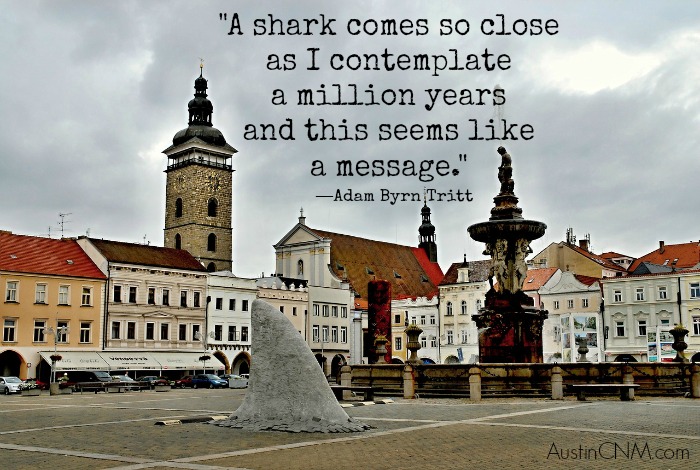
yomkippurshark_acnmAs I reach a million, I see something I have never seen but which is astonishingly familiar in the water a scant twenty feet from me: a triangular dorsal fin, a triangular tail fin, both moving gracefully in the water so close if I wanted to, if I were fool enough, I could walk out to it and barely have my calves half covered by ocean. This is amazingly close for a shark.

I stand and watch. This is an interruption in the flow of the meditation. Or is it? A shark comes so close as I contemplate a million years and this seems like a message. It feels like a hello from distance of time and I can see, now, what that million years looks like. I cannot go to it so it, instead, has come to me. Today.

I am aware of a person next to me, fewer than a few feet away. “Is that what I think it is?”

What else could he be asking? It is safe, I imagine, to answer in the affirmative. “Yes.”

“I was going to go swimming.”

“Still going to?”

“I just moved here. This is my first time at the beach. Are they out there all the time.”

“Are you asking me if there are always sharks out there or if death is always fewer than twenty feet away and swimming around us.”

He stares at me.

“The answer is yes to both. You’re just getting to see it today. Welcome to Florida. If you plan on hiking instead, remember, we’re the only state with all four kinds of venomous snakes.”

He walks off.

I continue my walk. With each step I think of a person I have wronged. I apologise. With the next step, I forgive myself as well. I do this until I can think of no more people but I am human and I must have hurt more people than I think by simply the act of living. I apologise, with each step, contemplating the many ways we hurt each other and never know it, cannot help it. And, when this is done, forgive myself.

As I continue to walk, I think of each person I know has hurt me. I forgive them. It no longer matters. In the span of time, what could it matter? If they have not admitted guilt, what does it matter? I forgive them. I forgive them all. If I have thought badly of them for the wrong they have done, for this, even, I apologise and forgive myself.

Why carry guilt? Why carry anger? Why carry a careless word? Of what use is it in the span of years? A million years and how long am I here? There is a shark in the water.

Gate gate paragate parasamgate bodhi svaha. Gone, gone. Beyond gone. Past beyond gone. There is enlightenment.

I start to run. Barefoot I pad the sand beneath me. Step by step following the mean line of the surf. If the waves come in further, I lift my legs higher, pull up my knees, splash as each sole descends. This varies my running, changes the muscles used, increases my activity.

With each footfall, I think of a year of my life. A year. Each time I pad the sand beneath me; grains millions of years in creation, millions in erosion. Each step, a year. I run out of years quickly, in a matter of half a minute. I think of my potential lifespan and run them out in another half minute.

I think then of the people I love and run them out, each step a year of life. My family, less than a minute each, like the blink in time they are, we are. My friends, a minute. I think of those I know, enjoy the company of, gone in minutes and I do this consecutively but I know it is all concurrent, all gone, more or less, in the steps it takes me to run out mine. I think of those I don’t like. All gone too. No different. All the same. We are a set of footprints. We wash away.

I wish all people happiness and the root of happiness. I wish all people freedom from suffering and the root of suffering. Even those I don’t like. Especially. Now, before I become invisible among the sands. Now, before I wash away.

I have run out of people. I have not run out of beach. I continue, watching the evannebirds skitter the foamline as I splash and make impressions which are instantly gone behind me as the tide washes out. I run and am not tired. How much further?

I expected to run for a few minutes. I thought, how long can I run before I need to turn back? How far can I go before I know I am half-spent and turn around to run back or all spent and must walk my way back? But neither point comes. I run.

I run easily, no pain, barely sweating, my heart slow, my breathing calm. It was not long ago I would run five minutes and be exhausted. I would run and walk and run and walk in alternate minutes. Now I am easy and feel free and comfortable, open. How long have I been running?

I choose a point in the distance; a home among the many but different in colour than most and decide to run to that, then turn around. On the return I can sense no reason to be heading back but my desire to return to my writing. Still, I am not tired, not worn, my breathing slow and full.

I see the salmon hued building that signals where I started. There is the boardwalk, invisible behind the sea oats and dunes. I run up to the ramp and there I stop.

Once to my car, I look at the meter. I have been gone more than an hour and a quarter and it flashes at me. I have run for much of that time. I have run for nearly an hour. It is not a marathon, but it is an amazement, an accomplishment and I have a sudden keen sense I have not eaten anything today but half a cup of milk. I am not fasting. I cannot fast. It is bad for my health and is, therefore, forbidden by Talmudic law. Certain people and people under certain conditions, according to the Talmud, may not fast. I have brought nothing by way of food with me and across the empty street is a Coldstone.

I get my things from the car, brush off my feet, put my sandals on, put another quarter into the meter and walk over. What could make this day more perfect than adding an ice cream?

There is a Starbucks, on one side of it and, on the other, Bizarro’s Pizza. There use to be café here Lee and I ate at once; had lunch with Jeannie, Joseph, and Connor on our first visit to Melbourne. It left with Frances, or Wilma or one of the September storms to visit in 2004. The building is still empty, partial.

I walk into Coldstone. It is slightly after twelve and it feels as though there have been few customers today. I ask the young lady behind the counter for plain ice cream with no fat and no sugar. They have ice cream with no flavouring; simply the taste of milk, crystalised, thick and solid. No sweetener. Why would milk need sugar? She is happy to oblige and what size? One cup. A small.

Would you like anything in that? No. Wait, yes.

Please, if you would, some almonds.

 
7 Comments

Posted by on October 3, 2006 in Culture, Religion, Social


Tags: , , , , , , , , , , , , , , , , , , , , ,

My Skinny Self

My daughter called last night. She was fired from her job and, certainly, it was one she needed firing from. It is best for her, a talented physical trainer, to not rely on a job at the counter of a pizza joint, organic pizza or not,

On top of it, she has a cold. A bad one. So, all around, she needed her Mommy and decided to come up even though it would be only over night.

She arrived at about seven in the evening. I took her out to a Chinese buffet/Mongolian grill where she ate mostly raw vegetables and fish. I took a few things in small quantities I should not have, would normally not have, and left most of what I took, eating a few bites, enjoying, sometimes, the flavour and /or texture and leaving the rest. After a quick trip to the grocery for eggs and milk, my wife treated her for her cold, my daughter laying on her back, on the couch, acupuncture needles erupting from her stomach and legs like sparse, corse hairs. After, her backed was cupped to relieve her congestion. All this after a listen through a stethoscope to make sure she was not about to have pneumonia.

Later that evening, me on my laptop, Lee on hers and my daughter on hers, she looks at us and says, “Is this what we’re going to do?”

It’s a Sunday night, 10:30. What to do with work the next day? With a daughter with the flu?

When she calls, she complains because we are always out, never home. “Are you out with your friends again?” Many of my friends are her age or thereabouts and this appears to upset, or, perhaps, just confuse her. She asks me where her mother is. She did not answer her phone. Out, I answer. Without you? Why?

We have lives.

But you didn’t when you lived in Miami.

Yes, I know. That’s why we like it here so much better.

So now, late on a Sunday night, we are relaxed, quiet and now, now she wants us to have a life.

The next day, she is treated again in Lee’s office. Then we take her to a gentleman for Live Blood Cell Analysis. He takes a drop of blood, looks at it in a scanning microscope and recommends olive leaf, black cherry extract and vitamin e as well as a way to drop some stress besides exercise.

My daughter is a dancer and trainer. Athletic, her body fat is about five percent. Low for a female, even for an athletic one.

While the chemist is talking with her, I notice an body fat analysis machine. An impedance model made by a company with an excellent reputation for medical devices. An Omron. The same company that makes my pedometer. I pick it up finding it easy to figure out: press the button for height/feet and it changes. Press for height/inches and it changes. Gender and age was the same. Hold he handles and press the ‘start’ button with your thumb. It took me less than half a minute and, of course, I expected ominous, horrific results.

Friday evening: Craig tells me I’m thin. He tells me even since my birthday, I have gotten thinner. I say I’m working on it. He answers that I am past working on it. I take this as a compliment, but, trust Craig as I do, still cannot believe it.

I mention this in an email thread from/to a WW friend in Maryland. Wulf, my twin, she of the same hight/weight/birthday/sci-fi collection/proclivities/etc… and she tells me I should believe him.

And, she continues, if I don’t believe him, how about my friends which whom I go to Playalinda Beach? Do they tell me that? I should believe them.

Yes, I say, they do. And I don’t.

And here I am, two days later, with an Omron Body Fat Analyzer in my hands and it is calculating, calculating, calculating… It seems to take longer than setting it up and it reads, finally, sixteen percent. What?

Sixteen percent. The chemist, Richard, he of the Natural Foods Coop, Café, Naturapathic School says he is not surprised and it is quite accurate.

What’s normal, I ask. Fifteen to eighteen percent is considered low to high normal for a guy.

Sixteen percent. I am doing something right. Maybe the belly and chest are in my imagination. (Evanne says everyone loves boobs. I still think they look better on her than me.) Maybe a cruel trick of heredity but, in any case, this is incontrovertible. I have been wrong.

The diet changes, exercise, attitude – it has all worked despite my seeing otherwise. I have worked for these results but did not believe them possible. I have been working, extending continuous effort for something I did not actually, in any way, believe I would accomplish. And then, there it is. Here it is in front of me and I am amazed. As though it dropped from the sky, I am amazed.

In a way, my success leaves me not knowing what to do. I succeeded? How is that? Just through hard work and dedication?

What else will I be surprised at success in? Selling a book? Producing a play? Can I do these things even if I do not believe I can? Is belief a necessary part of work? Do I need to believe to succeed? It would appear as not.

And despite the evidence, in the face of so much proof, why is it I believe I cannot?
My skinny self wants to know.

 
3 Comments

Posted by on September 26, 2006 in Culture, Social


Tags: , , , ,

No Ma’am, I am not Gus Grissom

2:31 am: My head is on the pillow, all is still. Blessed exhaustion and quiet but for the hum of the fan. The house is quiet and, finally, so am I.

2:28 am: Stargate is on…again. The same episodes as earlier today. Yesterday. I’m halfway through the show and I’ve had enough. I’m going to try again. Off to bed.

1:13 am: At this hour I should be sleeping in my bed but every time I close my eyes my room spins instead.

I’m hungry. I have waited two hours since last I ate and can barely believe I’m still wanting food. But I go to the refrigerator and find a container of brown rice, fill it with chicken broth and put it, along with a baked chicken leg, in the microwave. I put it on low so the circuits will not blow as the air conditioner is on in the conservatory and, in our Lisa Douglas fusebox, the air conditioner and the microwave equal more than ten.

I feel funny eating so late. I’ll regret this. I know, but I must assume physical stress causes hunger. Extreme physical stress seems to have caused extreme hunger. I want protein and protein and more protein. I tell myself tomorrow I’ll be careful, eat better, eat lightly but for now, I want meat and bulk. I want something that will hold me down.

12:10 am: I don’t know why I am waiting to go to sleep. Normally I’d be up late on a Friday night, but with my stomach upset, with my head hurting from side to side, perhaps I should have been in bed sooner. I’m stuffed, fatigued, in pain, still hungry (how can that be?) and every time I close my eyes I see a screen, black on either side and my head swims. Enough. I’m going to bed.

9:39 pm: Home. I’m headed to the fridge. I want more meat. I can barely believe it but I do. Chicken. White meat. Diet Pepsi I brought back with me. On to the couch. Lee is watching Stargate, as I would expect and I can’t really think of anything I’d like more right now than to lie on the couch, a near mirror opposite of Lee, and watch bad sci-fi with her. I’m queasy. My head hurts. My shoulders hurt. My neck hurts. Everything just plain hurts. Sore muscles. Physical stress? Emotional stress? Fatigue? But it feels great to be lying here, picking at the chicken, watching my sweetie watch Stargate.

9:18 pm: Our plans did not quite work out. Jack is quiet, watching TV. I could spread myself on the couch, splay myself on the carpet. I could but I will not. I feel welcome but tonight I feel a bit extra. Since I do not normally feel this way at their home, I figure something is up and, perhaps, feeling uneasy, queasy and unsteady I figure it is the right choice to go home. I say my good-byes and take my leave, driving home in the extra-sub-urban darkness. I later found Jack’s grandfather had taken ill.

7:43 pm: I arrive at Evanne’s, Jack’s and Beth’s home. Jack is not home. How is my day? I tell the truth as I have been asked but do not wish to sound whiney. I leave out a bit but tell how I feel. My stomach has calmed a bit. It still is not right, but it is no longer playing twist and shout and I am grateful for the improvement. Jack comes in some minutes later, seems tired. This is understandable. He sits on the couch, is asked by Evanne if he wants to play Changeling, he states he is not quite in the mood, is tired. This is why I had come here tonight. No that I ned a reason to visit with these fine people, but, tonight, I’d rather be sitting at home, quiet, watching television, still. So very still.

7:13 pm: I am leaving for Evanne’s. It is Jackanalia, Jack’s birthday week and I have been asked to come over and play Changeling as a surprise for him. I said I would go and on any other day I’d have no doubt about going, but I feel so terribly unwell, I do not know how I will drive there, sit there, play there. But this is his birthday and what he wants so off I go. On the way I stop for a bottle of diet coke. They are on well water and I am not use to drinking water that tastes of sulpher.

6:42 pm: Thumping wakes me. Not my heart but a larger drum from outside. My son’s bass drum. He must be practicing with friends. It is ok as I need to wake up anyway. I rise, dizzily. I am supposed to be at Evanne’s at 7:30. I am going to be late.

Lee says she saved some dinner for me. Dinner? Yes, I could eat more. A small piece of flank steak, about four ounces, the size I would normally eat. An ear of corn from the co-op. It is a rarity Lee cooks and this is wonderful. The corn is barely done. It is wonderful anyway. The steak is barely warmed and it is wonderful especially. It is covered with garlic salt which means Lee had this on her plate. Especially incredibly wonderful.

4:12 pm: I arrive home. Woozy. Nauseas but the aching in my head is beginning to subside in some remote locations. As I make my way to the door I hear the high commands of Invader Zim so I know my son is home, on the couch, and, as I enter, approach, I ask him to please, oh God please in all that is holy and right and proper in the world, if you have any compassion and decency and humanity, turn it down. It sounds like this. “Volume, please,” except that it is muffled and slurred. He looks at me and asks if I’m ok, that I don’t look ok. I answer “Bus, seventy kids. F-14 simulator. Headache. Nauseas and… Hungry?”

Yes, I am hungry and no-one is more surprised than I am. I want protein. I want something dead that use to get around on its own and decide its own fate. I want meat. I eat the contents of a can of salmon. I eat some turkey. Beef jerky. I see a piece of chicken from the other night and it is gone. If it walked , flew or swam, I want to eat it. This isn’t right. I think of the volume of food, of the calories, the effect. I wonder if physical stress does this, if this isn’t the right thing to do, give in to this as need and not gluttony. I am still nauseas but no more so and still hungry and not less so.

My wife arrives home, looks at me and puts me to bed.

3:50 pm: The bus pulls up in front of Stone Middle School. I get off last as I am in the back, walk wavering, slowly across the parking-lot to my truck. People wave, say goodbye, ignored. School isn’t out for ten minutes. Teachers cannot leave until 4:15. I should get the CD from Susan. I looked forward to that all day. I don’t care. I can’t. Not about that. Not about the time. I drive slowly home. No radio, windows open in the ninety degree day.

2:38 pm: The bus is loading and I am asked to get on first and do what I did this morning; sit at the back and not let the kids do the same. I do so, nearly lying down. It is noisy as the kids load. I am out of discipline. Maria takes care of what needs taking care of while sitting next to me. We talk a bit on the way from NASA to South Melbourne as the kids get louder and louder.

Sean is poking girls, complaining they are talking about him afterwards. A kid next to him keeps shouting how he is a crazy white nigger. Crazy and white, I have no doubt. Stephanie keeps trying to sit upside-down. She is wearing a skirt and this seems to be just a bad idea all around.

Sara sits in front of me. She seems protective. She has come to me in the past wanting help with poetry, writing, wants to see my books.

It is a huge bus. It waves and sways around curves, on entrance and exit ramps, corners. As it rolls down Palm Bay Road, it rocks and I feel once more and I will lose anything in my stomach. Everything.

Maria is still talking, Sean is still poking, I fight sleep. Chaparones are not supposed to sleep. My eyes close and I am woken at the school.

2:30 pm: We exit The Astronaut Hall of Fame and Space Camp and head to the bus. The heat feels wonderful. I have never been so happy to be so hot. It is delightful, comfortable, embracing and life-giving. I want to vomit. I want my head off but at least I am warm.

I am walking, not too steady, to the bus. Beside me a mother of one of the students. She looks at me, asks if I want Tylenol. I say bless you and accept two Extra Strength Tylenol. Who needs water? We mill at the bus waiting for the signal to board.

2:24 pm: Last stop. The conference room. I am shivering. It is the same sixty-two degrees in there it has been throughout the rest of the complex. There are rows of chairs facing the front table. On it, shuttle tiles, torches, vices. I walk to the back of the room and sit on the blue carpeted floor thinking it more stable than the chairs. Under me the floor twists and heaves. I ride it.

The students are told of all the wonderful jobs available in space and science. What they can do for NASA. How they will be the next astronauts. What amazing opportunities they have living as close to the world’s spaceport and how, with education, they can take advantage of those opportunities.

Tiles are heated on the front, glow red and furious bright. Students tough the back of the two inch thick blocks. They are amazed it is cool to the touch. The front becomes cool enough to touch within seconds of removing the flame. The students line up to touch. One calls me and I go, holding on to whatever is available as I wait in line.

When the line is done, we file outside. Outside.

2:04 pm: The door swings open and light, bright and painful, enters. I turn away and my head swims. My body seems to move the opposite way as my head feels as though it is continuing to turn. The old man walks to the opening, looks at me and says, “You need to sit a bit. The next person can wait.” He is right. I do. But soon, not more than a minute, I get up, grab the doorway, pull myself out. Walking into the bright light, toward the glass door, steadying myself. I do not want the students to see me ill. I’m not sure I have a choice.

Mr. Science Teacher looks at me closely, “O Man, you don’t look so good. Are you ok? If I had any idea it’d do that to ya.” He would have what? Stopped me? I should have stopped myself. I lean on the railing. Ms. Ramirez is heard in the distance and she tells us it is time to round up the kids and head to the conference room.

1:57 pm: I have waited an hour. Perhaps a bit more. The glass door opens and I am ushered in and to one of the small booths. Inside, it is no more larger than the space needed for a small chair and the person sitting in it. The chair faces front and toward a small screen. Next to the screen, one on either side, are two handles facing up. I sit within and fasten the seabelt. Below is a floor and an up-slanted foot rest joining the floor to front wall. It is made of dimpled metal and my feet rest comfortably there. A moment or two passes, I look ahead and see a sign above the screen: Keep eyes open at all times. I look ahead and below the screen and next to it, a large red button. “In case of distress or ailment, press this button and the simulator will slowly come to a halt.” Next to this was the same list of ailments I read outside. I have none of these? Why should I not ride? The door closes and it is a solid darkness.

The screen lights up and voices are heard. I had not noticed the speakers. It is a radio-voice from a virtual f-14 pilot and I hear we are about to take off and, jerking, not smoothly, I move. I spin, I know, but spinning this did not feel like. I reach forward and grab the handles and they do not give, do not move.

I feel consumed by the screen as the voice tells the tower he is ready for liftoff and the ground, which does not look remotely real in the monitor, falls away as the sky becomes wider and takes more of the screen. I feel as though my stomach has left me, choosing to attempt a stay on the round whilst I rise into the air. Unfortunately, my stomach did not make it out and I am more than astoundingly aware of it.

I do not listen carefully to the voice. For a moment I tried to loosen my grip on the handles. I could but felt them move toward me and decided I might not be able to get them back on and so left them, tightening my grip. It says something about a mountain and it comes into view, about not being able to avoid it and it comes closer and then lurches down and to the side. I am stamping the floor against the four G’s, plastered against the wall , beating it with my shoulder, elbow, voice as I discover I am making noises quite unbecoming, quite undignified.

This continues. The fake sky spirals as the ground circles coming closer and I can feel my head spin, hear myself whimper, still beating the right wall, the floor, the surface behind my head.

Six minutes, I think of hitting the red button but do not, cannot, will not. Six minutes long and I decide I will stand it, must stand it but will pay or this and the sky opens wide again as the ground fully falls away and I hit the back wall with my head again and again and again.

I have no idea what the voice says. I do not remember a thing of what happens on the screen and do not pay attention with my mind but my body accepts every fiction and reacts despite my knowledge of slow rotation and slight temporary tilt. I do not know what happens but I am panicked and ill and sorry and sore and want out, an end, stillness and quiet and light and all I have is noise and twisting and nausea and brightness in the solid claustrophobic dark and then I see the ground come close and level and coming fast and then slowing and then the screen image is still and something is different though I am not sure but I believe we have stopped.

12:43 pm: These kids keep cutting in line, but they are my kids, kids I’m in charge of and, of course, it is they who should ride so I let them in. They are not sneaky; some even ask. The sign says the ride is six minutes long and it takes two people at a time. I count the people in front of me. Eighteen. Nine times six and I can see I might not get my chance. I wait patiently and talk with my partner in chaperonedom, the science teacher, he of the mid-thirties and sixth career, ninth professional job, ex-cop and E.P.A. inspector. We move forward the distance of two middle-schoolers at a time. Our speed: twelve middle-schoolers and hour.

12:40 pm: I have spent a half hour or more in the museum. It is not that large and I have been here before. It is a static exhibit and nothing has changed. What is different is the time I have and it seems there is plenty. I walk toward the one exhibit I know, in my heart, in my gut, I should be walking away from. I tell myself it is jus because most of my young charges are there, in line, waiting patiently, well behaved and calm. It is a glass enclosed room about fifteen by fifteen. Within is a whirler of industrial proportions with a computer in the center, a pivot above that allowing for spinning and at either end a small fully opaque chamber big enough or a person in a chair. The chambers are on servos that allow them to rock out and in as they spin around the center as dictated by the program. The device spins slowly. It is the F-14 Simulator.

The sign says it produces four Gs. How much can that be other than four times the pull of Earth’s gravity. It’s spinning so slowly. It is nearly mesmerising. It looks calming. People go in and six minutes later they come out and no-one looks worn or upset or any worse than upon entering. People say it was fun, enjoyable, cool, neat, and I’ve nothing to do and find myself in line.

12:30 pm: Lunch is over. The students are given time to investigate the museum on their own terms and I, with my twelve kiddies and my teacher-partner enter the dim from the bright through corridors and doors and find ourselves in a hall of spacesuits, faces in monitors, touch-screens and hands-on science. Two small halls of exhibits. I read what there is to read. Make a spaceman balance in the center of a small tank of water, play a virtual game, learn of the Apollo One mission, read about Gus Grissom and how he was scapegoated by NASA, then died, burned alive inside the Apollo 1 capsule, along with two others as a result of a failsafe device to prevent the very mistake he was supposed to have made in his earlier flight. In short, they made he door so it would not open from the inside. Later his ‘mistake’ was found to be a design flaw which had nothing to do with him.

Grissom was an engineer who, even after that event in the mercury capsule, went on to create designs that were used and are still used in spaceflight. He is the reason NASA stopped naming individual capsules and named only overall missions and gave flights numbers. He called his 1961 capsule Liberty Bell Seven not because of his love for liberty but because he said the design would cause it to sink like a giant iron bell. NASA took a dim view.

His Mercury space suit is on display in the hall while a battle rages over who gets to own it. His family wants it to tour the country. The Smithsonian and NASA want it to stay just where it is where it can be seen only by those who can afford the pretty pennies. Forty years and Grissom is still making waves.

You go Gus!

12:00 pm: Lunch. Out of various coolers come lunches, all packed in their clear bags. Each with a name. The children sit on the bleachers in the room we have been in all morning. I don’t see the need for the coolers. Sixty-two degrees.

These kiddies are eating monstrous things. One has brought nothing but a bag of Cheetoes and another a bag of Fritos. These both had to be, of course, in large plastic bags. A bag in a bag. Cokes, Gatorade and cookies. A few have sandwiches and fruit.

I have my bag. I eat my apple, my carrot. I drink my bottle of water and then have my Cliff Bar. I walk my empty bag with it’s empty bottle, empty wrapper, apple core and carrot end to one of the two fifty-five gallon trash barrels which are the only reason, both I and the children have been told, a student may move from the bleacher and the shame of their terrible lunches is even greater as the barrels fill further and higher with huge quantities of food untouched now become trash.

11:30 am: The children have been lined up in front of a harness attached to a chain attached to four rows of three long springs each – twelve springs: three in line attached to three in line attached to…- and then a series of chains, pullies and then a winch attached to a track which runs forty feet and all this a four foot wide, six inch thick mat running under the track. Me and my twelve and Mr. Science Teacher. Our guide, Diane, shows us this will allow us to feel one-sixth gravity. She puts on the harness, much like the kind stuntmen use to fly, much like a wire-harness. She puts it on and tells us all the girls will have no trouble with this but warns the boys may find this more than slightly uncomfortable, and, as she says this she pulls a strap tight and we all see exactly what she is talking about.

She demonstrates the methods astronauts use to move in lower than Earth gravity as she sidles, hops and skips. She shows us how to pick up and object and bend in low gravity.

A boy goes first and confirms the discomfort, then a girl, then I lose track until the tallest of our group goes and there is little room left near the winch as the gears pull the chains and there is little left between the springs and the winch by the time it is high enough, taut enough for him. It dawn on me: this does not work. Most of the kids have their feet barely on the ground, touching it with their toes as they hang there. Even under low gravity, they would actually be in full contact with the surface. With a computer, they could enter the weight of the child, the compensate with the pullies for an accurate one sixth of the weight. But she just ups the child into the air until their toes dangle dragging the mat. For a half hour they flip and flop and hip and hop and bounce. The girls giggle. The boys seem to wince.

11:00 am: We sit in the bleachers in front an eight foot diameter gyroscope with a seat. We are given a lecture about the Multi Axis Trainer. We are told why it exists. How NASA was afraid a capsule could spin and twist in different axis and the astronaut within would need to withstand it and bring it under control. Thus, a Multi Axis Trainer.

The sign says if I have a heart condition, back problems, vertigo, pregnancy and some other such difficulties I should not ride. This is a ride? And I was not aware pregnancy was a ‘difficulty’ but who am I to argue with NASA?

The first child is strapped in, shoulder straps, leg straps, feet on the foot plate which is a new addition and the reason for such is without it the feet tend to fly around a bit. I’m glad Diane mentioned that. I’d hate to see the kid’s feet flying around.

We are told the way the device spins the center of gravity remains the center of the body so the abdominal area does not actually move very much. We’re told because the movement does not stay stable, because it does not continuously move in the same direction, the ears do not cause the rider to become dizzy as they would simply spinning. It appears true as the lever is pulled, the seat sways back and forward a bit, Diane walks out of the small cage surrounding the MAT, closes the gate, walks to the side and turns a throttle. The outside ring turns, the seat begins to move, the center ring begins to move as well, the seat begins to flip this way then that and spins, the inner ring turns in response to the other two and the seat moves no way more than one revolution. Hair, long and unbound, flies here and there, red flames blown by a fickle wind, the child screams. The child is smiling.

She comes off and appears no worse than when she got in. A thirty second ride. One minutes with strap-in and strap-out. The next goes, then the next all through the twelve of us and then, “Come on Mr. Teacher. Do you want to give it a try?’

I walk up, empty my pockets and a student, one I initially did not trust, takes my digital camera and tells me he’ll get my picture. All my belongings are on the bleacher but Diane is right there and I worry a bit anyway.

I enter the cage, am strapped in, I ask about epilepsy, am told it is not a problem, I ask about any number of things and am told I have only thirty second and if I want to try it now is the time and I say go ahead. Diane pulls the lever and the seat sways back, feeling like a swing that has gone too high, come back down and I say, quickly, “That’s good.”

“So you are ready?”

“No, I mean that’s good. That’s enough. It was fun. No ride. Out please.” And I realize I am about to become very much a spectacle and I also realize I don’t care and as I think this, I am being unstrapped.

I pick up my things, all still there after less than half a minute, my camera is handed back. There was no time for a picture.

10:00 am: I have six of the kids. Mr. Science Teacher has six and he is to be in another section of the Shuttle simulator. The kids have tags around their necks and have been given flight designation which tell them what their jobs are. Before coming here they have been given materials to read which helped them understand what those designations mean and what they entail.

We enter a hatch to a small room with a bank of screens. Behind us are ladders attached to the opposite walls which lead to hatches in the ceiling. Each leads the same place: the flight command center above us. Four of the kids go up there. I look up the ladder and decide to stay down here in the science center.

The other six students are in mission control in another room in this hanger.

Our guide shows the kids how to do the experiment when the script calls for it, to take the blood pressures of the flight crew, change the carbon dioxide filtration unit. The entire simulation experience is scripted and the kids each have a script to follow. Each has a microphone and an earpiece and can communicate with the others through these devices even though the space is small enough they could hear each other at a hush. I suppose, in space, no-one can hear you whisper.

I watched them follow the script right through the landing, as seen through a screen. They were proud of themselves, doing the experiment, changing the canisters, guiding the shuttle in.

While I watched them talk, crawl through hatches, ascend and descend, I had nothing to do but stand there in the six by six my eight space. I looked at the controls. I looked at the intercom. I looked at the thermostat and saw it was at sixty-two degrees. In the small box of a room, all metal and moving air, it was sixty-two. No wonder I was chilled, stiff. We were told to wear long pants but I would have worn long sleeves as well.

Later they got to see that the simulation was programmed to work smoothly but to record, as well, what the results of their flight would have been. The alternate results showed a rather large mess on the runway.

9:30 am: We pull up to The Astronaut Hall of Fame and Space Camp. As we exit the bus, we are escorted into a large hangerish room off of which all the other smaller rooms are connected, in which is the shuttle simulator, the multi-axis trainer, moon walker, space walker and other devices are.

Each child is asked his or her designation and are given a name tag and with that designation on it. Mission Control, flight crew manager one, flight crew junior, science crew, other designation I am not close enough to hear.

We are divided up and I am given my group of six and my companion, MR. Science Teacher, who has six as well. We are walked to the Shuttle Simulator and are met by our guide, Diane.

8:30 am: Our bus pulls out of Stone Middle School. I have not been in a bus this large. It rocks and sways. As we pull out the driver tells the students not to scream. Particulary the girls. Then he tells the boys not to give them anything to scream about. I sit in the back with Maria and watch them, many still tired, squirm and talk, sleep and poke.

Each turn we come to feels as though we are about to fall over. I figure this must be stable or Space Camp would not be transporting kids again and again and again. Still, it certainly does not feel that way.

Maria is talking. Curriculum, skin cancer, reading, skin cancer. She shows me her leg where the lymph glands were removed this last Summer. That’s what she did on her Summer vacation. Maria gets sick more now, it seems.

Maria is a native of Brevard County but looks like she would come from Upper Michigan or Wisconsin. It looks like the sun is not her friend. In the end, it wasn’t.
As we pull in, Maria is still talking. I have no idea about what.

8:15 am: The Science Department Chair meets me and thanks me for taking this on in such short notice but that there is no time for talking and, taking my hand, pulls me from Susan and toward the bus. I was asked only yesterday. I’m not een clear on where we are going. It’s called BLAST which stands for Brevard Something And Science Something.

None of these kids are my students, she knows. Mine are with a substitute. But the chapparones all failed to show and to go on a field trip one must be fingerprinted now, thanks to the Patriot Act. The schools board will not pay for the fingerprinting and few people want to pay the sixty dollar fee.

So here I am. I put my lunch, packed as directed, in a clear bag, in the large red cooler marked TEACHERS and mill. Ms. Pebbles runs up. She has been recruited just this morning to attend.

The bus driver is old. Rather incredibly old. Or at least he looks that way. The bus is huge and looks new and shiny white and is not a school bus but belongs to Space Camp. For some reason, they use their own buses and the cost is included in the camp or, in this case, the field trip. As we are a science school, each child gets to go. I am told this is through a grant of some kind and some other schools are involved.

Some students who are suspended had to be brought back to attend this and will be out again after the trip. Why, I ask. It has something to do with the grant and the superintendent himself said it had to be that way. Chalmers, I think his name it.

“Mr. Tritt, would you board first?”

Sure. I get in and see the back is a long bench seat from one side to the next. Prime real estate for kids to fight over, fall under, do things in behind the other seats where they cannot be seen. I walk all the way back and stand in the center directly in front of the bench. As kids come in they ask if they can sit there. Each on asks and I point to their seat. I don’t want to sit in that one, I’m told, and I point anyway. Most sit. A few I have removed until they comply. Not sitting with friends? Well then, board with them next time. Saving a seat? Nope, not this time.

Maria enters and walks to the back and I am now not alone.

There are about seventy students. The door closes and the bus starts.

8:11 am: I arrive as school, sign in and make my way toward the bus. On the way there, Susan finds me and hands me a yellow padded envelope and tells me it’s a present. In it is the first Big White Undies CD. I have been looking for this. Back in Gainesville, I use to see them play all over. I MCed a fundraiser or two with them, saw them play with Phish. I never had to pay but also never had the money to buy a CD.

I am overwhelmed as I look at it and Susan tells me she like the other one so much when she found this one she got two so I could have it.

Last week, I gave her Matter by Big White Undies to borrow. I never do that, let people borrow CDs or books, but I did for her. She loved it, telling me what I knew already, that there was not one bad cut on it, that it was formidable, concerted and tight. The songs were thoughtful and literary while the music was light and joyous. That is is an amazing recording.

Do I have something to listen to it with? No Susan, I don’t have a portable CD player and, if I did, I’d not be toting it with me on the field trip. She tells me she’ll hold it for me and I can get it from her when I get back this afternoon.

 
2 Comments

Posted by on September 22, 2006 in Culture, Education, History, Social, Travel


Tags: , , , , , , , , , ,

Crop Circles

I have a crop circle in my front yard. I awoke this morning to spiraled grass in two opposing adjoining sweeps, long and low on the wet mat of the soil. Six feet wide and here, in Palm Bay, on my one-eighth acre parcel, in my front yard, crop circles. And the cars go whizzing by. It is a private showing.

My front yard has not been cut in two months. We have decided to replace, pull out, do away with the non-native plants and allow the native to return, take over. It is a small thing to do and of little effect – my small home with the yard of native plants among the weekend mowers, gas trimmers, electric weed-eaters, leaf-blowers, grind-metal edgers. It is small and incredibly conspicuous.

Sections of the lawn have been pulled of grass and the naturally growing succulents of our area have retaken the sandy soil. Long red fleshy pencil-stems cover the ground and they are covered by small, puffy fat-needle green leaves and, they, spotted with small flowers in red, purple, yellow, blue. Sun mimosas trail, gather, subsume the open land, sending legs here and there of delicate leaves and up into the air, stalks of purple and pink puff-ball flowers. All together, a glorious mat of green leaf and rainbow flower not but six inches at its highest point and no need to mow, no need to cut, no need for gas fumes, exhaust fumes, chemical fumes or weekends spent in service of grass.

But the sections which have not been pulled, they grow wild, high and green, full and deep and talked about as the neighbours walk by. The grass grows four feet high, some topped with red flowers, large purple blooms arrive every morning and, by the afternoon, fall to create a speckled three-dimensional star-map of fading violet, suspended within the net of interlacing leaves. Florida poinsettias, orange jasmine. Plants and flowers I do not know the names of and do not want to know by name. They are, somehow, more natural, more real for my inability to place a name on them. Who am I to tell the flowers what they should be called?

And, in the midst of this, crop circles. And why not? One does not find crop circles in mowed yards. Faeries do not visit the space between mowers and clippings. But mine? Four feet high? Why not? Why not nocturnal visitors in the moistening pre-dawn patting out waves of elegance and delight in the spindles and leaves? Why not?

This is what I get for not mowing. This is what I get for inviting the invisible to my home. This is what I get for opening myself to the stares and quiet talk of my neighbours. I get crop circles. I’m fine with that.

 
1 Comment

Posted by on September 2, 2006 in Culture, Nature, Religion, Social